❌

Lees weergave

Dirk Eddelbuettel: qlcal 0.1.4 on CRAN: Fresh Upstream Updates

The twenty-second release of the qlcal package arrivied at CRAN yesterday, and has been built for r2u as well as on r-universe.

qlcal delivers the calendaring parts of QuantLib. It is provided (for the R package) as a set of included files, so the package is self-contained and does not depend on an external QuantLib library (which can be demanding to build). qlcal covers over seventy country / market calendars and can compute holiday lists, its complement (i.e. business day lists) and much more. Examples are in the README at the repository, the package page, and course at the CRAN package page.

This release is based on the changes in the QuantLib 1.44 release also made yesterday. It includes two new calendars for Malaysia and the Philippines, updates to around a dozen calendars, and a few other updates to internal files. Maxmilian Muecke spotted and fixed a few small bugs just as he did for the RQuantLib release we made yesterday; this is equally appreciated! The full details from NEWS.Rd follow.

Changes in version 0.1.4 (2026-10-13)

  • Add missing market calendars for Poland, Russia, Romania, Indonesia (Maximilian Muecke in #21)

  • Add (semi-deprecated) alternate separators '::' for Israel and New Zealand markets (Maximilian Muecke in #22)

  • Fix several typos across source, configuration and documentation files (Maximilian Muecke in #23)

  • Synchronize with QuantLib 1.44, add two new calendars, update several others, and update general utility files (Dirk in #24)

Courtesy of my CRANberries, there is a diffstat report for this release. See the project page and package documentation for more details, and more examples.

This post by Dirk Eddelbuettel originated on his Thinking inside the box blog. If you like this or other open-source work I do, you can sponsor me at GitHub.

  •  

Steinar H. Gunderson: Decompilation patterns, part 11: Irregular switch

Here's one that m2c usually gets right itself, but sometimes cannot:

    if (var_v1_7 != 1) {
        if (var_v1_7 < 2) { 
            if (var_v1_7 != 0) {
                spF0 = 40; 
            } else {
                vram_x = cmt46->vram_x;
                vram_y = cmt46->vram_y;
                spF0 = 40;
            }
        } else if (var_v1_7 != 2) {
            if (var_v1_7 != 3) {

Repeated comparisons against the same variable, especially in a nested form that could be binary search, should remind you of one thing: A switch. Usually, the compiler implements a switch with a jump table, but not always; if there are few conditions, or the range is too large for a reasonably-sized table, it will do some ifs instead (or, enough ifs to get within the range of a table). So what you want here is more like:

    switch (var_v1_7) {
    case 0:
       vram_x = cmt46->vram_x;
       vram_y = cmt46->vram_y;
       spF0 = 40;
       break;
    case 1:
       spF0 = 40;
       break;
    case 2:
       ...
    }

Remember that sometimes, you may need to insert cases that are not explicitly mentioned in the ifs (and/or a default case) to get everything to match back properly.

  •  

Reproducible Builds: Reproducible Builds in September 2026

Welcome to the September 2026 report from the Reproducible Builds project!

In our reports, we try to outline the most important things that we have been up to over the past month. As a quick recap about what problem our project intends to solve, whilst anyone may inspect the source code of free software for malicious flaws, almost all software is distributed to end users as pre-compiled binaries. The motivation behind the reproducible builds effort is to ensure no flaws have been introduced during this compilation process by promising identical results are always generated from a given source, thus allowing multiple third-parties to come to a consensus on whether a build was compromised or not.

As ever, if you are interested in contributing to the project, please visit our Contribute page on our website.

In this month’s report, we cover:

  1. Reproducible Builds Summit 2026 held in Gothenburg, Sweden
  2. dettrace expanding architecture support for PGO & Lisp dumps
  3. “They don’t care about this!”
  4. SOURCE_DATE_EPOCH specification updates
  5. Reproducible Builds at SeaGL 2026
  6. New Code of Conduct (CoC)
  7. Supporter Spotlight: Jochen Sprickerhof
  8. Mailing list news
  9. Tool and documentation development
  10. Patches

Reproducible Builds Summit 2026 held in Gothenburg, Sweden

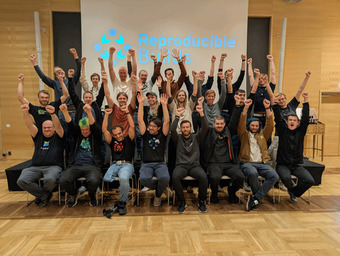
The annual Reproducible Builds summit took place from 22 to 24 September 2026 in Gothenburg, Sweden. The event brought together developers, distribution maintainers, security researchers and free software advocates from across the ecosystem to share updates on current initiatives, address outstanding toolchain bottlenecks and strengthen cross-project collaboration.

Participants engaged in a series of working sessions and technical roundtables focused on expanding the practical scope of reproducibility. Discussions covered ongoing work within major Linux distributions, language-specific package ecosystems and the various parts of the binary verification infrastructure.

Strategic planning formed a pillar of the gathering, with participants discussing long-term roadmap goals for supply-chain security, software integrity and related topics. Attendees explored new methods for automated verification, discussing how to lower the adoption barriers for maintainers and streamline the integration of deterministic build pipelines into established continuous integration (CI) systems. The event was then followed by two days of unmoderated hacking sessions. These hacking sessions provided space for technical progress, allowing attendees to draft specification updates, prototype new tool features and resolve standing reproducibility bugs in-person.


Dettrace expanding architecture support for PGO & Lisp dumps

Bernhard M. Wiedemann announced major updates to dettrace, porting the tool across most architectures supported by Debian and openSUSE. The release addresses key stability issues, passing test suites across these targets and making it ready for production build pipelines.

These improvements enable deterministic builds when utilising Profile-Guided Optimisations (PGO), removing the need to sacrifice runtime performance for reproducibility. Additionally, dettrace can now be applied to (notoriously difficult-to-reproduce) Lisp and Scheme memory dumps, including environments such as CLISP, SBCL, Scheme 48, Racket and GNU Emacs.


“They don’t care about this”

Annika Wilde, Marco Gutfleisch, Felix Reichmann, Anirban Chakraborty, Yuval Yarom, M. Angela Sasse and Ghassan Karame published a paper this month entitled “They don’t care about this”: A Systematic Study of Trusted Execution Environments Build Reproducibility in the Wild:

Trusted Execution Environments (TEEs) have become a cornerstone of modern cloud computing, providing strong confidentiality and integrity guarantees for both code and data. A critical component of this trust model is remote attestation, which enables external entities to verify the authenticity and integrity of code executing within a TEE through cryptographic measurements. However, the effectiveness of remote attestation fundamentally depends on the verifier’s ability to trace the reported measurement back to the original source code - a property that can only be guaranteed through reproducible builds. […]

The full PDF can be read online.


SOURCE_DATE_EPOCH specification updates

Bernhard M. Wiedemann shared a number of proposals regarding updating the SOURCE_DATE_EPOCH specification following discussions at a project summit. Seven distinct proposed changes have been submitted as merge requests on Salsa.

Bernhard’s proposed modifications are independent of one another, allowing for any combination to be merged depending on community feedback. Bernhard noted that one proposal may see the most debate, and could still benefit from further refinement before reaching consensus. Community members are invited to review and provide feedback on the individual merge requests by 1 December 2026. Input can be submitted via reactions or comments on Salsa, directly by email to Bernhard or the mailing list.

The specification was first published in 2015 and updated in 2017.


Reproducible Builds at SeaGL 2026

Reproducible Builds will be present at SeaGL in Seattle, WA, on October 23rd & 24th. Come chat with us in person!

Founded in 2013, SeaGL is a free, grassroots technical summit dedicated to spreading awareness and knowledge about free source software, hardware and culture.


New Code of Conduct (CoC) for the Reproducible Builds project

Mattia Rizzolo announced the official launch of a Code of Conduct for the Reproducible Builds project. This follows work and community discussions originally initiated in 2024, incorporating feedback gathered over email and during project summits, as well as with input from the Software Freedom Conservancy.

The new Code of Conduct establishes guidelines emphasising mutual respect among project contributors. It also defines a formalised process for submitting and handling complaints regarding community misconduct, ensuring transparent governance across project spaces. Along with the core policy document, an accompanying Code of Conduct FAQ has been published to outline the rationale behind adopting the guidelines.


Supporter Spotlight: Jochen Sprickerhof

As a reminder, another supporter spotlight interview was published featuring long-time Debian and Reproducible Builds contributor Jochen Sprickerhof, highlighting his work on package verification and project infrastructure.


Mailing list news

On our mailing list this month:

  • Jonathan Starr from the Institute of Open Science Practices (IOSP) posted with an announcement of its upcoming 2026 workshop series in Leiden in the Netherlands. This free-to-attend event aims to build a participant-owned data storage consortium, allowing community members to publish datasets, code and knowledge objects alongside algorithms designed to evaluate trust and value. The event features a dedicated Community Track for talks and discussions, a tool showcase and an opening session on resilient data storage.

  • Following up on IRC discussions regarding profile-guided optimization (PGO) on build servers, kpcyrd created a demonstration repository showing how PGO profiling can introduce non-determinism into output binaries. The demo highlights how runtime randomness (specifically, the randomised keys used in HashMaps to prevent denial-of-service attacks) causes varying bucket collision rates during test runs. These structural variances alter execution weights on underlying code branches, prompting the compiler to generate differing final assembly output for builds that would otherwise be perfectly reproducible if PGO was disabled. Rather than abandoning PGO performance gains, kpcyrd suggested treating generated profiling data as a documented build input or recorded environment artifact (similar to .buildinfo files), rather than regenerating profiles dynamically on the fly during build execution.

  • An autonomous AI agent (!), posted a controlled build result and reproducer demonstrating that pre-creating an obj directory in libmilter source trees prevents kernel-release path leaks (obj.Linux.<release>.x86_64) into debugging symbols. kpcyrd followed up with a helpful reply.

  • Alexander Sosedkin inquired on the mailing list about the preferred approach for sourcing pinned translation files to create reproducible GnuTLS release tarballs, asking whether external hosting should provide versioned downloads, or if projects ought to use Git submodules, dedicated side-repositories or some other mechanism.


Tool and documentation development

diffoscope is our in-depth and content-aware diff utility that can locate and diagnose reproducibility issues. This month, Chris Lamb made a number of changes, including preparing and uploading versions 330, 331 and 332 to Debian. In particular, Chris committed support for radare2 versions greater than 5.9.0 […] based on input from Guillaume Girol […], and committed support for .nar files via Guix. […][…].

Chris later modified diffoscope to not Build-Depend on the Debian package of GNU Guix, as its status in the Debian bug tracking system would transitively render diffoscope as being overly buggy for the next stable release […]. Similarly, he adjusted the Build-Depends on the apksigcopier package as it has been removed from Debian testing […] and, finally, he updated a number of copyright years […][…].

Vagrant Cascadian updated diffoscope in GNU Guix to version 332.


reprotest is our tool for building the same source code twice in different environments and then checking the binaries produced by each build for any differences. This month, reprotest version 0.7.33 was uploaded to Debian by Holger Levsen with the following changes:

  • Sergei Tachenov fixed the fileordering test on all filesystems, including the likes of ZFS, which could return a different order across two builds due to build being done in a different directory […].

  • Holger Levsen bumped the Standards-Version to 4.7.4, reflected that Priority: optional is the default now […], fixed the old Free Software Foundation address […] and bumped the debhelper ‘compat’ level to 14 after confirming there are only desired changes […].

  • Vagrant Cascadian updated *reprotest* to version 0.7.33 in GNU Guix.


rebuilderd, our server designed monitor the official package repositories of Linux distributions and attempt to reproduce the observed results there; it powers, amongst other things, reproduce.debian.net. This month, Bernhard M. Wiedemann submitted a pull request to rebuilderd that refactors RPM repository metadata handling. The change extracts rpm-md parsing out of the Fedora-specific scheduler module and into a shared one.


Lastly, there were a number of improvements made to our website this month as well. For example:


Patches

The Reproducible Builds project detects, dissects and attempts to fix as many currently-unreproducible packages as possible. We endeavour to send all of our patches upstream where applicable or possible. This month, we wrote a large number of such patches, including:

Vagrant Cascadian also performed a number of Non-Maintainer Uploads (NMUs) and Quality Assurance (QA) uploads in Debian for several packages with outstanding reproducibility issues. These included molttemplate, buddy, xfonts-nexus, fte and lifelines.

At the time of this writing, that leaves 130 submitted patches, with only 61 outstanding submitted patches that older than a year in the Debian bug tracking system. This number is only 26 if we exclude any low-priority build path issues.


If you are interested in contributing to the Reproducible Builds project, please visit our Contribute page on our website. However, you can get in touch with us via:

  •  

Matthew Garrett: Linux Lockdown and Hibernation (again)

(This is an updated version of an older post - the introduction remains the same, the technical details are different)

Linux draws a distinction between code running in kernel (kernel space) and applications running in userland (user space). This is enforced at the hardware level - in x86-speak1, kernel space code runs in ring 0 and user space code runs in ring 32. If you’re running in ring 3 and you attempt to touch memory that’s only accessible in ring 0, the hardware will raise a fault. No matter how privileged your ring 3 code, you don’t get to touch ring 0.

Kind of. In theory. Traditionally this wasn’t well enforced. At the most basic level, since root can load kernel modules, you could just build a kernel module that performed any kernel modifications you wanted and then have root load it. Technically user space code wasn’t modifying kernel space code, but the difference was pretty semantic rather than useful. But it got worse - root could also map memory ranges belonging to PCI devices3, and if the device could perform DMA you could just ask the device to overwrite bits of the kernel4. Or root could modify special CPU registers (“Model Specific Registers”, or MSRs) that alter CPU behaviour via the /dev/msr interface, and compromise the kernel boundary that way.

It turns out that there were a number of ways root was effectively equivalent to ring 0, and the boundary was more about reliability (ie, a process running as root that ends up misbehaving should still only be able to crash itself rather than taking down the kernel with it) than security. After all, if you were root you could just replace the on-disk kernel with a backdoored one and reboot. Going deeper, you could replace the bootloader with one that automatically injected backdoors into a legitimate kernel image. We didn’t have any way to prevent this sort of thing, so attempting to harden the root/kernel boundary wasn’t especially interesting.

In 2012 Microsoft started requiring vendors ship systems with UEFI Secure Boot, a firmware feature that allowed5 systems to refuse to boot anything without an appropriate signature. This not only enabled the creation of a system that drew a strong boundary between root and kernel, it arguably required one - what’s the point of restricting what the firmware will stick in ring 0 if root can just throw more code in there afterwards? What ended up as the Lockdown Linux Security Module provides the tooling for this, blocking userspace interfaces that can be used to modify the kernel and enforcing that any modules have a trusted signature.

But that comes at something of a cost. Most of the features that Lockdown blocks are fairly niche, so the direct impact of having it enabled is small. Except that it also blocks hibernation6, and it turns out some people were using that. The obvious question is “what does hibernation have to do with keeping root out of kernel space”, and the answer is a little convoluted and is tied into how Linux implements hibernation. Basically, Linux saves system state into the swap partition and modifies the header to indicate that there’s a hibernation image there instead of swap. On the next boot, the kernel sees the header indicating that it’s a hibernation image, copies the contents of the swap partition back into RAM, and then jumps back into the old kernel code. What ensures that the hibernation image was actually written out by the kernel? Absolutely nothing, which means a motivated attacker with root access could turn off swap, write a hibernation image to the swap partition themselves, and then reboot. The kernel would happily resume into the attacker’s image, giving the attacker control over what gets copied back into kernel space.

This is annoying, because normally when we think about attacks on swap we mitigate it by requiring an encrypted swap partition. But in this case, our attacker is root, and so already has access to the plaintext version of the swap partition. Disk encryption doesn’t save us here. We need some way to verify that the hibernation image was written out by the kernel, not by root. And thankfully we have some tools for that.

Trusted Platform Modules (TPMs) are cryptographic coprocessors7 capable of doing things like generating encryption keys and then encrypting things with them. You can ask a TPM to encrypt something with a key that’s tied to that specific TPM - the OS has no access to the decryption key, and nor does any other TPM. So we can have the kernel generate an encryption key, encrypt part of the hibernation image with it, and then have the TPM encrypt it. We store the encrypted copy of the key in the hibernation image as well. On resume, the kernel reads the encrypted copy of the key, passes it to the TPM, gets the decrypted copy back and is able to verify the hibernation image.

That’s great! Except root can do exactly the same thing. This tells us the hibernation image was generated on this machine, but doesn’t tell us that it was done by the kernel. We need some way to be able to differentiate between keys that were generated in kernel and ones that were generated in userland. TPMs have the concept of “localities” (effectively privilege levels) that would be perfect for this. Userland is only able to access locality 0, so the kernel could simply use locality 1 to encrypt the key. Unfortunately, localities are typically only available on systems that implement a Dynamic Root of Trust Measurement like Intel’s TXT, and most consumer systems have no support for this. So, we need another approach.

TPMs have a set of Platform Configuration Registers (PCRs), intended for keeping a record of system state. The OS isn’t able to modify the PCRs directly. Instead, the OS provides a cryptographic hash of some material to the TPM. The TPM takes the existing PCR value, appends the new hash to that, and then stores the hash of the combination in the PCR - a process called “extension”. This means that the new value of the TPM depends not only on the value of the new data, it depends on the previous value of the PCR - and, in turn, that previous value depended on its previous value, and so on. The only way to get to a specific PCR value is to either (a) break the hash algorithm, or (b) perform exactly the same sequence of writes. On system reset the PCRs go back to a known value, and the entire process starts again.

Some PCRs are different. PCR 23, for example, can be reset back to its original value without resetting the system. We can make use of that. The first thing we need to do is to prevent userland from being able to reset or extend PCR 23 itself. All TPM accesses go through the kernel, so this is a simple matter of parsing the write before it’s sent to the TPM and returning an error if it’s a sensitive command that would touch PCR 23. We now know that any change in PCR 23’s state will be restricted to the kernel.

When we encrypt material with the TPM, we can ask it to record the PCR state. This is given back to us as metadata accompanying the encrypted secret. Along with the metadata is an additional signature created by the TPM, which can be used to prove that the metadata is both legitimate and associated with this specific encrypted data. In our case, that means we know what the value of PCR 23 was when we encrypted the key. That means that if we simply extend PCR 23 with a known value in-kernel before encrypting our key, we can look at the value of PCR 23 in the metadata. If it matches, the key was encrypted by the kernel - userland can create its own key, but it has no way to extend PCR 23 to the appropriate value first. We now know that the key was generated by the kernel.

Unfortunately it turns out that some people actually make use of PCR 23, and restricting it to the kernel makes them sad. There are other resettable PCRs, but only in non-0 localities, so (a) we can’t reset them on most systems and (b) we’ll just find someone who uses them anyway and run into the same problem. We need a different approach.

Thankfully TPMs have a small chunk of non-volatile RAM that can be used for storing things, and by “storing” I mean they can be used in a range of different ways. One of these is effectively as additional PCRs. These values can be configured such that they work the same way as PCRs, with the only way to modify them being to append a new hash to their existing value and update the new value to the hash of that merged value. We can allocate one of these for in-kernel use and reject any access from userspace, and also there are officially allocated ranges (so people shouldn’t be using random values) and the namespace is large enough anyway that w eshouldn’t collide with anyone, so we can carve one of those out and use it for this purpose.

Unfortunately, though, these NV indexes aren’t included in the creation data we get when we create a key, so we need another approach. TPMs have the concept of sessions, a series of commands executed in sequence. A flag allows these sessions to be “audited”, with the TPM keeping a running track of the hash of the commands executed and the results returned. At the end of the session you can ask for a signed copy of this hash, and if you’ve kept a log of all the commands then you can verify that they match that signed hash and know that this log represents a real communication with the TPM. If we read the NV index and generate the key inside the same session, we can verify that the key we’re looking at was created while the NV index had a specific value, and if only the kernel can set that value then we know that the key was generated by the kernel.

Or, well, can we? Only new kernels would impose the restriction on modifying that NV index. An attacker could boot an old kernel, generate a key there in userland, sign a hibernation image with it, and then reboot into a new kernel. The new kernel would see a valid signature with a valid NV index associated with it and have no way to know it was generated from userland rather than the kernel. We need to be able to tell the difference between kernels that implement this feature and ones that don’t, and we need to do that without being able to go back in time to change old kernel behaviour. We can extend a PCR to indicate we implement the new functionality, but so can an attacker running an old kernel.

The normal approach to determining whether an event occurred in a specific phase of the boot process is to “cap” the PCRs - extend them with a known value that indicates a transition between stages of the boot process. Any events that occur before the cap event must have occurred in the previous stage of boot, and since the final PCR value depends on the order of measurements and not just the contents of those measurements, if a PCR is capped before userland runs, userland can’t fake the same PCR value afterwards. If Linux capped the PCRs before userland started running, we’d be able to place a measurement there before the cap occurred and then prove that that extension occurred before userland had the opportunity to interfere. We could simply place a statement that the kernel supported the NV index restrictions there, and we’d be fine.

Unfortunately Linux doesn’t currently do this, and adding support for doing so doesn’t fix the problem - if an attacker boots a kernel that doesn’t cap a PCR, they can just cap it themselves from userland. So, we’re faced with the same problem: booting an older kernel allows the system to be placed in an identical state to the current kernel, and a fake hibernation image can be written out. Solving this requires a PCR that was being modified after kernel code was running, but before userland was started, even with existing kernels.

Thankfully, there is one! PCR 5 is defined as containing measurements related to boot management configuration and data. One of the measurements it contains is the result of the UEFI ExitBootServices() call. ExitBootServices() is called at the transition from the UEFI boot environment to the running OS, and the kernel contains code that executes before it. So, if we measure an assertion regarding whether or not we support restricted access to NV indexes into PCR 5 before we call ExitBootServices(), this will prevent userspace from spoofing us (because userspace will only be able to extend PCR 5 after the firmware extended PCR 5 in response to ExitBootServices() being called). Obviously this depends on the firmware actually performing the PCR 5 extension when ExitBootServices() is called, but if firmware’s out of spec then I don’t think there’s any real expectation of it being secure enough for any of this to buy you anything anyway.

That’s what this patchset does. Review feedback so far seems positive, although James Bottomley suggested a design improvement. My approach of using an NV index as a PCR and generating a signing key made sense as a consequence of my original approach involving PCR 23, which had been to use the key creation data and not use audit sessions at all. But the goal isn’t to use a key - it’s to prove that hibernation occurred in-kernel, and while signing is one way of doing that, there are others. His suggestion is to simply record the hash of the hibernation image into the NV index and then read that back as part of the audit session. On resume we verify the audit session log is legitimate, read the hibernation image, and compare the hash of the hibernation image against the hash in the log. If it matches, and if the PCR 5 value matches, we know the audit session happened in kernel and that the hibernation image hasn’t been modified.

It still seems like we’re missing something, though. If we’re not storing a key anywhere, how do we verify the audit session? To explain this we’re going to need to go into some details about how TPM keys work in the first place. TPMs can produce a special kind of key called an Attestation Key, or AK. Attestation keys are used to sign attestation statements from the TPM, such as PCR quotes or audit logs. We need a separate key type for this in order to prove that the signature was generated as part of an attestation - normal TPM signing keys are fundamentally designed to sign arbitrary material, and so can be used by userland to sign something that looks identical to an attestation record. By being able to distinguish the types of key the TPM uses, we can prove that a signature was generated using an AK, and so know that it’s a real TPM attestation (because nothing other than the TPM can sign stuff with an AK).

But even beyond this distinction, TPMs have different key types. Ordinary keys are generated using an RNG and will be unique. Primary keys are generated using a seed that is used as an input into a key derivation function. For a given TPM, using the same seed to generate the same type of primary key will always generate the same primary key8. We can have the kernel deterministically generate an AK during suspend in order to sign the audit log, and then generate the same key again on resume to validate it. This means we don’t need any other form of trusted storage for the AK - the TPM already provides that functionality.

This is all rather complicated but I’ve been thinking about this for some time now and I haven’t come up with a cleaner solution. The only real open issue is the degree to which machines actually perform the PCR 5 extension. If it turns out there’s a bunch that don’t we’ll need to come up with some alternative approach to identifying whether the kernel supports this functionality, but the design is such that that should be invisible to userspace so adding alternatives later shouldn’t be an issue. Filtering accesses to the NV index is also not super clean, and depends on there not being alternative mechanisms to get at the TPM by sending raw commands. Again, this is intended to be opaque to userland and can be improved if we come up with something better later on (such as a secure way to pass a secret to the kernel on boot that can be used as an auth value for acess to the NV index).

Anyway. Time to go and fix the next thing.


  1. Other architectures use different terminology here, such as “supervisor” and “user” mode, but it’s broadly equivalent ↩︎

  2. In theory rings 1 and 2 would allow you to run drivers with privileges somewhere between full kernel access and userland applications, but in reality we just don’t talk about them in polite company ↩︎

  3. This is how graphics worked in Linux before kernel modesetting turned up. XFree86 would just map your GPU’s registers into userland and poke them directly. This was not a huge win for stability ↩︎

  4. IOMMUs can help you here, by restricting the memory PCI devices can DMA to or from. The kernel then gets to allocate ranges for device buffers and configure the IOMMU such that the device can’t DMA to anything else. Except that region of memory may still contain sensitive material such as function pointers, and attacks like this can still cause you problems as a result. ↩︎

  5. This describes why I’m using “allowed” rather than “required” here ↩︎

  6. Saving the system state to disk and powering down the platform entirely - significantly slower than suspending the system while keeping state in RAM, but also resilient against the system losing power. ↩︎

  7. With some handwaving around “coprocessor”. TPMs can’t be part of the OS or the system firmware, but they don’t technically need to be an independent component. Intel have a TPM implementation that runs on the Management Engine, a separate processor built into the motherboard chipset. AMD have one that runs on the Platform Security Processor, a small ARM core built into their CPU. Various ARM implementations run a TPM in Trustzone, a special CPU mode that (in theory) is able to access resources that are entirely blocked off from anything running in the OS, kernel or otherwise. ↩︎

  8. Unless the TPM is cleared, in which case it’ll generate a new internal seed and now the keys will be different to before the clear ↩︎

  •  

Freexian Collaborators: Debian Contributions: New experimental backend for autopkgtest using pconr, DebConf site visit and more! (by Anupa Ann Joseph)

Debian Contributions: 2026-09

Contributing to Debian is part of Freexian’s mission. This article covers the latest achievements of Freexian and their collaborators. All of this is made possible by organizations subscribing to our Long Term Support contracts and consulting services.

DebConf site visit, by Stefano Rivera

In preparation for DebConf 27, Stefano Rivera, Nattie Mayer-Hutchings, and Jongmin Kim from the DebConf Committee visited Asahikawa Japan. A contingent of the local team gathered to tour the venues with us, discuss plans, and meet the local organizations assisting the event. We held a press conference at the city hall that got some coverage. A few potential day-trip options were explored. Photos from the site visit.

autopkgtest-virt-pconr, by Helmut Grohne

Following the creation of the pconr module that provides a basis for unschroot and a more secure containment for mmdebstrap, an experimental autopkgtest backend autopkgtest-virt-pconr is now available. It fits a spot between autopkgtest-virt-unshare and more fully fledged containers as it does not require much infrastructure like setting up incus or lxc but still provides a containment running an initsystem. Due to the use of erofs as base image format, it boots and reverts quickly. This development also required fixing concurrency issues in asyncvarlink and even shed light on a matching bug in systemd that was promptly fixed upstream.

Miscellaneous contributions

  • Carles reviewed and submitted six Catalan po-debconf translations using po-debconf-manager. Improved po-debconf-manager’s workflow for updating translations.
  • Carles reviewed, translated or updated webwml Catalan translations for security and CD pages. He also fixed issues that prevented building webwml, deleted orphaned translation pages, etc. and experimented with a more global HTML tidying up experiment.
  • Carles refactored check-relations adding capacity to ignore concrete from_package -> to_package specific relations and more flexibility around ignores. Detects unused ignore rules as well.
  • Carles improved some Wiki pages (LibreOffice, Framework amongst some other ones)
  • Thorsten did an hplip upload to replace an expired certificate of HP. This certificate is used to sign new upstream releases and modules that can be downloaded later. Afterwards work on a new upstream version started.
  • Thorsten also struggles with autopkgtest problems of the new upstream version of cups. Work is still ongoing.
  • Antonio loaded the video recording URLs into the MiniDebConf Winterthur 2026 website, and deployed the website for MiniDebConf Curitiba 2027 (still very early work in progress at this point).
  • Antonio uploaded debci 4.3, autodep8 0.31, gem2deb 2.2.10, ruby-sass 3.7.4-7, init-system-helpers 1.69+nmu2 and 1.69+nmu3.
  • Antonio worked on several topics around Debian CI maintenance, reliability and performance.
  • Stefano updated the autopkgtests for cPython packages in Debian to support setuptools 80.
  • Stefano uploaded pypy 8.
  • Stefano helped to get DebConf 26 reimbursement claims processed, and worked on some of the resulting issues in debian-reimbursements.
  • Emilio managed various transitions.
  • Emilio worked on the rustc-web/trixie bootstrap for armel, using the rustc 1.95 version from trixie-backports. This will be needed by the upcoming clamav security updates.
  • Helmut sent patches for 11 cross build failures.
  • Helmut introduced a new build profile to libcap-ng to keep architecture cross bootstrap working.
  • Helmut uploaded debvm_0.5.5 introducing support for Hurd thanks to a lot of work by Johannes Schauer Marin Rodrigues.
  • Colin worked with OpenSSH upstream to reduce the linkage of /usr/sbin/sshd, hardening it a little further.
  • Colin upgraded to new security releases of groff and parted.
  • Colin upgraded 50 Python packages to new upstream versions, and fixed over 40 RC bugs in the Python team.
  • Santiago continued mentoring Aryan Karamtoth with the GSoC project about introducing livepatching support for linux. This mentoring is done in collaboration with Emmanuel Arias. In particular, Santiago explored different requirements for providing binary modules for the same kernel packages used by Debian, that require a matching version number.
  • Anupa joined Jean-Pierre Giraud to prepare the files for point release announcement for Debian 13.7.
  •  

Russ Allbery: Review: Ties That Bond in Gretna Green

Review: Ties That Bond in Gretna Green, by Linzi Day

Series: Midlife Recorder #3
Publisher: Linzi Day
Copyright: February 2023
ISBN: 9798376517017
Format: Kindle
Pages: 616

Ties That Bond in Gretna Green is a self-published fantasy novel and the third book in the Midlife Recorder series. As with the previous book, it picks up almost immediately after Painting the Blues in Gretna Green. Day calls the genre paranormal women's fantasy, and that sounds about right to me.

There is an intervening short story that you can get by joining Day's mailing list (along with an epilogue to the first book and to this book). I don't think it's that important, but there are frequent references to it at the start of this novel that become somewhat annoying if you haven't read it.

Valentine's Day is fast approaching. This the busiest day of the year for the part of the Recorder's job that Niki already knew how to do: marrying people. She performed marriage ceremonies in her previous job before her inheritance, and she loved that work despite her awful boss. Performing marriages in the Gateway sounds even more rewarding, but the sheer number of couples and the political complications from the first two books create logistical problems she has to solve first.

Also, the remaining member of her staff held over from her grandmother's time has returned from vacation to discover that Niki has upended most of what she thought she knew about the job. Time for Niki to apply what she learned from the change management training her old boss forced her to attend and then ignored! (If you just groaned, rest assured that Day somehow makes this work, although she clearly has a higher opinion of corporate training than I do.)

This plot was more to my taste than Painting the Blues, mostly because Niki seemed on top of the problems and didn't postpone looking at them for half the book. There is more of the management competence porn that readers have come to expect of the series, a few more revelations about Niki's magic, more mysterious manifestations and the first mention of a prophecy, and a few political developments. As always, the pacing is exceptional. These books grab me and pull me along, page after page, often robbing me of sleep because I find them nearly impossible to put down.

Ties that Bond (and to some extent the last book) looked like it was going to introduce a romantic subplot, and I was preparing to be annoyed by it because I did not like the man in the subplot at all. I won't spoil how it works out in this book, but I will say that Niki surprised me and showed more sense than I thought the author was telegraphing. This is not the first time that Day has surprised me with what I thought was foreshadowing that did not turn out how I expected, usually for the better. If she can keep that up, it's a nice effect (if a bit unbalancing) and adds to my desire to read just one more chapter.

The way the world-building of these books is structured continues to intrigue me. Day gets away with some problems that I think would be more noticeable in other books thanks to the excellent pacing (no time to ponder the world-building, we're on to the next crisis!) and the tight third-person perspective. Niki is not a detail person, to say the least, but she does keep returning to bits of world-building and poking at them a bit harder, which gives Day repeated opportunities to shore up ideas that felt shaky and dubious at first glance. Still, this is not a book that prizes deep logical consistency or full exploration of the ramifications of a bit of magic. You have to be willing to go along with the ride and not think too hard.

For example, Niki can see bonds between couples and judge their strength. This is apparently a long-standing power of the Recorder's line (she was able to do that before she became the Recorder), and part of her responsibility in these weddings is to check the bonds of the couples. This leads to some well-handled scenes where she diagnoses a problem or resolves a conflict because she can magically see the true relationship structure.

Everyone in the book just takes this power in stride. This is wild to me! This ability would completely upend half of society if you fully worked out its ramifications and could find people other than Niki with the same ability. Even if one assumes that a bond only forms over time and can't be sensed in the early stages of a relationship (something the book never establishes), can you imagine the implications of having an infallible oracle that says at a glance whether a marriage will work (permanently, the book strongly implies)? The implications for how to structure marriage, for family planning, for psychology and psychiatry, for how to structure dating, even for living arrangements and housing markets? This is not a small world-building detail, and yet it's treated more like part of Niki's characterization than like a foundation of society.

I think some of this all-vibes world-building may come from the general new-age feel to how magic works. Day makes a grab-bag of random magic canonical in this world: psychic lie detecting abilities, auras, chakras, premonitions, and other bits of the sort of spiritualism that tends to be heavily marketed to middle-class women. I have that niggling feeling that one sometimes gets in SF that a lot of this is in the world-building because the author believes it's partly real (see, for instance, psychic powers and the Dean drive in 1960s science fiction). If one believes that psychic powers and various bits of mysticism are true in our world, one has already developed the rationalization mechanisms to explain away their almost total lack of influence or impact on how the world is structured. If one then introduces them into a true fantasy world, one may not notice how many implications that should have for how society is structured, since one is used to believing magic exists but has no significant implications.

I could be entirely wrong about this analysis, and maybe it's a bit unfair to Day. I should also be clear that this is not a complaint, just a point of fascination to me when I think back over one of these books after I finished it. There is a glut of fantasy out there that's constructed like an engineering problem or that goes deep into politics or social theory, usually written by people with strong opinions but not a lot of training in real sociology. One of the joys of self-published books is that you occasionally get something that assembles genre conventions in a way that feels odd and delightfully strange. What if, in addition to dimensional gates and overwhelming protean power invested in a true heir, all the magic sold by the local Tarot and crystal store was also true? Sure, why not! If the pacing is good and the story is grabby, it works for me.

It does seem worth attaching a warning for the folks who need scientific reproducibility and explored implications in their world-building, though. If you're the sort of reader who is bothered by political boundaries and economic systems that match our world despite the existence of magic, this series may cause you problems.

This continues to be a grabby, highly entertaining story of a woman who finally gets to run her own small business the way that she always thought the business should be run after years of working for an awful manager, except that her business is total magical power over an interchange point between dimensions, she's the chosen one, and the setting is a high fantasy world with prophecies and gods. If that sounds appealing, don't start here, but I highly recommend giving Midlife in Gretna Green a try. The series seems to be holding up.

Followed by a short story epilogue available by joining Day's mailing list, an optional novella (maybe novelette) published in Spilling the Tea in Gretna Green, and then Seeing Red in Gretna Green.

Rating: 7 out of 10

  •  
❌