❌

Lees weergave

Bits from Debian: DebConf26 starts today in Santa Fe on Monday, July 20, 2026

DebConf26, the 27th annual Debian Developer Conference, is taking place at Santa Fe, Argentina from 20 to 25 July 2026. Debian contributors from all over the world have come together at the Facultad de IngenierΓ­a en Ciencias HΓ­dricas (Faculty of Engineering in Water Sciences), one of the faculties that belong to the Universidad Nacional del Litoral (National University of the Littoral), to participate and work in a conference exclusively ran by volunteers.

Today the main conference starts with around 300 expected attendants and over 80 scheduled activities, including 45-minute and 20-minute talks, Bird of a Feather ("BoF") team meetings, workshops, a job fair, as well as a variety of other events. The full schedule is updated each day, including activities planned ad-hoc by attendees over the course of the conference.

If you would like to engage remotely, you can follow the video streams available from the DebConf26 website for the events happening in the three main talk rooms: Aula Magna -Β FADU, Aula Magna -Β FBCB and AulaΒ 0.3 -Β FICH accessible from the DebConf26 homepage. You can also join the conversations happening inside the talk rooms via the OFTC IRC network in the #debconf-fadu, #debconf-fbcb, and #debconf-fich3 channels. Please also join us in the #debconf channel for common discussions related to DebConf.

You can also follow the live coverage of news about DebConf26 provided by our micronews service or the @debian profile on your favorite social network.

DebConf is committed to a safe and welcoming environment for all participants. Please see our Code of Conduct page for more information on this.

Debian thanks the commitment of numerous sponsors to support DebConf26, particularly our Platinum Sponsors: Infomaniak and Proxmox.

DebConf26 sponsors logo

  •  

Russ Allbery: podlators v6.1.0

This is the latest release of the Pod::Man and Pod::Text modules and their supporting scripts, which convert POD documentation to text and *roff output.

The major change in this release is a workaround for a groff bug in the 1.24.0 release that breaks compatibility between the .IP and .TP macros and misrenders .IP by removing all space between the tag and the text. Ideally groff bugs should be fixed in groff, but apparently this rendering bug was introduced intentionally by the groff maintainer to force authors who were using .IP with text tags to switch to .TP for correct formatting, allowing future introduction of a semantic distinction between the two macros. I didn't see a good alternative at this relatively late date after the release other than changing Pod::Man accordingly.

This will at least work around this problem for Pod::Man users, although it won't help with existing manual pages.

This release also works around another backwards-incompatible change to groff that attempts to force the default enabling of hyphenation and full justification after every occurrence of the .TH macro. The groff upstream position is currently that the end user should be able to set registers and strings to override the defaults of hyphenation and full justification, but the man page author has no control over the defaults for these settings. Pod::Man ignores the admonishment in groff_man(7) and overrides these registers anyway to restore its long-standing historic behavior of always using left justification and disabling hyphenation, because there is currently no way to change the default without overriding the new user preference. Should some mechanism be provided in the future, I'll be happy to adopt it and thus honor user configuration as well.

New in this release is support for an encoding of none, which tells Pod::Man and Pod::Text to do no character set encoding in their output and leave the output in Perl's internal representation. This is useful in combination with output_string() when the output will be used internally by a Perl program.

Pod::Man also adopts CR as the default fixed-width font instead of its long-standing default of CW, originally chosen for compatibility with Solaris. This avoids warnings with newer groff at the cost of breaking troff (not nroff) output on Solaris 10. I believe this platform is now sufficiently old, and this use case sufficiently obscure, that no one will miss it. Solaris 11 and later will render man pages correctly with troff, and --fixed=CW will restore the previous behavior.

This release also has a few other bug fixes, particularly for quoting heuristics in C<> blocks, and various documentation improvements.

You can get the latest release from CPAN or from the podlators distribution page.

  •  

Russell Coker: ECC and DDR5

Hamming Codes

ECC RAM corrects errors that occur in memory before it gets to the CPU. The most common form of ECC is the Hamming Code [1] which when it has R redundant bits can correct single bit errors and detect double-bit errors in messages with 2^R-R-1 bits of data. For PC use that means if you want to protect 32bits of data you need R=6 and with 64bits you need R=7. The standard for DDR4 and similar RAM is 72 bits of data width on the bus and Hamming codes to correct single bit errors and detect double bit errors for 65bits of data. The computers we use have 64bits of data so that allows an extra bit that could be an extra parity, I don’t know what if anything is done with this extra bit.

RDIMM vs UDIMM

One point of confusion in such things is the difference between Registered memory AKA RDIMMs [2] and regular PC/laptop memory which is often referred to as UDIMMs. The β€œregister” is just a buffer which due to complex issues that aren’t relevant to this post means that DIMMs can be larger and you can have more DIMMs in a system but latency may be slightly worse. It is technically quite possible to create RDIMMs without ECC (64bits wide instead of 72) but I have never seen a system that used such RAM.

I have used more than a few systems with ECC UDIMMs and I recommend avoiding them if convenient as ECC UDIMMs are expensive on the second hand market while ECC RDIMMs can get very cheap. There are servers with ECC RDIMMs that are very unsuitable for home use (such as dual-CPU 1RU servers which are very noisy) so once they are past the 5 year tax write-off period the server chassis gets sent to ewaste and the RAM goes on the second hand market, the glut of RAM without systems to use it forces the price down.

For the systems most commonly seen there are RDIMM systems with ECC and UDIMM systems without ECC.

Chipkill

If every bit in RAM was independent of every other bit then the basic Hamming code would solve most problems. However multiple bits in the same chip may be affected by the same problem, or one chip on the DIMM might entirely fail. With every RDIMM having 18 or 36 DRAM chips there are 2 or 4 bits per chip. On DIMMs with 36 DRAM chips one chip could fail and have the errors reliably detected with a Hamming code. On DIMMs with 18 DRAM chips one failed chip can’t necessarily be detected with Hamming codes. IBM trademarked the term ChipKill for ECC systems which can cope with a single DRAM chip failing [3]. This is referred to as β€œAdvanced ECC” on Dell and HP servers which require an even number of DIMMs. If anyone knows what coding method is used for β€œChipKill” type systems then please let me know.

Systems with advanced ECC also often have features like hot-spare for RAM and RAID-1 type functionality which is interesting but not something most people who read my blog will ever want to use.

DDR5

DDR5 has on-die ECC to deal with the increased error incidence from smaller and faster memory [4], this is specified as 8 bits of error correction per 128 bits of data which implies basic Hamming codes.

The on-die ECC is not a replacement for regular ECC, it’s a mitigation for new problems introduced. My experience of memory errors is that the majority of repeatable errors (where a system would get an error with Memtest86+ or an ECC error report repeatedly) were DIMM seating issues, I could unplug and reinsert the DIMM in question and then the same tests would pass. Those errors would not be affected by on-die ECC.

One thing that concerns me is the possibility of on-die ECC interacting with ECC on the motherboard and reducing it’s effectiveness. I haven’t been able to find out enough about how this works to determine if that’s the case. My concern is that an error of 3+ bits that’s corrected with a basic Hamming code might be more likely to create an error condition that β€œAdvanced ECC” can’t fix than the original error.

Currently the best published research on the effectiveness of ECC on RAM errors is the Google paper published in 2009 which is based on DDR and DDR2 RAM [5]. So I don’t expect that we will see published research about even DDR4 ECC any time soon. I presume that Google and the other cloud providers are still doing such research and providing the information to DRAM vendors under NDA so we have to just hope that the DRAM vendors do what’s required to make things work correctly and allow us to buy products based on that research.

DDR5 EC4 vs EC8

DDR5 supports 2*32bit β€œsubchannels” instead of just supporting 64bit words [6]. For DDR5 ECC RAM there are variants EC4 which has 36bits of data per subchannel and EC8 which has 40 bits. EC8 allows Hamming codes on each subchannel indepdendently. I haven’t found a reference on how exactly EC4 works, it could be reading 64bits at a time (not taking advantage of the subchannels) to use Hamming codes or it could have 1 parity bit for each subchannel and just assume that there’s no need to check Hamming codes unless the subchannel parity fails. EC8 allows full Hamming code checks on 32bits of data and presumably ChipKill on 64bits.

It’s widely claimed that all DDR5 RDIMMs are EC8 and all DDR5 ECC UDIMMs are EC4. A quick search on ebay turned up adverts for EC4 and EC8 RDIMMs and links to apparently reliable sites confirming that some of the RDIMMs are EC4. There are reports of EC8 UDIMMs even though I couldn’t find any advertised. This seems to mirror the situation with DDR4 where non-ECC RDIMMs are apparently available somewhere and ECC UDIMMs are something I’ve used a few times but most people have never seen.

I then searched for information on what servers support. The Dell R760 server supports both EC4 and EC8 RDIMMs but you can’t have both in the same system.

The existence of EC4 DIMMs is wrong. They shouldn’t make substandard gear, the manufacturing price difference between 72 and 80 bit wide DIMMs isn’t going to be great and the end result is some systems with inadequate specs and extra difficulty in upgrading systems with more things to check for compatibility.

Why ECC is Needed

Here’s an interesting article about Mozilla’s claim that 15% of Firefox crashes are due to RAM hardware errors [7], this seems to be based on repeatable errors and therefore won’t count errors where a bit flip happens once a day or less.

Some years ago I reported a BTRFS corruption issue on my desktop PC to the BTRFS developers and one of them stated that the corruption in question didn’t match any pattern expected from a BTRFS bug and recommended that I run Memtest86+. The memory test revealed that I was getting about one memory corruption per 5 hours so if I had used Firefox on that system any crashes probably wouldn’t have been regarded as hardware errors with RAM. Those errors caused filesystem corruption and some data loss, if I hadn’t been using BTRFS that could have gone unnoticed for years.

On another occasion I had a VM I was using for testing software I was developing that had some unexpected errors. After working on it for a day I had shared the errors with a mailing list of other developers who also spent some time investigating it. Eventually I began to suspect a hardware problem, I went on site and when I rebooted the system to run Memtest86+ it didn’t even boot as it had errors that stopped the BIOS from even working correctly. It was strange that the system was apparently working correctly and restarting the KVM VM resulted in the same errors happening in the same code and nothing else on the VM apparently having a problem. It turned out that the system had a motherboard problem that made all but one of the DIMM sockets unusable so I ended up sending it to e-waste. That wasted a day of my time and some hours of other people’s time. Presumably on other occasions developer time is wasted due to hardware errors and no-one even realises.

What Society Needs

We need ECC RAM to be more widely used. Ideally we would have some government action to force this given the ongoing cost to society in corrupted data and lost time due to RAM hardware errors. I think that at minimum we need sufficient taxes on non-ECC RAM (and EC4 RAM for DDR5) to make it more expensive when bought new than ECC RAM.

We need to have greater knowledge of the benefits of ECC RAM among computer experts, people need to recommend that computers be purchased with ECC RAM whenever possible and that systems which can’t have ECC RAM (laptops and phones) shouldn’t be used for storing important data.

We need to avoid silly things like having so many variants of RAM to confuse people and make it needlessly difficult to get ECC RAM working.

Related posts:

  1. Desktop Machines and ECC RAM In a comment on my post about memory errors Chris...
  2. DDR4 RAM Size I’ve been looking at computer hardware on AliExpress a lot...
  3. Workstations With ECC RAM The last new PC I bought was a Dell PowerEdge...
  •  

Bits from Debian: DebConf26 welcomes its sponsors

Alt DebConf26 by Romina Molina

DebConf26, the 27th edition of the Debian conference is taking place at the Facultad de IngenierΓ­a en Ciencias HΓ­dricas of the Universidad Nacional del Litoral, in Santa Fe, Argentina. We appreciate the organizers for their hard work, and hope this event will be highly beneficial for those who attend in person as well as online.

This event would not be possible without the help from our generous sponsors. We would like to warmly welcome the sponsors of DebConf26, and introduce them to you.

We have two Platinum sponsors.

  • Our first Platinum sponsor is Proxmox. Proxmox develops powerful, yet easy-to-use open-source server solutions. The comprehensive open-source ecosystem is designed to manage divers IT landscapes, from single servers to large-scale distributed data centers. Our unified platform integrates server virtualization, easy backup, and rock-solid email security ensuring seamless interoperability across the entire portfolio. With the Proxmox Datacenter Manager, the ecosystem also offers a "single pane of glass" for centralized management across different locations. Since 2005, all Proxmox solutions have been built on the rock-solid Debian platform. We are proud to return to DebConf26 as a sponsor because the Debian community provides the foundation that makes our work possible. We believe in keeping IT simple, open, and under your control.

  • Infomaniak is the second Platinum sponsor. Infomaniak is an independent, employee-owned Swiss technology company that designs, develops, and operates its own cloud infrastructure and digital services entirely in Switzerland. With over 300 employees β€” more than 70% engineers and developers β€” the company reinvests all profits into R&D. Its public cloud is built on OpenStack, with managed Kubernetes, Database as a Service, object storage, and sovereign AI services accessible via OpenAI- compatible APIs, all running on its own Swiss infrastructure. Infomaniak also develops a sovereign collaborative suite β€” messaging, email, storage, online office tools, videoconferencing, and a built-in AI assistant β€” developed in- house and as a privacy-respecting solution to proprietary platforms. Open source is central to how Infomaniak operates. Its latest data center (D4) runs on 100% renewable energy and uses no traditional cooling: all the heat generated by its servers is captured and fed into Geneva's district heating network, supplying up to 6,000 homes in winter and hot water year-round. The entire project has been documented and open-sourced at d4project.org.

Our Gold sponsors are:

  • Freexian, Freexian specializes in Free Software with a particular focus on Debian GNU/Linux. Freexian can assist with consulting, training, technical support, packaging, or software development on projects involving use or development of Free software. All of Freexian's employees and partners are well-known contributors in the Free Software community, a choice that is integral to Freexian's business model.

  • Viridien an advanced technology, digital and Earth data company that pushes the boundaries of science for a more prosperous and sustainable future. Viridien has been using Debian-based systems to power most of its HPC infrastructure and its cloud platform since 2009 and currently employs two active Debian Project Members.

Our Silver sponsors are:

  • Arm: leading technology provider of processor IP, Arm powered solutions have been supporting innovation for more than 30 years and are deployed in over 280 billion chips to date.
  • Pexip brings the ease of commercial video platforms to secure and sovereign environments without compromising control or performance.
  • The Bern University of Applied Sciences with around 7,959 students enrolled, located in the Swiss capital.
  • Ubuntu, the Operating System delivered by Canonical.
  • OS-Sci, Open Source Science is a world-leading institution dedicated to teaching computer science through Free and Open Source Software (FOSS).
  • gcoop, a free software development company with over 19 years of market experience, organized as a worker cooperative, promoting best practices in software development.
  • Qualcomm Technologies, one of the world's leading companies in field of mobile technology, sponsors and contributes to Open Source developer communities that drive collaboration.
  • Civil Infrastructure Platform, a collaborative project hosted by the Linux Foundation, establishing an open source β€œbase layer” of industrial grade software.
  • Siemens is a technology company focused on industry, infrastructure and transport.
  • Collabora, a global consultancy delivering Open Source software solutions to the commercial world.
  • NERDEARLA, the largest free tech event in the Spanish-speaking world.

Bronze sponsors:

And finally, our Supporter level sponsors:

A special thanks to the Facultad de IngenierΓ­a y Ciencias HΓ­dricas - FICH UNL, our Venue Partner!

Thanks to all our sponsors for their support! Their contributions enable a diverse global community of Debian developers and maintainers to collaborate, support one another, and share knowledge at DebConf26.

  •  

Sergio Cipriano: Running Graphical Applications in Incus Containers

Running Graphical Applications in Incus Containers

I didn't know how easy it is to display the graphical console of a virtual machine until I tried recently.

$ sudo apt install virt-viewer
$ incus launch images:debian/trixie test --vm
$ incus console test --type=vga

That's it.

  •  

Gunnar Wolf: Got your keys ready for DebConf26?

Yay! Finally it’s that time of year β€” DebCamp is underway, and soon it will be time for DebConf! ξ½πŸŽ‰πŸ₯³

As it is by now tradition, it’s my task to coordinate the DebConf26 keysigning party. And, as usual, I have set up the list of DebConf26 keysigning maps for everybody involved.

So, if you are taking part of DebConf, make sure to:

  •  

Steinar H. Gunderson: Looking at dpkg startup time

Five years or so ago, I had a look at trying to speed up dpkg's package installation; I concluded that it was probably possible to speed up, but that there was no appetite for this kind of large-scale changes. (You'd probably need to rewrite the transaction system to get rid of a lot of fsyncs, you'd ideally want to reduce the number of syscalls for unpack by io_uring and so on.)

This summer, I've been looking at something related on and off; it is possible to speed up the startup time? That's in a sense the opposite scenario; instead of installing lots of packages in a newly debootstrapped chroot (with very few packages), see how fast you can install one in a much more busy chroot (I just copied my laptop's dpkg dir, with ~6600 packages installed).

Before I show the numbers, I must stress that this is an investigation, not a fair benchmark, and you should not go shout at the dpkg maintainers that they need to get to β€œcatch up”. That said:

> sudo time dpkg --root=root -i hello_2.12.3-1_amd64.deb >/dev/null
Not building database; man-db/auto-update is not 'true'.
1.12user 0.49system 0:01.85elapsed 87%CPU (0avgtext+0avgdata 171880maxresident)k
0inputs+14648outputs (0major+72963minor)pagefaults 0swaps

> sudo time ./src/dpkg --root=root -i hello_2.12.3-1_amd64.deb > /dev/null
0.04user 0.01system 0:00.15elapsed 38%CPU (0avgtext+0avgdata 6520maxresident)k
0inputs+1080outputs (0major+2705minor)pagefaults 0swaps

How is it unfair? Well, for one, the code to run triggers is messed up so they're not run (but the trigger in question should be very fast). And there's one step at the end with detecting β€œdisappearing packages” that doesn't run properly because it's a bit tricky in my model and I didn't want to deal with, well, difficult problems. But I think both are perfectly doable without really affecting the end time, it just requires engineering. There's a lot of work to be done, though; diving into the code makes me shudder at all the complexities that need to be in place to support all the corner cases of multiarch, for instance.

The code is extremely proof-of-concept, but it runs and can read (and write) metadata from SQLite instead of flat text files, it can resolve dependencies in the most basic fashion, it can keep track of installed files, it should be crash- and powerloss-proof. You know, the very very basic stuff, and without changing the model fundamentally (like e.g. Michael Stapelberg did with distri, fundamentally replacing packages with disk images and ending up in a very fast but rather different-looking system). So it was satisfying to see that it ends up around 10x even on my not-very-new laptop (plus a significant RAM reduction); I believe it should be possible to squeeze under 100 ms, but that would probably require also optimizing the unpacking itself, which I didn't look at this time.

Having a bunch of files being read into RAM and then processed freely was a design that made a lot of sense when dpkg was written (in 1995!) and Debian had ~250 binary packages in total (and you probably wouldn't install all of them). There was no reasonable database available for desktop systems; the closest thing you'd have was probably BerkeleyDB and that wasn't really it, so flat files and fsync made a lot of sense, and was easy to manipulate and persist. But now, SQLite is widely available and probably the most battle-tested code in history, a typical system has thousands of packages (you could easily install tens of thousands if you're doing heavy development), SSDs have replaced HDDs almost everywhere for system disks, and the environment has just changed a lot in general. So I hope that someone at some point will be crazy enough to pick this up and run with it, because it's a lot of work and I don't intend to. :-)

PS: I didn't look at apt; I think what I'd really love to see first and foremost is a package format change so that apt-listchanges can look at (or look for) NEWS.gz without having to unpack the entire package. Perhaps a control field saying β€œnothing new here”?

  •  

Russell Coker: libproc-processtable-perl in Debian

I’ve just filed a Debian bug report about libproc-processtable-perl giving bad errors when SE Linux denies access to files under /proc [1].

Ran into unknown state (hex char: 0) at /tmp/test.pl line 8.

The errors are of the above form which Google didn’t find before now so obviously isn’t a common situation, below is my test program.

#!/usr/bin/perl
use strict;

use Proc::ProcessTable;

my $process_table = new Proc::ProcessTable('cache_ttys' => 0 );

foreach my $process ( @{$process_table->table} )
{
Β  print $process->fname . "\n";
}

Here is the relevant part of strace output:

newfstatat(AT_FDCWD, "/proc/2", 0x7fff19533c10, 0) = -1 EACCES (Permission denied)
openat(AT_FDCWD, "/proc/2/stat", O_RDONLY) = -1 EACCES (Permission denied)
access("/proc/2", F_OK)                 = 0
write(2, "Ran into unknown state (hex char: 0) at /tmp/test.pl line 8.\n", 61) = 61

Below is the apt sources.list line for my personal repository which has a version of the package with this fix. The gpg key is in the etbe-base package in that repository and the source is all there. To access it without apt use this web page [2].

deb [signed-by=/usr/share/keyrings/etbe.gpg arch=amd64 ] https://www.coker.com.au trixie misc

I’ve also done some work on the ps.monitor script in etbe-mon that uses this Perl package and made it better handle program names longer than 15 characters. That improvement apparently only works on Linux, Darwin, and Cygwin. People who want things to work better on BSD etc could patch libproc-processtable-perl accordingly.

Related posts:

  1. AMT/MEBX on Debian I’ve just been playing with Intel’s Active Management Technology (AMT)...
  2. unaligned access on IA64 I recently had some problems with unaligned access on IA64,...
  3. Packaging Amazfish for Debian I have done some packaging work on Amazfish (the smart-watch...
  •  

Freexian Collaborators: Debian Contributions: Python 3.14 as default transition, DebConf 26 preparations, debvm, pconr and more! (by Anupa Ann Joseph)

Debian Contributions: 2026-06

Contributing to Debian is part of Freexian’s mission. This article covers the latest achievements of Freexian and their collaborators. All of this is made possible by organizations subscribing to our Long Term Support contracts and consulting services.

Python 3.14 as default transition, by Stefano Rivera

Debian has had Python 3.13 and 3.14 in unstable and testing since December 2025, with Python 3.13 as the default version (/usr/bin/python3 = 3.13). This gave time for packages to implement support and detect issues in their test suites.

A slot to transition to 3.14 as default was requested from the release team in March, and they indicated that we would likely be able to schedule it in late June. In preparation, Stefano reviewed the open bugs against Python interpreters and squashed some in uploads of the latest point releases of Python: 3.13.14 and 3.14.6. Also in June, Python 3.15.0 beta 2 and beta 3 released. Stefano uploaded these to Debian experimental.

The 3.15 betas were reason to attempt to revive review of a blocked upstream patch to support Debian multiarch in stable ABI Python extensions, now that Python 3.15 is adding a new stable ABI abi3t.

DebConf 26 preparations, by Stefano Rivera, Antonio Terceiro, Lucas Kanashiro, Santiago Ruano RincΓ³n and Anupa Ann Joseph

DebConf 26, the annual Debian Developer Conference, is being held in Santa Fe, Argentina, in July. Stefano Rivera, Antonio Terceiro, Lucas Kanashiro, Santiago Ruano and Anupa Ann Joseph contributed to the preparations for the event.

  • As usual, Stefano has been supporting the conference website and registration, helping the local team to get accurate data on attendee numbers.
  • Antonio has been supporting the conference website and helping the content team to put together the conference schedule.
  • Santiago has been helping the local team on different topics regarding logistics.
  • Anupa assisted with the accommodation arrangements for DebCamp and DebConf, working alongside Nattie.
  • Lucas has been coordinating the conference schedule and communicating with some speakers.

debvm, by Helmut Grohne

The debvm tool used for creating and running ephemeral virtual machines saw a number of small improvements. The requirement of having a filesystem label has been removed in favor of using a uuid and /etc/fstab is no longer created. A memory balloon is enabled by default and this enables qemu to automatically release free guest memory to the host. Booting Ubuntu VMs regressed as a result of their use of uutils and has been fixed. The --architecture flag is back to be able to better support Hurd, which is a work-in-progress of Johannes Schauer Marin Rodrigues. Thanks to Jochen Sprickerhof, you can more easily create VMs for autopkgtest-virt-qemu using --hook-dir=/usr/share/mmdebstrap/hooks/autopkgtest-create-qemu. There also are a few documentation and error message improvements. All of this is pending in git waiting to be uploaded once development slows down. While booting a machine from virtiofsd succeeded, turning the proof-of-concept into production remains for later.

pconr, by Helmut Grohne

At DebConf25, Helmut reported on a schroot substitute called unschroot. The second iteration uses varlink IPC to construct a container. That varlink API is now separated into a new project called programmable container runtime. It is meant to provide more flexibility in constructing containers than established solutions such as the unshare command from util-linux, bubblewrap or podman provide while still managing repetitive complexity such as process orchestration for the developer. A new example that uses this infrastructure is a better containment for mmdebstrap eliminating chroot escape. There also is an asyncvarlink/0.3.2 release taking steps to become more maintainable in Debian to eventually get pconr into Debian.

Miscellaneous contributions

  • Stefano did routine uploads (mostly new upstream versions) of python-pip, python-pipx, hatchling, dh-python, beautifulsoup4, python-virtualenv, python-mitogen.
  • Stefano uploaded a snowball mini-transition: snowball, snowball-data, and pystemmer
  • Stefano did some debian.net team admin, setting up a container and later a VM for vote.debian.net.
  • Stefano responded to a semi-escalation to the Debian Technical Committee, after some communication between an upstream, a bug reporter, and a Debian package maintainer went sideways and got heated.
  • Emilio managed several transitions, and filed bugs against the few remaining GCC 13 rdeps.
  • Antonio did salsa maintenance work, debugging service issues, approving user registrations, and processing support requests.
  • Antonio worked on Debian CI maintenance, including but not limited to deploying new armhf and armel workers, fixing bugs and preparing an upcoming release of debci.
  • Antonio did several maintenance tasks for MiniDebConf websites.
  • Antonio uploaded ruby-bunny, ruby-sinatra and ruby-mustermann, fixing a few FTBFS bugs among them.
  • Carles using po-debconf-manager: Reviewed Catalan translations for 5 packages, submitted 6 packages. Added a draft blog/update about the po-debconf-manager project.
  • Carles submitted a new Geeqie Catalan translation: it had accumulated a large number of untranslated strings over the last 4 years.
  • Carles contributed to the Debian wiki: improved documentation for the Framework Laptop and added a new section β€œBattery charging control” (after doing some debugging and testing). He wrote a page about Signal Desktop. Carles started looking at testing/documenting Mailman2 -> Mailman3 migration.
  • Carles, in relation to the migration process, double checked old pages without relevant information in the Debian wiki.
  • Thorsten did another upload of package hplip to fix some bugs.
  • In the context of the Google Summer of Code 2026 project, Santiago continued co-mentoring Aryan Karamtoth, who is working on the Linux live-patching project. As part of the team, Santiago guided Aryan to help design the different workflows and to study the different tools available, including the upstream klp-build (that was introduced in v6.19), and compare it with SUSE’s klp-build.
  • Colin clarified the bug tracking system’s documentation to indicate that maintainers may sometimes reasonably ask users to file bugs upstream themselves.
  • Colin fixed 15 packages for pytest 9.1.
  • Colin fixed a depthcharge-tools regression with Python 3.14 as default that broke debian-installer builds.
  • Helmut continued to report undeclared file conflicts and correspond about them.
  • Helmut wrote patches for strace to enable cross building and a 32bit personality on arm64.
  • Helmut continued maintaining rebootstrap working fixing build failures in fontconfig, gettext and sqlite3 as well as changing the way packages from gcc builds are installed to better serve a need reported by Samuel Thibault.
  •  

Dirk Eddelbuettel: qlcal 0.1.2 on CRAN: Fresh Upstream Updates

The twentieth release of the qlcal package arrivied at CRAN today, and has been built for r2u. This version synchronises with QuantLib 1.43 released today as well.

qlcal delivers the calendaring parts of QuantLib. It is provided (for the R package) as a set of included files, so the package is self-contained and does not depend on an external QuantLib library (which can be demanding to build). qlcal covers over seventy country / market calendars and can compute holiday lists, its complement (i.e. business day lists) and much more. Examples are in the README at the repository, the package page, and course at the CRAN package page.

This releases updates to several new calendars (see below), and extends the calendars for Israel to some added new conventions, updates a few helper functions, and turns on ccache for continuous integration builds.

The full details from NEWS.Rd follow.

Changes in version 0.1.2 (2026-07-14)

  • Synchronized with QuantLib 1.43

  • Calendar updates for India, Israel, and South Korea; small interface update for Israle

  • New calendars for Croatia, Malta, Montenegro, North Macedonia, Serbia, Slovenia, Uzebekistan

  • Updates to a number of QuantLib helper functions

  • Continuous integration now uses ccache via a setup action

Courtesy of my CRANberries, there is a diffstat report for this release. See the project page and package documentation for more details, and more examples.

This post by Dirk Eddelbuettel originated on his Thinking inside the box blog. If you like this or other open-source work I do, you can sponsor me at GitHub.

  •  

Jonas Meurer: zed-xdebug

Nextcloud PHP debugging with Xdebug in Zed editor

I started to switch from PhpStorm to Zed as IDE recently as Zed is open source and has a much smaller footprint and is more slick than PhpStorm.

One thing that I didn't get running immediately was Xdebug integration, so I did a bit of research and asked Claude for help. Here's a quick writeup of how to get it running.

I have Zed installed as Flatpak on a Debian Trixie host system.

The PHP process runs in a nextcloud-docker-dev Docker container.

Install Zed and configure debugging there

Install Zed: flatpak install flathub dev.zed.Zed

In Zed: open the Extensions view and install PHP.

Configure the debugger:

Create ~/.var/app/dev.zed.Zed/config/zed/debug.json:

[
  {
    "label": "PHP: Listen to Xdebug",
    "adapter": "Xdebug",
    "request": "launch",
    "port": 9003,
    "pathMappings": {
      "/var/www/html":             "/home/<user>/devel/nextcloud/server",
      "/var/www/html/apps-extra":  "/home/<user>/devel/nextcloud/server/apps-extra",
      "/var/www/html/apps-shared": "/home/<user>/devel/nextcloud/apps-shared"
    }
  }
]

Add one entry per bind-mounted app directory.

After creating the file, restart Zed.

Inside Zed, select "debugger: start" from command palette and then "PHP: Listen to Xdebug".

Verify Zed is listening. Running ss -tlnp | grep 9003 on the host should show *:9003 with Zed as the process.

Configure Xdebug inside the container

/usr/local/etc/php/conf.d/xdebug.ini:

xdebug.mode = debug
xdebug.idekey = PHPSTORM
xdebug.trace_output_name=trace.%R.%u
xdebug.profiler_output_name=profile.%R.%u
xdebug.output_dir=/shared/xdebug

xdebug.log = /var/log/xdebug.log
xdebug.log_level = 3

; Try to discover the client host, otherwise fall back to the docker host
xdebug.discover_client_host=true
xdebug.client_host=host.docker.internal

; When you cannot specify a trigger, use "xdebug.start_with_request = yes" to autostart debugging for all requests
; https://xdebug.org/docs/all_settings#start_with_request
xdebug.start_with_request = trigger

; Set xdebug.mode trace to use this
; More details at https://derickrethans.nl/flamboyant-flamegraphs.html
xdebug.trace_format=3
xdebug.trace_output_name=xdebug.%R.%u

Apply changes by restarting apache in the container: apache2ctl -k graceful

Notes:

  • host.docker.internal resolves on Linux Docker only if the container was started with --add-host=host.docker.internal:host-gateway (nextcloud-docker-dev already does this).
  • discover_client_host = true makes xdebug follow X-Forwarded-For - useful behind Nextcloud's dev reverse proxy.

Test xdebug with a PHP command inside the container

Run XDEBUG_SESSION=PHPSTORM php occ status inside the container and check /var/log/xdebug.log.

Install the browser extension

Install Xdebug Helper (Firefox/Chrome). In its preferences, set the IDE Key to PhpStorm. It will set the XDEBUG_SESSION cookie when toggled to Debug.

Click the Xdebug Helper icon in the browser and set it to Debug.

Test Xdebug with browser extension

Load the URL that exercises the code path with the breakpoint. Zed should stop the code exection at the breakpoint.

  •  

Utkarsh Gupta: FOSS Activities in June 2026

Here’s my monthly but brief update about the activities I’ve done in the FOSS world.

Debian

Whilst I didn’t get a chance to do much, here are still a few things that I worked on:

  • Leading the DebConf Bursary team along with PEB.
    • This took most of my Debian time this month but we’ve been able to wrap that work now.
    • Got back to all the tickets on Zammad, too.
  • Assisted a few folks in getting their patches submitted via Salsa.
  • Mentoring for newcomers.
  • Moderation of -project mailing list.

Ubuntu

I joined Canonical to work on Ubuntu full-time back in February 2021.

Whilst I can’t give a full, detailed list of things I did, here’s a quick TL;DR of what I did:

  • Continued to push for infrastructure improvements:
    • Charming.
    • Artifact signing.
    • Reorganizing cdimage.
    • And so on.
  • Successfully released 26.10 Snapshot 2!
    • We landed a breaking change in the directory structure.
    • …whihc had consequences on the rsync, being run by the sysadmins.
      • The 30 GB rsync failed because of the load on the system and it resulted in things blowing up. Yay. Stress-testing the shit out of our infra. :)
      • We got it back under control in the next few days but oh wow, what a journey to get there.
  • Assisted a bunch of folks with my Archive Admin and Release team hats to:
    • Helped in archive opening tasks.
    • Promoting/demoting binaries to/from main.
    • Taking care of package removals and so on.
    • Reviewed the NEW queue.
  • Reviewed quite a lot of MPs, specs, and other people’s work.
  • Mentoring, coaching, and leading the Release Management team.

Debian (E)LTS

This month I have worked 15 hours on Debian Long Term Support (LTS) and on its sister Extended LTS project and did the following things:

Released Security Updates

Work in Progress

Other Activities

  • [LTS] Emilio pointed out that the gst-plugins-ugly1.0 binaries were still not fully released, so I ran dcut migrate to fully release them. The DLA had gone out earlier.

  • [ELTS] Did some more work on ruby-rack - a lot of new CVEs have opened up and, whilst I made some progress, Santiago let me know that ruby-rack is no longer supported and so it’ll be removed from the ela-needed list.

  • [E/LTS] Set up the security-tracker and a few other things on the new machine, and debugged the git repository size madness. Sent a summary here.

  • [E/LTS] Monitored discussions on mailing lists, IRC, and all the documentation updates.

  • [E/LTS] Attended the monthly LTS meeting on Jitsi. Meeting notes here.


Until next time.
:wq for today.

  •  

Kentaro Hayashi: Try to build Mozc with Bazel 7.7.1

Introduction

Recently, I've got a chance to try building Mozc (Most famous Japanese input method editor) with Bazel.

As you know, recently newer Bazel related packages were landed into debian/unstable. Then now I'm planning to update Mozc from 2.29.5160.102 to 3.33.6133.

Background story about Mozc and Debian

The upstream of Mozc had released 3.34.6239, but on Debian, we stick to Mozc 2.29.5160.102.

Mozc requires newer Bazel but we only had Bazel 4.2.3 at that time on Debian, so even though the upstream of Mozc switched from GYP to Bazel, we had patched Mozc with GYP based package.

We even did make an effort to restore build options that had been already removed. :-( And needed to migrate from GTK2 renderer to GTK3 renderer.

That is why the version of Mozc is diverged from upstream on Debian.

  • 2.29.5160.102 (Now on Debian)
  • 2.29.5268.102
  • 2.29.5374.102
  • 2.29.5544.102
  • 2.30.5544.102
  • 2.31.5712.102
  • 2.31.5851.102
  • 2.32.5994.102
  • 3.33.6089
  • 3.33.6133 (Target to upgrade for)
  • 3.34.6239

How to switch from GYP to Bazel?

At first, we needed to decide what Mozc version to work with it.

Now latest version of Mozc is 3.34.x, but it requires Bazel 9.x. Please recall that Bazel 7.7.1 was introduced Debian/unstable. And more, newer dependency libraries are required.

You might feel that target version (3.33.6133) is too high from 2.29.5160.102, but if we upgrade to more older Mozc, it means that it requires to backport Mozc to older libabsl compatible codes and so on.

That is why Mozc 3.33.6133 was chosen.

Even once the target version has been decided, you can't let your guard down.

There are many technical tasks to solve.

  • Revisit patch sets to apply
  • Porting uim mozc patch and fix FTBFS
  • Porting fcitx5 mozc patch and fix FTBFS
  • Fix src/third_party vendoring
  • Switch from GYP to Bazel build systems
  • ...

At least, it will likely require several rounds of testing in the Debian experimental.

Conclusion

Currently, gbp buildpackge has succeeded finally on local machine, but need to tidy and cleanup stuffs.

I didn't know packaging with Bazel best practice yet, to remove many third party vendor/ bundles, I've found that it requires pile of patch to eliminate them.

In the current version of Debian, as a one of build system, further work β€” such as support from debhelper - will be needed.

I'll file working progress on #1085173

  •  

Vasudev Kamath: Releasing debvulns-exporter: Prometheus exporter for Debian System Vulnerabilities

Following up on my previous post, I am releasing debvulns-exporter, a Prometheus exporter for tracking Debian system vulnerabilities. The underlying vulnerability analysis logic remains identical to the previously released MCP server and CLI utility.

Why an Exporter?

In my engineering workflows, I frequently deal with Debian and vulnerability management. Most enterprise environments rely on commercial, paid vulnerability platforms like Tenable or Rapid7. While these platforms provide extensive feature sets, I noticed a distinct lack of open-source tools tailored for this specific pipeline. While debsecan exists, it lacks a structured, parseable format suitable for building dashboards aimed at management consumption. What started as an experimental MCP server for learning purposes evolved into a practical question: why not convert it into a Prometheus exporter? Given that Prometheus is the de facto standard metrics platform across the industry, this architecture was the logical next step.

Design and Exported Metrics

The exporter is implemented as a native Prometheus exporter utilizing the prometheus-client library. It operates using two threads: one handles fetching the vulnerability data, parsing EPSS feeds, and cross-referencing installed packages to identify local vulnerabilities; the second handles serving the metrics endpoint. The full architecture details and metrics specifications can be found in the design doc. The specification was drafted during a technical brainstorming session with Claude 4.6 Sonnet on Antigravity prior to writing the implementation.

Testing and Dashboarding

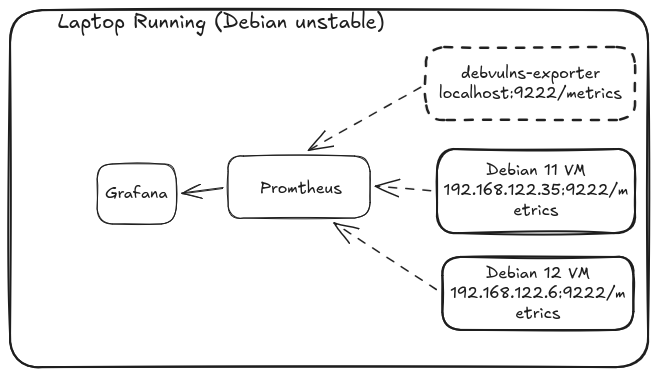
To validate the exporter, I spun up older Debian 11 and Debian 12 cloud images sourced from the Debian Cloud team. The older image was intentionally selected to guarantee a standard baseline of unpatched vulnerabilities for testing. The local evaluation topology is structured as shown below:

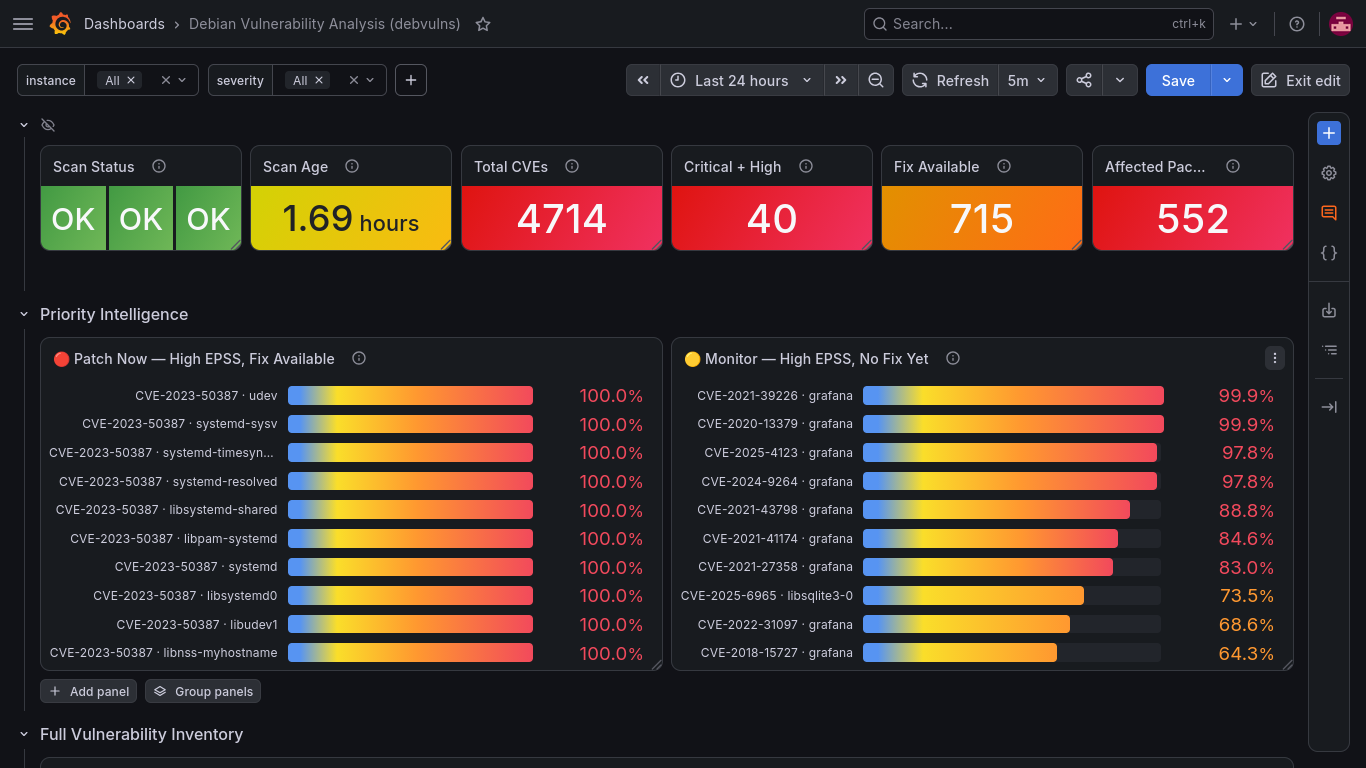
Rather than constructing the Grafana dashboard from scratch, I used Claude 4.6 Sonnet via Antigravity to generate the layout configuration. The generated dashboard for the local testbed functions effectively:

The complete, ready-to-import Grafana dashboard configuration is included directly in the debvulns source code.

Renaming the project

To prevent namespace conflicts and confusion with the native debsecan utility in Debian, I have unified the ecosystem under the debvulns moniker. The core CLI is named debvulns, the exporter is debvulns-exporter, and the MCP component is debvulns-mcp. The migration release has been published to PyPI, and the new consolidated repository is active at debvulns.

Conclusion

While this began as a personal utility to fill a niche tool gap, I expect it will be useful for others managing Debian infrastructure at scale. My next objective is to formalize Debian packaging for both the CLI and the exporter. The MCP component will likely remain available as an independent artifact. Until then, happy hacking.

Note: As a core design choice, `debvulns` still uses native `debsecan` as its ground-truth standard. The tool continuously cross-verifies its output against `debsecan` to ensure perfect functional parity and data consistency.

  •  

Jamie McClelland: DNS, OG of high availability

At May First, we recently received (all within a single week) three different complaints about domain names that previously worked fine suddenly not resolving to our servers.

While that isn’t terribly uncommon, we discovered that in each case, the domain name’s authoritative name servers were pointing to our mail servers (a.mx.mayfirst.org, b.mx.mayfirst.org and c.mx.mayfirst.org) instead of our name servers (a.ns.mayfirst.org, b.ns.mayfirst.org and c.ns.mayfirst.org). The weird part: this mistaken configuration was happening at the registrar level, protected by each member’s own credentials that we don’t have access to.

Each affected member fixed their records to resolve the problem but also made very clear that they had not logged into their registrar in years, sugggesting that the DNS authoritative records in their registrar accounts spontaneously changed on their own. The first time was weird, the second time could possibly be a coincidence? But by the third time this happened, we started to panic. How could registrar records spontaneously change? All three domain names were registered with different companies - so it couldn’t be a single registrar problem? Are we going to get a flood of these complaints? What is going on!?!?

We did an inventory to see if this was happening with other domain names in use by our membership and that’s when we discovered just how hard it is for our mostly non-technical users to set a domain’s authoritative name servers. The error rate was less than 1% but still that was a lot of domain names with typos:

  • raise your fist in the air with a.ns.mayfist.org!
  • or just plain give up and hit the floor with a.ns.matfirst.org
  • Or more commonly people added our name servers, but also left the default name servers in place.
  • Also, one person added as their authoritative name servers: a.ns.mayfirst.org, b.ns.mayfirst.org, c.ns.mayfirst.org, a.mx.mayfirst.org, b.mx.mayfirst.org, c.mx.mayfirst.org, and even a.webproxy.mayfirst.org - in other words, all the domain names we tell you do to anything with.
  • And lastly, I did find two more domains just pointing to a.mx.mayfirst.org, b.mx.mayfirst.org and c.mx.mayfirst.org.

That’s when it occurred to me: for years we have maintained an offsite server that provides both c.ns.mayfirst.org and c.mx.mayfirst.org. It hangs out in case something terrible happens to our main colo. The week before we started receiving these complaints, I separated these services, moving c.mx.mayfirst.org to a dedicated MX server. As a result, these two domain names stopped pointing to the same IP address. And that’s when the complaints started rolling in. In other words: the affected members set the incorrect name servers years ago, but because just one of the name servers resolved to an IP that happened to provide the correct authoritative lookup services, it went undeteced all this time.

So… mystery solved. Nobody’s authoritative registrar records β€œsuddenly” changed. They were mis-configured for years but thanks to the amazing resilience of the DNS system, nobody noticed because just one working DNS server is all you need.

  •  

Reproducible Builds: Reproducible Builds in June 2026

Welcome to the June 2026 report from the Reproducible Builds project!

In these reports, we outline the most important things that we have been up to over the past month. As a quick recap about what problem our project intends to solve, whilst anyone may inspect the source code of free software for malicious flaws, almost all software is distributed to end users as pre-compiled binaries. The motivation behind the reproducible builds effort is to ensure no flaws have been introduced during this compilation process by promising identical results are always generated from a given source, thus allowing multiple third-parties to come to a consensus on whether a build was compromised or not.

If you are interested in contributing to the project, please visit our Contribute page on our website.

In this month’s report, we cover:

  1. Only installing reproducible packages with repro-threshold
  2. Distribution work
  3. diffoscope development
  4. From our mailing list…
  5. Documentation updates
  6. Patches
  7. Four new scholarly papers


Only installing reproducible packages with repro-threshold

A very interesting demonstration is now available showing how you might configure your Debian system to only install packages that have been reproduced by m/n rebuilders.

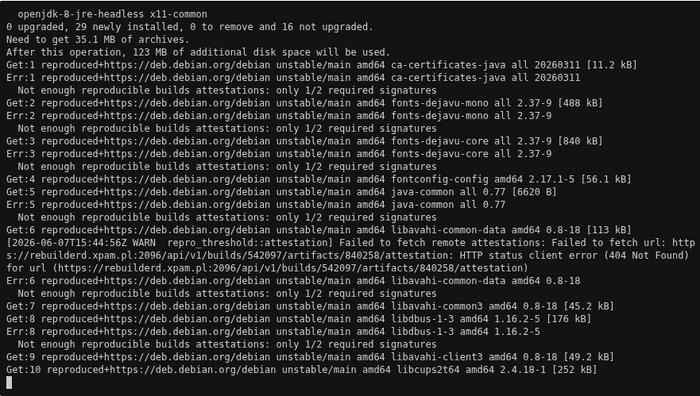
This is implemented via a reproduced+https:// APT transport ( a mechanism for communicating between the APT client and its repository source β€” commonly HTTP):

Every package download is intercepted by repro-threshold, which queries two independent rebuilders for a signed attestation before allowing installation to proceed. [It] is important to note that [an] install will only succeed if all package dependencies are also reproducible.

The demo gives examples of how to quickly experiment with this using a Docker container.


Distribution work

In Debian this month:

The IzzyOnDroid Android APK repository reached its next milestone this month, now covering 2 out of every 3 apps (66.7%) with reproducible builds. Their documentation for debugging and fixing failed builds has steadily grown as well. More clients have picked up showing reproducibility results (e.g. Droid-ify), and Neo Store now can be configured to stick to only reproducible applications. Further, an independent builder has been added to the build farm, increasing the trust level even more as APK builds can have multiple confirmations now.

At the same time, IzzyOnDroid’s rbtlog got several new features. The most outstanding is caching for frequently used resources such as reproducible-apk-tools, command-line tools and NodeJS in order to counter ongoing issues with GitHub availability, while at the same time saving bandwidth and build time. This change also enables some other some smaller enhancements such as being able to configure build timeouts per recipe for those builds running longer than the average, release pattern filtering for update checks or having a field for maintainer notes to shortly summing up e.g. why a reproducible build failed.


Lastly, Bernhard M. Wiedemann posted another openSUSE monthly update for their reproducibility work there.


diffoscope development

diffoscope is our in-depth and content-aware diff utility that can locate and diagnose reproducibility issues. This month, Chris Lamb made the following changes, including preparing and uploading versions 319, 320, 321, 322 and 323 to Debian:

  • Debian adds an extra Flags: line in the output of ocamlobjinfo, so adjust the test for cross-distribution compatibility.Β […]
  • Bump debhelper compatibility level to 14.Β […]
  • Fix compatibility with Ocaml 5.4.1.Β […]
  • Use --long-form-style arguments when calling apktool in order to support apktool version 3.Β […]
  • Support Androguard version 4 and previous versions at the same time.Β […]
  • Update copyright years.Β […]

In addition, Jochen Sprickerhof added better header detection for the Sphinx documentation systemΒ […], Michael Daniels fixed the tests when run with zipdetails version 4.006Β […] and Zbigniew JΔ™drzejewski-Szmek added a version of the deprecated os.path.commonprefix methodΒ […].

In addition, Vagrant Cascadian updated diffoscope in GNU Guix to version 321 and 323.


Chris Lamb also made the following changes to strip-nondeterminism, our tool to remove specific non-deterministic results from a completed build:

  • Skip symlinks when manually called via /usr/bin/strip-nondeterminism.Β (#1139000)
  • Update debian/watch format.Β […]
  • Drop Rules-Requires-Root: no and Priority: optional fields.Β […]
  • Bump Standards-Version to version 4.7.4.Β […]


From our mailing list…

On our mailing list this month:

  • kpcyrd posted to our mailing list regarding the β€œwaves of malware uploads to aur.archlinux.org”. Curiously, β€œevery incident I looked at used npmjs.com for malware delivery”, specifically where the npm package includes an (automatically executed) preinstall script that is an ELF binary.

  • kpcyrd also announced the release of debian-repro-status version 0.4.0, a tool written β€œto give you an approximate idea of how viable it would be to enforce a β€˜reproducible packages only’ update policy for the computer system you’ve built”:

    The change updates dependencies to the latest versions, and adds support for multiple -H options, to query results from multiple rebuilderd instances. The results are also now fetched concurrently.

  • kpcyrd also reported that, whilst taking a screenshot for the above release, they noticed that the debian:sid container now is 100% reproducible.

  • Finally, kpcyrd also created a pull request against the add-determinism package to update the itertools and zip Python dependencies.


Documentation updates

Yet again, there were a number of improvements made to our website this month including:

  • Chris Lamb added a reminder re. using the UTC variants of the Javascript Date methods.Β […]

  • Mattia Rizzolo moved OTF to the β€˜old’ sponsors list. Thank you for your support!.Β […]

  • kpcyrd updated the Rust documentation to recommend using the --release argument for consistency.Β […]


Patches

The Reproducible Builds project detects, dissects and attempts to fix as many currently-unreproducible packages as possible. We endeavour to send all of our patches upstream where applicable or possible. This month, we wrote a large number of such patches, including:


Four new scholarly papers

Kenichiro Muto and Kuniyasu Suzaki of the Institute of Information Security in Yokohama, Japan published an interesting paper this month titled Attestable Build Chain: Enabling Trust in Reproducible Builds (PDF). Their abstract is as follows:

Ensuring trust in software supply chains requires verifying not only artifacts but also the processes that produce them. Although Reproducible Builds (R-B) require rebuilding to validate artifacts, they cannot verify whether the build was executed with the intended toolchain and inputs and may reproduce unintended or compromised builds without detection. We present Attestable Build Chain, a framework for externally verifying build-time execution without rebuilding. Rather than preventing compromise, it provides verifiable, tamper-evident evidence of actual build-time execution, enabling verification of build process integrity from observed file accesses during the build. […]


Julien Malka, Stefano Zacchiroli and ThΓ©o Zimmermann published a 50-page report detailing A Decade of Software Reproducibility in the Nix Package Ecosystem:

We find that functional package management enables extremely high rebuildability over time (near-universal ability to reconstitute historical build environments and rebuild software packages), while bitwise reproducibility has steadily improved and reaches a high point in recent years (up to 93% in 2024). Early years show substantially lower bitwise reproducibility, indicating that functional package management alone does not guarantee bitwise-identical outputs, and that the observed high level of bitwise reproducibility is not solely due to the package management approach. Common causes of unreproducibility, both in the rebuildability and bitwise reproducibility dimensions, include management of dates in build and test processes; we quantify their prevalence and other common causes using manual analysis of logs of rebuild failures and automated analysis of diffoscope.

A PDF of their report is available online


Tim Bastin of L3montree GmbH and Jacek Galowicz of Applicative Systems GmbH from DevGuard published a paper detailing How We Built a Sovereign, Reproducible Container Supply Chain for DevGuard:

This paper presents how the DevGuard project rebuilt its OCI container pipeline around reproducible Nix builds and independent dual-platform digest verification. DevGuard images are built hermetically from pinned source revisions, signed with Sigstore/Cosign, and verified through digest comparison across GitHub Actions and sovereign GitLab infrastructure hosted on container.gov.de. We describe the practical integration of reproducible OCI image builds into existing CI/CD workflows and argue that independently reproducible container digests provide a stronger integrity guarantee against build tampering than provenance alone. The paper further discusses remaining trust assumptions and the relevance of sovereign build infrastructure for government and regulated environments.


Finally, Yiseul Choi, Junga Kim, Jun-Ho Hong and Seongmin Kim of the Department of Convergence Security Engineering at the Sungshin Women’s University in Seoul, Korea titled Attestation-based verification of SBOM integrity via consumer-side reproducibility:

Software bills of materials (SBOMs) support supply chain transparency, but they do not prove that a delivered SBOM reproducibly corresponds to its software artifact. Existing signing and provenance mechanisms protect integrity and traceability, yet lack consumer-side reproducible verification. We propose an SBOM integrity verification framework combining procedure disclosure, consumer-side reproduction, authority-generated reference evidence, and digest comparison. A trusted authority records a reference digest, and consumers compare it with locally reproduced and delivered SBOM digests. Experiments on 100 real-world container images show detection of artifact tampering, SBOM substitution, distribution modification, and adaptive tampering beyond signature-based approaches


Finally, if you are interested in contributing to the Reproducible Builds project, please visit our Contribute page on our website. However, you can get in touch with us via:

  •  

Dirk Eddelbuettel: RQuantLib 0.4.28 on CRAN: Small Update

A new minor release 0.4.28 of RQuantLib arrived on CRAN this evening, has been uploaded to Debian, and is being built for r2u as well.

QuantLib is a rather comprehensice free/open-source library for quantitative finance. RQuantLib connects (some parts of) it to the R environment and language, and has been part of CRAN for nearly twenty-three years (!!) as it was one of the first packages I uploaded to CRAN.

This release of RQuantLib brings a minor update to the calendars for Israel which in QuantLib 1.43 can now use one of three different exchange choices. However, using β€˜settlement’ is now deprecated so we adjusted our code. This came up as we had packaged the 1.43-rc version of the (upcoming) 1.43 release a few days ago, and it is now in testing requiring RQuantLib to catch up. Full details from the NEWS file follow as usual.

Changes in RQuantLib version 0.4.28 (2026-07-10)

  • Adjust to Israel calendar constructor change in QuantLib 1.43

  • Continuous integration uses ccache-with-R action

Courtesy of my CRANberries, there is also a diffstat report for the this release. As always, more detailed information is on the RQuantLib page. Questions, comments etc should go to the rquantlib-devel mailing list. Issue tickets can be filed at the GitHub repo.

This post by Dirk Eddelbuettel originated on his Thinking inside the box blog. If you like this or other open-source work I do, you can now sponsor me at GitHub.

  •  

Dirk Eddelbuettel: Rcpp 1.1.2 on CRAN: Usual Improvements in Semi-Annual Update

rcpp logo

Team Rcpp is excited to share that an brandnew new version 1.1.2 of Rcpp is now on CRAN, has also been uploaded to Debian, and has already built for r2u and r-universe; Windows etc builds at CRAN should follow in due course.

Rcpp has long established itself as the most popular way of enhancing R with C or C++ code. Right now, 3236 packages on CRAN depend on Rcpp for making analytical code go faster and further. On CRAN, 13.4% of all packages depend (directly) on Rcpp, and 61.4% of all compiled packages do. From the cloud mirror of CRAN (which is but a subset of all CRAN downloads), Rcpp has been downloaded 121.6 million times. The two published papers (also included in the package as preprint vignettes) have, respectively, 2263 (JSS, 2011) and 471 (TAS, 2018) citations, while the the book (Springer useR!, 2013) has another 742.

The is the second update in the 1.1.* series which had, among other changes, switched to C++11 as the minimum standard. This release continues as usual with the six-months January-July cycle started with release 1.0.5 in July 2020. Interim snapshots are always available via the r-universe page and repo. We continue to strongly encourage the use of these development released and their testingβ€”we tend to run our systems with them too.

Having said that, we would like to reiterate that we strongly object to the upstream R release and change management which in this 4.6.* cycle made several abrupt changes forcing packages which consume header files to make very abrupt change. Rcpp, just like numerous other CRAN packages demonstrates that API changes can be undertaken responsibly in a managed manner which allows for transition periods followed by possible warning periods, deprecations periods and finally (but only at long last) errors. What happened here is a speed run to the final stage of forced errors. Uncool and irritating for something as widely used as R. This forced us to make an interim release 1.1.1-1.1 even though we have of course had a policy of always keeping properly tested, installable, and error-free releases candidate version in the main repository branch and hence available via R-universe tested packages for all relevant platforms, and even via binaries for most (including Ubuntu LTS). It would be nice if R Core found a way to take advantage of this. Maybe development cycles, running apart for a year as they do for R, should also include selected packages.

Once again I am not attempting to summarize the different changes. The full list follows below and details all these changes, their respective PRs and, if applicable, issue tickets. Big thanks from all of us to all contributors!

Changes in Rcpp release version 1.1.2 (2026-07-01)

  • Changes in Rcpp API:

    • Use of execinfo.h is again conditional to avoid build complexity (Dirk in #1445 addressing #1442)

    • An internal state component for Datetime is now int (Dirk in #1448 and #1449 fixing #1447)

    • Three new (in R 4.6.0) attribute accessors are used conditionally (Dirk in #1450 closing #1432)

    • An UBSAN error in the Sugar-based NA comparison has been corrected (IΓ±aki in #1453 fixing #1452)

    • Treatment of Inf outside of integer range in Sugar function has been corrected (IΓ±aki in #1458 fixing #1455)

    • Integer overflow protection has been added for sugar functions (IΓ±aki in #1457 fixing #1454)

    • The parent environment is now accessed via R_ParentEnv (Dirk in #1460 fixing #1459)

    • Change to returning dataptr again for better handling of empty vectors (IΓ±aki in #1462 fixing #1461)

    • Undefined behavior errors in use of ListOf proxies have been addressed (IΓ±aki in #1464 fixing #1463)

    • Under newer R version, R_UnboundValue is no longer used (IΓ±aki in #1466 fixing #1465)

    • New R API access point R_getRegisteredNamespace() is used with current R versions (Dirk in #1469 fixing #1468)

    • The Nullable::as() exporter now uses an explicit cast to the templated type (Dirk in #1471 fixing #1470)

    • A memory leak in the variadic Rcpp::warning() template has been fixed (Kevin in #1475 fixing #1474)

    • The Nullable::operatorT() has been added as a 'opt-out' (Dirk in #1477 with coordination in #1472)

    • Add templated integer-index overload for operator[] on small systems such as WASM (Jeroen Ooms in #1482)

    • The attribute accessors in AttributeProxyPolicy no longer rely on get__() (Kevin in #1484 fixing #1483)

  • Changes in Rcpp Documentation:

    • Reference in the bibliography used by the package vignettes have been updated.
  • Changes in Rcpp Deployment:

    • Excute permissions are set consistently on scripts with shebangs (Mattias Ellert in #1467)

    • R 4.5.* has been added to the CI matrix (Dirk in #1476)

    • Three nag messages issued when obsolete build flag accessors are used now show Rcpp::: (Dirk in #1480 fixing #1456)

    • Reference GitHub Actions have been updated to their current versions (Dirk in #1481)

  • Non-release Changes:

    • A non-release hotfix 1.1.1-1 used by CRAN accommodates breaking changes to the API in R 4.6.0. It would be nice to have the same level of release management in R itself that CRAN expects from us.

Thanks to my CRANberries, you can also look at a diff to the previous interim release along with pre-releases 1.1.1-1 and 1.1.1-1.1 that were needed because R-devel once again sudden decided to move fast and break things. Not our doing. And there also should not have been a need to two such uploads but it was amateur hour all around.

Questions, comments etc should go to the GitHub discussion or issue section, or the Rcpp list. Bugs reports are welcome at the GitHub issue tracker as well. GitHub offers decent search for issue, pull requests and discussions; as many topics have been covered it is worth checking as well.

This post by Dirk Eddelbuettel originated on his Thinking inside the box blog. If you like this or other open-source work I do, you can sponsor me at GitHub.

  •  

Jonathan Dowland: Bauer Fly30 ice skates

I used to ice skate as a teenager but I stopped at University. I tried to pick it back up in 2024 but had to stop when I got ill. I restarted in 2025, initially with a weekly skate session but last month I started group hockey skate lessons.

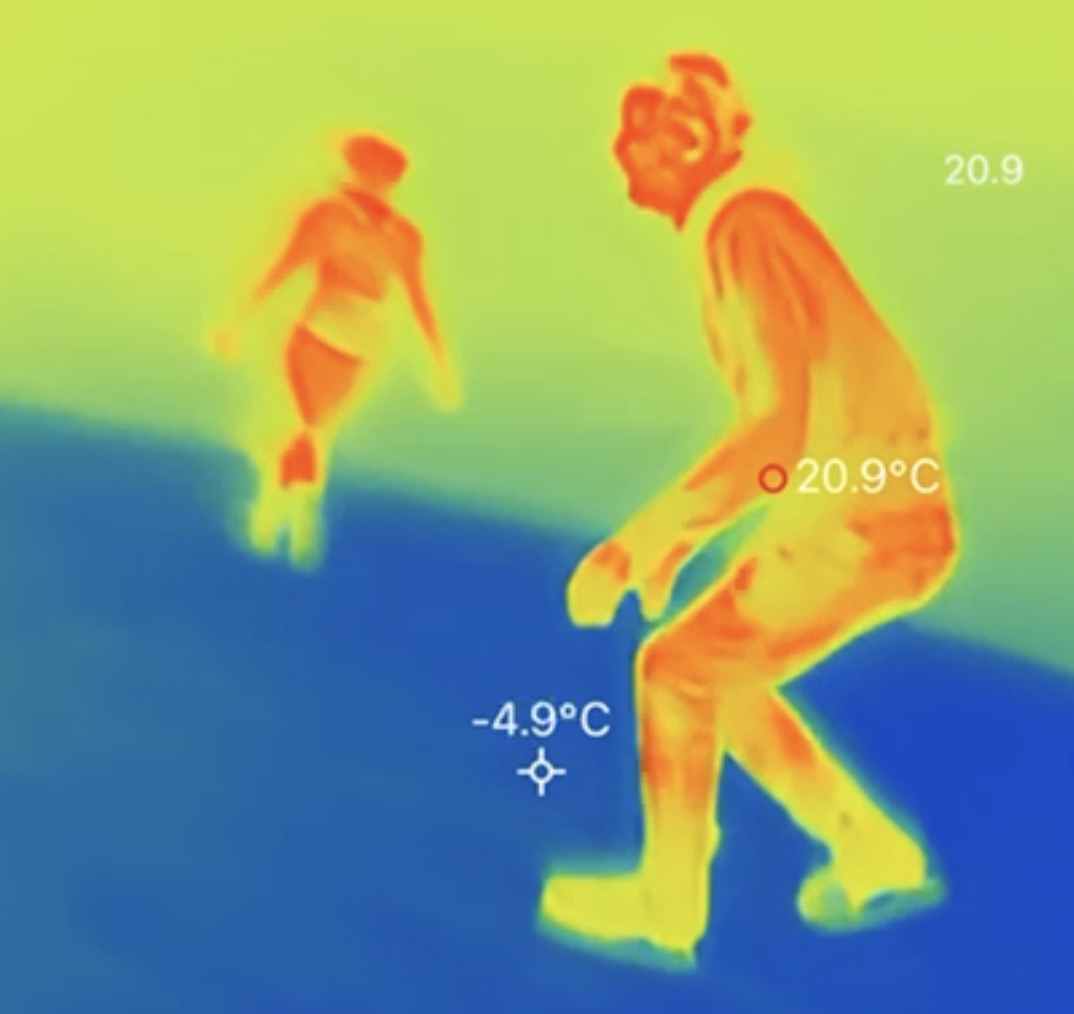
IR photo of me skating

There's not a lot of pics of me skating… this one from an IR camera

I've been skating in a pair of Bauer1 Nexus N77s that I bought 7 years ago on a work trip to Toronto. These did a great job of getting me back into the hobby for 6 years but recently I felt it was time to step up to a better quality pair. Despite being a size down from my shoe size, the Nexuses are too large: I had been compensating with thick socks but still struggling to get the boots tight enough. I'd have to wear gloves to lace up because I'd cut my hands pulling the laces otherwise.

After too long researching/deliberating/kvetching (very much on trend for me) I upgraded to Bauer Vapor Fly30s another half-size down (and nearly ten times as much). The fit is much better, in almost every respect. They actually go on easier and I don't have to tear my hands tightening the laces. They feel like a natural extension of my feet. I seem to be using a different set of muscles to skate, so the first few sessions were very fatiguing, but that settled. The Vapor line is speed-oriented, which I thought would fit my skate style best.

new and old skates

new and old skates

I have unfortunately gained a common problem: arch pain. More precisely, my navicular bone seems to be quite prominent2, and that part is pressing uncomfortably into the boot. Boots typically take a few sessions to break in, but after 7-8 sessions the pain was getting to the stage that I couldn't skate for a full session without being in agony.

The last time I skated I tried to throw everything at the problem: I'd had the skates baked3; bought some orthotic insoles; then some "Bunga" pads over the sore bit and an attempt to more loosely tie the laces over the affected area. I tried a ten minute skate, and it seemed a bit better.

I then tried experimentally to swap back to my old skates, and I felt like Bambi: I just couldn't do it! They didn't press on the navicular, and they're softer so you can compensate for the size with tight lacing, but I had no confidence in them, I couldn't lean into the turns. They just felt weird. I realised there's no way back.

I switched back to the fly30s, adjusted the bunga pad positioning, tweaked the lacing and went back on for about 40 minutes. It went well: the rink was quiet, it was cool whilst we had a heat wave outside, so I worked up a sweat. By the end there was some discomfort, but not too much, and I think partly the area is currently sensitive so just about anything will cause discomfort. Fingers (or toes) crossed that I've mitigated the problem! If not, it might be time to try a punch out.


  1. I've owned four pairs of skates: all hockey, my first were Bauers, my second CCM Tacks of some kind. I've no idea what happened to them.↩
  2. Or possibly I have accessory navicular bones↩
  3. modern mid-tier skates are thermoformable, and many skate shops carry a specially designed oven to briefly bake skates such that you wear them as they cool and the padding should mould to your foot.↩
  •  

Tim Retout: Blocking distracting news links

β€œYou are what you eat” – but perhaps this is even more true of our information diet. It is hard to strike a balance between remaining a well-informed citizen versus spending hours ingesting unnecessary news about issues and events we can’t affect. But I’m increasingly convinced that my hours lost to doomscrolling are down to design choices by web publishers rather than a failure of individual willpower.

We have created an β€œobesogenic” information environment

I don’t think it is just me – I think our information environment has been progressively altered over time as news sites look to maximize engagement. Even outside of social media, the invisible hand of the market for eyeballs forces sites to optimize for browse time or risk irrelevance.

Even as newspapers find it increasingly difficult to fund good journalism through advertising in an online world, especially local journalism, they need to keep readers on their sites, clicking through as many articles as possible. Clickbait headlines, β€œurgent” flashing live icons to draw the attention, and many opportunities to leap from one article to another, and another.

But this design approach even extends to news organisations with a different funding model, like BBC News, which is a public service (state-owned but arms-length) organisation funded through a mandatory television licence – a matter of controversy in some quarters. And it extends even to sites where I pay a subscription fee; I might get adverts removed, but I am still bombarded with the same design philosophy; too many opportunities to be pulled away from what I’m reading towards some other unrelated article.

Even if I try and limit my exposure to algorithmic β€œdiscovery” of new news, via RSS feeds or similar, if I’m reading the full article in a browser then I am prompted to read more stuff that I didn’t intend. This defeats the benefit of curating a set of feeds, because you still get dragged away to random articles.

Only 44% of BBC News is news

To show you what I mean, I’m going to pick on the BBC, although I love them dearly and the same issue very much applies elsewhere.

I’ve taken a screenshot of a random BBC News article in mobile view (my preferred doomscrolling user access device), and measured approximately what proportion of the full length of the page is taken up by each section. This is a fairly in-depth news article, so I reckon if anything the figures would be worse than this on shorter articles.

A full-length screenshot of a BBC News article showing proportions of the page allocated to the main article vs. related links etc.

(These numbers will not sum to 100% for reasons which are obvious if you look at the crossbars. Also they’re approximations.)

Less than half of the page (44% if you exclude the inline related links) is actual news text/images; the rest are links trying to help you find the next thing to read/watch. I do not want this.

I’m sure this A/B tests well in terms of reader figures, but it sometimes leaves me exhausted – it must take subconscious mental energy to ignore, or I spend too much time trying to keep on top of things.

And remember, this is a publicly-funded site that does not rely on advertising!

Blocking out the noise

If you are technically-minded, you can use an ad-blocker such as uBlock Origin to take back some control. Applying the following lines as a custom filter (Settings > My filters) brutally cuts out almost all of these links:

bbc.co.uk##aside
bbc.co.uk##footer>div:has(h2)
bbc.co.uk##[data-block="uploaderEmbed"]
bbc.co.uk##[data-block="links"]

Caveat emptor: I have not road-tested this for more than half an hour, so who knows what consequences this could have on your web browsing. In particular, international readers outside the UK will likely be redirected to bbc.com, the commercial arm of the BBC, where these rules will need adapting.

Is it unethical to use an ad-blocker to remove these links? I would argue not. I am not depriving the BBC of any revenue, because I pay my licence fee. I might reduce the amount of time I spend on their website, but if anything the subjectively better experience might encourage me to consume more news from them, not less. In other circumstances (outside the UK for instance, where the BBC relies on advertising), the balance might be different.

Product managers, please find better metrics

I lament the state of the internet in 2026. I now can’t unsee these innocuous β€œrelated stories” links as a mechanism to grab my attention, and it’s gone too far.

If you are a normal person just browsing the news and looking to discover the latest important stories relatively quickly, I can see that these types of links might actually be useful for discovery; but I’m actually reasonably sure that I’m not going to miss out on anything major. You still have the option of the news home page if you want to be presented with more news for example, and it feels natural to go back to there when you’ve run out of stories to consume.

But it shouldn’t be down to individual responsibility to ignore or geekily block these types of link; news sites with alternative funding models should find better metrics for engagement than β€œhours spent on site” – how about optimizing for customer mental wellbeing, or minimizing time required to catch up with the news? There’s no need to maximize clicks and eyeballs. This is a societal level issue, because we are all going mad with news over-engagement.

Product managers, over to you.

  •  

Valhalla's Things: Cockades!

Posted on July 10, 2026
Tags: madeof:atoms, FreeSoftWear, craft:sewing

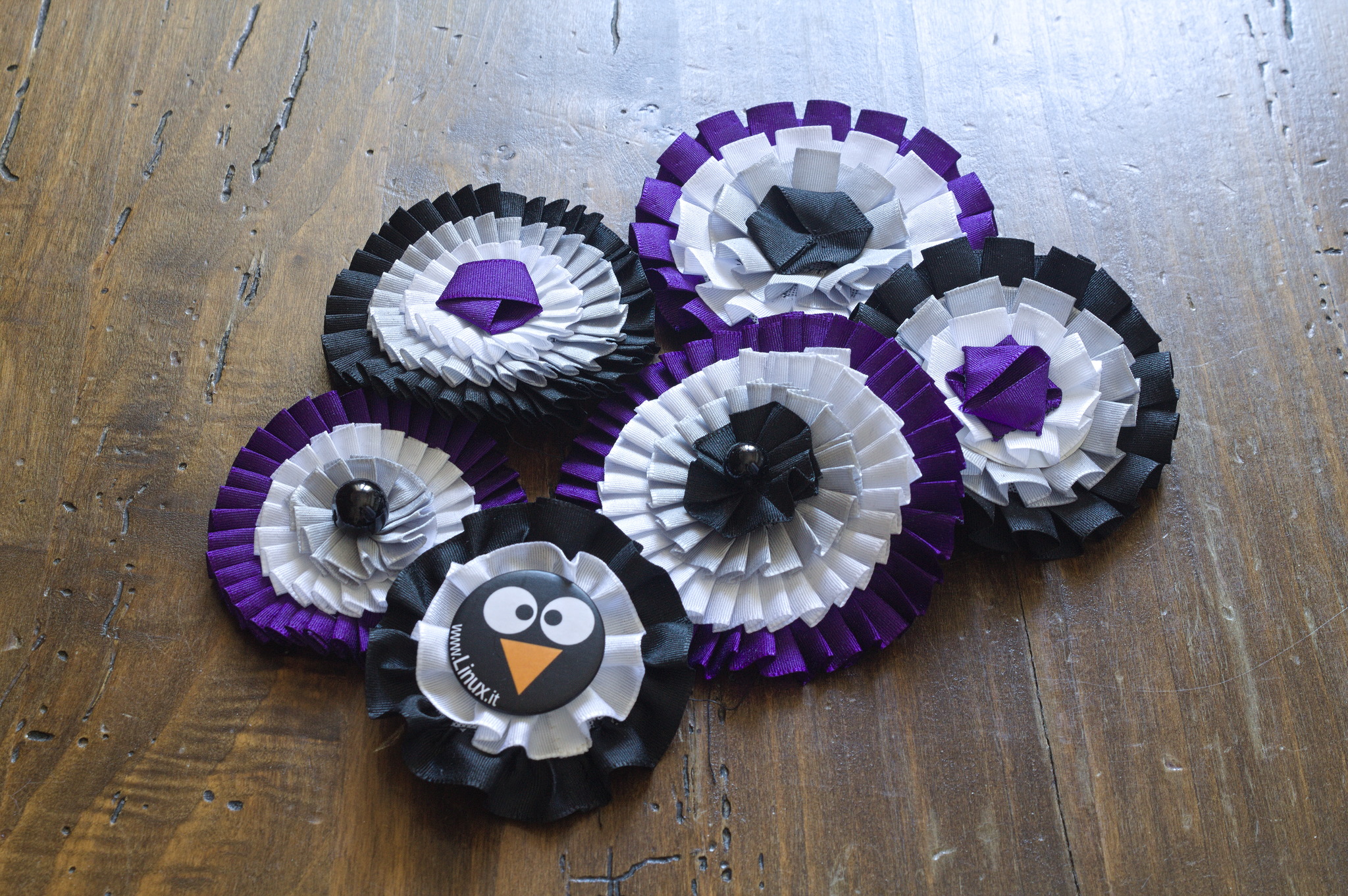
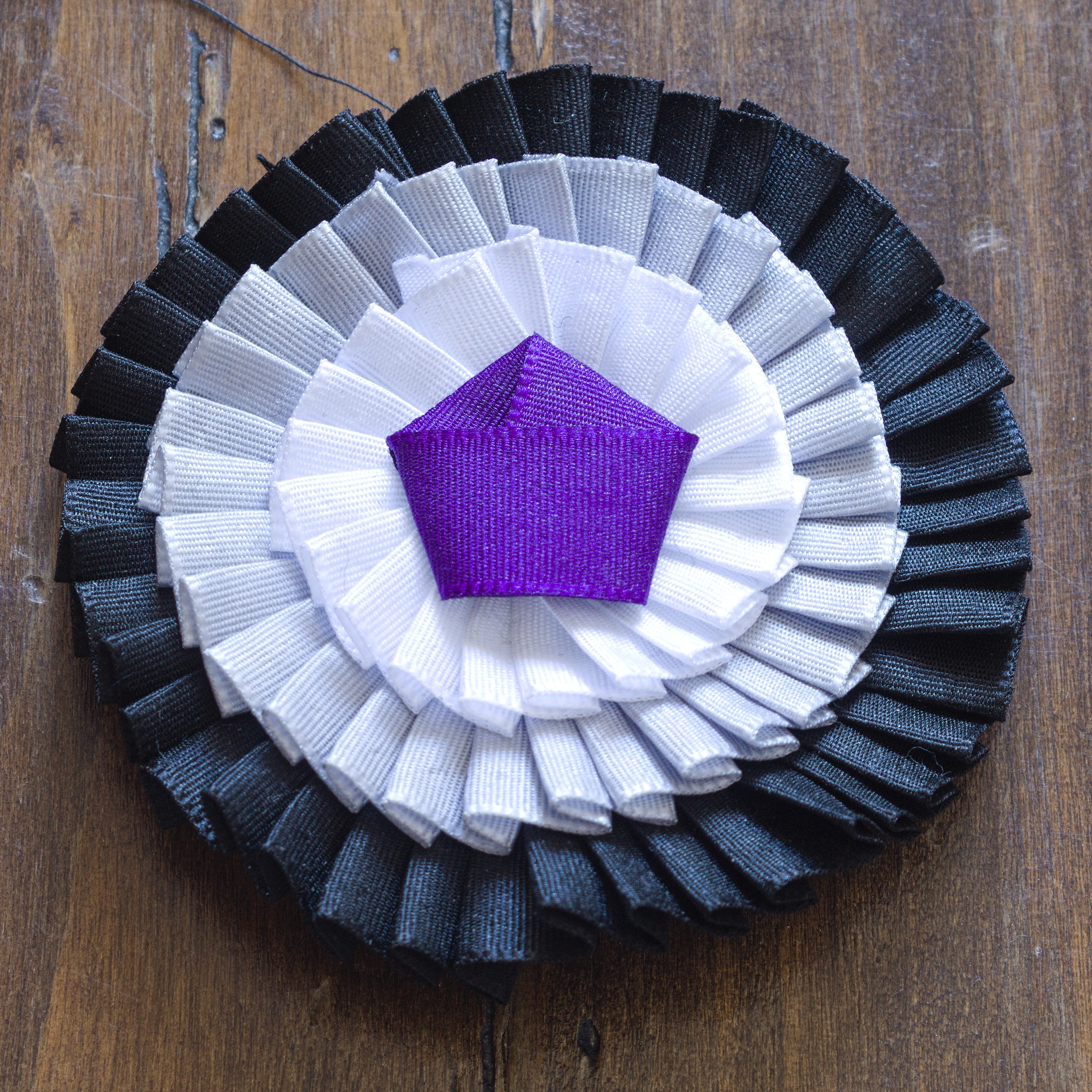
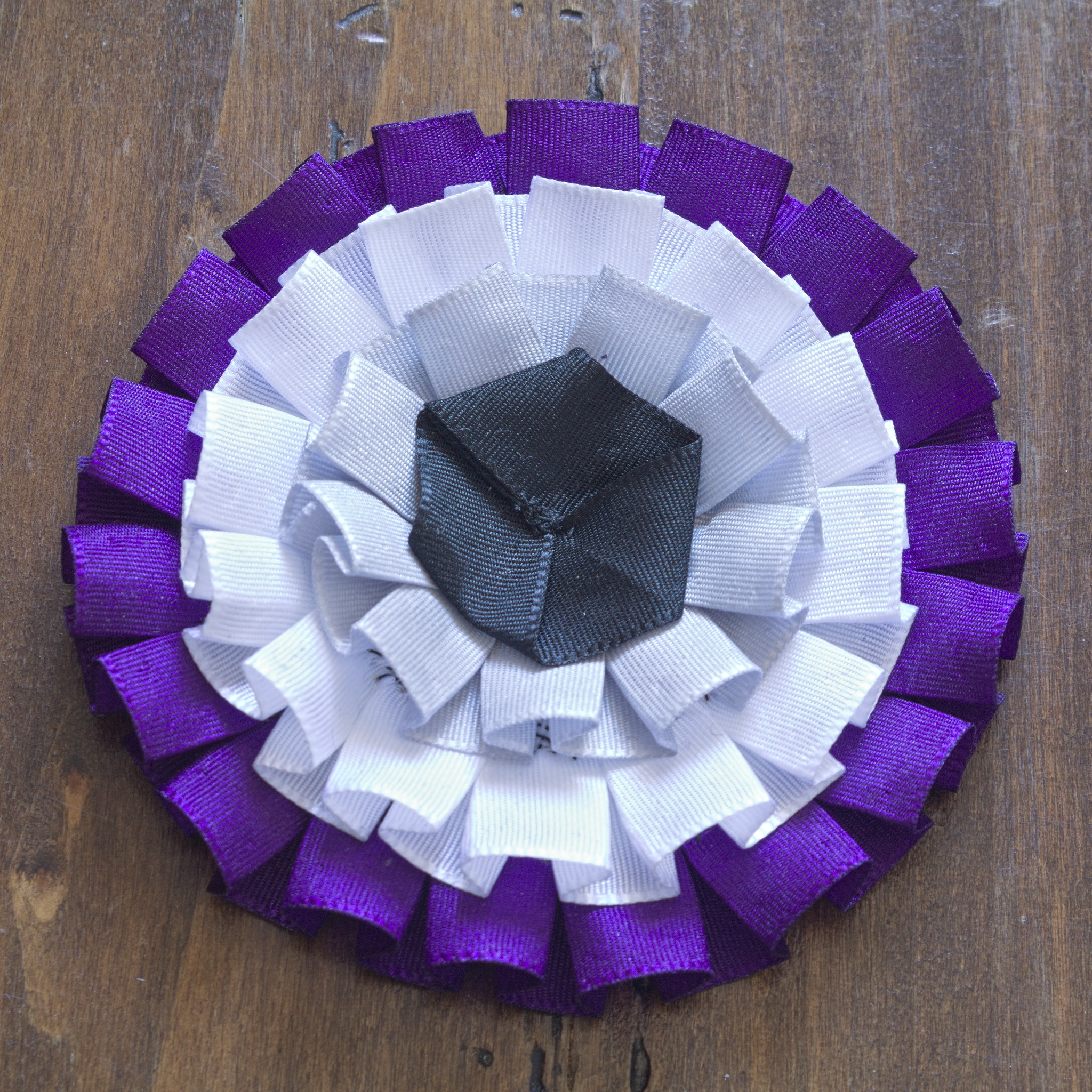
six cockades in black, grey, white, purple, in different sizes and with different centrepieces. One is only black and white and has a penguin pin in the middle.

Earlier this year, I made myself a new hat (it will be blogged), and I wanted to put a nice cockade on it. So, I looked for suitable ribbons, and couldn’t find any. I found some ribbon that looked passable, but the colours I wanted weren’t available, so I set up the website to notify me, and kept working on the hat.

Eventually the hat was done, the ribbon was still not available, so I decorated the hat with fake flowers from my stash, and started wearing it.

And that’s when I got notified that the ribbon was back in stock.

By the time the ribbon arrived, I had decided that the hat looked better with the flowers, and project cockade was put on hold, possibly for a future hat.

And then June came, and what could be a better time than that for a project based on flag colours?

As I feared, the ribbon I got wasn’t the best: it was a bit too stiff and plasticy, and not really usable for many other things. It did however work well enough for a cockade, and I decided it was a good chance to try different methods and designs, and then make another one to take pictures and publish step-by-step instructions.

And that’s the perfect recipe to find oneself surrounded by a somewhat unreasonable number of very similar cockades, I guess.

A big cockade with four ribbons, starting with purple on the outside, and a black bead in the middle covering the centre of the black ribbon. The pleating isn't the most regular, and the black ribbon at the centre is almost more gathered than pleated.

I looked around for instructions, and the ones that gave a result that was closer to my mental idea of a cockade were the ones by American Duchess, so on my first attempt I tried to follow those.

I didn’t have a cork board with a hole, so it was a bit fiddly, and the result was passable, but could have been better. Meanwhile I saw a forum post commenting on the above tutorial and that gave me ideas for a procedure more suitable to the tools I had.

A cockade with tree ribbons, starting with purple on the outside, then white, grey, and a black bead in the middle that is a bit bigger than the one on the previous one. The pleating isn't perfect, but neater than the previous one.

The second cockade I made was indeed more satisfactory, and I also started to experiment with making a center piece with ribbons, to cut down on the types of materials needed.

On this one I also tried to add a pin backing, so that I could write instructions on how to do it in what I believe is a more stable way than simply adding it to the felt backing at the end.

I’m not sure whether the other ones will be tacked to a hat, and thus won’t require pins at all, or if I’ll just put them on some dress with pins hidden under the ribbon layers.

A cockade with three ribbons, starting with black on the outside, then grey and white, and a flat pentagonal knot of purple ribbon at the centre.

And then I was ready to make a third cockade, taking step by step pictures for my website, and I planned to start on it the next morning.

Trenord had different ideas.

Thanks to the combination of independent but complete disruptions on two nearby train lines, I spent the morning driving a couple of people to the nearest station that was still being served by trains, and then back home less than 10 minutes before I had to start working, which if you ask1 me was pretty homophobic of the train company.

There was way less traffic than I expected, and I did enjoy the drive 2, but for various reasons it meant a significant delay for this post.

Anyway, less than a week later than I had planned, halfway in June I managed to publish step by step instructions on my website, but I wasn’t done with the project yet.

Beside the fact that I still needed to finish sewing the backing felt to the cockades I had done, I also had a few ideas for more centrepieces made of ribbon I wanted to try.

And this means that I moved on to another project that was already in progress (this one will also be blogged).

A cockade with three ribbons, starting with black on the outside, then grey and white, and two squares of purple ribbon at the centre, forming a sort of eight point star. The ribbons are box pleated and this gives the cockade a bit more of a tree-dimensional shape.

After I’ve finished that one, at the very end of June I quickly made the last two centrepieces, taking pictures for the instructions, and in the next few days I also finished the cockades.

A cockade with three ribbons, starting with purple on the outside, then white and grey, and an hexagonal shape made of black ribbon at the centre. The ribbons are again box pleated.

This time, instead of plain pleats I tried to use box pleats, and I quite like the look they give, so if in the future I’ll have a need for more cockades I may use again this pleating pattern.

A cockade with just two gathered ribbons, starting with black on the outside, then white, and a linux.it pin in the middle with a black background and two eyes and an orange beak reminding of a penguin.

For the last cockade I wanted to try two things: putting a pin in the middle as a centrepiece, and gathering the ribbons.

For the pin, I found that the only one I had that had a colour scheme compatible with the ribbons I had was one with the penguin from linux.it, which had a black background, so I put black ribbon on the outside and white next to it for contrast.

And gathering was done with a whipped gather with ribbons that were one and a half times the outer circumference of their slot, and looks decent enough, but I think I prefer the look of pleated cockades a lot. Maybe it would look better with a softer ribbon.

Anyway, I think this is plenty of cockades for the time being, unless I get tempted by buying more colours of ribbon to make different ones. But I’m not making an online purchase just for those. I am not.


  1. you probably shouldn’t.β†©οΈŽ

  2. also thanks to my partner who, on entering the destination town, told me to stop on the big, straight, two-way road with plenty of roundabouts to turn around, and went through the maze of one-way streets to the station by foot.β†©οΈŽ

  •  

Bits from Debian: New Debian Developers and Maintainers (May and June 2026)

The following contributors got their Debian Developer accounts in the last two months:

  • Vivek K J (vivek)
  • Benjamin Somers (bensmrs)
  • Colin King (colinianking)
  • Nadzeya Hutsko (nadzeya)

The following contributors were added as Debian Maintainers in the last two months:

  • Pieter Lenaerts
  • Syed Shahrukh Hussain
  • Ural Tunaboyu

Congratulations!

  •  

Jonathan Dowland: Korg Minilogue XD Desktop Module

I bought a new synth! Kind-of.

I've traded my Minilogue-XD (full-size version with integrated keyboard) for the desktop/modular alternative.

Modular Minilogue XD

Modular Minilogue XD

Why? Partly, because it fits on my desk better. Partly, because it changes the way you engage with the instrument. It makes a huge difference: the ivory keys come with so much cultural precedent. The module version of the synth gains a switch that lets you use the 16 sequencer step buttons as note inputs, so you can still play the thing solo. But the emphasis moves away from note generation and more firmly towards tone.

Both versions have a lovely stained wood back, which you never see; the modular one has a hint of that at the front as well (which you do see).

I plan to eventually buy a MIDI keyboard that could drive it, and other things: possibly an Arturia KeyStep or Minilab, but there's no rush on that.

(It's about time I recorded and shared something I produced on this)

  •  

Thorsten Alteholz: My Debian Activities in June 2026

Debian LTS/ELTS

This was my hundred-forty-fourth month that I did some work for the Debian LTS initiative, started by Raphael Hertzog at Freexian.

During my allocated time I uploaded or worked on:

  • [DLA 4615-1] exim4 security update to fix one CVE related to information disclosure in combination with proxies.
  • [DLA 4616-1] haveged security update to fix one CVE related to local root privilege escalation.
  • [DLA 4618-1] gsasl security update to fix one CVE related to denial of service.
  • [DLA 4631-1] asterisk security update to fix 13 CVEs related to buffer under- or overflows, either on heap or on stack. Some are related to use-after-free or wrong processing of invalid or untrusted certificates.
  • [ELA-1747-1] gimp security update to fix three CVEs in Buster related to denial of service or execution of arbitrary code if malformed PSP, JPEG 2000 or PSD files are opened.
  • [ELA-1748-1] gimp security update to fix two CVEs in Stretch related to denial of service or execution of arbitrary code if malformed PSP or PSD files are opened.
  • [ELA-1749-1] exim4 security update to fix one CVEs in Buster and Stretch related to information disclosure in combination with proxies.
  • [ELA-1750-1] gsasl security update to fix one CVEs in Buster and Stretch related to denial of service.

Besides fixing all CVEs of asterisk in Bullseye, I started to look at asterisk in other releases as well. Rather surprisingly asterisk is only part of Unstable and Bullseye. All other releases don’t include any version of asterisk at all. So first things first, besides some security related RC bugs, asterisk did not migrate due to RC-bugs in dahdi-linux. As I maintain osmocom-dahdi-linux (which supports less/other hardware), I looked at the open issues and after some rounds I could upload a new upstream version, fixed some bugs and resolved issues with piuparts. dahdi-linux meanwhile migrated to testing, job done!
As a next step I looked at the open CVEs. Some of them had been already fixed in previous uploads but had not been marked accordingly. So I fixed all remaining ones and sent a debdiff to the maintainer. Unfortunately there was some kind of overlap in our work and he ignored my debdiff but uploaded a new upstream version. Anyway, job done as well, no open security issues anymore. The only thing that hinders asterisk from migrating to testing is the reproducible build. So if anybody has some spare time …

Other things I worked on were the regression update of rsync. Some of the elven new patches need to be backported, but I am confidentially to finish this month. I already reviewed the rsync– uploads of Sylvain to Buster and Stretch, so I don’t expect any big hurdles here. I am also making progress to find the correct patches for hplip and cups.

Debian Printing

This month I uploaded a new upstream versions:

  • … hplip to unstable to fix some bugs.

This work is generously funded by Freexian!

Debian Lomiri

This month new upstream versions of dozens of lomiri packages have been released and I uploaded lots of them to Debian. After they migrate to testing, I am also going to sync them to the Ubuntu PPA.

This work is generously funded by Fre(i)e Software GmbH!

Debian Astro

This month I uploaded a new upstream version or a bugfix version of:

  • … indi-pentax to unstable. This is a package in contrib without autobuild and needed a new upload for the libraw transistion.
  • … c-munipack to unstable.
  • … supernovas to unstable (sponsored upload).

Debian IoT

This month I uploaded a new upstream version or a bugfix version of:

Debian Mobcom

This month I uploaded a new upstream version or a bugfix version of:

misc

This month I uploaded a new upstream version or a bugfix version of:

  • … visam to unstable. There had been an RC bug due to two binaries with the same name but different functionality. Yes, it is in the policy but … (my mother forbade me to elaborate more on this)
  • … mailio to unstable.
  •  

Aigars Mahinovs: How to make a good group photo

Taking a good group photo consists of multiple aspects:

  • hardware
  • scouting
  • organization
  • preparation
  • execution
  • processing
  • publishing

I can say with confidence that nearly everything here comes from having failed to do these things right at least once, even on the latest attempts, so this is an ideal to reach towards, not something we expect to hit every time.

The Goal

The main goal of a big event group photo is capture both the moment itself and each individual person inside that moment.

We want people, who were not there to see all the people involved and get an impression of what it was like being there. It needs to show the breadth and depth of people that make up this group, this project.

And we want people who were there to be able to look back the next week, the next year or in ten years and remember - ah, yes, I was there, I was standing right there with this grin on my face next to this wonderful person and I was feeling great.

Hardware

Based on the goal we want to have high level photographic gear that is able to capture both a broad enough picture to encompass all the people and some of their surroundings to communicate the context (without undue distortions) and to deliver enough detail and resolution so that faces and facial expressions and underlying feelings of every single person in that group could be clearly seen and preserved.

To both capture the context and minimise distortion the final picture should be just a bit wider than normal human field of view. That is about 50mm for a full-frame camera or 35mm for a typical 1.6 crop camera. You can go a bit wider if there are no better alternatives (as detailed in the scouting section), but be prepared that corners of the image will be distorted and not really usable (but we can fix that in processing step). Or you can go to unusual aspect ratios, like we did in Debconf 10.

In the absence of a 100MP+ camera, you will need to be stitching together multiple frames to achieve resolution high enough to have enough pixels-per-face to see emotions clearly. This means that the photos you will actually be taking will be tighter than the overall field of view mentioned above. Still, a higher resolution camera body is preferable - nowadays 24MP-32MP cameras APS-C provide a good compromise between resolution and price, but 45-67MP full-frame cameras also exist on the market. Assume that we will be shooting in a bright environment, so most likely with quite low ISO settings, that means that high-ISO noise characteristics of more expensive cameras will not really play a role here. You will also not need very fast burst modes, even manual speed of one frame per second is sufficient.

You will also want to get as much detail as possible out of your lens, and this is the most important part. You can do amazing work in all other steps of the process and have a great camera too, but if you pair it with a lens that is not sharp, then the end result will be disappointing.

You want the lens that is sharpest corner-to-corner when stepped down to about f/8-f/11, that you can get for your system. You also want that lens to be about 85mm full-size sensor or 50mm for 1.6 crop size. Luckily that kind of range is also a great range for optical design and sharpest lenses are typically available in exactly these kinds of sizes. You absolutely want to have a fixed focal length lens, not a zoom lens. Even profession grade zoom lenses often deliver worse image quality compared to fixed lenses that cost less 1/10th of their price (when shooting in the same focal length). Newer design lenses are better than older lenses - optical design, coatings and precision manufacturing have advanced a lot over the decades. Retro look is great for mood, but not as good for actual resolution and clarity. You don't need to overpay for most expensive lenses because those often only improve image quality on lower F-stops. To encompass the whole group we will need to shoot at f/8 and in bright light, so the extra benefits of those f/1.2-capable super expensive lenses will not come into play here.

We will have no use for a flash here. A tripod will be too restrictive when rapidly repositioning the camera between different parts of the panorama shoot. But a monopod might help with stability - I have not tried that myself, however.

For my last photos I used a Canon EOS R7 (32.5MP) with Canon RF 50mm f/1.8 STM lens and considering an upgrade to Sigma 56mm f/1.4 DC DN for the next time.

Scouting

Scouting a good location for the group photo is another big chunk of a successful picture. The critical piece of the puzzle is lens-to-face distance. In order to keep everyone's face in-focus and have enough resolution on the farthest faces (without making nearest faces truly massive) we want to do everything possible to reduce the variance in lens-to-face distance - to reduce the difference in distance between closest and farthest face.

The most effective way to do that is to have the photographer climb higher. To see this in action on the Debconf photos, compare Debconf6 (very high camera position, group on level ground - good) to Debconf10 (camera not too high, group on stairs, still good) and to Debconf17 (camera could not get high enough and the group is on flat ground - not great). Even the Debconf25 photo was suboptimal from this perspective. The Debconf23 photo was a very good example from the recent years - good height and also the group was positioned in a semi-circle so there were no people directly in front and very near to the camera.

So you are looking for the highest point you could get to (even if that requires a special permission of key or a ladder) with a field large enough to fit the whole group comfortably. How to check that? Normally I simply take a photo from the top of the whole area and note down from there where the extreme corners of the group could be and still be fully seen in the shot - not blocked by trees, buildings and shadows. Then I go down and measure that space. Rule of thumb being - people in one horizontal line can stand 1 normal length step from each other and two horizontal lines can be half a step from each other vertically. So I can just measure a rough rectangle in steps, multiply the sides, multiply that by two and I have the rough number of people that can fit there for the photo.

Once you have a candidate location or two, it is important to check them at the same time-of-day as you plan to do the photo (see organization section for that). You want to make sure that the whole area of the group is in the same illumination - if half of the group is in the sun and half in a shadow, then you will be having a very bad time later. The absolute ideal positioning for the group photo is to have everyone be in shadow, but still have enough bright skies and bright buildings in front of the people to give good illumination of the faces. Worst you can do is have the sun be behind the people (so all the faces are really dark) and second worst is have the sun be directly in front of the group, so that the faces are very well illuminated, but everyone's eyes are closed because they are being blinded by the sun. And sometimes all you can do is pray for some light clouds to provide for even and dispersed light. Debconf23 was very lucky that way.

Another consideration is to how people are going to get to that place. You need to consider accessibility needs of people (it is ok, if it takes more effort or time, but it needs to be organized and communicated well in advance). And you need to consider how the big masses of people will be getting there - how to tell people where exactly it is and how to get there from various locations where people might be hanging out during the event?

Having an alternate location indoors might be necessary if the weather report for the next days is not sufficiently predictable. We had to use that contingency in Debconf9, for example.

Organization

It's hard to take a good group photo if half of the group does not show up or is too late, so this needs some organization to happen smoothly.

First of all you need to choose date and time for the photo. The photo does not take too much time from the schedule of the event and can be squeezed in after all the other events are already scheduled. In fact I prefer that as it allows you the flexibility of choosing the date based on weather conditions and time based on light and shadow conditions in potential photo spots. You don't want to choose the daytrip day as most people will be away and return times are not really predictable. You do not want to choose the morning after Cheese and Wine party for obvious reasons. First day and last two days are also sub-optimal as some people arrive late and some leave early for various personal reasons. Also you don't want it to happen just before Cheese and Wine either because then you'd have very little time and clarity to do the processing of the image on the same day.

For timing, the best way, in my experience, is to schedule the photo directly after the end of talk sessions before a meal break - lunch or dinner. Typically in the Debconf schedule there are 2-3 daily breaks planned, say for Debconf25 there was lunch, afternoon break and dinner. Talks are planned to end ~10 minutes before those breaks (and meals) begin, so for example, afternoon break starts at 16:00 and all talks in the previous block end at 15:50. In such a case just schedule the "Group photo" event from 15:50 to 16:05. This gives people the info to go there directly from the end of all talks and that they will have sufficient time for break/meal afterwards. Do not forget to specify the location (as exactly as possible) in that event entry and make sure to post it at least two days in advance. People often want to wear something specific for the photo and thus need to know about it in advance. This also makes sure that people do not make alternate food plans for that specific break and don't leave the venue.

Announce the date, time and the exact location as wide as possible, don't be shy. Announce and discuss mailing lists, IRC, Signal, Telegram, make sure the front desk knows in case anyone asks in-person, ... Check that it is again included in the announcements email on the day preceding the photo date.

When the date has arrived, it is a good idea to check in early with people with special mobility needs to make sure they know where to go, how to get there and how much time they will need to be able to get there on time.

As the final round of talks before the group photo is starting up, it is time to recruit "runners". I've had great success with this technique. The idea is pretty simple - for each room where people congregate (talk rooms, hacklabs, cafeteria, outside hackspace, front-desk, ...) go there and choose one person. You want to choose a person that you will recognise and remember among everyone else in the group, either because of who they are or what they are wearing, whatever works best for you. If they agree to help, instruct them to: "at end of talk, announce that the group photo happening now and the location, herd people towards the photo location, be the last person out, make sure there are no stragglers from this area behind you, when you arrive to the photo place I will assume that everyone else from this room is also now there, when you are there catch my attention and show this sign so I know for sure that it is all good and make sure that I did see it from you". With that sorted out all you will need to remember is how many runners you recruited and how many have reported in to figure out if everyone has now arrived or if we still have to wait for someone or some group.

Then you will only have one last point of organization left - shaping the crowd into a group. People will not know what your vision for the group photo is, so you will have to give clear and LOUD instructions on where people should not be standing. Use clear, large gestures to support your words. You want to compact the group, have the people that just joined in the last moment and are standing to the side come deeper in and join the crowd. Have any holes in the middle of the crowd filled in. Forming a semi-circle instead of a blob helps with averaging face-to-lens distances. Make sure people are not in unexpected shadows. Make sure carried objects, like umbrellas of flags do not cover the faces of other people. Take the time to look at everyone face to make sure there are no people hiding behind someone's shoulder - typically they are not aware that their face is in fact not really visible. If there are such people, call them out and point directly at them and encourage them to step forward, if they wish to do so. You are the only one seeing the final picture now and only you can correct it before capturing the moment. So a few extra seconds here are worth taking, even if 300+ people are standing in scorching heat and waiting on you.

When you are happy with what you are seeing, make sure to tell people clearly that you are now about to take the pictures and again remind them not to move and explicitly not to turn their heads to the side until you are done (this is the source of most of the extra work in processing). Be very loud and clear and make sure you have everyone's undivided attention before you start saying the important stuff.

When done - say so. There will be other groups that will want to also have a photo taken after the main group is a bit more dispersed, so don't run away. Typically at least the T-shirt group will want a picture and also all the organizers.

Final bit of organization during the group photo shooting itself is the sneaky self-insert. You may choose not to bother with it, or do it in the simplest way, like I did in Debconf6, but if you really want to blend in with the crowd, you need to have someone else take a photo of you in the exact same location at the same date and time from the same location. So you should already during shaping the crowd decide where you would fit in, it is easiest to blend in at the back of the crowd and to one or other side, so that it appears like you are just standing behind the shoulders of a couple peoples. Remember that spot - it is easiest if you stand in the exact same ground spot when your photo is taken. Just go down, recruit a volunteer to take your photo, make sure the settings are fixed to the same ones as for the group photo shots and have them take a handful of shots of you - one of you centered in the camera frame and a couple more with you more towards the corners of the frame. This distortion from being off-center in the frame may be important later.

Preparation

In addition to preparing the crowd for the photo, you also need to prepare yourself and the equipment. Make sure you have dusted your camera sensor and cleaned both inside and outside glass of your lens. It is usually a good idea to remove any filters from the lens. Install the hood, if that could help with blocking the sun flares. Make sure you have the right lens and that you have installed the right lens.

For fixed settings I typically shoot in JPEG with RAW being there more like an emergency backup. The extra dynamic range of RAW could be used, but it is really complex to do that in combination with image blending and it is hard to get right, so I prefer an all-JPEG workflow and fix the dynamic range in the scene itself, before shooting. For Canon I am using the Standard profile that boosts the color saturation and sharpness a bit as I just enjoy that look and find it hard to get anything significantly better from RAW data even with a lot of effort. In any case make sure you have enough space on the cards to take at least 100 images and that you have a full battery. Do not use high speed burst setting because it is then too easy to take too many pictures at the start of the sequence and be stuck with your camera still in "Busy" state writing big RAW files to slowish SD cards and not allowing you to finish the full picture rapidly.

You want to have the shutter speed at at least 1/100th of a second to prevent blur from both your hand movements and also from people in the shot moving around a bit (image stabilisation will not help you there). And you want to have the aperture to be around f/8 - lower apertures risk people in front or behind falling out of focus, make the lenses look less sharp. Higher apertures also start to become less sharp due to diffraction effects above f/8. ISO should stay as low as possible, ideally at ISO 100, but if there is not enough light then upping the ISO to 400 would be the first step that I would try to do and second would be decreasing the aperture to f/5.6. If there is too much light, then increasing the shutter speed should be the safe thing to do.

As people start to arrive into the shooting location - check the exposure and nail down the settings, ideally in manual mode. Consider that left side could be a bit lighter or darker than right side. Err on the side of making the picture a bit too dark as there is more depth to darkness before cut-off compared to clipping on the high end. However, do not trust the exposure detection, instead take a picture and look specifically at skin tones in faces of people that already are standing in the photo area. Faces are the key bit and the exposure needs to be adjusted just to the faces and ignore darker of lighter clothing. Do some test shots and find settings where faces look not too bright, but also not very dark and fix those settings in manual mode.

Now you are ready for the action. Shape the crowd, check the faces and the action can start!

Execution

During taking of the group photo you want to finish it fast, but at the same time you have to take the time to make it right. If you hurry too much under pressure, you risk being left with unusably blurry images and the whole effort wasted. Having already prepared and verified the manual settings makes it easier.

When you are taking pictures, you have to remain as still as possible - even at very high shutter speeds even slow hand movements are still bad for image quality. So think of the movement as of biathlon athlete shooting the very middle of five, very separate targets - take a burst, reframe, then steady up for a second and only then take the next burst. 3 frames per burst are sufficient. 90% of the time the very first photo of a burst will be best. As you move from frame to frame, aim for just a bit more than half-frame overlap. This will give the opportunity to skip frames if all is good, but also have backup coverage of every face in case of problems. Proceed systematically, I typically start off on the top left of the crowd, then go right until the end of the line, then shift down half a frame and go left until the end and repeat until I am done with the crowd.

After that it is very helpful to also immediately take photos of a "frame" around the whole crowd. Stitching process often distorts the frames in weird ways that leave holes in the resulting image that you can fill if you have a wide frame around the crowd. It is possible to compensate with creative cutouts in the final image (like Debconf9), but the more framing room you make, the more flexible you will be able to be with cropping of the final photo. The frame also gives you the opportunity to capture more of the context of the place and space.

As an example, Debconf25 group photo in the end consisted from 9 images + 1 for sick people + 1 for me. I ended up missing the framing shots for bottom left, top left and top right corners. To get there I took 68 images. And in some years it was more than a hundred.

Processing

This part might be less stressful than taking the pictures from intensity perspective, but it lasts longer. Depending on you luck, skill and perfectionism it can take anywhere from 3 to 9 hours of work to complete.

Before you start, however, you should first request things that you will need for other people. This can even be done before taking the actual group photo, but usually I forget. To finish the photo you will need three things:

  • good quality vector graphics of the current Debconf logo
  • good quality vector graphics of the next years Debconf logo (even if preliminary)
  • motto of the conference

The first two you should be able to get from the respective organizers. The motto is harder. I typically try to ask the current DPL to come up with something describing the current mood of the project or of the event, but it is rare that it is that easy. Most of the time I came up with something as I was editing the photo and reflecting on what was the mood, the feeling, the mojo of this conference and of this year was like. Bend that around a recognisable phrase or expression, make it a bit more insider-relevant and you are on the right path. Some years this was the hardest part.

For the panorama stitching I will describe the workflow that has served me good for years, but maybe there are better ways possible nowadays. Feel free to let me know!

First I would save all photos taken and select one sharpest photo from every burst. Next I would select the minimal number of photos that appear to be covering the entire crowd. The fewer images you use, the better in the end because the most quality problems crop up in the areas where photos are getting stitched together. Fewer seams leads to fewer issues.

Open Hugin (you will also need enblend and enfuse installed) and import your minimal set of images into it. Click the "Align" button and wait a while - the processor will be trying to figure out keypoints in each image and then try to match these points between the images to try to fit them all together into a single projection. To do that it will distort the images. This is the trial and error process part. You may need to add, remove or replace images to get the stitching to work or to work better. You may want to add more of the frame images to fill the ragged holes around the image.

After initial alignment, go to "Move/Drag" tab and move the image a bit up in the projected field of view and make it a bit more central visually. That will help a bit with the distortions in the near-by people and people in the corners of the image. In the "Crop" tab set the initial crop - leave it generous, you can always crop more in later steps. Do not be afraid of leaving in sizable chunks of black homes, empty skies or grass. All of that can be filled in later as well.

Go back to the "Assistant" tab and click "Create panorama". It is good enough to have JPEG output at 100% quality using exposure corrected low dynamic range output option. Make sure to check the "Keep intermediate images" option. This will not only generate the final, merged panorama, but also keep around the individual images after perspective correction and exposure blending steps. These are critical for fixing blending error in the next step.

You might need to go back a forth a few times with a different sets of source images, maybe adding some image between other two, maybe removing another to reach a better starting point. The key part to pay attention - how many ugly stitches are there in the image. Check every face, the blending algorithms do not recognise faces and sometimes try to stitch one face from two or more images creating very weird effects. They can be fixed in the next step, but it is rather hard manual work, so the fewer such faces are in the blended image, the less work you will have. In some years I've managed to find a combination where all faces were good and in other years I had to manually fix 13-15 faces.

Do not try to blend the extra pictures (like with you or with sick people) into the main panorama with Hugin - it will get very confused with the parts of the grass that it is able to see where other people were standing.

The next is the final processing in GIMP. Think of it like a large and complex project - do as much as possible in separate layers, save often.

Fixing wrongly stitched faces and also putting yourself into the photo are very similar activities in the end. Just the scale and the source differ. For yourself you just cut out yourself (upper torso is enough) from the separate photo. For corrupted face, choose one of two intermediate images that the Hugin created where the face is transformed, but not yet merged (with a different version of itself). In either case crop the photo to roughly the interesting size and put roughly in the right spot as a separate layer on top of the group photo background. Reduce the opacity of the small layer to 30-40% and zoom in to 400%. With that it is much simpler to position the layer with pixel precision. Then all you need to do is add a layer mask to this layer and paint it just right. Basically in layer mask black means transparent and white means non-transparent. So you need to just make everything that is you have white mask and everything that is not you have black mask. And smudge the border a bit with finger tool or blur to make the transition smoother. Easy to say. Hard to do. This is what takes most of the actual work hours in post-processing.

You might miss someone. I am sure Phill is just thrilled to see me in the very middle of the Debconf25 final picture .... But do try to fix them all.

Use large, sweeping geometric figures to cover up black holes, empty grass fields and other sub-optimal corner features. And then use that newly created free space to put in a large version of the logo of this years conference, decently sized motto and slightly smaller invitation to the next years conference.

Do not forget to add a copyright and license statement somewhere in the corner in smaller, but still well readable font. I am using a text like: "Photo by: Full Name, Email: fullemail@debian.org, License: GPLv2+ or CCv3-BY" This ensures that this image may be used in any press coverage (with basic attribution) and also can be included in any GPL-licensed software, if that ever comes up. The same statement is also in the metadata of the image file (see Image-Metadata-Edit metadata in GIMP) along with information that states that this is "Debian Developer Conference Group photo, City, Country, Year". Image->Image properties->Comment is another place where GIMP hides this EXIF information.

For ease of use, in addition to a full-resolution image it is also useful to make a lower resolution version that would still fit on a 4K screen at full resolution, so about 3840px wide. Some photo hosting services set other limits for image size as well, so it might be needed to scale the image down below 100Mpix to upload it to Google Photos, for example.

Publishing

So, it is finally 1AM and the group photo is ready! How do you push it out to people? Well, in all possible ways and places. Again - don't be shy, people do really want to see it.

Push it to whatever you use for your shared photos. Push it to Debconf shared git (note that this is GIT-LFS repo, make sure you know how to add content to the LFS specifically). All permanent links to that in GroupPhotosAll wiki. And then send those links to IRC, Signal, Telegram groups, debconf-announce mailing list. Publish it in your blog and push that to Debian Planet. Push it in Threads, Bluesky and Mastodon. Send an email separately to Debconf orga team. And one to Debian Publicity Team so they can put it into the Debian Home Page and push via Debian micronews accounts.

And that is about it. Now you can go back to enjoying the rest of the conference. Or running around doing other things that you think need to be done. It's up to you. You did it. This moment will remain with people for a very long time. And you helped.

Questions? Feedback? Just ask here or here.

  •  

Russ Allbery: Review: The Player of Games

Review: The Player of Games, by Iain M. Banks

Series: Culture #2
Publisher: HarperPrism
Copyright: 1989
Printing: February 1987
ISBN: 0-06-105356-2
Format: Trade paperback
Pages: 295

The Player of Games is political space opera and the second book in the shared Culture setting. As with most Culture books, the reading order is not particularly important. It won the 1989 Locus Award for best science fiction novel and sometimes competes with Use of Weapons as the consensus best Culture novel.

This review is a re-read and yet another experiment in how to re-review a book. This time, I decided to write a full second review with substantial spoilers so that I can talk in more detail about the book. If you want to avoid spoilers, or just want to see how my thoughts have evolved from my first reading, see my original review from 2005.

Gurgeh plays games. He is probably the best strategy game player in the entirety of the galaxy-spanning Culture. He has written papers on game theory, won innumerable major championships, and is a celebrity in the circle of like-minded aficionados.

Gurgeh is also bored and in the middle of the Culture equivalent of a mid-life crisis. As the story opens, he's vaguely unsatisfied and adrift, unenthused by his normal activities, and searching vaguely for something that will break through his ennui. He is caught by surprise by the thrill he gets from a moment's misunderstanding in which an opponent suspects him of cheating, which sets him up to be (apparently) clumsily blackmailed by a deeply unpleasant drone named Mawhrin-Skel.

SPOILERS BELOW. If you have not read this book, consider stopping here and instead reading my original no spoiler review.

The first hundred pages of The Player of Games is a slow, somewhat plodding introduction to Gurgeh, his social circle, and life in (one part of) the Culture. I remember being fascinated by this part the first time I read this book. It was only the second Culture novel I read and the first set in the Culture proper, so the world-building underlying this odd post-scarcity utopia on a vast intelligent habitat with sentient drones, complex privacy rules, endless cocktail parties, and apparently directionless socialites was intriguingly unlike the other science fiction I was reading at the time. This time through, I have to admit I was less impressed.

Gurgeh is not very likable, and his desultory mid-life crisis is a little boring. None of his friends have enough depth to appear as more than side notes, in part because Gurgeh doesn't seem to care enough about any of them to make them interesting to the reader. I've since read seven other Culture novels, so Banks's cocktail parties hold less charm and I was impatient for the real action to begin.

These chapters are still important, though, because they establish how utterly average Gurgeh is. He has one unique talent, a deep affinity with and obsession with strategy games, and is otherwise a bit of a depressed narcissist with a few casual relationships, a friend that he barely confides in, and a comfortable and familiar life. He is not in any way a hero or a charismatic figure; he just happens to be exceptionally good at one thing, enough to make him famous among people who care about that one thing and probably unknown to anyone else apart from the occasional idly perused news headline. He is the Culture's equivalent of the world chess champion.

The Contact division of the Culture has a problem. The Empire of Azad in the Lesser Magellanic Cloud is a nasty, expansionist culture of the sort that Contact would like to deal with before it causes broader problems. The Culture's normal approaches are thwarted by an unusual organizing principle: The empire is built around and takes its name from the game of Azad, a highly complex strategy game developed over thousands of years. Azad is the civil service exams, means of political and religious dispute resolution, selection mechanism for the emperor, and civic religion. Faced with that oddity, Contact turned to Special Circumstances, the Culture's more aggressive and less restrained way of dealing with tricky problems. Special Circumstances, in turn, needs someone who can learn how to play the game of Azad. They want Gurgeh to take a very long trip.

For all of Gurgeh's dissatisfaction, he's not impulsive enough to take a five year journey away from his life and everyone he knows just to play a novel game. Conveniently, Mawhrin-Skel's blackmail resolves this reluctance.

The game of Azad requires some suspension of disbelief. Banks provides a few glimpses at the mechanics of the game, but those details are insufficient to reconstruct the rules, and some of the claims made about its properties are improbable at best. The best mental model I could build for it is a strategy or simulation game built around units and territory control, with supplemental side games used to build up resources for the main boards, but it's more of a plot device and a set piece than a world-building invention. The significance of Azad the game is its role in society: The Empire of Azad believes they have constructed a game whose complexity so closely models reality that the skills required for success in the game are precisely the skills required for success in the empire.

The Empire of Azad is wrong, and this is one of the core themes of The Player of Games. As with many Culture novels, what Special Circumstances tells Gurgeh is, at best, incomplete. Gurgeh is a refutation of the basis of belief in Azad; this is why it is important thematically that he is an average, somewhat unlikable citizen of the Culture whose only special characteristic is skill at learning and playing games.

Azad is the myth of meritocracy given physical form as a game. It provides the anchor of the empire for the same reason that societies on Earth place enormous weight on standardized tests, capitalist success, or public debates. All societies face the problem of selecting good leaders and testing opposing beliefs, and all societies attempt to find some form of shortcut, some set of general principles, tests, or objective metrics used to select the best person via a process that people consider plausible and fair. The game of Azad is a paragon of apparently meritocratic process. No matter who you are or what your background is, if you excel at the game that, in theory, objectively tests your skills, you are given a position of power.

In practice, the Empire of Azad is not that naive. Manipulation outside of the game happens, only some players have the opportunity and resources to spend years learning the game at a deep level, and only their dominant sex truly stands a chance in games that matter. But neither is Azad's place in society a fiction. There is corruption around the edges, and a lot of people are filtered out before the games begin, but the highest echelons of society are true believers. The game does decide both rank and policy; Banks is arguing against a strong form of apparently working meritocracy.

Gurgeh represents a refutation of this meritocracy through the mechanism that breaks every supposed meritocracy: The map is not and cannot be the territory. Any objective evaluation criteria is necessarily separate from what it is trying to measure, and in that separation there is always an opportunity. Gurgeh has none of the background, training, or mindset expected for a player of Azad because he could not possibly care less about any of the things Azad represents to the Empire. What he has instead is a preternatural skill at games and vast experience with the most intricate strategy games the Culture, a much larger society, has been able to devise. He also has both the patience and the resources to devote himself entirely to learning a game for several years, and past experience in doing that with other games.

If Azad represents the civil service exams, Gurgeh is the person who has no interest in ruling but adores memorizing facts and taking tests. The theory behind the exams is that the skills to pass the exam only come with the correct mindset to do the job for which the exam is testing. Gurgeh is an existence proof that this is not always the case.

Banks also uses Azad to show another aspect of the failure of meritocracy: A society whose rulers are chosen through a competition takes on the shape of that competition. The Empire of Azad is run by the winners of competitive games, so the empire is a winner-take-all system of dominance and status hierarchy. Here, I think Banks lays the point on a little thick; the empire is an irredeemable hellhole of misogyny, sexual abuse, slavery, genocide, and military colonialism to a degree that is a bit hard to justify solely from the game. There is a beautiful turning point about two-thirds of the way through the book where Gurgeh's face is shoved into just how vile Azad society is and reconsiders his approach to the tournament as a result, and I think it may have been a bit stronger if the morality had been a little less blatant and absolute.

To the extent that Gurgeh has political beliefs, he represents a Culture flavor of soft liberalism. He has opinions about acceptable and unacceptable ways to treat people, but he grew up in a utopia and his opinions are mostly theoretical. When he sees just how vile people can be outside of that utopia, he is revolted and appalled and redoubles his efforts to fight that society in the only way he knows how, inside of a game. This part of the book follows the standard, if enjoyable, plot of a flawed but fundamentally decent person discovering a true injustice and becoming enraged at it.

In a lot of books, that would have been where the plot stops. Banks is doing something more subtle and more interesting, though. Gurgeh wipes the board with his next challenger, but that soft liberalism eventually proves inadequate. To learn the game of Azad and to play in the tournament, Gurgeh has been wrapping himself in Azad culture and its language, and in that frame of mind he is losing the climactic game of the book. It's only when he is pushed to think in Marain, the native language of the Culture, that he understands what is happening in the game and how to defeat Nicosar, the emperor.

This, on the surface, is a bit too close to the strong hypothesis of linguistic relativity to be entirely plausible, but such an objection would miss the point that Banks is making here. Marain is a construct, the product of considerable effort within the Culture to match language to the most nuance and complexity that brains can understand, and it is a language, one of the most social and collective artifacts a society can produce. Gurgeh is a remarkable individual with an impressive talent, but individual skill and achievement can only take him so far. The critical final piece is the support of societal infrastructure intentionally built and maintained to help him make better decisions.

Once I noticed that point, I saw it everywhere in the book. The empire repeatedly attempts to subvert or distract Gurgeh with drugs, pleasure, politics, or danger, and at each point there is some critical piece of Culture social infrastructure that blunts the attack. Illicit substances and forbidden vices are less tempting to someone for whom the illicit has been demystified by the Culture's gentler approach to rules and boundaries. Embedded biological mechanisms allow him to divert drugs so that they don't affect him. At first, it's easy to read this as an exercise of self-control, but on this re-read I saw how much behind-the-scenes infrastructure supports Gurgeh's ability to ignore temptation.

This social support notably does not take the form of some ideological principle or moral framework. Gurgeh is not a monk or an ascetic, as is obvious from the first third of the book, and he has no political ideology to speak of. He is a flawed person with a streak of danger-seeking and self-aggrandizement, which the Culture exploited to get him involved in Azad. But through a lot of hard work, technological and social, the Culture has given him a robust foundation and a set of mental and biological tools that make him remarkably hard to corrupt. The implication is that if Gurgeh has that support, so does every other member of the Culture. It's neither a religion or an ideology; it's well-maintained infrastructure, complex and nuanced and pragmatic, and composed of innumerable small solutions to specific problems.

I think the true climax of this book takes place the night before the final day of the game, in the tower meeting between Gurgeh and Nicosar. Gurgeh has realized that he's already won; there's nothing Nicosar can do to salvage the game. He's also seen that the game represents a cultural conflict and conversation between the Culture and Azad and he's overwhelmed by the beauty of that communication and sadness that the game is about to be over. Gurgeh's true passion is the game. It is doubtless easier for him to be magnanimous because he's winning, but he also loves the structure of the game itself and what two players can create in a sort of collaborative competition.

Gurgeh tries to express all of this to Nicosar. It is one of the most centrist liberal moments I've ever read in a novel, the pure essence of "reaching across the aisle" or "disagreeing agreeably." Gurgeh has seen something beautiful, something he's created with Nicosar, a moment of true communication, and he wants to share it. Surely Nicosar sees the same thing; surely now that he sees Gurgeh has won, he can appreciate the board structure, savor the moment, understand the transient beauty of a game that is about to end and how perfectly it captures the meeting of their different cultures. That moment does Gurgeh real credit. It's a rare sign of emotional and spiritual depth in a character who often seems superficial.

Nicosar meets this outreach with unhinged, furious contempt. He despises everything Gurgeh represents, everything the Culture is, and the next day he tries to kill Gurgeh on the board of the game.

It is a devastating critique of liberal tolerance, all the more so because Gurgeh's attitude and outreach is truly admirable. It is perhaps the most sympathetic moment that Gurgeh has in the entire book, the moment where the reader thinks "oh, I get it, I understand what he really cares about." Gurgeh assumes that Nicosar is not his position or culture, that they have made a moment of connection that transcends all the awful things he previously learned about the empire of Azad. That Nicosar, despite being the emperor of the society that is currently doing so many things Gurgeh finds repulsive, cannot be as bad as his society. And Nicosar considers that outreach to be weak, disgusting, and vile, and does everything that he can to destroy it.

One of the oddest twists of our current moment is the obsession that some billionaires have with stories that are moral arguments against exactly what those billionaires are currently doing. The most obvious example is Peter Thiel, who is obsessed with The Lord of the Rings and has devoted his life to becoming Saruman, a character who is notably not one of the protagonists. It's as if something in them recognizes the power of the story, but some deep shame or narcissism or simple aversion allows them to completely ignore what the story means.

Elon Musk is obsessed with the Culture novels. He names the SpaceX rockets following Culture Ship naming conventions and has claimed that one of his goals is to bring about a Culture-style utopia. And in 1989, years before anyone had ever heard of him, Banks cast him as the villain of The Player of Games. There is so much of Nicosar in Musk: the superficial charm, the limited brilliance (Nicosar is a very good Azad player), the ambition, the pride, and the vicious, spitting contempt for everything the Culture represents at every level deeper than superficial materialism. And Banks is as clear about his opinion of Nicosar as he is about anything in any Culture novel.

One of the oldest fictional answers to what a society does with people like Nicosar is the consequences of hubris. By being unable to accept defeat, by holding a vision of the world so tightly, they become brittle and unstable and bring about their own collapse. In a broad sense, that is what happens in The Player of Games with a bit of pushing from Special Circumstances. By the politics of the game, Nicosar had already won; the results of Gurgeh's earlier games had already been faked, the final game had no political consequences, and everyone who knew its true outcome could be disposed of. Gurgeh's win could have been covered up and ignored. But Nicosar could not endure the thought that he would be beaten by someone like Gurgeh, playing Azad the way that Gurgeh was playing it. Gurgeh had to be destroyed on the board of the game; Nicosar's pride did not allow any other outcome, even if it meant Nicosar's death.

However, Special Circumstances didn't let hubris be the end of the story. In the climax of the book, the drone protecting Gurgeh also makes sure that Nicosar dies. There is a fig leaf of plausible deniability, but it's so obvious that even the unobservant Gurgeh sees through it immediately. It's hard to escape the feeling that was Banks's answer to what to do with people like Nicosar: They cannot live within society, because they will not live peacefully within society.

I enjoyed The Player of Games as much this time through as I did the first time, but for entirely different reasons. In my first read, I focused on the world-building of the Culture, the political machinations, and the concept of games as conversations between the players. This time, I was struck by the political commentary just below the surface. Special Circumstances wanted to resolve the problem of the Empire of Azad without a military conflict and occupation that would be long, brutal, expensive, and demoralizing. They found an answer that relied on the diversity of the Culture. A vast, utopian civilization in which people can pursue whatever interests make them happy produces innumerable microspecialized oddities, people with astonishing talents in some small field that only a tiny fraction of people care about. It produces, in other words, innumerable keys for locks that you may never encounter, but which are invaluable if you happen to stumble across that lock.

Gurgeh is not a hero. He is not a paragon of moral virtue, or even a charming charismatic, He is an entirely average member of an extraordinary society, the beneficiary of thousands of years of concerted effort at producing a robust, flexible foundation on which to raise robust, flexible citizens with a shared sense of basic morality. Those people, by themselves, do not solve all of life's problems; the structure of Special Circumstances and its willingness to bend rules in order to maintain them is the tension and deus ex machina in all of the Culture novels. But much of the strength of Special Circumstances is that it has an entire civilization of people like Gurgeh to draw upon when it needs them.

It has those people because the Culture comprehensively rejects competitive meritocracy, something that some readers of the Culture novels appear incapable of comprehending.

Rating: 9 out of 10

  •  

Russ Allbery: INN 2.7.4

This is a bug fix and minor feature release over INN 2.7.3, and the upgrade should be painless. You can download the new release from ISC or my personal INN pages. The latter also has links to the full changelog and the other INN documentation.

For the full list of changes, see the INN 2.7.4 NEWS file.

As always, thanks to Julien Γ‰LIE for preparing this release and doing most of the maintenance work on INN!

  •  
❌