❌

Lees weergave

v4.3.6

Features

  • Added full-width and centered page layout preferences.
  • Added searchable breadcrumb switching for applications, databases, and services.
  • Added an Admin navigation link for root users.
  • Added the installed Coolify version to the mobile sidebar.

Fixes

  • Correctly marked missing resources as stopped when Sentinel reported a complete empty container snapshot.
  • Fixed dropdown sizing and positioning, including trigger-width matching and viewport overflow.
  • Fixed horizontal scrolling and row borders in the database backup execution table.
  • Displayed a clear empty state when no database backup executions existed.
  • Added missing Turkish translations for Authentik and Zitadel sign-in (#9938).
  • Improved loading indicator contrast in dark mode.

Improvements

  • Replaced page-size selectors with clearer dropdown controls while retaining custom page sizes.
  • Sorted resources alphabetically in breadcrumb switchers.
  • Refined desktop header borders and breadcrumb search styling.

What's Changed

  • fix(lang): add missing keys for Authentik and Zitadel OAuth by @onurdilmen in #9938

New Contributors

Full Changelog: v4.3.5...v4.3.6

  •  

v4.3.4

Features

  • Added project icons to dashboard cards and shared-variable project views.

Fixes

  • Restored clickable deployment-log download actions (#11306; closed #11301).
  • Fixed an error that prevented eligible teams’ danger zones from loading (#11305; closed #11303).
  • Added subscription access for Coolify Cloud team admins, correctly positioned the mobile account menu, and preserved the server-limit adjustment modal during updates.

Improvements

  • Standardized pagination, page-size controls, and responsive filter and sorting menus across resource lists.
  • Constrained the deployment log viewer’s desktop height for easier navigation.

What's Changed

Full Changelog: v4.3.3...v4.3.4

  •  

v4.3.3

Features

  • Added custom project icons with local and S3-backed storage.
  • Added configurable CPU limits for volume-backup compression.

Fixes

  • Fixed the What’s New dialog failing to open from the account menu (#11261, fixes #11219).
  • Fixed PostgreSQL instances with SSL certificates failing to start because of private-key ownership (#11286, fixes #5450).
  • Fixed S3 connection tests using saved settings instead of current form values (#11297, fixes #11289).
  • Fixed inconsistent MinIO client versions across Coolify images (#11291, fixes #11288).
  • Fixed search-indexing table headers overflowing domain tables (#11275, fixes #11263).
  • Fixed Sentinel restarting after it had been disabled (#11298, fixes #11280).
  • Allowed more startup time before Coolify health checks marked the container unhealthy (#11299, fixes #11277).
  • Fixed databases disappearing from counts and resource operations when different database types shared the same numeric ID (#11300, fixes #11285).
  • Fixed Traefik network labels for Docker Compose services without a user-selected network.
  • Fixed PostgreSQL custom-format backup uploads being rejected by SQL safety validation.
  • Fixed Compose environment variables that referenced themselves becoming uneditable.
  • Fixed stopped resources retaining stale running states.
  • Fixed deployment logs losing the manually selected follow mode and showing filtered lines.
  • Fixed S3 endpoint normalization, validation feedback, and partial numeric host editing.

Improvements

  • Made volume and full-database backups faster by using parallel gzip compression when available.
  • Prevented deletion of Compose-managed persistent volumes and improved persistent-volume management.
  • Improved mobile application links, backup screens, loading states, and validation feedback.
  • Clarified application image-retention cleanup options.

What's Changed

New Contributors

Full Changelog: v4.3.2...v4.3.3

  •  

uNmINeD 0.20.1-dev

New uNmINeD development snapshot is available for download!

Changes:

  • Breaking change: the β€œUse textures when zooming in” (CLI: --textures=true) experimental feature is no longer available
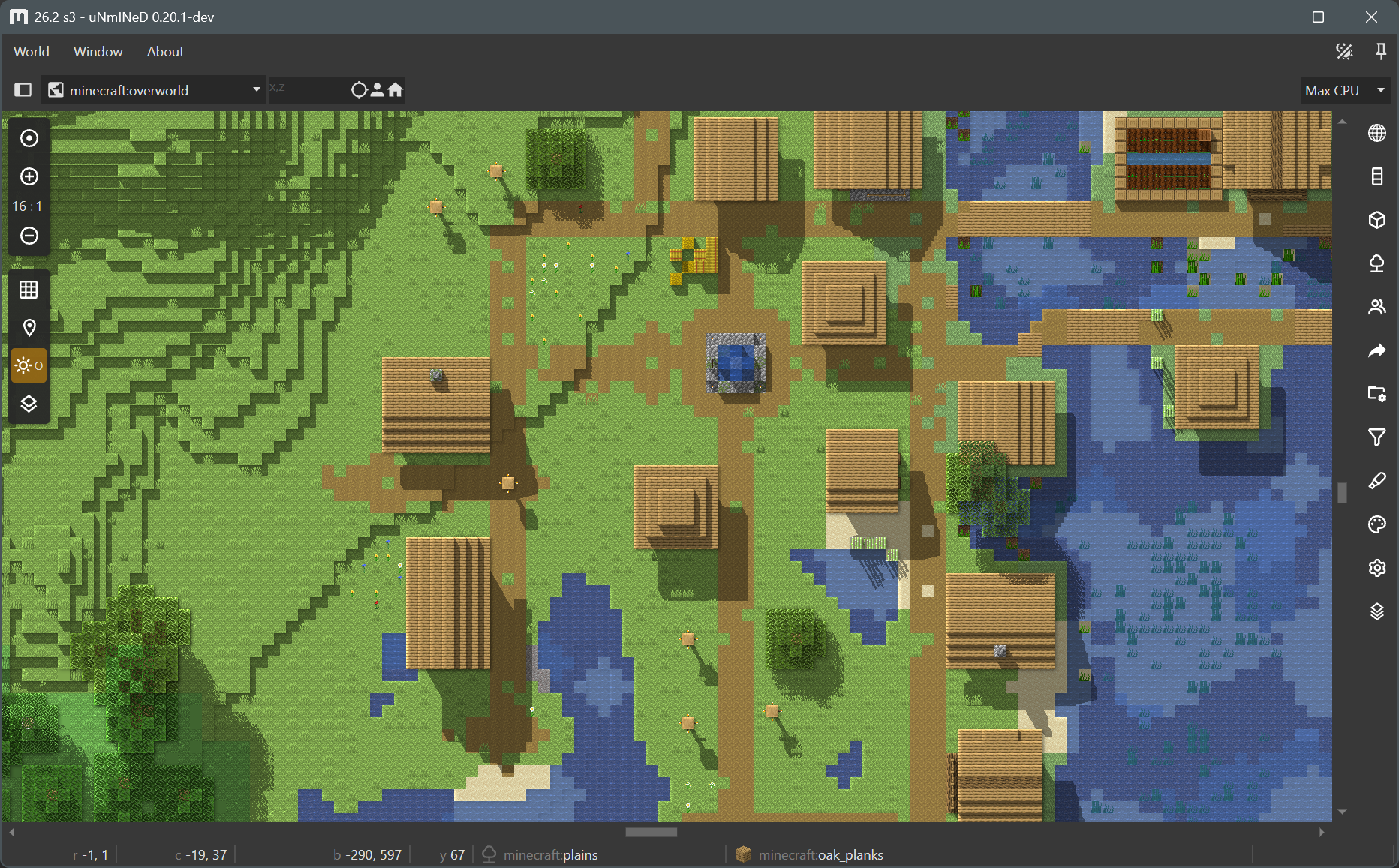
  • Added 2.5D top-down block model rendering mode (feature preview)
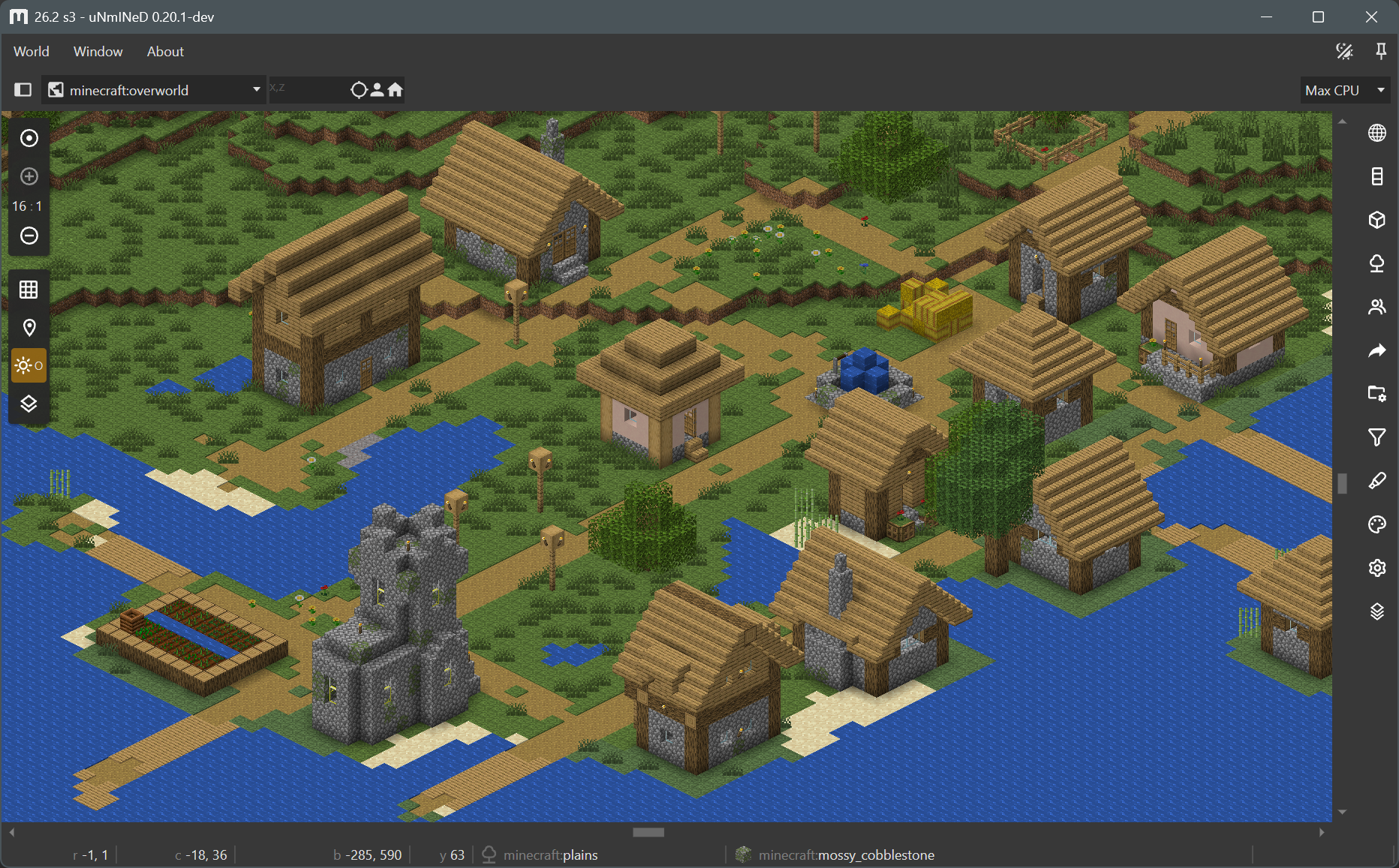
  • Added isometric rendering mode (feature preview)
  • Added support for the new chunk NBT format introduced in 26.3-snapshot-7.
  • Added support for region files with LZ4 compression (JE 1.20.5+).
  • Added 3D block model preview to the block list and the status bar
  • Optimized/fixed Bedrock LevelDB loader (100x speed and 100x less memory usage with large log files)
  • Improved Hytale installation and save folder detection on Windows
  • Fixed a lot of datapack and resource pack related issues
  • Updated Avalonia UI to 12.1.1. Many thanks to the Avalonia Team for granting me the community license.

Block model handling

uNmINeD now can read and use 3D block models from Java Edition client JARs and datapacks, and render them in 2.5D top-down and isometric views.

Bedrock Edition does not have 3D block models available for external tools, so uNmINeD uses Java block models to render Bedrock blocks. You will need a Java client JAR file to make this work. You can download it even if you do not have Java Edition, the original Mojang download links are available on GitHub, scroll right to see the client JARs.

Assigning Java block models to Bedrock blocks is controlled by config/bedrockmapping.json. The content of this file is largely based on information extracted from the Chunker project.

Bedrock fences, stairs, glass panes and other connecting blocks may render incorrectly if you have a version older than 1.26.40, because the required information is not present in the world save files.

Block model rendering mode

🚧This is a preview of a new feature under development.

uNmINeD now can render 3D block models to draw blocks instead of using single colors.

  • It works at 4:1 or higher zoom-in levels
  • It works with shadows
  • It works with image and web export
  • It does not need a GPU (uses only CPU)
  • It requires a Java Edition client JAR file even if you use it with Bedrock worlds.

Use the --blockrender=true command line parameter to enable block model rendering in the CLI.

Isometric rendering mode

🚧This is a preview of a new feature under development.

uNmINeD now can render an β€œisometric” (axonometric) 3D map.

  • It only works at 16:1 zoom-in level (other zoom levels coming soon)
  • It has multiple view angles
  • Image and web export not yet available
  • It does not need a GPU (uses only CPU)
  • It is only available in the GUI (CLI will come later)
  • Shadow rendering will come later
  • It requires a Java Edition client JAR file even if you use it with Bedrock worlds.

Notes and known issues

Block model rendering is a new feature under development. There are a lot of bugs, glitches and unfinished stuff. The code is not yet optimized for speed, upcoming releases will be faster.

Some of the most visible known problems:

  • Some 3D block models are not rendered correctly or not visible at all
  • Waterlogged blocks are rendered as dry
  • Custom (modded) Bedrock blocks are not rendered at all
  • Ambient occlusion shading in isometric mode does not work at chunk borders
  • Blocks do not cast shadow on themselves
  • Terrain elevation shading is applied incorrectly
  • Water settings are ignored
  • Water transparency is not supported in isometric mode
  •  

v4.3.2

Features

  • Added a one-click Jean Server template with configurable tokens and allowed origins (#11248).

Fixes

  • Allowed long-running backups and scheduled tasks to honor their configured SSH timeouts, including S3 uploads (#11183, closed #8435).
  • Restored built-in Coolify database backups and other scheduled jobs whose legacy records used ID 0 (#11249, closed #10623).
  • Corrected application and database container memory charts to display megabytes instead of raw bytes (#11247, closed #11246).
  • Replaced deprecated Docker stop flags with version-aware options for older and newer Docker engines (#11251, closed #11244).
  • Made upgrades wait for the restarted instance and target version before reporting success, including upgrades from older releases.
  • Stopped suggesting unconfigured www counterpart domains and corrected domain guidance and mobile domain visibility.
  • Prevented nested controls in new-resource cards from accidentally triggering deployment.

Improvements

  • Unified application, service, database, and server headings with responsive action menus.
  • Made resource, environment, and new-resource cards fully clickable, and displayed domains in resource grids (#11231, #11227).
  • Improved API token input and empty states (#11226, #11224).
  • Clarified health check wording (#11232).
  • Reduced layout shifts and added smoother notification event selector transitions.

What's Changed

Full Changelog: v4.3.1...v4.3.2

  •  

PostgreSQL 18.6, 17.11, 16.15, 15.19, 14.24 and 19 Beta 3 Released!

The PostgreSQL Global Development Group has released an update to all supported versions of PostgreSQL, including 18.6, 17.11, 16.15, 15.19, and 14.24, as well as the third beta release of PostgreSQL 19. This release fixes 28 security vulnerabilities and over 110 bugs reported over the last several months.

This release skips PostgreSQL 18 versions from PostgreSQL 18.4 to 18.6. 18.5 was not shipped due to a regression.

There are three issues that may require you to take extra steps after updating, which are described in detail below. These issues are related to:

For the full list of changes, please review the release notes.

PostgreSQL 14 EOL Notice

PostgreSQL 14 will stop receiving fixes on November 12, 2026. If you are running PostgreSQL 14 in a production environment, we suggest that you make plans to upgrade to a newer, supported version of PostgreSQL. Please see our versioning policy for more information.

Security Issues

The following security vulnerabilities are closed across in this update release. You can find more details about the vulnerabilities and their affected versions in the links below:

  • CVE-2026-6464: psql COPY FROM STDIN early failure processes data lines as psql commands (CVSS v3.1: 8.1)
  • CVE-2026-6469: ALTER TABLE ALTER TYPE resets extended statistics ownership (CVSS v3.1: 3.8)
  • CVE-2026-6470: Fails to check type USAGE privilege (CVSS v3.1: 4.3)
  • CVE-2026-6471: Logical decoding can dlopen arbitrary file (CVSS v3.1: 7.2)
  • CVE-2026-14662: tsvector and tsquery undersize allocations, via integer wraparound (CVSS v3.1: 8.8)
  • CVE-2026-14663: pgcrypto, for OpenSSL-disabled ciphers, silently encrypts to and decrypts from cleartext (CVSS v3.1: 6.5)
  • CVE-2026-14664: Regexp heap buffer overflow executes arbitrary code (CVSS v3.1: 8.8)
  • CVE-2026-14666: Row security caching disregards role modifications (CVSS v3.1: 4.2)
  • CVE-2026-14668: ctid type confusion in selectivity estimator discloses derivative of arbitrary read (CVSS v3.1: 8.1)
  • CVE-2026-14669: to_char heap buffer overflow executes arbitrary code (CVSS v3.1: 8.8)
  • CVE-2026-14670: plperl tied object heap buffer overflow executes arbitrary code (CVSS v3.1: 8.8)
  • CVE-2026-14671: refint plan cache type confusion executes arbitrary code (CVSS v3.1: 8.8)
  • CVE-2026-14672: Observable response discrepancy with non-default scram_iterations provides user existence oracle (CVSS v3.1: 5.3)
  • CVE-2026-14673: amcheck does not clear untrusted search path (CVSS v3.1: 3.8)
  • CVE-2026-14676: pg_stat_statements heap buffer overflow executes arbitrary code (CVSS v3.1: 8.8)
  • CVE-2026-14677: 32-bit pltcl and plperl undersize allocations, via integer wraparound (CVSS v3.1: 8.8)
  • CVE-2026-14678: pg_trgm picksplit reads past end of buffer (CVSS v3.1: 4.3)
  • CVE-2026-14679: Stack buffer overflow in argument match writes 0x0 and 0x1 to server memory (CVSS v3.1: 8.2)
  • CVE-2026-14680: Type confusion via "internal" arguments (CVSS v3.1: 8.8)
  • CVE-2026-14681: Improper enforcement of GSSAPI encryption when coupled with SSL (CVSS v3.1: 4.2)
  • CVE-2026-15741: Expression deparse allows SQL injection via EXTRACT argument (CVSS v3.1: 8.8)
  • CVE-2026-15742: fuzzystrmatch writes effectively-arbitrary addresses, via integer wraparound (CVSS v3.1: 8.8)
  • CVE-2026-16238: Type confusion in pg_restore_attribute_stats() executes arbitrary code (CVSS v3.1: 8.8)
  • CVE-2026-16239: Type confusion in cursor CLOSE + DECLARE executes arbitrary code (CVSS v3.1: 8.8)
  • CVE-2026-16241: ECPG integer underflow can crash the client (CVSS v3.1: 3.8)
  • CVE-2026-18024: ascii() function reads past end of buffer (CVSS v3.1: 4.3)
  • CVE-2026-18408: psql \unrestrict lets superuser of pg_dump origin server execute arbitrary code in psql client (CVSS v3.1: 8.8)
  • CVE-2026-19385: pg_dump heap buffer overflow executes arbitrary code (CVSS v3.1: 8.8)

Bug Fixes and Improvements

This update fixes over 110 bugs that were reported in the last several months.

This specific issue only affects PostgreSQL 14, 15, and 16, but we're highlighting it in the release announcement due to its severity:

  • Fix a self-deadlock that could occur while replaying WAL generated by an older minor version. This regression, introduced in the previous set of minor releases, could cause a standby server following a primary running an older minor version to become stuck.

The remainder of issues listed below affect PostgreSQL 18. Many of these issues also affect other supported versions of PostgreSQL.

  • Fix parallel GIN index builds to correctly update the table's reltuples value in pg_class. Previously, a parallel worker could report an uninitialized row count, leaving reltuples set to a bogus value (including Infinity or NaN). Such a value can cause autovacuum and autoanalyze to not process the table, and this situation will not self-correct. If you have any tables with GIN indexes, we recommend checking that their reltuples values look reasonable after updating. See the "Updating" section for how to identify and repair affected tables.
  • Several fixes to btree_gist, including for NaN handling for float4/float8 that could give wrong answers for columns containing NaN and correct sorting of bit/bit varying values during index building. You may need to reindex btree_gist indexes on float or bit columns after updating. See the "Updating" section.
  • Fix an integer overflow in ltree comparisons. ltree values containing more than about 14,653 labels could compare incorrectly, which could present as a corrupt B-tree index. If you use ltree, you may need to reindex affected indexes after updating. See the "Updating" section.
  • Fix partition pruning for RANGE-partitioned tables so the DEFAULT partition is no longer skipped in cases where it should be scanned. Previously this could cause rows to be missing from query results.
  • Several fixes for partitioned tables that have foreign-table partitions, including when run-time partition pruning determined that some partitions don't need to be scanned, in-flight requests to foreign servers were not always handled correctly, leading to failures.
  • Several fixes to RETURNING with OLD and NEW.
  • Improve hash join performance when there are multiple join keys and many NULL values.
  • Several fixes to the planner that could produce wrong query results, including value IN (array) tests where the array might be empty, and COUNT() window functions that use an EXCLUDE clause or lack ORDER BY.
  • Add missing checks for the hashability of equality comparisons on container types (arrays, composite types, and ranges). Without these checks, the planner could choose a hash-based plan that then failed at execution with a "could not identify a hash function" error.
  • Fix attaching partitions of indexes that are exclusion constraints, which also fixes dump/restore of partitioned exclusion constraints.
  • Fix REINDEX CONCURRENTLY on an index backing a deferred uniqueness constraint, which could cause false constraint-violation reports.
  • Restore an index-scan optimization that converts a LIKE or regular-expression exact-match pattern into an equality index condition when the index and expression collations differ.
  • Several fixes to jsonpath, including that the @? and @@ operators now correctly raise an error for an undefined variable in the path expression. Previously, because these operators cannot supply variable values, an undefined variable was treated as a JSON null rather than an error, which could also lead to unbounded memory consumption.
  • Ensure access is blocked to other sessions' temporary tables, which could lead to silently incorrect results.
  • Fix "no empty local buffer available" errors during temporary table access when a large effective_io_concurrency setting could allow a single read stream to consume all local buffers.
  • Prevent autovacuum from processing databases in the wrong order (lowest-priority first instead of highest).
  • Restore VACUUM's wraparound failsafe mode to use the full shared buffer pool as intended, which had slowed down emergency vacuuming.
  • Fix possible incorrect decoding of index tuples during GiST and SP-GiST index-only scans, which could emit corrupted data.
  • Fix a race condition in conflict detection under SERIALIZABLE isolation. A conflict could be missed when examining an initially-empty btree index, allowing conflicting transactions to commit and breaking serializability.
  • Fix WAL logging of operations that clear bits in table visibility maps. This could lead to producing incorrect incremental backups or potentially leaving torn-page writes uncorrected.
  • Fix logical decoding of empty prepared transactions. A prepared transaction with no decodable changes could send COMMIT PREPARED or ROLLBACK PREPARED to the output plugin with no preceding PREPARE, which breaks replication for the built-in subscriber.
  • Several fixes to libpq, including ensuring it drains all pending bytes from the SSL or GSS decryption buffer when reading data, avoiding cases where a client waits for data that has already arrived.
  • Fix pg_createsubscriber to clean up objects left on a publisher after failure, including a replication slot.
  • Fix pg_restore with --statistics or --statistics-only so that, when combined with other selective-restore options such as --schema, it restores the expected items, matching the behavior of pg_dump.

This release also updates time zone data files to tzdata release 2026c, in which Alberta (America/Edmonton) will be on year-round UTC-06 (effectively, permanent DST) beginning in November 2026. This release assumes that their TZ abbreviation will be CST from that time forward (though this could change). It also reflects that Morocco (Africa/Casablanca) will move to permanent UTC+00, without daylight saving transitions, on September 20, 2026.

Updating

All PostgreSQL update releases are cumulative. As with other minor releases, users are not required to dump and reload their database or use pg_upgrade in order to apply this update release; you may simply stop PostgreSQL and update its binaries.

If you have any tables with GIN indexes, we recommend checking their reltuples values after updating. A prior bug in parallel GIN index builds could have left reltuples set to a bogus value (including Infinity or NaN) that prevents autovacuum and autoanalyze from ever processing the table. The following query lists the tables that have a GIN index, along with their current reltuples:

SELECT DISTINCT t.oid::regclass, t.reltuples FROM pg_class t JOIN pg_index i ON t.oid = i.indrelid JOIN pg_class ic ON i.indexrelid = ic.oid WHERE t.relhasindex AND ic.relam = 2742;

For any table whose reltuples value looks incorrect, run ANALYZE on it (or create another index) to reset the value.

If you use btree_gist, you should reindex btree_gist indexes on float4 or float8 columns that might contain NaN values, as well as btree_gist indexes on bit or bit varying columns, for example:

REINDEX INDEX your_index_name;

If you use ltree and have btree indexes over ltree values with very many labels (more than about 14,653), you should reindex those indexes, since they may be corrupt, for example:

REINDEX INDEX your_index_name;

Users who have skipped one or more update releases may need to run additional post-update steps; please see the release notes from earlier versions for details.

For more details, please see the release notes.

A Note on the PostgreSQL 19 Beta

This release marks the third beta release of PostgreSQL 19.

In the spirit of the open source PostgreSQL community, we strongly encourage you to test the new features of PostgreSQL 19 on your systems to help us eliminate bugs and other issues. While we do not advise you to run PostgreSQL 19 Beta 3 in production environments, we encourage you to find ways to run your typical application workloads against this beta release.

Your testing and feedback helps the community ensure that PostgreSQL 19 upholds our standards of delivering a stable, reliable release of the world's most advanced open source relational database. Please read more about our beta testing process and how you can contribute:

https://www.postgresql.org/developer/beta/

Upgrading to PostgreSQL 19 Beta 3

To upgrade to PostgreSQL 19 Beta 3 from an earlier version of PostgreSQL, you will need to use a strategy similar to upgrading between major versions of PostgreSQL (e.g. pg_upgrade or pg_dump / pg_restore). For more information, please visit the documentation section on upgrading.

Changes Since Beta 2

Fixes and changes in PostgreSQL 19 Beta 3 include:

  • Revert GROUP BY ALL.
  • Several fixes for the new FOR PORTION OF temporal table syntax.
  • Several fixes for the new logical replication sequence synchronization feature, including a race involving REFRESH SEQUENCES.
  • Fix an "unexpected logical decoding status change" error that could occur when logical decoding is activated concurrently.
  • Fix issues around ownership changes for subscriptions.
  • Fix wrong query results from postgres_fdw when pushing down an array comparison such as field = ANY($1) that involves an implicit type coercion.
  • Fix a crash during foreign-key checks involving a nullable UNIQUE constraint.
  • Fix pg_plan_advice parsing of underscores in numeric literals.
  • Fix a missing FORMAT clause when deparsing JSON_ARRAY(query).

Please see the release notes for a complete list of new and changed features:

https://www.postgresql.org/docs/19/release-19.html

Testing for Bugs & Compatibility

The stability of each PostgreSQL release greatly depends on you, the community, to test the upcoming version with your workloads and testing tools to find bugs and regressions before the general availability of PostgreSQL 19. As this is a Beta, minor changes to database behaviors, feature details, and APIs are still possible. Your feedback and testing will help determine the final tweaks on the new features, so please test in the near future. The quality of user testing helps determine when we can make a final release.

A list of open issues is publicly available in the PostgreSQL wiki. You can report bugs using this form on the PostgreSQL website:

https://www.postgresql.org/account/submitbug/

Links

If you have corrections or suggestions for this release announcement, please send them to the pgsql-www@lists.postgresql.org public mailing list.

  •  

v4.3.1

Coolify v4.3.1

Features

  • Added persistent β€œChanges pending” warnings to the desktop and mobile navigation bars, including change counts and direct access to configuration differences.

Fixes

  • Ensured HTTP Basic Auth updates made through the Applications API regenerated managed deployment labels while preserving custom labels (#11196, closed #11191).
  • Fixed a 500 error on volume backup pages when database backup execution logs were present (#11210).
  • Removed duplicate borders from CPU and memory metrics tooltips (#11213, closed #11212).
  • Repaired environment and project settings page headers (#11204).
  • Corrected the German password-reset email translation (#9680).
  • Updated error pages to use the correct Coolify-branded background glow.

Improvements

  • Redesigned terminal target selection and improved filtering and mobile controls (#11203).

What's Changed

  • fix(release): preserve tags when publishing draft releases by @andrasbacsai in #11199
  • feat(workflows): add pull request branch management workflow by @ShadowArcanist in #11193
  • fix(lang): correct german translation for password reset email by @EchterTimo in #9680
  • fix(ui): remove duplicate metrics tooltip border by @nexmoe in #11213
  • fix(models): add datetime cast for finished_at in ScheduledDatabaseBackupExecution by @ejscheepers in #11210
  • fix(ui): environment settings broken header & project settings header by @yk-sgr in #11204
  • fix(ui): terminal page design by @yk-sgr in #11203
  • fix(api): regenerate basic auth labels after updates by @drewmt in #11196

New Contributors

Full Changelog: v4.3.0...v4.3.1

  •  

Minecraft 26.3-snapshot-8 (snapshot) Released

26.3 Snapshot 8 (known as 26.3-snapshot-8 in the launcher) is the eighth snapshot for Java Edition 26.3, released on August 12, 2026, which adds invite codes for Realms, renames a few explorer maps, and fixes bugs. Full changelog: https://minecraft.wiki/Java_Edition_26.3-snapshot-8
  •  

v4.3.0

Let us know what you think about the new UI here: #11195

Breaking Changes

  • Team members with the Member role became read-only. They could still view team resources and configuration, but could no longer create, update, delete, deploy, start, stop, or otherwise modify resources. Review team roles and promote users who still require write access (v4.2.0).
  • State-changing API endpoints began requiring POST; legacy GET requests now return 405 Method Not Allowed. This affected /enable, /disable, /deploy, server validation, application/database/service lifecycle actions, and service-application lifecycle actions (v4.2.0).
  • Changed proxy router names for Compose services containing dots or hyphens to use a stable suffix; custom references to previous router names must be updated (#11040).
  • Removed confirmation dialogs for deploy, redeploy, and force-deploy actions; these actions began immediately when selected (#11023).

Features

  • Added a redesigned interface with clearer navigation, improved domain management, DNS checks, and automatic Cloudflare DNS setup (#11119).
  • Added scheduled backups for persistent volumes and directory mounts, with local or S3-compatible storage, retention controls, on-demand runs, history, and API management (#10946, closed #7701).
  • Added per-domain search engine indexing controls (#10908).
  • Added support for deploying private repositories from self-hosted GitLab instances (#10538).
  • Added diagnostics and deployment controls to the Coolify MCP server (#11000).
  • Added profile pictures backed by local or S3-compatible storage.
  • Added Buzz, Celld, InfluxDB, Stalwart, and Termix one-click services (#11020, #11155, #11103, #10984, #11090).
  • Added an early development preview of the next-generation infrastructure experience (#10987).
  • Added team-member two-factor authentication status to the team view (#11192).

Fixes

  • Fixed S3 storage connections on servers without IPv6 (#11061, closed #11059).
  • Fixed backup uploads to S3 endpoints that also resolved to IPv6 (#11028).
  • Fixed Compose domains and environment variables for service names containing dots or hyphens (#11040, closed #10658).
  • Fixed application duplication, rollback image handling, and protection of sensitive API settings (#11003).
  • Fixed errors after deleting GitHub or GitLab source apps (#11105).
  • Fixed clearing all resource domains so it no longer caused a type error (#11083, closed #11030 and #11079).
  • Fixed www redirects for applications using Traefik.
  • Fixed Firefly III health checks (#10475).
  • Fixed the top bar appearing beneath open service action menus (#11197).

Improvements

  • Simplified new-resource creation with clearer choices and updated icons (#11140).
  • Improved dashboard metrics, status visibility, global search, mobile layouts, accessibility, and theme customization.
  • Combined database and storage backup schedules into one easier-to-manage page.
  • Shared the service template catalog across app nodes and made template downloads more reliable (#11094).
  • Reduced LiteLLM's default resource usage (#10698).
  • Updated SparkyFitness, OpnForm, and Forgejo service templates (#9927, #10600, #10639).
  • Updated Traefik security patch versions and added Traefik 3.7 support (#11029).
  • Updated Cloudflare Tunnel to address two critical security vulnerabilities (#11145).

What's Changed

New Contributors

Full Changelog: v4.2.0...v4.3.0

  •  

v0.16.17

[0.16.17] - 2026-08-10

If you are upgrading from v0.16.x, replace the binary (or run docker pull). If you are upgrading from v0.15.x and below, please read the upgrading documentation for more information on how to upgrade from previous versions.

Added

  • IMAP:
  • WebDAV: Range and If-Range header support on file downloads (RFC 7233) (#2377).
  • Spam filter: url_original expression variable for Url rules.

Changed

  • Memory allocator: Replaced the unmaintained jemallocator crate with tikv-jemallocator (contributed by @checkraisefold).
  • ACME registry: Use description as label property.

Fixed

  • MTA:
    • Certificates for domains publishing an enforcing MTA-STS policy are always validated, even in the fallback TLS strategy.
    • DSN delivery date uses wrong timestamp.
    • FUTURERELEASE HOLDUNTIL uses Unix timestamps instead of RFC 3339 date-times.
  • JMAP:
    • EmailSubmission/query filtering on undoStatus contradicts EmailSubmission/get, reporting held FUTURERELEASE submissions as final instead of pending.
    • EmailSubmission/get requests without an ids argument iterates the wrong index.
  • CardDAV: Accept: text/vcard version negotiation is ignored whenever another parameter such as q or charset follows version=.
  • Calendar: Server-side scheduling messages place the text/calendar part outside the multipart/alternative and disposed as an attachment.
  • Sharing: Accounts holding the impersonate permission never have their ACL grants collected, so shared items are never listed in JMAP sessions, CalDAV/CardDAV discovery or IMAP.
  • IMAP:
    • COPY/MOVE into a shared folder fails with NO [ALREADYEXISTS] when the destination account already holds the message, leaving the message in the source mailbox and clients in a retry loop.
    • BODYSTRUCTURE and ENVELOPE return MIME parameters, Content-Description, subjects and display names as raw UTF-8 even to sessions that never enabled UTF8=ACCEPT.

Check binary attestation here

  •  

Postfix stable release 3.11.6 and legacy releases 3.10.13, 3.9.14, 3.8.20, 3.7.22, 3.6.20, 3.5.27

Postfix stable release 3.11.6 and legacy releases 3.10.13, 3.9.14, 3.8.20, 3.7.22, 3.6.20, 3.5.27

[An on-line version of this announcement will be available at https://www.postfix.org/announcements/postfix-3.11.6.html]

This release addresses medium-impact problems that need to be fixed as some enable remote DOS or policy bypass.

The fixes below, and more, are also released in the unstable version postfix-3.12-20260809.

In addition to updated releases for the supported Postfix versions 3.8-3.11, releases will also be available for the out-of-support Postfix versions 3.5-3.7. NOTE: these do not include the patches for out-of-support Postfix versions that have been issued for "large SMTP inputs (June 2026)", "TLSA parsing (June 2026)", and "SMTP smuggling fixes". Those patches still need to be applied.

These defects were found by Qualys assisted by Claude Mythos Preview, and by OpenAI Security; more than half date from 20 or more years ago. When I implemented Postfix, I knew that there were going to be mistakes. That is the reason why Postfix has its architecture and safety nets. The number of defects may seem large, but considering that they were found in a code base of over 150 thousand lines, the error rate is still lower than what I designed for.

Policy bypass:

  • Bug (introduced: Postfix 2.2, date: 20041102): missing SMTP server resets of MAIL FROM and RCPT TO command state after smtpd_end_of_data_restrictions rejected a message. This resulted in SMTP protocol state desynchronization between the remote SMTP client and the Postfix SMTP server.

    A crafted remote SMTP client could then send RCPT TO and DATA without MAIL FROM, and deliver a second message. Then, smtpd_end_of_data_restrictions skipped check_recipient_access constraints, because a recipient counter was > 1. Reported by OpenAI Security. File: smtpd/smtpd.c.

    As reported by OpenAI Security, the failure to reset MAIL FROM and RCPT TO state also affected Milter support (added in Postfix 2.3). Here, after a Milter replied with "accept this message" based on the message envelope, and smtpd_end_of_data_restrictions rejected the message, the Postfix SMTP server as before accepted RCPT TO and DATA without MAIL FROM, and smtpd_end_of_data_restrictions as before skipped check_recipient_access constraints for the second message. Under these conditions, the Postfix Milter client remained in the "accept this message" state, skipping Milter policy enforcement for the second message.

Denial of service:

  • Bug (defect introduced: Postfix 3.4, date: 20180805): SMTP server command history memory exhaustion with a large number of very small BDAT requests. Reported by OpenAI security. File: smtpd.c.

  • Bug (defect introduced: Postfix 1.1, date: 20021116): address verification cache poisoning. A local user could use the postdrop command to submit an address verification probe with envelope or message content that Postfix rejected later, resulting in a negative address verification cache entry for that address. On systems that enable address verification, the negative address verification cache entry would force the Postfix SMTP server to reject a message that it should accept (denial of service). Problem reported by OpenAI Security. File: postdrop.c.

Server crashes and panic()s:

  • Bug (defect introduced: Postfix 3.4, date: 20180805): missing SMTP server reset of RCPT TO state, after a BDAT command error. A crafted remote SMTP client could then send a DATA command without MAIL FROM or RCPT TO, and crash a Postfix SMTP daemon process with a null pointer read error. Reported by OpenAI Security. File: smtpd/smtpd.c.

  • Bug (defect introduced: Postfix 2.4, date: 20051222): null pointer read crash while parsing a malformed Dovecot AUTH server response. Reported by Qualys, assisted by Claude Mythos Preview. File: xsasl_dovecot_server.c.

Read after free, uninitialized read, under/over read:

  • Bug (defect introduced: Postfix 2.8, date: 20100914): read-after-free in the PSC_CALL_BACK_NOTIFY() macro. This had no effect on program execution, because myfree() wiped memory, and that memory was not yet reused. Problem reported by Qualys, assisted by Claude Mythos Preview. File: postscreen_dnsbl.c.

  • Read after free (no privilege escalation) in debug logging (defect introduced: Postfix 2.2, date: 20050117). Reported by Qualys, assisted by Claude Mythos Preview. File: util/inet_connect.c.

  • Bug (defect introduced: Postfix 2.10, date: 20120617): uninitialized memory read in postscreen HaProxy client after remote I/O exception, causing garbage to be logged. Reported by Qualys, assisted by Claude Mythos Preview. File: postscreen_haproxy.c.

  • Latent bug (defect introduced: Postfix 2.7, date: 20090618): uninitialized memory read after dnsblog(8) returns a string that is not an IPv4 address. Reported by Qualys, assisted by Claude Mythos Preview. File: postscreen_dnsbl.c.

  • Bug (defect introduced: before Postfix alpha, date 19970424): the DNS client could read up to two bytes past the end of an MX record, before discovering that the record was too short. This behavior was later copied with SRV records, potentially over-reading up to six bytes. Problem reported by Qualys, assisted by Claude Mythos Preview. File: dns_lookup.c.

  • Bug (defect introduced: Postfix 1,1, date: 20010524): the postsuper command under-read or over-read a very short queue filename. No crash, information leak, or privilege escalation. Reported by Qualys, assisted by Claude Mythos Preview. Files: postsuper.c, mail_queue.h.

Other code hygiene:

  • Bug (defect introduced: before Postfix alpha, date: 19971106): 'int' over-shift, in the queue file record-length parser. Postfix programs do not generate such records, but an attacker could cause postdrop to reject input or panic(). Reported by Qualys, assisted by Claude Mythos Preview. File: record.c.

  • Bug (defect introduced: Postfix 2.2, date: 20050117): non-transitive comparison of IPv4 addresses. Reported by Qualys, assisted by Claude Mythos Preview. File: sock_addr.c.

  • Bug (defect introduced: Postfix 1.0, date: 20000928): the fast flush server, used by the SMTP command "ETRN", and by the commands "postqueue -s site" and "postqueue -i queue_id" (and their sendmail(1) equivalents), used the wrong duplicate suppression API, resulting in unnecessary queue scans by the queue manager. Reported by Qualys, assisted by Claude Mythos Preview. File: flush.c.

  • Queue hygiene: the postdrop command accepted the null record type which the rest of Postfix ignores. Reported by OpenAI Security. File: postdrop.c.

You can find the updated Postfix source code at the mirrors listed at https://www.postfix.org/.

  •  

Certified Asterisk Release certified-22.8-cert4

The Asterisk Development Team would like to announce
the release of Certified asterisk-22.8-cert4.

The release artifacts are available for immediate download at
https://github.com/asterisk/asterisk/releases/tag/certified-22.8-cert4
and
https://downloads.asterisk.org/pub/telephony/certified-asterisk

Repository: https://github.com/asterisk/asterisk
Tag: certified-22.8-cert4

This release resolves issues reported by the community
and would have not been possible without your participation.

Thank You!

Change Log for Release asterisk-certified-22.8-cert4

Links:

Summary:

  • Commits: 13
  • Commit Authors: 6
  • Issues Resolved: 8
  • Security Advisories Resolved: 0

  •  

Asterisk Release 23.5.0-rc1

The Asterisk Development Team would like to announce
release candidate 1 of asterisk-23.5.0.

The release artifacts are available for immediate download at
https://github.com/asterisk/asterisk/releases/tag/23.5.0-rc1
and
https://downloads.asterisk.org/pub/telephony/asterisk

Repository: https://github.com/asterisk/asterisk
Tag: 23.5.0-rc1

This release resolves issues reported by the community
and would have not been possible without your participation.

Thank You!

Change Log for Release asterisk-23.5.0-rc1

Links:

Summary:

  • Commits: 38
  • Commit Authors: 16
  • Issues Resolved: 27
  • Security Advisories Resolved: 0

  •  

Asterisk Release 22.11.0-rc1

The Asterisk Development Team would like to announce
release candidate 1 of asterisk-22.11.0.

The release artifacts are available for immediate download at
https://github.com/asterisk/asterisk/releases/tag/22.11.0-rc1
and
https://downloads.asterisk.org/pub/telephony/asterisk

Repository: https://github.com/asterisk/asterisk
Tag: 22.11.0-rc1

This release resolves issues reported by the community
and would have not been possible without your participation.

Thank You!

Change Log for Release asterisk-22.11.0-rc1

Links:

Summary:

  • Commits: 38
  • Commit Authors: 16
  • Issues Resolved: 27
  • Security Advisories Resolved: 0

  •  

Asterisk Release 20.21.0-rc1

The Asterisk Development Team would like to announce
release candidate 1 of asterisk-20.21.0.

The release artifacts are available for immediate download at
https://github.com/asterisk/asterisk/releases/tag/20.21.0-rc1
and
https://downloads.asterisk.org/pub/telephony/asterisk

Repository: https://github.com/asterisk/asterisk
Tag: 20.21.0-rc1

This release resolves issues reported by the community
and would have not been possible without your participation.

Thank You!

Change Log for Release asterisk-20.21.0-rc1

Links:

Summary:

  • Commits: 38
  • Commit Authors: 16
  • Issues Resolved: 27
  • Security Advisories Resolved: 0

  •  

Proxmox Virtual Environment launches official Arm64 Support

  • First official Arm64 release extends Proxmox VE beyond x86-64 architectures.
  • Features day-one validation for NVIDIA Graceβ„’ and NVIDIA Veraβ„’ CPU architectures.
  • Delivers complete feature parity across KVM, LXC, ZFS, and Ceph storage stacks.

VIENNA, Austria – August 05, 2026 –Enterprise software developer Proxmox Server Solutions GmbHΒ today announced the immediate availability of the first officially supported Arm64 edition of its flagship platform, Proxmox Virtual Environment. The release extends the open-source virtualization platform to Arm-based server systems, supporting enterprise demand for high-density, energy-efficient data center architectures.

Proxmox VE for Arm64 provides a unified platform to manage Arm64 virtual machines and Linux containers (LXC). Users benefit from the established web-based management interface, software-defined networking, storage, high-availability clustering, and backup capabilities of Proxmox VE on supported Arm64 hardware.

Systems based on the NVIDIA Grace and NVIDIA Vera CPU architectures are supported from the first official Arm64 release. These platforms target demanding data center, cloud, accelerated computing, and AI training and inference environments, expanding the infrastructure options available to organizations building modern and energy-efficient data centers.

Technical validation on NVIDIA Grace Hopperβ„’ systems

Developed in technical collaboration with NVIDIA and Supermicro, Proxmox engineers performed joint validation on NVIDIA Grace Hopperβ„’ Superchip server systems. This effort enabled rapid porting and thorough testing across the platform stack, which is already operating across select enterprise production environments.

Full feature parity for ZFS and Ceph

Built on Proxmox VE’s established Linux and KVM foundation, the Arm64 edition underwent architecture-wide validation. Key enterprise storage mainstays – including ZFS and Ceph – have been fully optimized to deliver exact performance, reliability, and feature parity with existing x86 deployments.

β€œAs data centers shift toward high-density, energy-efficient architectures, our customers require the exact same mission-critical stability on Arm64 that they have relied on with x86," said Tim Marx, COO at Proxmox Server Solutions. "Through our close engineering work with NVIDIA and Supermicro, we are ensuring that enterprises can scale their next-generation AI and cloud workloads with complete confidence in their underlying hypervisor."

β€œOur goal was not simply to run Proxmox VE on a new architecture, but to deliver full feature parity: KVM, networking, clustering, ZFS, and Ceph all behaving exactly as our users expect from our x86-64 builds,” said Thomas Lamprecht, CTO at Proxmox Server Solutions. β€œDeveloping directly on NVIDIA Grace Hopper systems let us validate that on production-class hardware from day one, and NVIDIA's upstream kernel work ensures the platform evolves alongside NVIDIA Grace and NVIDIA Vera.”

Availability

Proxmox Virtual Environment for Arm64 is open-source software and immediately available for download via bare-metal ISO images or package repositories alongside existing x86-64 builds.

For enterprise environments, Proxmox Server Solutions offers comprehensive support plans that provide stable and secure updates and direct access to expert support services. These support contracts offer a cost-effective way to secure enterprise-grade stability. Enterprise support for Arm64 deployments are available upon request.

Resources:

###

About Proxmox Virtual Environment
Powering over 2 million hosts globally, Proxmox Virtual Environment is a complete open-source platform for enterprise virtualization and hyper-converged infrastructure. It natively unifies KVM virtualization, LXC containers, software-defined storage, and networking on a single platform. Alongside its dedicated Backup Server and Datacenter Manager, the Proxmox ecosystem eliminates multi-site complexity as well as dependency on proprietary stacks. Backed by a global community of over 225,000 members, the platform serves as a scalable, cost-effective foundation for modern data centers.

About Proxmox Server Solutions
Proxmox Server Solutions provides powerful, intuitive open-source server software that guarantees vendor independence and minimizes total cost of ownership. Enterprises of all sizes rely on the company’s reliable vendor support, certified training services, and a global network of 3,000 integration partners to ensure business continuity. Established in 2005 and headquartered in Vienna, Austria, tens of thousands of corporate customers worldwide trust Proxmox solutions to secure their mission-critical IT environments.

Contact:Β Daniela HΓ€sler, Proxmox Server Solutions GmbH, press@proxmox.com

  •  

v1.20.0

New major features

General

  • support forwarding streams natively (#5558) It is now possible to define forward destinations for each path configuration. For each destination, the server will create a client that will forward the stream to the intended destination. Supported protocols are RTSP, RTMP, SRT. API and metrics have also been improved to allow monitoring the new forwarding system. Documentation: https://mediamtx.org/docs/features/forward

Media-Over-QUIC

  • support publishing and reading through native QUIC (#6039)
  • support draft-17 (#6040)
  • support draft-16 (#6045)

Fixes and improvements

General

  • docs: add missing MoQ ports (#5983)
  • Add OpenAPI definition of the Playback server (#5546)
  • fix support for regexp groups greater than 10 (#6033)

Media-Over-QUIC

  • increase max namespace field count to 32 (#6043)
  • link primitives to draft-17 sections (#6044)

RTSP

  • fix inability to read some AV1 streams with RTSP (#6001) (#6006) Since v1.16.0, temporal unit delimiters were not stripped from AV1 streams anymore. This has been restored, healing AV1 streams read with RTSP.
  • log write errors (#6023)
  • make multicast errors on single interfaces non-fatal (bluenviron/gortsplib#1115) (#5574) When writing multicast packets to several interfaces at one, a write error to a single interface was fatal and prevented writing to the other ones. Fix this.

RTMP

  • server: fix parsing URL from multitrack OBS (#6007) (bluenviron/gortmplib#93)
  • client: change mapping between URL and tcURL, app, streamKey (bluenviron/gortmplib#94) (#4676) URLs passed to clients are now mapped into RTMP-native fields (tcURL, app, streamKey) in this way: tcURL contains URL without credentials and without fragment, app contains path and query of tcURL, streamKey contains the fragment.
  • client: fix compatibility with YouTube (#5558) (bluenviron/gortmplib#95)

HLS

WebRTC

  • sort tracks in a deterministic way (#5988) (#5989) When ingesting tracks with WebRTC, track order was randomized, preventing multi-track always-available streams from working reliably, since they require tracks to be ordered in a precise way. WebRTC tracks are not ordered by MID, RID, trackID and streamID respectively.
  • fix packet corruption when reading G722 (#6000)
  • reset recomputed audio PTS if it drifts too much (#6021)
  • fix "packet lost" error when routing streams from WebRTC (#6034) Chrome sometimes sends empty packets, that are discarded by the server, but the sequence number of following packets is not recomputed, leading downstream packet loss detectors to emit errors. This is fixed.

SRT

  • improve log clarity (#5990) use message 'passphrase not provided by client' when clients do not provide passphrases.
  • show stream ID in logs (#6018)
  • close sources immediately when path is closed (#6038)

Dependencies

  • code.cloudfoundry.org/bytefmt updated from v0.82.0 to v0.83.0
  • github.com/MicahParks/jwkset updated from v0.11.0 to v0.11.3
  • github.com/MicahParks/keyfunc/v3 updated from v3.8.0 to v3.8.1
  • github.com/bluenviron/gohlslib/v2 updated from v2.4.1 to v2.4.2
  • github.com/bluenviron/gortmplib updated from v0.4.1 to v1.0.0
  • github.com/bluenviron/gortsplib/v5 updated from v5.6.2 to v5.6.3
  • github.com/go-git/go-billy/v5 updated from v5.9.0 to v5.9.1
  • github.com/go-git/go-git/v5 updated from v5.19.1 to v5.19.2
  • github.com/pion/ice/v4 updated from v4.3.0 to v4.4.0
  • github.com/pion/interceptor updated from v0.1.46 to v0.1.47
  • github.com/pion/webrtc/v4 updated from v4.2.17 to v4.2.18
  • github.com/quic-go/quic-go updated from v0.60.0 to v0.61.0
  • github.com/quic-go/webtransport-go updated from v0.11.1 to v0.12.0
  • github.com/pion/sctp updated from v1.11.0 to v1.11.1
  • golang.org/x/time updated from v0.14.0 to v0.15.0

Security

Binaries are compiled from source code by the Release workflow, which is a fully-visible process that prevents any change or external interference in produced artifacts.

Checksums of binaries are also published in a public blockchain by using GitHub Attestations, and they can be verified by running:

ls mediamtx_* | xargs -L1 gh attestation verify --repo bluenviron/mediamtx

You can verify checksums of binaries by downloading checksums.sha256 and running:

cat checksums.sha256 | grep "$(ls mediamtx_*)" | sha256sum --check

  •  

Minecraft 26.3-snapshot-7 (snapshot) Released

26.3 Snapshot 7 (known as 26.3-snapshot-7 in the launcher) is the seventh snapshot for Java Edition 26.3, released on August 4, 2026, which adds concrete stairs and slabs in 16 colors and new explorer maps for various structures; it also updates the texture of maps and the loot of abandoned camps, and turns explorer maps into unique items. Full changelog: https://minecraft.wiki/Java_Edition_26.3-snapshot-7
  •  

v0.16.16

[0.16.16] - 2026-08-02

If you are upgrading from v0.16.x, replace the binary (or run docker pull). If you are upgrading from v0.15.x and below, please read the upgrading documentation for more information on how to upgrade from previous versions.

Added

  • JMAP Email Delivery Push Notifications (draft-ietf-jmap-emailpush-03)
  • MTA: Allow System Sieve scripts to access orcpt during the DATA stage.

Changed

  • S3: accessKey can now be read from an environment variable or file.

Fixed

  • Meilisearch: Verify index existence using GET instead of creating a new task which times out on busy servers.
  • Branding: Stalwart logo flashes before the per-tenant logo is loaded on the login page.
  • Calendar: iMIP and alarm notification messages embed the default logo using bare LF line endings, producing a single 4247 octet line that strict SMTP relays reject with line too long.
  • DMARC: Failure reports state Identity-Alignment: none when a mechanism authenticated successfully but against an identity that is not aligned with the From domain.
  • Redis: Task and queue locks are never released after a worker dies, because failed lock attempts refresh the lock expiry.
  • Recovery mode: Download WebUI if missing.
  • Logging: The systemd journal tracer omits the parent span's fields.
  • MTA:
    • BDAT chunks sent without a valid MAIL FROM are answered with 552 5.3.4 Message too big for system instead of 503 5.5.1.
    • A maxMessageSize of 0 rejects every message with 552 5.3.4 Message too big for system instead of disabling the size limit.
  • Windows: Listeners bound to the unspecified IPv6 address ([::]), including all defaults, refuse IPv4 connections such as 127.0.0.1, since IPV6_V6ONLY is enabled by default on Windows.

Check binary attestation here

  •  

Minecraft 26.3-snapshot-6 (snapshot) Released

26.3 Snapshot 6 (known as 26.3-snapshot-6 in the launcher) is the sixth snapshot for Java Edition 26.3, released on July 28, 2026, which tweaks the abandoned camps, makes technical changes, and fixes bugs. Full changelog: https://minecraft.wiki/Java_Edition_26.3-snapshot-6
  •  

Proxmox VE delivers high-availability infrastructure management for NVIDIA Mission Control AI factories

VIENNA, Austria – July 28, 2026 – Enterprise software provider Proxmox Server Solutions today announced a collaboration with NVIDIA to enhance the infrastructure layer of the modern AI-factory. By integrating the proven reliability of Proxmox Virtual Environment (Proxmox VE) with NVIDIA Mission Controlβ„’, enterprises can deploy a highly resilient, virtualized management plane designed to power the world’s most advanced AI workloads running on NVIDIA accelerated infrastructure, including the NVIDIA Blackwell and NVIDIA Vera Rubin platforms.Β 

As generative AI moves into large-scale production, the AI factory requires a seamless transition from raw hardware to orchestrated, consumable resources. NVIDIA Mission Control streamlines this entire lifecycle, from developer workload scheduling and orchestration to autonomous recovery. Proxmox VE serves as the critical virtualization layer beneath this ecosystem, providing the stable, highly available substrate for hosting the management services that drive NVIDIA Mission Control’s intelligence.

A key pillar of this collaboration is the optimization of Proxmox VE for NVIDIA’s frontier silicon. Proxmox VE is being engineered specifically to support the bring-up of NVIDIA Grace and NVIDIA Vera CPU architectures, ensuring seamless deployment of advanced hardware in the modern AI data center.

The synergy between Proxmox VE and NVIDIA Mission Control creates an β€œalways-on” environment for AI innovation. While NVIDIA Mission Control provides the advanced management intelligence for the AI-factory, Proxmox VE delivers the underlying, mission-critical resilience. Through native clustering and live-migration capabilities, Proxmox VE ensures that the software services governing the AI-factory remain operational and scalable, maximizing the total ROI of the entire NVIDIA-powered AI-factory.

"Proxmox VE delivers proven, mission-critical reliability for the most demanding workloads- whether in AI-factory pipelines, regulated industries, sovereign clouds, " said Tim Marx, COO of Proxmox. "By joining the NVIDIA Mission Control ecosystem, we are offering enterprises the structural reliability needed to run, protect, and scale their most valuable AI workloads, working alongside one of the industry’s most essential partner for the AI era."

###

About Proxmox Server Solutions
Proxmox Server Solutions provides powerful, intuitive open-source server software that guarantees vendor independence and minimizes total cost of ownership. Enterprises of all sizes rely on the company’s reliable vendor support, certified training services, and a global network of 3,000 integration partners to ensure business continuity. Established in 2005 and headquartered in Vienna, Austria, tens of thousands of corporate customers worldwide trust Proxmox solutions to secure their mission-critical IT environments.

Contact:Β Daniela HΓ€sler, Proxmox Server Solutions GmbH

  •  

v0.16.15

[0.16.15] - 2026-07-26

If you are upgrading from v0.16.x, replace the binary (or run docker pull). If you are upgrading from v0.15.x and below, please read the upgrading documentation for more information on how to upgrade from previous versions.

Added

Changed

Fixed

  • JMAP:
    • Email/copy should return alreadyExists when copying a message to a mailbox that already contains it.
    • Email/copy with onSuccessDestroyOriginal destroys the copy's creation id instead of the source Email id.
    • CalendarEvent/set does not generate a uid on create when the client omits it.
    • CalendarEvent/set does not refresh the updated property (iCalendar DTSTAMP) on create or update.
    • EmailSubmission/set rejects valid recipients whose domain is itself a public suffix (e.g. gov.in, co.uk).
    • Requests are rejected with notRequest when a method name contains a JSON-escaped solidus (e.g. Core\/echo).
  • MTA: Panic when MTA-STS is disabled and a remote MTA fetched /.well-known/mta-sts.txt.
  • Auth: Scoped credentials with SysApiKeyCreate or SysApiKeyUpdate permissions can regain its own account's full rights.
  • Web Push: Valid VAPID keys are rejected when PEM-encoded with explicit EC parameters, in SEC1 (EC PRIVATE KEY) format, or with a leading byte-order mark.
  • Encryption at rest: Appended messages are encrypted for accounts that did not opt in to encryptOnAppend.
  • Cache: Account caches silently discard entries larger than a single quick-cache shard, causing constant database rebuilds.
  • Registry: Id references (e.g. #certificate-...) fail to resolve on defaultCertificateId, defaultAdminRoleIds, listenerIds and publicKey.
  • Search: reindex drops calendar and contact index tasks for accounts with fewer than a full batch of items.
  • Migration: Abort --import when the target already contains data in the key range being imported.
  • Cluster: Broadcast subscriber re-subscribes after every message, losing bursts of cluster broadcasts during the reconnect window.
  • Enterprise: Per-tenant logo is not shown on the OAuth login password and OTP screens, which are served from the server's canonical host rather than the tenant domain.

Check binary attestation here

  •  

v1.19.3

Fixes and improvements

General

  • fix error message (#5922) 'all' is a synonym for 'all_others'
  • fix clearing lists with environment variables (#5410) (#5924) MTX_AUTHINTERNALUSERS_0_IPS, MTX_LOGDESTINATIONS and MTX_RTSPTRANSPORTS can now be used to clear their corresponding list by setting them to an empty value.
  • add runOnOnline / runOnOffline hooks (#5399) (#5956) These are triggered and a stream is online (i.e. not just provided by an offline segment).
  • rename runOnReady into runOnAvailable, runOnNotReady into runOnUnavailable (#5957)
  • fix wrong PTS and wrong playback of alwaysAvailableFile (#5436) (#5960) PTS offset of samples was not properly considered, and sleep between samples was PTS-based instead of being DTS-based.
  • avoid potential timing attack when validating SHA256 credentials (#5961) The == operator is vulnerable to timing attacks as it short-circuits on a mismatch. Use ConstantTimeCompare to avoid this vector. Co-authored-by: Tristan Matthews tmatth@videolan.org
  • normalize authentication error messages (#5421) (#5959) Log authentication errors as soon as possible, use the "warn" level, use the same message whatever the author or protocol.
  • adjust code to prevent security scan false positives (#5963) about string escaping.
  • ask for credentials only in case of protocols that support it (#5966) When clients connect with some protocols (SRT, RTMP), they are unable to provide credentials even if they are asked to. In this case, it's useless to wait for credentials, and it's better to immediately log authentication errors and apply the anti-brute force algorithm.
  • docs: add fail2ban integration (#5016) (#5967)
  • add comment to prevent security scan false positives (#5973)
  • pmp4: fix support for ctts version 0 (#5436) (bluenviron/mediacommon#343)

API

  • generate most of OpenAPI automatically (#5918) enums and structs are now generated automatically. This eliminates some inconsistencies and makes development easier.

Media-Over-QUIC

  • fix race condition during startup (#5965) allocate the HTTP server only after the MoQ server has been initialized.
  • fix several panics and OOM errors (#5964) Check for limits before allocating memory by using sizes passed from the remote peer. Also add fuzzing to all MoQ primitives.
  • support draft-19 of the specification (#5968) * support draft-19 of the specification * support subscribing the same track multiple times.
  • prevent excessive CPU consumption in reorderer (#5976) do not iterate by maxGroupID (passed by user) but iterate by internal pending packets (uncontrolled by user).

WebRTC

  • prevent cross-origin unauthorized access (#5975) when a user had previously inserted credentials into a MediaMTX instance through a browser, and AllowOrigins was set to a wildcard, third-party websites visited by the user were allowed to read streams without restrictions. This is now prevented by returning "*" in Access-Control-Allow-Origins when AllowOrigins is a wildcard, a behavior that prevents browsers from sharing credentials with third-party websites.

RTSP

HLS

  • prevent cross-origin unauthorized access (#5975) when a user had previously inserted credentials into a MediaMTX instance through a browser, and AllowOrigins was set to a wildcard, third-party websites visited by the user were allowed to read streams without restrictions. This is now prevented by returning "*" in Access-Control-Allow-Origins when AllowOrigins is a wildcard, a behavior that prevents browsers from sharing credentials with third-party websites.

SRT

  • fix compatibility with StreamToStudio app (#5414) (#5928)

Dependencies

  • code.cloudfoundry.org/bytefmt updated from v0.78.0 to v0.82.0
  • github.com/alecthomas/kong updated from v1.15.0 to v1.16.0
  • github.com/bluenviron/gohlslib/v2 updated from v2.4.0 to v2.4.1
  • github.com/bluenviron/gortmplib updated from v0.4.0 to v0.4.1
  • github.com/bluenviron/gortsplib/v5 updated from v5.6.1 to v5.6.2
  • github.com/bluenviron/mediacommon/v2 updated from v2.9.1 to v2.9.2
  • github.com/matthewhartstonge/argon2 updated from v1.5.5 to v1.5.6
  • github.com/pion/ice/v4 updated from v4.2.8-0.20260604162030-72f5001c4596 to v4.3.0
  • github.com/pion/interceptor updated from v0.1.45 to v0.1.46
  • github.com/pion/rtcp updated from v1.2.16 to v1.2.17
  • github.com/pion/rtp updated from v1.10.2 to v1.10.5
  • github.com/pion/webrtc/v4 updated from v4.2.15 to v4.2.17
  • github.com/pires/go-proxyproto updated from v0.12.0 to v0.15.0
  • github.com/quic-go/webtransport-go updated from v0.11.0 to v0.11.1
  • golang.org/x/crypto updated from v0.53.0 to v0.54.0
  • golang.org/x/net updated from v0.56.0 to v0.57.0
  • golang.org/x/sync updated from v0.21.0 to v0.22.0
  • golang.org/x/sys updated from v0.46.0 to v0.47.0
  • golang.org/x/term updated from v0.44.0 to v0.45.0
  • github.com/pion/datachannel updated from v1.6.0 to v1.6.2
  • github.com/pion/dtls/v3 updated from v3.1.4 to v3.1.5
  • github.com/pion/sctp updated from v1.10.0 to v1.11.0
  • github.com/pion/stun/v3 updated from v3.1.5 to v3.1.6
  • github.com/pion/turn/v5 updated from v5.0.9 to v5.0.12
  • golang.org/x/text updated from v0.38.0 to v0.40.0

Security

Binaries are compiled from source code by the Release workflow, which is a fully-visible process that prevents any change or external interference in produced artifacts.

Checksums of binaries are also published in a public blockchain by using GitHub Attestations, and they can be verified by running:

ls mediamtx_* | xargs -L1 gh attestation verify --repo bluenviron/mediamtx

You can verify checksums of binaries by downloading checksums.sha256 and running:

cat checksums.sha256 | grep "$(ls mediamtx_*)" | sha256sum --check

  •  

v4.2.0

⚠️ Breaking Change

  1. Team members with the Member role now have read-only access. They can continue to view team resources and configuration, but can no longer create, update, delete, deploy, start, stop, or otherwise modify resources. Review your team roles before upgrading and promote users who still require write access.

  2. State-changing API endpoints now require POST. Legacy GET requests return 405 Method Not Allowed. Update API clients and deploy webhooks that use these endpoints:

  • /enable
  • /disable
  • /deploy
  • /servers/{uuid}/validate
  • /applications/{uuid}/start
  • /applications/{uuid}/restart
  • /applications/{uuid}/stop
  • /databases/{uuid}/start
  • /databases/{uuid}/restart
  • /databases/{uuid}/stop
  • /services/{uuid}/start
  • /services/{uuid}/restart
  • /services/{uuid}/stop
  • /services/{uuid}/applications/{app_uuid}/start
  • /services/{uuid}/applications/{app_uuid}/restart
  • /services/{uuid}/applications/{app_uuid}/stop

Features

  • Added scheduled persistent-volume and application-storage backups, including retention controls, manual execution, and API schedule deletion. (#10946, fixes #7701)
  • Added API endpoints for database, service, and container logs, including optional timestamps. (#6293)
  • Added API endpoints to move applications, databases, and services between authorized environments. (#8968)
  • Added a configurable Docker registry URL. (#9017)
  • Added API management for service applications and service databases, including lifecycle actions and logs. (#9249)
  • Added tag management and tag assignment during application, database, and service creation. (#9275)
  • Added Hetzner firewall, internal network, and backup options during server creation. (#9646, fixes #9619)
  • Added preview deployment settings to application API endpoints. (#10188)
  • Added REST API endpoints for listing, creating, inspecting, and deleting destinations. (#10405)
  • Added Vultr cloud server provisioning and power controls. (#10533)
  • Added an Inngest one-click service template. (#10612)
  • Added a per-team toggle for the MCP server. (#10771)
  • Added internal endpoint controls with protected DNS resolution for webhooks. (#10835)
  • Added DigitalOcean Droplet provisioning. (#10871)
  • Added scheduled ClickHouse backups and cloud administration commands.
  • Added dedicated server, cloud credential, cloud-init, and private-key management flows.
  • Added application settings to application API responses.

Fixes

  • Enforced authorization policies consistently across the API and Livewire, restricted sensitive operations to admins, and protected secrets from team members. (#8628)
  • Populated Docker Compose domains correctly for applications created through the API. (#9300, fixes #9211)
  • Hid sensitive API fields by default while allowing privileged tokens with sensitive-read access to retrieve them. (#9893)
  • Prevented force=false deployment requests from incorrectly forcing cache-busting rebuilds. (#9909)
  • Ensured closed pull-request previews were cleaned up even when status updates failed. (#10180, fixes #9495)
  • Preserved full public Git repository URLs for non-GitHub hosts. (#10274)
  • Allowed the source-commit build setting through the application API. (#10551, fixes #10280)
  • Limited Grafana-specific service fields to Grafana images. (#10562, fixes #10556)
  • Corrected GitHub Enterprise App installation paths. (#10576, fixes #10573)
  • Corrected GitHub API URL derivation while preserving custom API URLs. (#10610)
  • Corrected Convex origin variables and exposed its HTTP Actions port. (#10646, fixes #7232, #7989)
  • Validated invitation magic-link tokens while preserving database-session login flows. (#10651, fixes #10633)
  • Accepted underscores in HTTP(S) domain hostnames used by the API. (#10663, fixes #10597)
  • Interpolated Railpack build-time environment variables correctly. (#10768, fixes #10736)
  • Validated environment-variable keys before saving them. (#10773)
  • Preserved deployment-key command metadata without exposing private-key commands in logs. (#10795)
  • Hardened database backup imports and file handling. (#10796)
  • Aligned resource-creation permissions across the application. (#10799)
  • Improved team resource route handling. (#10829)
  • Improved storage mount-path handling. (#10831)
  • Improved S3 storage selection, validation, and error handling. (#10832)
  • Strengthened outbound URL validation. (#10833)
  • Corrected additional release regressions and compatibility issues. (#10834, fixes #9204)
  • Improved application URL validation and preserved case-sensitive paths. (#10836)
  • Avoided invalid service preview environment-variable lookups. (#10837, fixes #10830)
  • Isolated Railpack Buildx commands from Docker client environment settings. (#10840, fixes #10769)
  • Preserved file-volume state during service parsing. (#10843, fixes #10525)
  • Removed Ray debugging hooks from production runtime paths. (#10847, fixes #6407)
  • Preserved intentionally empty service environment-variable values. (#10850, fixes #10827)
  • Honored skip flags when synchronizing pull-request preview deployments. (#10873, fixes #10870)
  • Clarified and enforced build-server hosting restrictions. (#10961, fixes #10898)
  • Hardened Vultr provisioning cleanup, cloud-provider retries, Gmail identity normalization, and cloud server status handling.
  • Fixed application configuration-change detection after settings updates.
  • Fixed backup storage defaults and required valid S3 selections.

Improvements

  • Added responsive resource navigation, mobile lifecycle actions, and consistent status badges.
  • Improved private-key creation and prevented deletion of keys still used by servers.
  • Improved cloud server provisioning by retaining instances awaiting public IP assignment and separating provider checks from SSH checks.
  • Updated EspoCRM configuration for version 10 compatibility. (#10848)
  • Updated the Alexandrie service template to version 8.10.0. (#10864)
  • Updated the Gitea Runner template. (#10566)
  • Improved contributor documentation and issue templates. (#8577)
  • Updated Laravel, Vite, Symfony, Guzzle, phpseclib, WebAuthn, and NGINX dependencies. (#10665, #10680, #10683, #10710, #10711, #10738, #10739, #10901)

Breaking Changes

  • Required POST for state-changing API operations such as start, stop, restart, deploy, enable, disable, and server validation; equivalent GET requests now return 405 Method Not Allowed.

Related issue references:

  •  
❌