
❌

Lees weergave

Anthropic Launches Claude Sonnet 5 With Near-Opus Performance at a Lower Price

Anthropic today introduced Claude Sonnet 5, a more affordable model that narrows the gap between Sonnet and Opus. Anthropic says Claude Sonnet 5 is its most agentic Sonnet model to date, able to make plans, use tools like browsers and terminals, and run autonomously.


Opus models have better agentic capabilities, but they're more expensive than Sonnet models. Sonnet 5's performance is similar to Opus 4.8, and it has improved over Sonnet 4.6 in areas including reasoning, tool use, coding, and knowledge work.

As for agentic capabilities, Sonnet 5 is able to finish complex tasks that Sonnet 4.6 could not complete, and it checks its own output without being asked. It is better at refusing malicious requests, and Anthropic says it shows lower rates of hallucination and sycophancy.

Sonnet 5 is available across all plans and is the default model for Free and Pro plans. It is priced at $2 per million input tokens and $10 per million output tokens through August 31, then prices will go up to $3 and $15, respectively.
This article, "Anthropic Launches Claude Sonnet 5 With Near-Opus Performance at a Lower Price" first appeared on MacRumors.com

Discuss this article in our forums

  •  

Supreme Court Will Hear Apple's Appeal in Epic Games App Store Fight

The United States Supreme Court has agreed to hear Apple's appeal against the contempt ruling that forced it to change its App Store linking rules, reports Reuters.


In a statement to MacRumors, Apple said the court's decision was welcome news.
This is an important question of law and we are pleased the Supreme Court will hear our case.

Apple asked the Supreme Court to review the decision back in May, and it was unclear if the request would be granted because the court previously declined to weigh in on the dispute. The 2024 denial involved the original Epic Games vs. Apple commission battle, but the case has since gotten spicier and piqued the Supreme Court's interest.

Apple largely won the Epic Games case in 2021 and wasn't found to have violated antitrust law, but Yvonne Gonzalez Rogers, the judge overseeing the case, ordered Apple to relax its anti-steering rules and let developers link to alternate payment options in apps. Apple agreed, but ended up charging a 12 to 27 percent fee on link-outs instead of 15 to 30 percent. When adding in fees to payment processors, developers got more hassle with little to no discount, which resulted in few developers using the new link system.

β€ŒEpic Gamesβ€Œ accused Apple of violating the judge's order, and took Apple back to court. Gonzalez Rogers agreed with Epic, and in April 2025, found Apple in contempt of court for willfully violating the 2021 injunction. She barred Apple from collecting any fees on links in the U.S. App Store, and Apple changed its β€ŒApp Storeβ€Œ rules to comply.

Apple appealed, and the Ninth Circuit Court of Appeals upheld the contempt finding, leading Apple to further appeal to the Supreme Court.

Apple argued the contempt ruling was inappropriate because of the wording around the original order and Apple's implementation. The initial order did not bar Apple from charging fees when developers linked to third-party payment options, but both the district court and the appeals court said Apple violated the "spirit" of the injunction by charging fees that were too high. Apple said that a contempt ruling based on "spirit" instead of the word of the ruling is a "recipe for abuse." Apple is aiming to have the Supreme Court toss out the contempt decision because there was no clear and unambiguous violation.

Apple also asked the court to evaluate the scope of the injunction, which Apple said should apply only to β€ŒEpic Gamesβ€Œ and not to all developers. Apple heavily leaned on Trump v. CASA, a recent ruling that said lower courts do not have the authority to issue universal injunctions to block nationwide policies.

In its request to the Supreme Court, Apple said the contempt ruling based on spirit and the order forcing it to change its policies for all developers "have combined to create an injunction that may reshape the global app marketplace." Apple's argument that the outcome of the case could lead to regulatory changes worldwide may also have swayed the court to weigh in on the case.

The Supreme Court will hear the case in its next term that begins in October after a summer break. While Apple waits for the Supreme Court decision, it will be going back to district court for fee calculations that will go into effect if the higher court does not toss out the contempt ruling and resulting anti-steering order. Apple was ordered back to district court because the appeals court found the district court's total ban on commissions went too far, and sent it back to set a reasonable fee.
This article, "Supreme Court Will Hear Apple's Appeal in Epic Games App Store Fight" first appeared on MacRumors.com

Discuss this article in our forums
  •  

Apple Now Sells Refurbished iPhone 16e Starting at $419

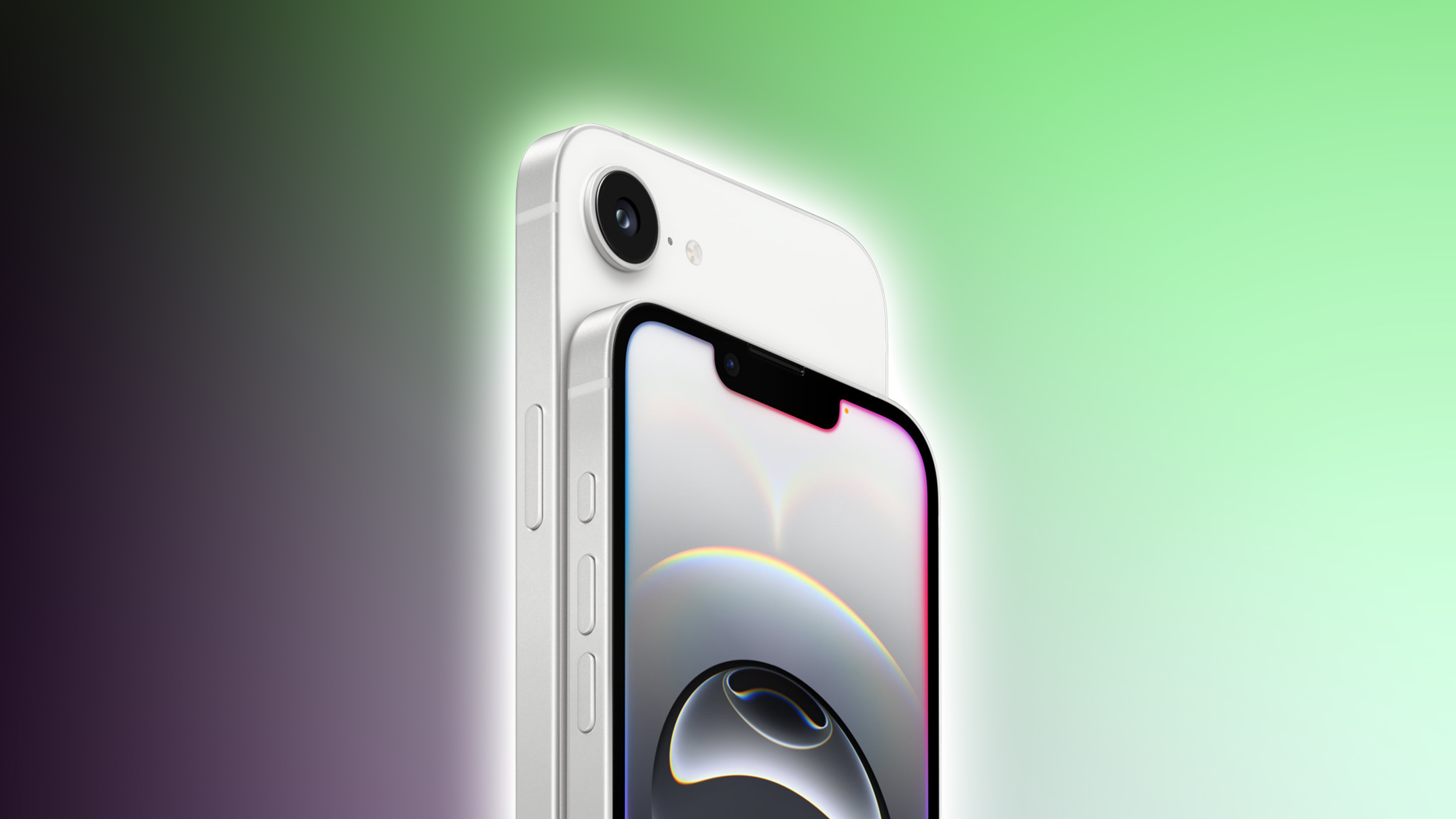
Apple today updated its online refurbished store in the United States, adding the iPhone 16e. Refurbished iPhone 16e models are available at discounted prices for the first time since the device launched in February 2025.


Entry-level 128GB iPhone 16e models are priced at $419, which is a $180 discount from the original price. The iPhone 16e was retired when the iPhone 17e came out, so it is no longer available new from Apple.

Upgraded 256GB and 512GB iPhone 16e models are available for $509 and $679, respectively. The iPhone 16e comes in black or white, and Apple has both colors available.

At $419, a refurbished iPhone 16e is $180 less than Apple's most affordable iPhone, the 17e, but it lacks a few useful features. It does not include MagSafe charging, it has a slower C1 modem instead of the C1X, 128GB starting storage instead of 256GB, an older A18 chip, and original Ceramic Shield glass instead of Ceramic Shield 2.

Refurbished iPhones are unlocked and eligible to be used with any carrier. Apple revamps iPhones that have been returned or repaired, adding new batteries, outer shells, and cables. Refurbished iPhones are essentially identical to new iPhones after going through Apple's cleaning and testing process, and they come with the same one-year warranty with an option to purchase AppleCare+ coverage.
This article, "Apple Now Sells Refurbished iPhone 16e Starting at $419" first appeared on MacRumors.com

Discuss this article in our forums
  •  

Apple Seeds Third Public Betas of iOS 26.6, macOS Tahoe 26.6 and More

Apple today provided public beta testers with the third betas of iOS 26.6, iPadOS 26.6, macOS Tahoe 26.6, watchOS 26.6, and tvOS 26.6, with the software coming a day after Apple seeded the betas to developers.


After signing up to beta test the software updates on Apple's beta site, public beta testers can download the new software using the Software Update section in the Settings app on each device.

iOS 26.6 has a feature that will let you know when you have blocked too many contacts, but the limit is in the thousands so most users may not ever see the messaging. There are also signs of a new iPhone anti-snatching feature that locks a stolen iPhone when it's grabbed from your hand.

No other major new features have been found in any of the software updates, with Apple likely focusing on bug fixes and security improvements. We're nearing the end of the "26" software cycle, with Apple planning to release iOS 27, iPadOS 27, macOS Golden Gate, and more in September.
Related Roundups: iOS 26, iPadOS 26, macOS Tahoe
Related Forums: iOS 26, macOS Tahoe

This article, "Apple Seeds Third Public Betas of iOS 26.6, macOS Tahoe 26.6 and More" first appeared on MacRumors.com

Discuss this article in our forums
  •  

Apple Creator Studio Gets New AI Features

Apple today updated its Creator Studio apps, adding new AI features to Pixelmator Pro, Final Cut Pro, Logic Pro, and more.


Apple is integrating Pixelmator Pro with Final Cut Pro, Keynote, Numbers, and Pages. Final Cut Pro users can send a frame to Pixelmator Pro to create thumbnails and social graphics. In Keynote, Numbers, and Pages, users can select an image in a document and open it in Pixelmator Pro to edit, with changes saved to the original document.

The three office apps support generating vector shapes using AI, and Pixelmator Pro is getting advanced image generation and a Content Hub. Users can generate AI images directly in Pixelmator Pro with natural language, and browse a curated collection of images in Content Hub. Freeform also integrates with Pixelmator Pro in iOS 27, iPadOS 27, and macOS Golden Gate.

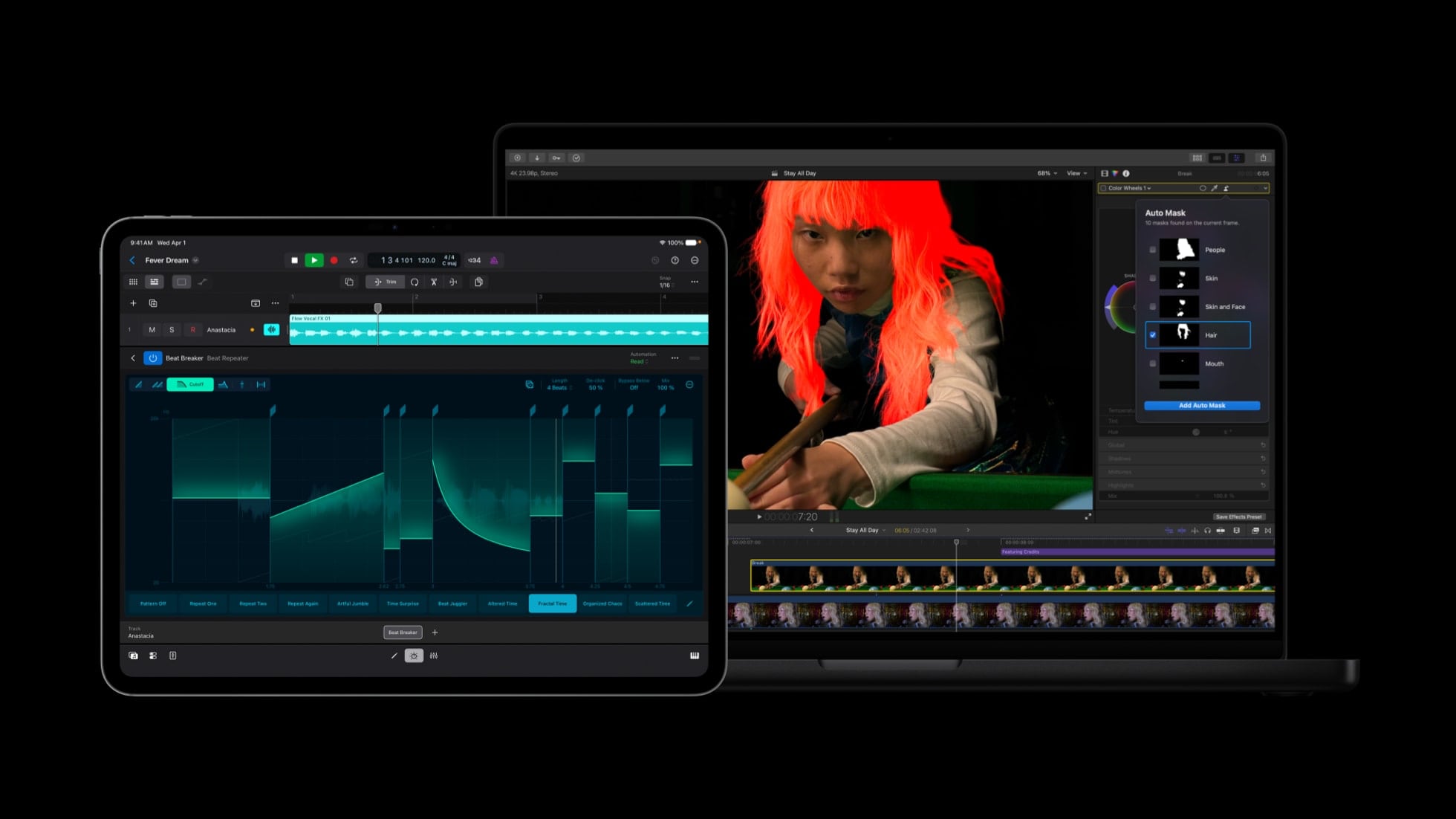
Final Cut Pro is getting Generate Captions, an on-device AI feature that automatically adds subtitles to videos based on audio. Subtitles can have animations and custom fonts, colors, and positions.

Edit Detection is a new AI feature that analyzes rendered video and splits it back into the original clips on the timeline. Apple says editors can use the tool for edit refinements or assembling a cut-down highlight clip for social media.

On the Mac, Final Cut Pro has an Auto Mask feature that isolates and refines video elements like skin, hair, sky, foliage, and clothing. Users can hover over a clip and make precise adjustments with no manual tracking. Color Match now produces more accurate and natural color matches in different lighting conditions, plus Advanced Trimming lets users fine-tune incoming and outgoing frames one-by-one.

Motion gains native support for scaling vector graphics without affecting quality, and Compressor has an Immersive Metadata Viewer for the Vision Pro. Final Cut Camera is getting expanded ProRes Support, an option to disable digital zoom, and Clean HDMI Out for sending a pristine video signal to external monitors and recorders.

Logic Pro's Chord ID feature has been rebuilt and it is more accurate than before. Apple says Session Players will respond and perform chord changes more quickly. Both Logic Pro and MainStage have a new granular sync mode in Alchemy to open up "new dimensions of sound design."

More information on the updates can be found on Apple's website. Creator Studio Pro includes all of Apple's creative software, and it is priced at $12.99 per month or $129 per year. Up to six people can share a single membership.
This article, "Apple Creator Studio Gets New AI Features" first appeared on MacRumors.com

Discuss this article in our forums

  •  

T-Mobile Automatically Moving Legacy Plan Customers to New Plans

Some T-Mobile customers with legacy phone plans are being upgraded to newer T-Mobile plans automatically, reports CNET. The company has been sending out notifications to customers with older plans, letting them know that they're going to be transferred to a current plan.


Customers being pushed to a new plan could get an automatic bill increase. The carrier plans to move customers to comparable modern plans. T-Mobile options include Essentials, Essentials Saver, Experience More, and Experience Beyond. Prices for a single line start at $50 per month.

T-Mobile marketing lead Allan Samson said the majority of customers being automatically upgraded will pay below what the plan sells for, and won't have the same pricing that a plan would cost a new customer. The average increase will be around $4 per line per month, with some pricing going up $6.

Employees were told T-Mobile is transitioning customers to modern plans to get rid of over 1,100 legacy billing codes, and were warned to expect increased customer contact volume in the coming weeks.

T-Mobile declined to tell CNET which plans are being retired, but some date back 15 years. The company has run through a lot of plans over the last decade and a half, plus Sprint users on legacy plans were folded into T-Mobile after the 2020 merger.

Thousands of customers are affected, and will be receiving alerts from T-Mobile. Plans will change during the next billing cycle. Customers unhappy with T-Mobile's decision can pick a different T-Mobile plan or switch carriers.
This article, "T-Mobile Automatically Moving Legacy Plan Customers to New Plans" first appeared on MacRumors.com

Discuss this article in our forums

  •  

WhatsApp Now Lets You Reserve a Username

Popular messaging app WhatsApp is now allowing users to reserve usernames ahead of plans to launch username-based messaging. Right now, WhatsApp uses a person's phone number as an identifier, but usernames will allow people to interact without having to exchange personal information.


Username reservations are rolling out starting this week, and not all users will have access to the reservation system right away. WhatsApp is sending a notification when a username can be reserved. Usernames are optional, and once access has been granted, a username can be selected by going to Settings > Account > Username. Usernames can be 3 to 35 characters in length.

There are over three billion people on WhatsApp, and the company says it is opening up reservations early so "everyone has the opportunity to select the username that matters to them." WhatsApp suggests users choose a unique name only contacts would know.

Creators, small businesses, and organizations have the option to claim their existing Instagram or Facebook username on WhatsApp. Users who have a username on Instagram or Facebook can claim the same username on WhatsApp by choosing the Use Instagram username or Use Facebook username option, as long as it isn't already taken.

WhatsApp has no directory of usernames to browse, and no username discovery suggestions. People will need to know a WhatsApp user's exact username to send a message, plus there is an optional username key that adds extra spam protection.

Usernames will roll out gradually over the next few months. Once live, an account with a username set will no longer reveal a phone number when messaging a person or a business for the first time.
This article, "WhatsApp Now Lets You Reserve a Username" first appeared on MacRumors.com

Discuss this article in our forums

  •  

Open Source AI Agent OpenClaw Gets Native iOS App

Popular open source AI agent OpenClaw is expanding to the iPhone and iPad with a new native iOS app. OpenClaw for iOS can be used alongside an existing gateway as a secure node for chat, voice approvals, sharing, and device-aware automation.


The iOS app replaces iPhone and β€ŒiPadβ€Œ workarounds that involved using Telegram or WhatsApp for on-the-go access.

OpenClaw is a self-hosted AI agent that runs on a Mac or PC. Users can connect an API key from Claude, OpenAI, Gemini, or other AI services, linking the model to content on the gateway machine. OpenClaw lets an AI model access messaging apps, files, web browsers, and more, so it can complete tasks.

To make use of the new iOS app, you'll need a gateway running on a local machine. The App Store description says the iOS app can be used in multiple ways.


  • Pair with your private OpenClaw Gateway by QR code or setup code

  • Chat with your assistant from iPhone

  • Use realtime and background Talk mode

  • Review Gateway action approvals from your iPhone

  • Share text, links, and media directly from iOS into OpenClaw

  • Enable device capabilities such as camera, screen, location, photos, contacts, calendar, and reminders when you choose

  • Receive push wakes and node status updates for connected workflows


OpenClaw is a useful tool, but it has risks. It is susceptible to prompt injection and requires broad system permissions on gateway devices.

OpenClaw started out as Clawdbot, because the initial version created by Peter Steinberger used Claude. Anthropic complained about the name, prompting a rename.

The app can be downloaded from the β€ŒApp Storeβ€Œ for free. [Direct Link]
This article, "Open Source AI Agent OpenClaw Gets Native iOS App" first appeared on MacRumors.com

Discuss this article in our forums

  •  

Apple Released iOS 26.5.2 Security Fixes Early to Thwart AI-Assisted Hacks

Apple today released iOS 26.5.2, iPadOS 26.5.2, and macOS Tahoe 26.5.2 with a long list of security fixes that it initially introduced in the iOS 26.6, iPadOS 26.6, and β€ŒmacOS Tahoeβ€Œ 26.6 betas.


Apple told Reuters that it released the updates earlier than planned due to concerns about AI-assisted hacks.
The company told Reuters on Monday it was adapting to ​the reality that, given the ability of artificial intelligence ​to speed the development of malicious hacking tools, it needed to reduce the time between when updates were first ​made public and when they were put into customers' hands.

Vulnerability fixes are typically included in most Apple software updates, but its major point updates usually include more fixes. Apple intended to release the 25+ security fixes that it introduced today in iOS 26.6 and its sister updates, but didn't want to wait for iOS 26.6 to come out.

In its security document outlining the changes, Apple did not say that any of the vulnerabilities that were fixed had been actively exploited, and the company further told Reuters that there was no evidence any of the now-patched vulnerabilities had been taken advantage of. Apple said the time between when the security fixes were announced and when they were deployed needed to be compressed, but did not say which vulnerabilities drove the urgency.

Apple is among Anthropic's Project Glasswing partners, and it has been using the Claude Mythos Preview to hunt down and patch vulnerabilities before hackers can use them to breach devices. It's not known if Mythos played a role in Apple's decision to release the fixes ahead of schedule.
Related Roundups: iOS 26, iPadOS 26
Related Forum: iOS 26

This article, "Apple Released iOS 26.5.2 Security Fixes Early to Thwart AI-Assisted Hacks" first appeared on MacRumors.com

Discuss this article in our forums

  •  
❌