Lees weergave
Distribution Release: Archcraft 2026.08.01
Apple Watch Series 11 GPS Models Available From $299.99 on Amazon
Note: MacRumors is an affiliate partner with Amazon. When you click a link and make a purchase, we may receive a small payment, which helps us keep the site running.
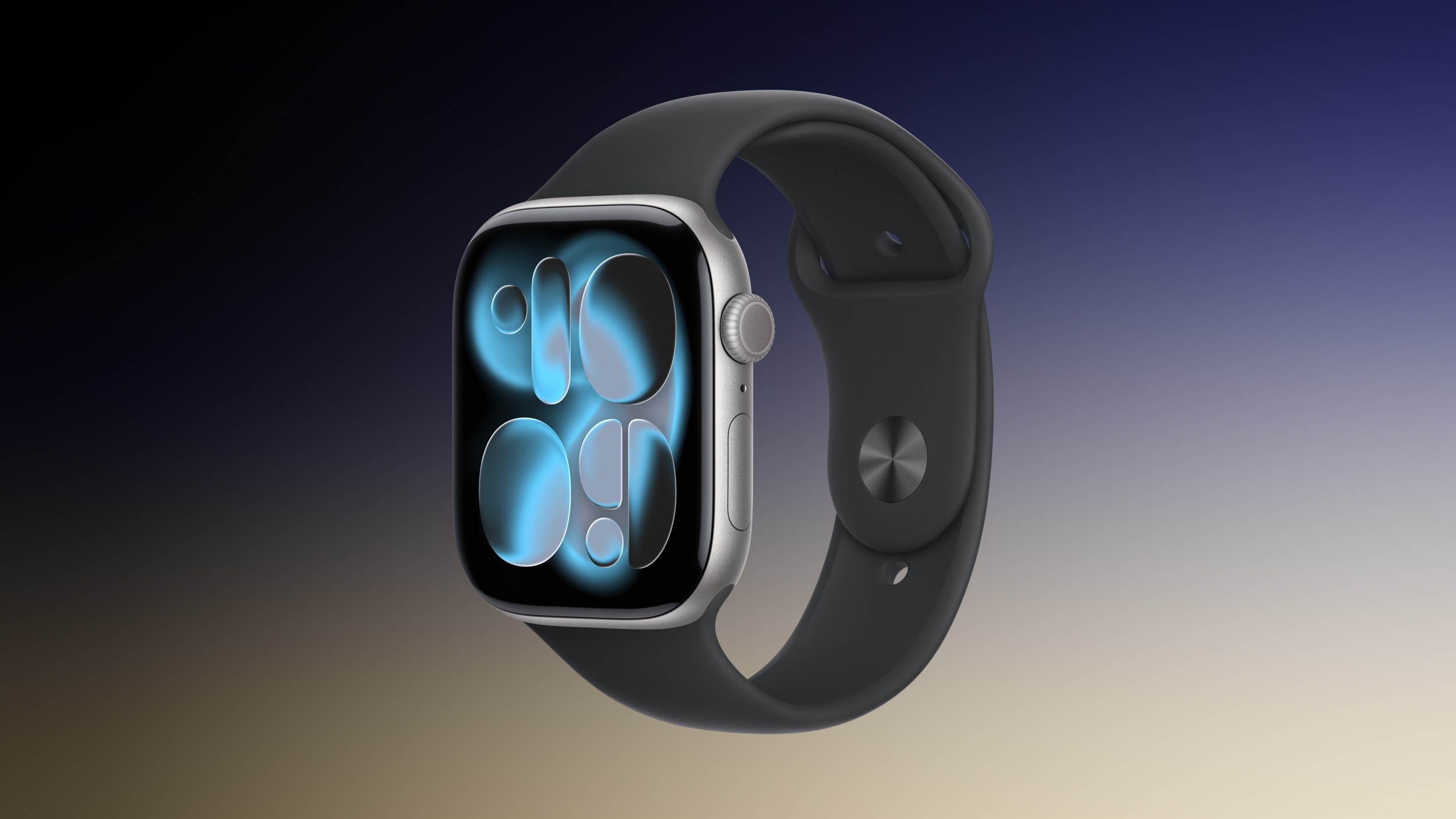
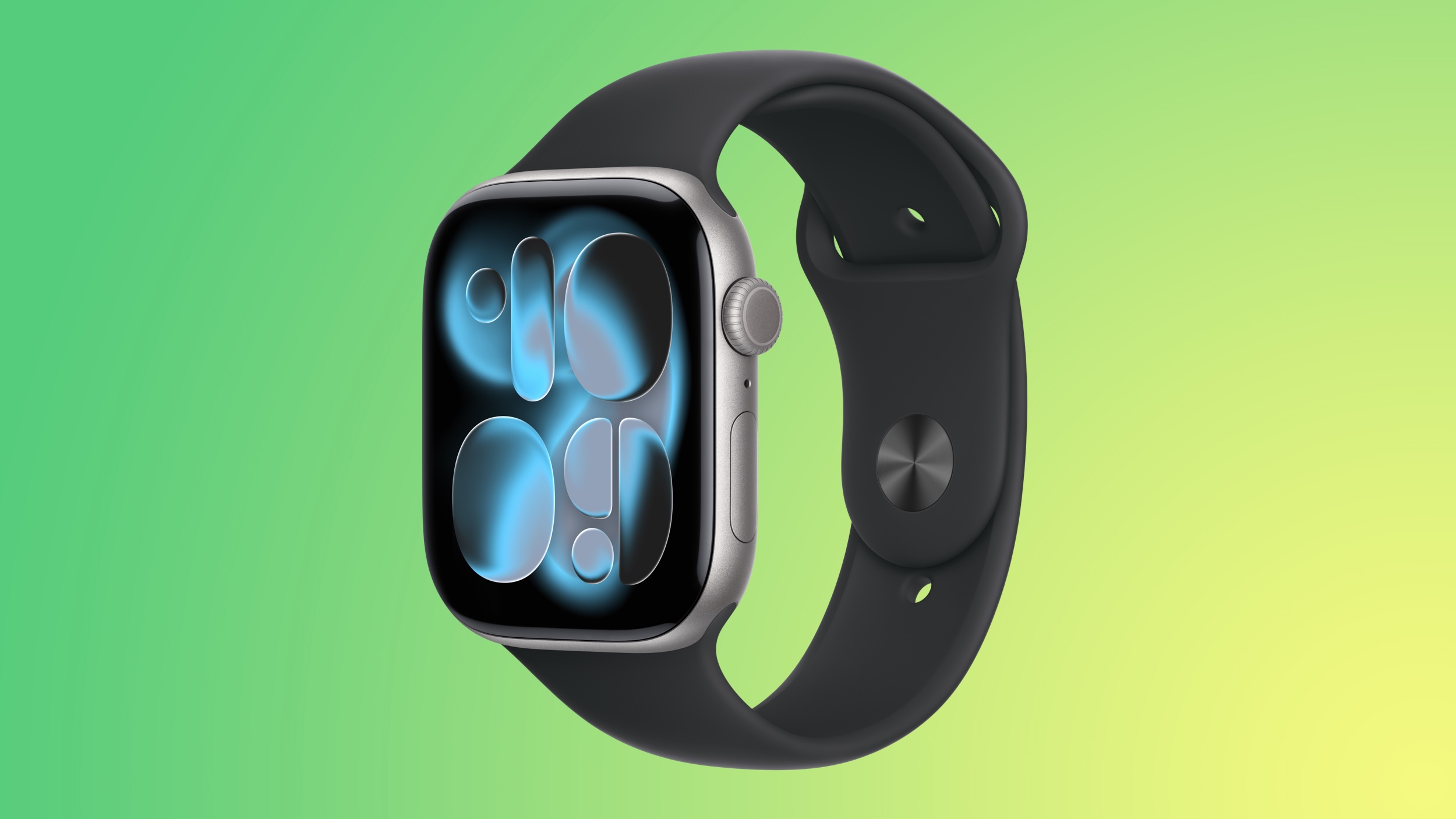
You can get the 42mm GPS Apple Watch Series 11 for $299.99, down from $399.00, and the 46mm GPS model for $329.99, down from $429.00. On Amazon, you'll find three of the 42mm GPS models and two of the 46mm GPS models on sale at these all-time low prices.
Compared to past sales, these are both solid second-best prices on the Apple Watch Series 11 and come within $20-$30 of those previous all-time low prices. Head to our full Deals Roundup to get caught up with all of the latest deals and discounts that we've been tracking over the past week.
Deals Newsletter
Interested in hearing more about the best deals you can find in 2026? Sign up for our Deals Newsletter and we'll keep you updated so you don't miss the biggest deals of the season!
This article, "Apple Watch Series 11 GPS Models Available From $299.99 on Amazon" first appeared on MacRumors.com
Discuss this article in our forums
Top Stories: 'Apple Upgrade' Launches, iOS 26.6 Released, and More
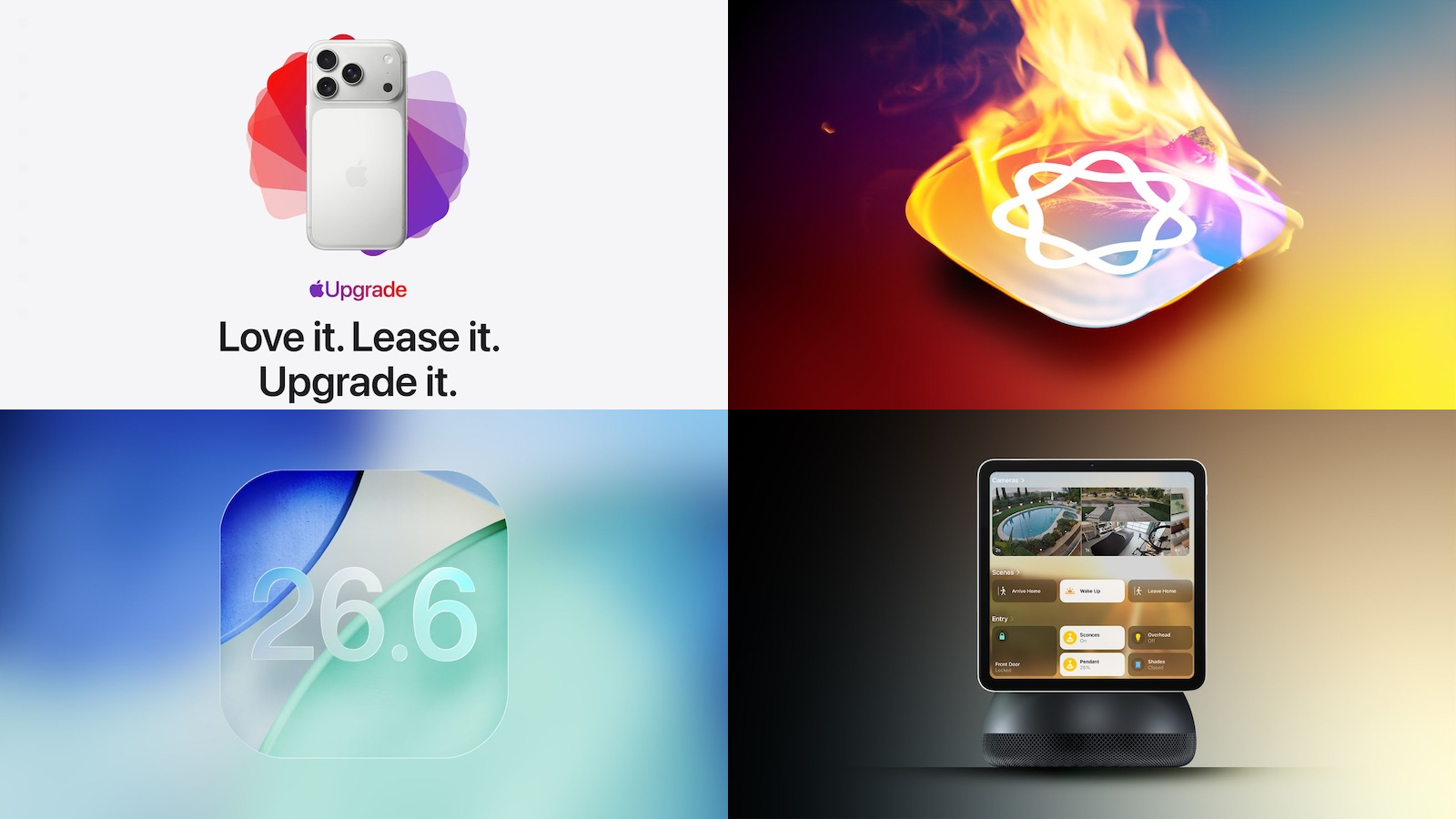
This week also saw the release of iOS 26.6 and other updates, fresh rumors about Apple's upcoming home hub and new Apple TV and HomePod mini models, and a MacRumors interview with Ed Zitron to discuss the state of the AI industry and where Apple may end up if it turns out there's an AI bubble which bursts at some point, so read on below for all of the details on these stories and more!
Top Stories
Apple Upgrade: Apple Retires iPhone Upgrade Program for Klarna-Backed Leases
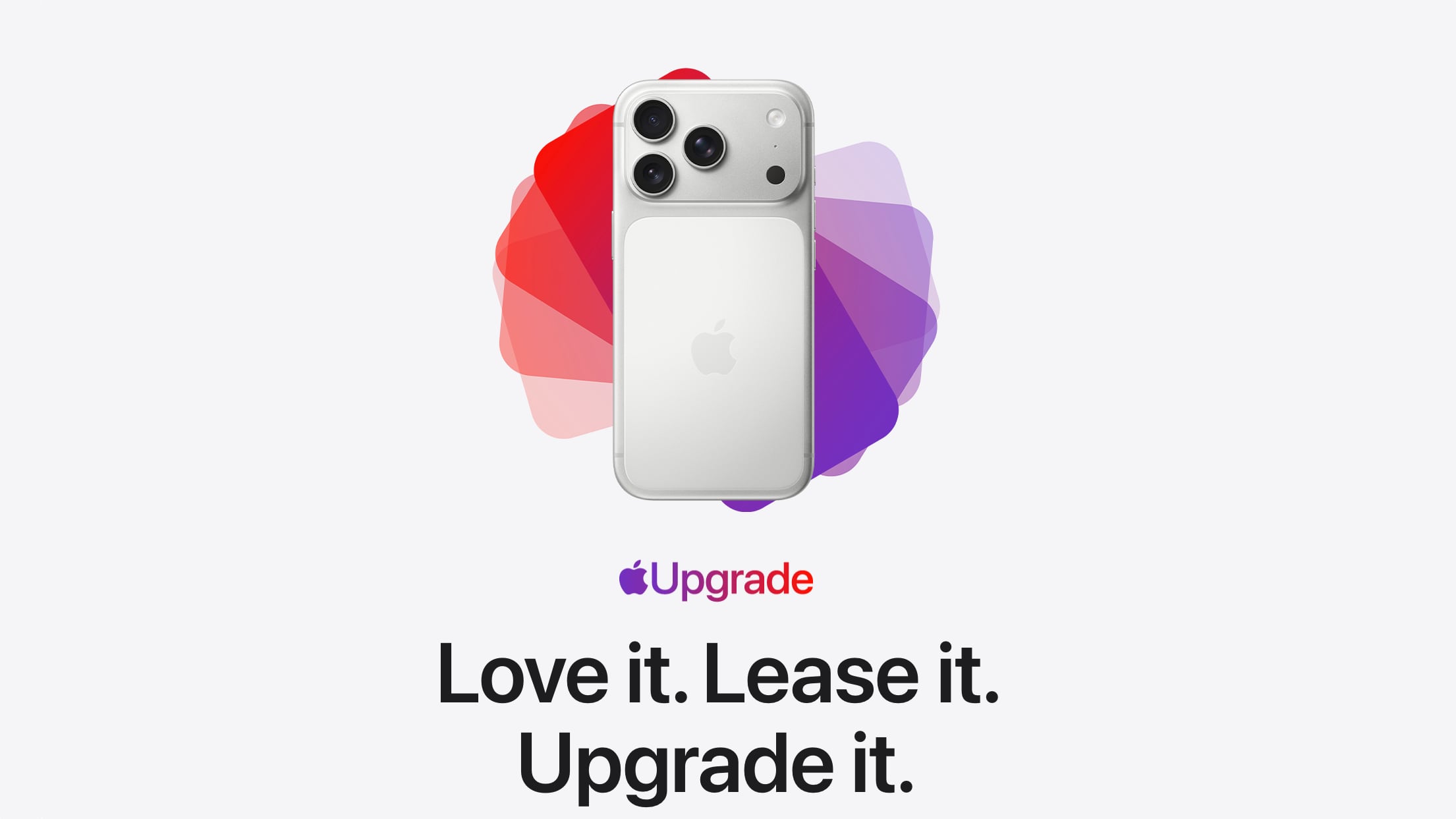
As rumored, Apple this week launched Apple Upgrade, a new U.S. leasing program for iPhone, iPad, Mac, and Apple Watch. Apple partnered with Klarna for Apple Upgrade, and it replaces the current iPhone Upgrade Program and iPhone Payments.
Apple Upgrade lets you lease a variety of Apple devices, with iPhone and Apple Watch available in 12-month and 24-month term options and iPad and Mac offered in 24-month and 36-month term options. At the conclusion of the lease period, you can simply return the device, start a new lease, or convert the lease to an outright purchase by making a final payment covering the difference between the total lease payments made and the original retail price.
Be sure to check out our list of 20 things to know about the program before you take the plunge, and see our comparison example to help you decide whether Apple Upgrade is worth it to you.
Apple Will 'Watch Everything Burn' When AI Bubble Bursts - Ed Zitron
Memory prices have doubled, Macs and iPads have gone up, and iPhones are expected to follow. Ed Zitron – who writes the Where's Your Ed At newsletter, hosts the Better Offline podcast, and has been described by Politico as the AI boom's most "acerbic gadfly" – has spent years arguing the buildout driving those costs will never pay for itself.
We asked him what happens to Apple if he's right.
Apple Releases iOS 26.6 and iPadOS 26.6 With iOS 27 Optimizations
Apple this week released iOS 26.6 and related updates to the public, marking what should be one of the final updates before iOS 27 sees its official launch in September.
The updates patch hundreds of security flaws across Apple's operating systems, and Apple says they also prepare the Spotlight search index for the upcoming cycle of OS 27 releases.
All-New Apple Home Hub Reportedly Launching as Soon as October
Apple plans to release an all-new smart home hub at some point between October and early next year, according to Bloomberg's Mark Gurman.
Apple Home Hub (Concept)Siri AI is expected to be a core feature of the hub, which is designed to be placed in rooms throughout your house, such as a kitchen, living room, or bedroom. The report said the device will be available in tabletop and wall-mounted versions, with Apple apparently believing that many customers will buy more than one.
Apple has also had updated Apple TV and HomePod mini models ready to go for quite some time, but they too have been waiting for Siri AI to be ready and thus should be launching in the fall once Siri AI is available to everyone.
iOS 27: All the New iCloud Features
Over the course of the iOS 27 beta testing cycle, we've been highlighting various changes and additions across apps and services, and this week we took a look at changes to iCloud and the Phone and FaceTime apps.
iCloud includes a number of improvements to syncing and sharing features, as well as new premium benefits for iCloud+ subscribers, while the Phone app gets a Call Context feature to show you relevant information from across your apps while you're on a phone call and FaceTime gets a number of improvements including a Dual Capture feature to let you stream video from both front and rear cameras simultaneously.
Apple Planning to Unveil Privacy-Focused Smart Glasses at WWDC 2027
Apple currently plans to unveil its first smart glasses at WWDC 2027 next June, and privacy will be a focus, according to Bloomberg's Mark Gurman.
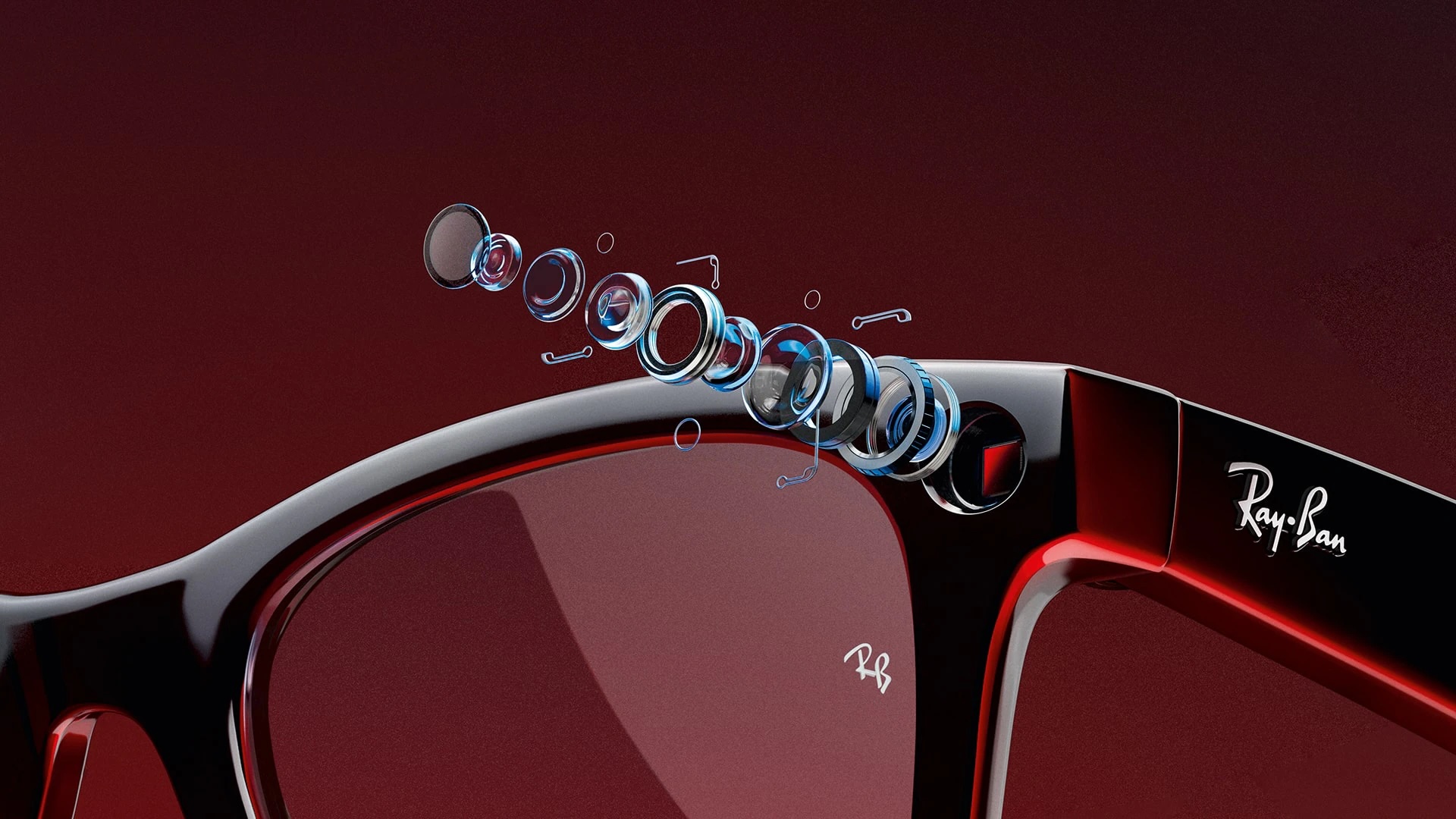
For the glasses, Apple is prototyping "a slew of new hardware and software-related privacy features" that are not available on current products, he said. He did not mention any specific features, but he noted that Apple's marketing will likely emphasize the privacy measures of its glasses compared to rival products like the Meta Ray-Bans.
MacRumors Newsletter
Each week, we publish an email newsletter like this highlighting the top Apple stories, making it a great way to get a bite-sized recap of the week hitting all of the major topics we've covered and tying together related stories for a big-picture view.
So if you want to have top stories like the above recap delivered to your email inbox each week, subscribe to our newsletter!
This article, "Top Stories: 'Apple Upgrade' Launches, iOS 26.6 Released, and More" first appeared on MacRumors.com
Discuss this article in our forums
Russ Allbery: Review: How to Steal a Galaxy
Review: How to Steal a Galaxy, by Beth Revis
| Series: | Chaotic Orbits #2 |
| Publisher: | DAW Books |
| Copyright: | December 2024 |
| ISBN: | 0-7564-1949-2 |
| Format: | Kindle |
| Pages: | 143 |
How to Steal a Galaxy is a far-future science fiction caper short novel (maybe a novella?) and the sequel to Full Speed to a Crash Landing. You don't have to remember the details of the previous book to enjoy this one. There's an excellent inline summary at the start of this installment.
After an annoying negotiation with people who keep trying to preach at her about causes, Ada Lamarr has a new contract. She is going undercover, after a fashion, at a charity gala and auction on Rigel-Earth. While she's there, she's going to steal something. What, precisely, she keeps a mystery from both the other characters and from the reader until the end of the story.
Government agent Rian White is working security at this charity gala. Due to its link with the plot of Full Speed to a Crash Landing, he was fairly certain Ada would be there, as indeed she is. What she is planning, however, is maddeningly unclear. Also maddening is how good Ada looks in a dress.
As with the previous book, How to Steal a Galaxy is told by Ada in the first person using the same teasing tone and constant misdirection that she uses when verbally fencing with Rian and the other characters. I found this novella even more entertaining and satisfying than the previous one. The charity gala is supposedly intended to benefit the poor people of Earth, and is run with exactly the sort of condescension and disguised capitalist looting typical of such exercises in elite charity. Ada's narration is scathing in a deeply relatable way.
Also, there is a trillionaire tech-bro fake philanthropist who is smug and condescending and accustomed to getting exactly what he wants.
"I don't think anyone should have enough personal wealth to decimate a large country's income just because he's going through a midlife crisis."
Ada's interactions with Strom Fetor are an absolute delight. He is so sure of himself that he is incapable of registering her as a threat, and she effortlessly deceives him by hiding in plain sight.
"You really shouldn't be talking about this," Rian starts.
Fetor waves aside his concerns. "We're all friends here."
"Not me," I say. "I hate you. Remember?"
Fetor laughs in a tone I'm sure he thinks is charming.
Fetor's complete inability to realize that a beautiful woman might both sincerely not like him and not be flirting with him is perfect. I was cackling through half of this book.
Like any good heist story, there are twists and turns, surprises, double agents, unexpected complications, and a delightful amount of verbal fencing. I adore the narrative tone Revis uses for these stories. Ada has just the right mix of idealism, cynicism, professionalism, and irreverence to carry off the feeling that she's a step ahead of everyone else. Underneath the bones of a delightful plot is a character who cares deeply but is very aware of her limitations, and therefore has taught herself to laugh at and be ruthless with her own emotions. I am finding it an incredibly compelling type of competence porn.
I enjoyed the first book of this series, but this one was so much better. These stories are exactly the right length to keep the reader engrossed throughout and satisfied but wanting more at the end. How to Steal a Galaxy ends on a cliffhanger of sorts, to be resolved in the next and final book. I can hardly wait to start it.
Highly recommended.
Followed by Last Chance to Save the World.
Rating: 9 out of 10
Distribution Release: 4Mlinux 52.0
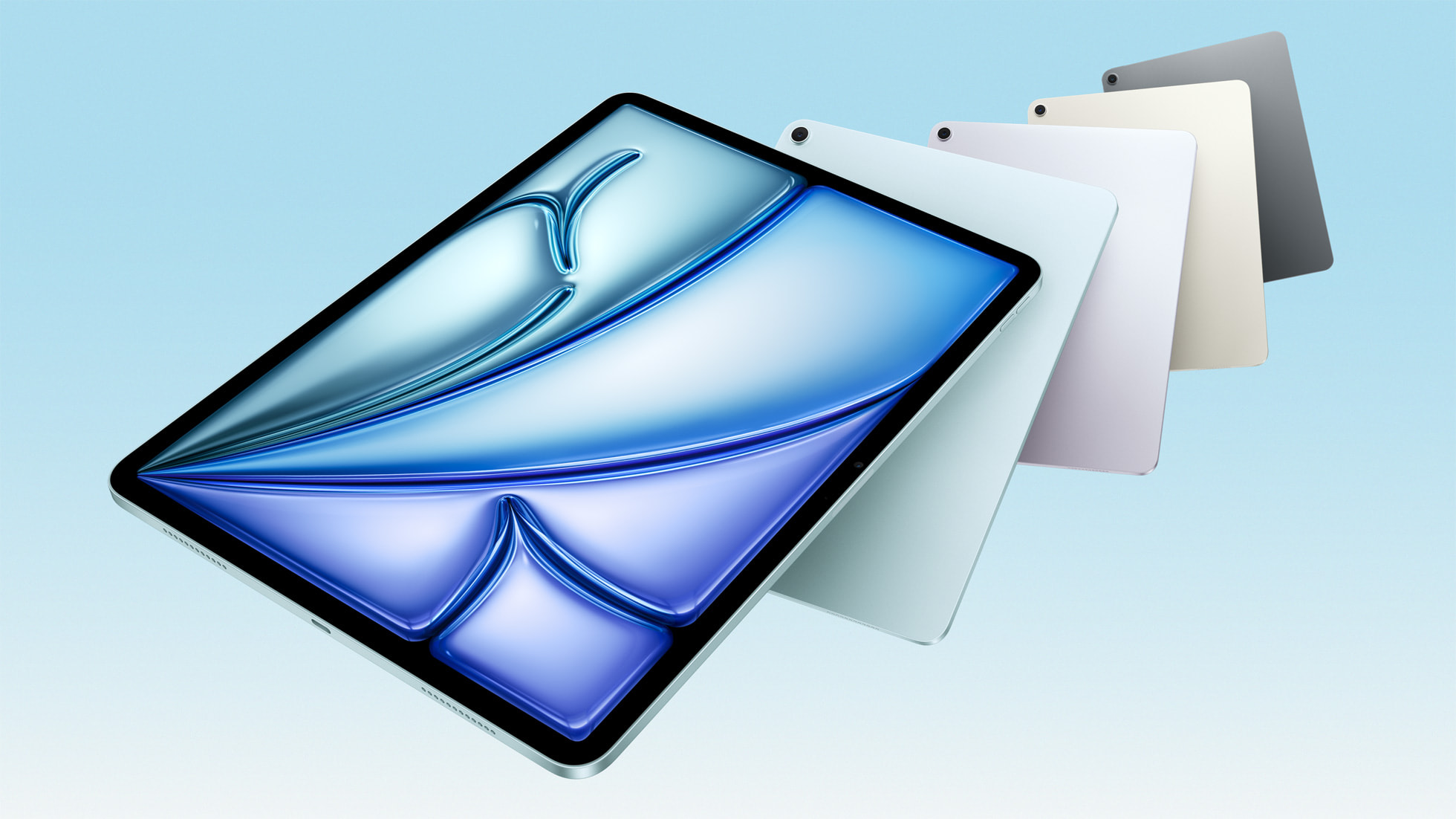
iPad Air Could Finally Be Redesigned Next Year
Apple last gave the iPad Air a new enclosure in 2020, when the fourth-generation model introduced flat sides, an all-screen front, and Touch ID in the top button. The subsequent M1, M2, M3, and M4 updates were all internal with no design changes.
That could change next year. Apple is expected to move the iPad Air to OLED in early 2027, with Samsung Display supplying single-stack LTPS panels that sit below the tandem OLED in the iPad Pro on cost and brightness. The M5 chip is also rumored. That will form the largest change the product has had in years, and it comes as part of a wider OLED rollout that will eventually reach products like the iMac and MacBook Air.
The substantial upgrade would be a suitable candidate for a complete redesign. When the iPad Pro moved to OLED in 2024, Apple completely redesigned the device for the first time since 2018, introducing a substantially thinner chassis.
More strikingly, the iPad mini 8 is expected by October with a new design, an OLED display, a vibration-based speaker system that eliminates speaker holes, and a water-resistant casing that would be an iPad first.
The iPad Air and iPad mini have shared their design language since their introduction, with the mini most recently adopting the Air's look in 2021 and holding it through to the iPad mini 7. If the mini receives a new enclosure this year, the Air is the obvious candidate to bring over the same one next. It could be much like how the original iPad mini from 2012 set the design standard for the iPad Air just a year later.
There have been no specific rumors about an iPad Air redesign for next year, but if it does mirror the iPad mini, the device could gain the same vibration-based speaker system, water-resistance, and more.
This article, "iPad Air Could Finally Be Redesigned Next Year" first appeared on MacRumors.com
Discuss this article in our forums
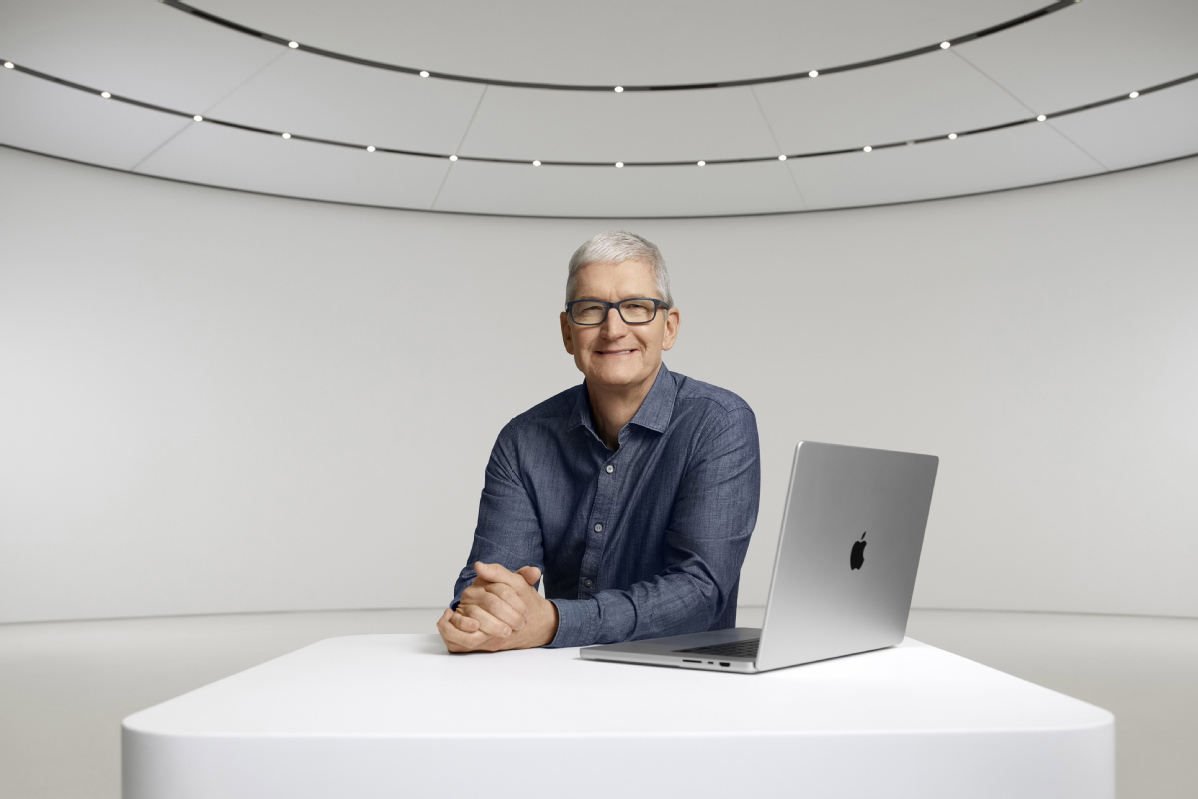
How Apple Changed Under Tim Cook: 15 Years in Numbers
Cook took over as CEO on August 24, 2011, after Steve Jobs resigned.
Apple's Revenue
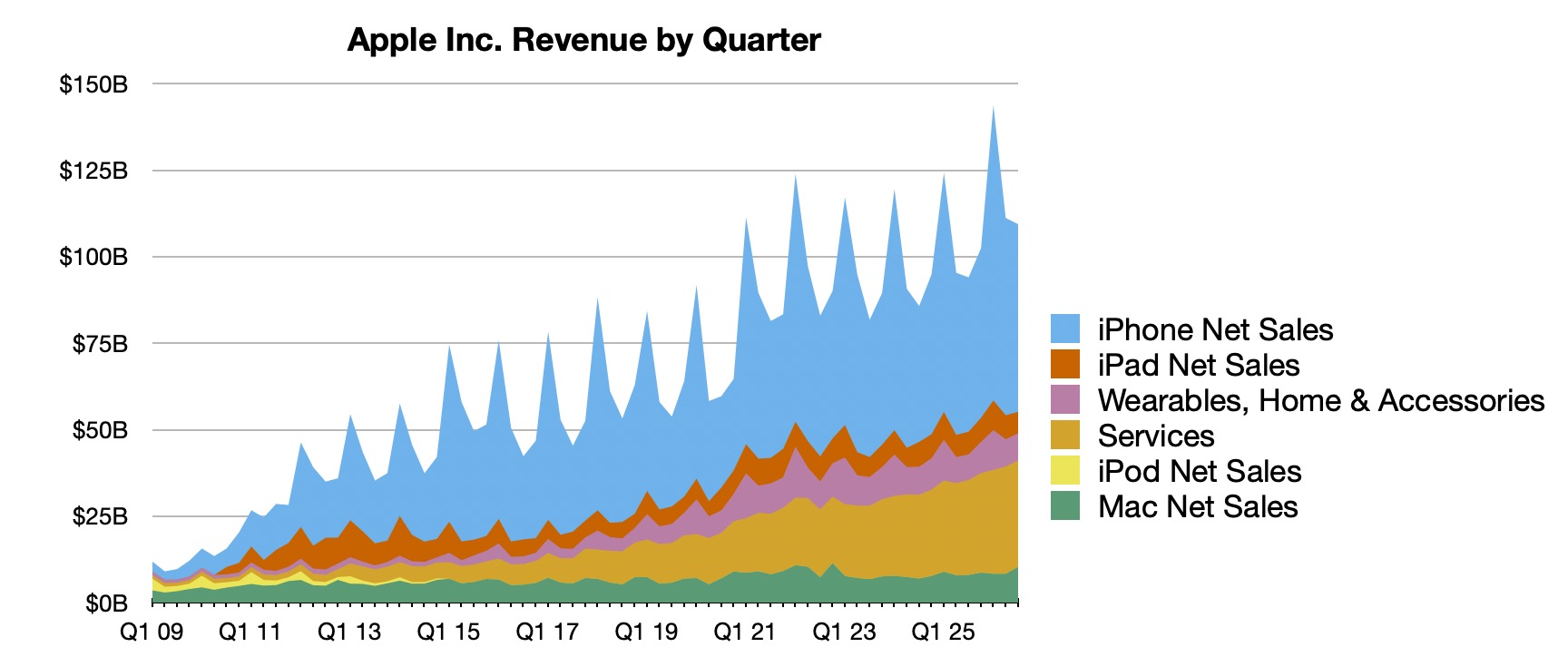
During yesterday's earnings call, Bank of America analyst Wamsi Mohan shared an interesting observation about Apple's quarterly earnings. When Cook took over as CEO, Apple's revenue for all of 2011 was $108 billion.
Apple reported $109.4 billion for Q3 2026, earning its 2011 revenue in a single quarter. We don't have the numbers for fiscal 2026 yet, but in fiscal 2025, revenue was $416 billion.
iPhone revenue in 2011 was $47 billion, and just this quarter, it was $54.3 billion.
Valuation
Apple stock is down today after Cook said he expects supply constraints and memory shortages to affect revenue in the current quarter, but last week, Apple briefly hit a market cap above $5 trillion. Apple's market cap is now around the $4.5 trillion mark, and it once again trails Nvidia for world's most valuable publicly traded company.
Apple was the first company to reach a $1 trillion valuation in August 2018, the first to reach $2 trillion in August 2020, and the first to reach $3 trillion in January 2022. It was the third company to hit a $4 trillion valuation in October 2025, and then the second to reach $5 trillion.
A day after Cook took over in August 2011, Apple's stock price was $13.35 (split-adjusted). Today, it opened at $304.81, a roughly 23x increase. There was a 7-for–1 split in 2014 and 4-for–1 split in 2020 during Cook's tenure.
Installed Base
Apple said it has over 2.5 billion active devices. Apple didn't share installed base numbers until 2016, when it hit a billion active devices.
Services
Apple's services category revenue has seen the most growth. It was $9.4 billion in all of 2011, but in Q3 2026, it was $30.7 billion. In fiscal 2025, services brought in $109 billion.
Apple said during the earnings call that it now has 1.5 billion subscriptions. A huge number of services launched under Cook, including:
- Apple Pay
- Apple Pay Cash
- Apple Card
- Apple Music
- Apple News
- Apple TV+
- Apple Arcade
- Apple Fitness+
- iCloud+
- App Store Search Ads
- Ads in Maps
Back in 2011, Apple's services were limited to AppleCare, iTunes, and the App Store.
Product Launches
Under Cook, Apple launched everything from the AirPods to the Apple Watch.
- Apple Watch
- AirPods
- Apple silicon chips
- Vision Pro
- iPhone Air
- iPhone X
- HomePod and HomePod mini
- MacBook Neo
Capital Returns
Cook initiated quarterly dividends in 2012, and also executed an ongoing share repurchase program. Since then, Apple has returned more than $1 trillion to shareholders.
Transition to John Ternus
Cook said yesterday that the transition to Ternus is "going seamlessly." Ternus will become CEO on September 1, ahead of when Apple announces new iPhone models. Cook will remain at Apple as executive chairman, where he will engage with policymakers and help Apple navigate regulatory pressure.
In April, Cook said he planned to remain at Apple for years to come. "I am healthy. My energy is high, and I plan to be in this role for a long time," said Cook. He said he will support current hardware engineering chief John Ternus in any way necessary when Ternus takes over as CEO, and he plans to continue to offer knowledge and experience whenever it's needed. "Apple will be my top priority," he said. "It's who I am at my core, and I can't imagine it any other way."
Cook on Ternus
Cook yesterday said Ternus is the best choice to take over Apple.
The transition is going seamlessly, and I am beyond excited for John to step into his new role and lead Apple into its next era. He is truly one of a kind and there is no better person to take the helm of the company.
As I've said, I couldn't be more confident in his leadership, in our executive team, and in the extraordinary people at Apple who are determined to enrich the lives of our users all over the world. We have a bright future ahead, and I truly have never been more optimistic.
Ternus has been at Apple since 2001, when he joined the product design team. He became vice president of hardware engineering in 2013 and focused on the AirPods, Mac, and iPad. In 2020, he also took on the iPhone, and he became senior vice president of hardware engineering in 2021.
This article, "How Apple Changed Under Tim Cook: 15 Years in Numbers" first appeared on MacRumors.com
Discuss this article in our forums
Windows quality: an update on the commitment we made in March
- More taskbar customization
- Integrating AI where it’s most meaningful
- Reducing disruption from Windows Updates
- Faster and more dependable File Explorer
- More control over widgets and feed experiences
- A simpler, more transparent Windows Insider Program
- Improving the Feedback Hub experience
- Earlier this month, we began previewing improvements to Windows Search Box, including a calmer home screen, clearer results, removing promotional content from web results and more.
- At Build 2026 in June, we introduced a number of improvements to the developer experience on Windows including a developer-optimized Windows 11 experience to build and ship faster, announcing and later delivering a public preview of WSL containers, Windows 365 with developer configuration, Microsoft Execution Containers and much more.
- We've strengthened the fundamentals of WinUI 3 and extended it into more of the Windows shell, including Widgets and the new Run experience, with Autoplay dialog and more File/Folder Properties dialogs coming soon to Windows Insider Preview Experimental builds. And with substantial improvements in memory efficiency and latency, these investments are strengthening the platform foundation needed to accelerate the modernization of Windows 11 and the broader application ecosystem.
- In May, we began previewing changes to Taskbar and Start, which included the ability to move your taskbar positions as well as provide more personalization of Start.
- In May, we shared updates on how we've been simplifying AI throughout the OS, starting with inbox apps, part of a broader shift to make AI in Windows more intentional and focused on the experiences that provide the most value to customers.
- We have previewed several improvements to File Explorer, including foundational architecture enhancements designed to improve responsiveness and reliability across launch and navigation. We’ve addressed long-standing feedback about Home, including unstable transitions and blurry thumbnails. We also made updates to address File Explorer reliability, readability, and usability across the Address Bar, file size formatting, keyboard navigation, and renaming, and there’s more to come soon.
- In May, we previewed updates to the widgets and feed experience, giving you more control over and making them quieter by default.
- In May, we introduced the Driver Quality Initiative (DQI), a comprehensive, ecosystem-wide effort designed to fundamentally raise the bar on driver quality, reliability, and security across Windows. Since March, we've improved reliability across some of Windows' most common connectivity experiences, including improved USB4 docking performance, improved compatibility with Bluetooth devices like AirPods, as well as major gains in printer connectivity, including reducing in-network printer discovery failures.
- We're continuing to invest across the full stack, from the kernel and shell to the apps and developer tools built on Windows, so performance improvements benefit the broad range of ways people use Windows. Building on the responsiveness and scheduler work we described in May, application launches and experiences like Start, File Explorer, Search, and Snipping Tool are faster and more responsive. Our focus has been on improving these experiences, so they are responsive, free of stutters and delays, and customers enjoy a reliable experience every time. Boot and logon times are also improved. Additionally, developers benefit from faster compile times, streamlining enterprise workflows.
- Alongside all of these areas, we’ve steadily been introducing several improvements to the memory efficiency of Windows, from taking advantage of a more efficient memory allocator to reduce overhead across apps and components, continued tuning of WinUI 3 so that apps built on it use less memory by design, as well as driving efficiencies across Chromium and Webview2 components when they appear in the operating system.
- Throughout this effort, we've improved Windows Hello to make signing in with your face or fingerprint more reliable, helping you get to your desktop faster. It's part of our broader focus on the everyday experiences that should just work, making Windows feel more polished, dependable, and consistent every day.
- In April, we began previewing changes that reduced disruption from Windows Updates and provided more control like the ability to skip updates during the out-of-box experience (OOBE), extending update pauses and more.
- In April, we made changes to the Windows Insider Program to become simpler and easier to navigate, with fewer channels and more control over the features you flight.
- Onboarding and setup. Delivering a faster and more efficient out-of-box experience.
- Memory optimization for 8GB and above. Reducing Windows memory footprint to deliver a fast and responsive Windows experience across the PCs customers use every day.
- Family. Providing a faster set up and making it easier for families to access useful parental controls.
- Voice. Making voice more natural and fluid to interact across the apps you use every day.
Announcing new builds for 31 July 2026
- Beta: Build 26220.9022
- Experimental: Build 26300.9032
- Beta (26H1): Build 28020.2623
- Experimental (26H1): Build 28120.2630
- Experimental (Future Platforms): Build 29639.1000
Notable new features:
[Updated 4 August 2026: thank you for the feedback from Insiders who found that the taskbar improvements had not made their way to the latest Beta build on release. After a slight delay, those improvements are now included in the build, a reboot maybe required. We look forward to continuing receiving your feedback for the new Taskbar improvements.][Taskbar]
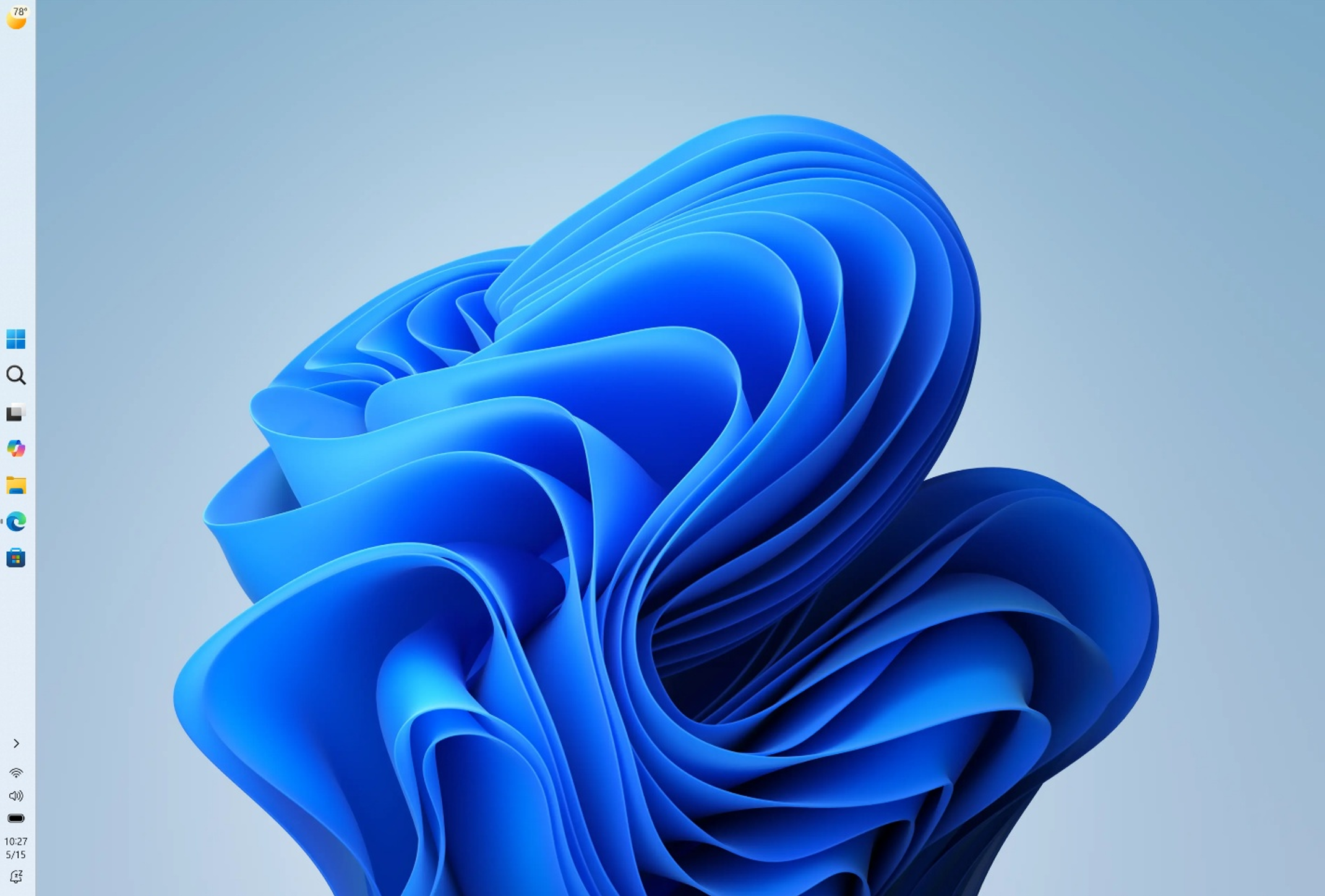
Release channel: Experimental, new to Beta and Beta (26H1) Alternate Taskbar Position- You can now change the position of taskbar on your screen. In Settings > Personalization > Taskbar > Taskbar Behaviors, you can select the side of the screen you want your taskbar on: bottom, top, left, or right. In these other positions, tooltips, flyouts, and animations will still come from the taskbar, and most customization settings like never combine taskbar icons will work with all locations.
- Support for touch gestures, Search box, and Ask Copilot in alternate locations is in progress. Auto-hidden taskbar and touch optimized taskbar are not currently supported. Smaller taskbar is currently supported only for top and bottom positions.
Screenshot of the taskbar in the left-aligned position.[/caption]
Smaller Taskbar
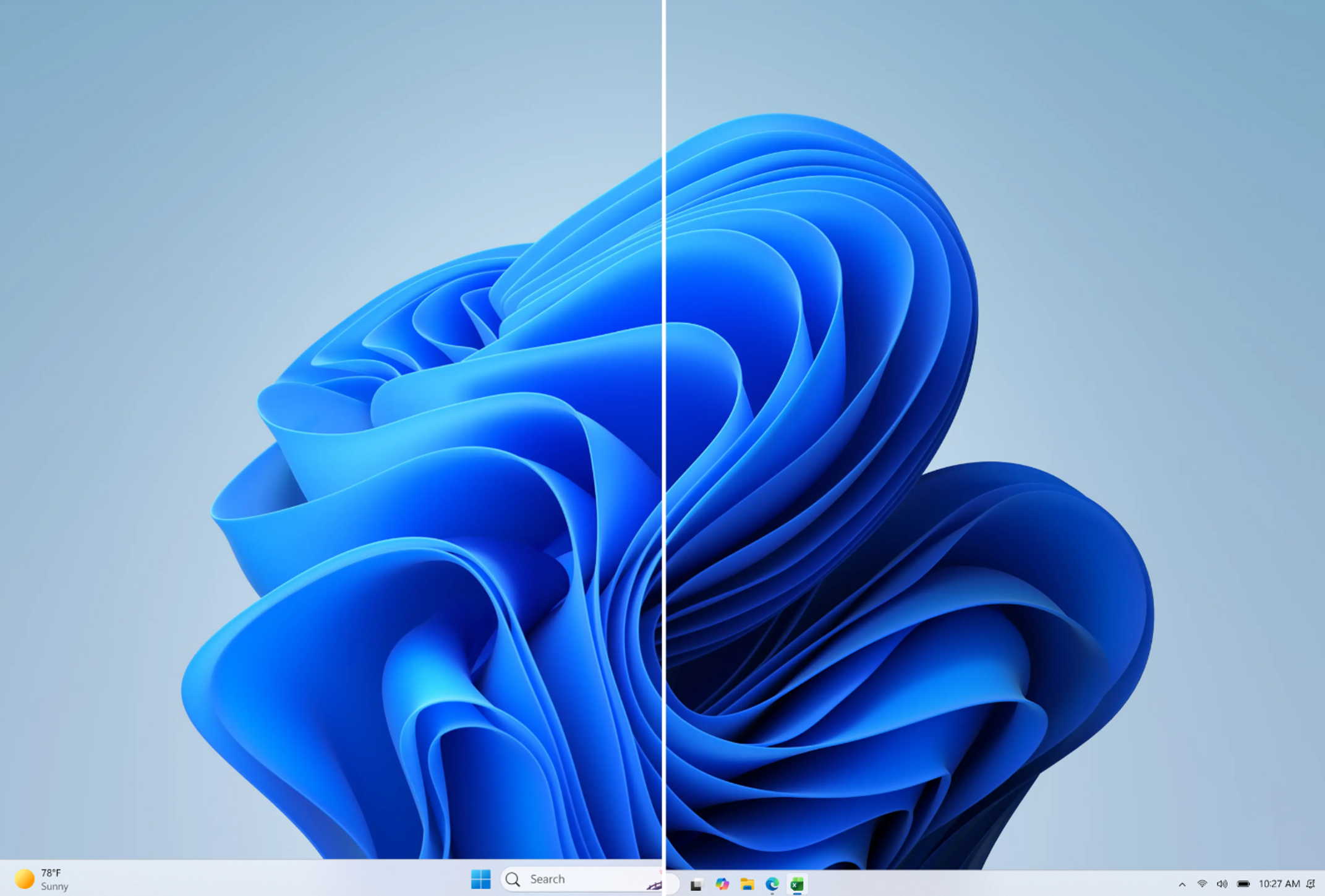
- We’re introducing a smaller taskbar for users who want to maximize screen space, especially on smaller devices. While the default taskbar remains unchanged, this setting provides a more compact experience with smaller icons and a reduced taskbar height, giving you more room for your apps. Core elements like Start, Search, and the system tray scale appropriately to stay aligned and consistent.
- To change your taskbar size, go to Settings > Personalization > Taskbar > Taskbar behaviors > Taskbar size. When set to Small, both the icons and the taskbar height become smaller.
Side-by-side comparison of the standard and smaller taskbar heights on the same device and resolution, showing the additional screen space gained.[/caption]
[Adaptive Hibernate Policy]
Release channel: Experimental Updates to the adaptive hibernate policy to increase instances of instant-on resumes from Modern Standby and increased battery preservation at the low end of the battery. Noticeable changes include less hibernation while the battery is above 80% and hibernating sooner when the battery is below 10%. Thanks, Stephen and the Windows Insider Program teamThe MacRumors Show: Revisiting iOS 27 Ahead of iPhone 18 Pro
iOS 27 is expected to launch this fall, bringing sweeping performance work across the system. Apple has cited more than 80 speed and efficiency improvements, with app launches up to 30 percent faster and AirDrop transfers up to 80 percent faster than on iOS 26. Animations, keyboard responsiveness, Home Screen page swapping, and App Library loading have all been sped up, and Apple says the improvements extend even to older iPhones like the iPhone 11.
The centerpiece of iOS 27 is Siri AI, a substantially overhauled version of the assistant positioned as a rival to chatbots like Claude and ChatGPT. Siri AI can hold back-and-forth conversations, draw on personal context from Mail, Messages, Photos, and Files, and see what's on screen to answer follow-up questions. A new standalone Siri app houses ongoing conversations, while a "Search or Ask" interface, accessed via the Dynamic Island, has effectively replaced Spotlight as the default way to search the device and launch apps.
Liquid Glass, the translucent design language introduced in iOS 26, has also been reworked. iOS 27 adds a system-wide transparency slider in place of the binary "Clear" and "Tinted" toggle from iOS 26.1, letting users dial the effect anywhere between fully opaque and completely clear. Apple also improved how the material diffuses busy content behind it, addressing readability complaints that dogged the original rollout, and refreshed first-party app icons with additional Liquid Glass layering.
Elsewhere, Apple has leaned into contextual, on-device intelligence. For example, Call Context, a new Phone app feature, automatically surfaces relevant information, such as a flight confirmation number or order code pulled from Mail, when a user calls a business they've recently corresponded with. Apple says the feature works entirely on-device and looks only at who is being called, not at call audio, and it also appears on the Apple Watch during a call.
Calendar and Reminders now support natural language entry, letting users type something like "meeting at 2pm with Eric on July 14" and have the app suggest the date, time, and attendees automatically. Apple says Siri can handle more complex natural-language scheduling requests directly, including edits to recurring events.
The Photos app gains three generative editing tools grouped under an Apple Intelligence Tools section: an upgraded Clean Up, a new Extend tool, and Spatial Reframing. Clean Up now offers Fast, High Quality, and Auto modes for object removal and can reconstruct more complex backgrounds than before. Extend uses generative AI to fill in new content when a photo's borders are expanded, and is capped at a maximum of 25% per side. Spatial Reframing, which draws on the same spatial data used for Portrait mode, lets users shift a photo's apparent camera angle after it was taken.
The Shortcuts app has been rebuilt around a "Describe a Shortcut" interface, where Apple Intelligence assembles an entire automation from a plain-language description rather than requiring users to build workflows action by action manually. Safari picks up a similar natural-language approach with a new Create an Extension option for building custom browser extensions on the fly, automatic AI-driven tab organization by topic, and a "Notify Me" tool that monitors a webpage and alerts users when it changes, which is useful, Apple says, for tracking ticket sales or restocked products.
Image Playground has also been overhauled for iOS 27, adding support for photorealistic image generation, edits to existing images via text descriptions, and additional aspect ratio options for wallpapers and Contact Posters.
iOS 27 is available now to developers and public beta testers, and Apple plans to release the software officially in September. The MacRumors Show has its own YouTube channel, so make sure you're subscribed to keep up with new episodes and clips.
You can also listen to The MacRumors Show on Apple Podcasts, Spotify, Overcast, or other podcast apps. You can also copy our RSS feed directly into your player.
If you haven't already listened to the previous episode of The MacRumors Show, catch up to hear our discussion about OpenAI's move into hardware and the trade secret lawsuit Apple filed against the company earlier this month.
Subscribe to The MacRumors Show for new episodes every week, where we discuss some of the topical news breaking here on MacRumors, often joined by interesting guests such as Kayci Lacob, Kevin Nether, John Gruber, Mark Gurman, Jon Prosser, Luke Miani, Matthew Cassinelli, Brian Tong, Quinn Nelson, Jared Nelson, Eli Hodapp, Mike Bell, Sara Dietschy, iJustine, Jon Rettinger, Andru Edwards, Arnold Kim, Ben Sullins, Marcus Kane, Christopher Lawley, Frank McShan, David Lewis, Tyler Stalman, Sam Kohl, Federico Viticci, Thomas Frank, Jonathan Morrison, Ross Young, Ian Zelbo, and Rene Ritchie.
The MacRumors Show is on X @MacRumorsShow, so be sure to give us a follow to keep up with the podcast. You can also email us at podcast@macrumors.com or head over to The MacRumors Show forum thread. Remember to rate and review the podcast, and let us know what subjects and guests you would like to see in the future.
This article, "The MacRumors Show: Revisiting iOS 27 Ahead of iPhone 18 Pro" first appeared on MacRumors.com
Discuss this article in our forums
Set a Custom EQ for Your AirPods in iOS 27
It's worth noting that iOS has had an EQ setting for years – it's buried in Settings ➝ Apps ➝ Music, but it applies only to Apple Music playback, and works on any pair of headphones. In iOS 27, the new EQ is specifically tied to your AirPods, so it applies to everything you listen to. Your custom EQ profile also carries over to iPad and Mac when you pair your AirPods with them.
What You Need
Custom EQ requires Apple's H2 chip, so it supports AirPods Pro 2, AirPods Pro 3, AirPods 4, and AirPods Max 2. Earlier models, including the original AirPods Max, aren't compatible with the feature.
You'll also need current AirPods beta firmware. If the Equalizer option described below doesn't appear, pair your AirPods with your iPhone, tap your AirPods in Settings, then tap AirPods Beta Updates and toggle on the beta updates option. Afterwards, put your AirPods in the case, connect the case to power, and leave it near your unlocked iPhone to let the latest beta firmware install quietly in the background. It shouldn't take more than half an hour.
How to Adjust Your AirPods EQ
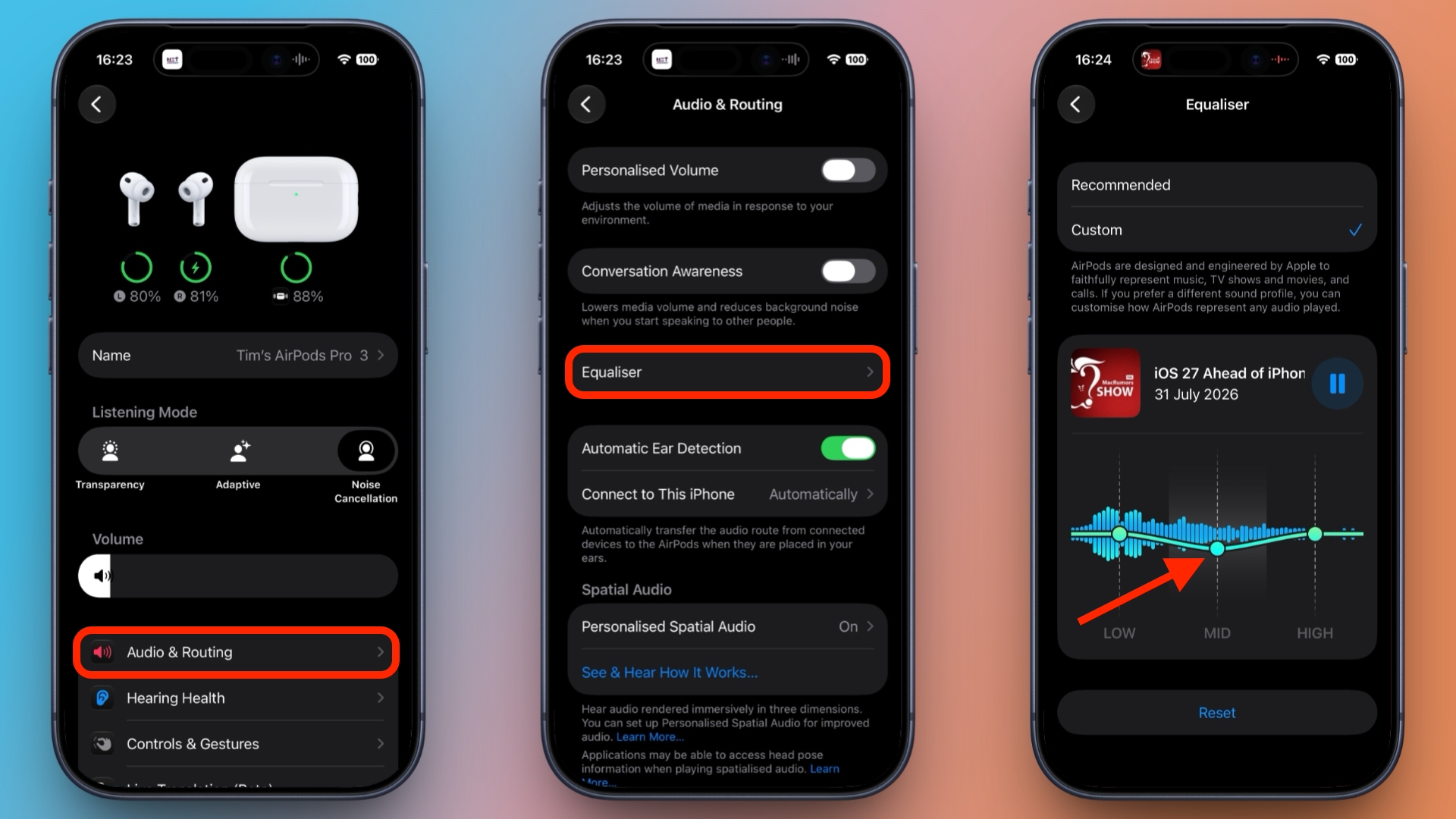
- With your AirPods connected, open Settings on your iPhone.
- Tap your AirPods at the top of the screen.
- Tap Audio & Routing.
- Tap Equalizer.
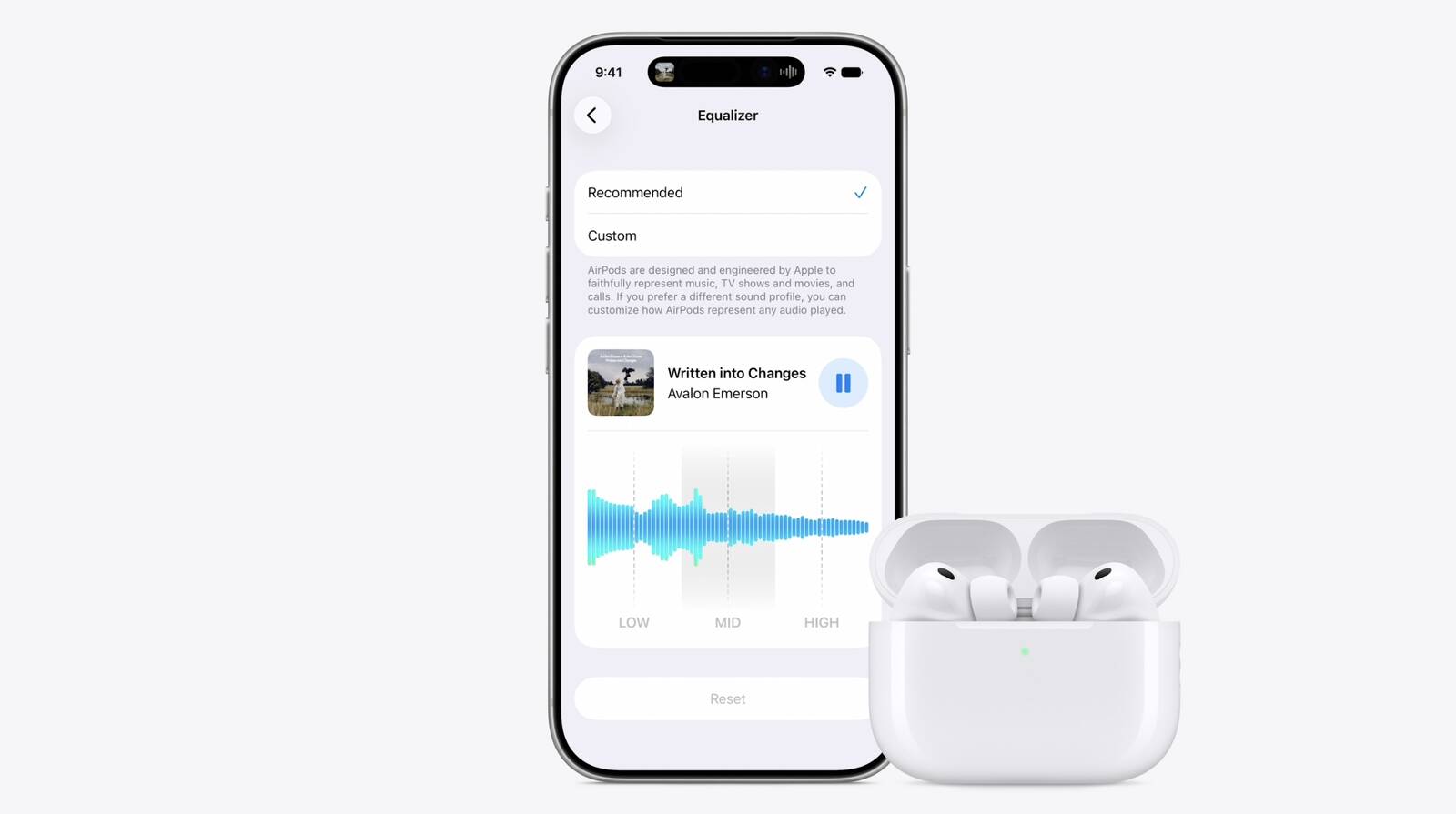
- Tap Custom, then drag the low, mid, and high points up or down.
You should see a media playback control above the EQ showing the last thing you listened to, allowing you to hear how your adjustments sound in real time. Lows cover bass weight, mids carry vocals and most instruments, and highs handle treble detail and sibilance.
To undo your changes, simply tap Reset, or choose Recommended at the top to restore Apple's default profile. You'll find all the same options in iPadOS 27, as well as in macOS 27 Golden Gate (in System Settings).
iOS 27 and Apple's other upcoming software updates remain in public beta for now, with a general release expected sometime this September.
This article, "Set a Custom EQ for Your AirPods in iOS 27" first appeared on MacRumors.com
Discuss this article in our forums
iPhone 18e Rumored to Feature Increased RAM
The lower-end iPhone 18e that Apple is expected to release by March 2027 will be equipped with 9GB of RAM, up from 8GB in the iPhone 17e, according to analyst Jeff Pu.
9GB of RAM for the iPhone 18e was already rumored by another analyst Ming-Chi Kuo last month.
This article, "iPhone 18e Rumored to Feature Increased RAM" first appeared on MacRumors.com
Discuss this article in our forums
Clint Adams: N.K. Jemisin is doing a worldbuilding workshop at the Bronx Library Center tomorrow afternoon
Normally, I do not read book reviews. Either I haven't read the book, in which case there's spoiler potential, or I have, in which case it's unlikely to be useful or enjoyable for me to read a thing about a thing I've already read.
But Review: Radiant Star caught my eye, and I thought, “Hmm, I've read all those books” and was curious. Of course, because I am old and senile and have no understanding of time, the “May 2026” staring at me was not able to trigger the neural synapses that would remind me that I haven't read any Ann Leckie since 2023.
However, as I read Russ's review, and began to wonder what the hell he was talking about, I was able to piece together that while I have, in fact, read 6 Ann Leckie books, none of them have been Radiant Star.
This presented an opportunity, so I resolved to add Radiant Star to my todo list. To my surprise, it was already there.
iPhone Air 2 Expected to Launch Early Next Year With Five New Features
In a research note with GF Securities today, Pu said the iPhone Air 2 will have the following five new features compared to the current model:
- The addition of a second 48-megapixel rear camera — an Ultra Wide lens to complement the existing Fusion lens.
- A slightly smaller Dynamic Island.
- A faster and more power-efficient A20 Pro chip manufactured with TSMC's advanced 2nm process. The current iPhone Air has a 3nm A19 Pro chip.
- Apple's second-generation N2 chip for wireless networking. In the existing iPhone Air, the N1 chip is an Apple-designed wireless networking chip that enables Wi-Fi 7, Bluetooth 6, and Thread. The chip also improves the overall performance and reliability of features like AirDrop and Personal Hotspot.
- Apple's second-generation C2 chip for 5G. Apple says the current C1X chip is already the most power-efficient modem in an iPhone ever.
Apple reportedly plans to release the iPhone Air 2 alongside the regular iPhone 18 and a lower-end iPhone 18e around March 2027. The higher-end iPhone 18 Pro, iPhone 18 Pro Max, and foldable "iPhone Ultra" are expected to launch this September, with the devices in the lineup rolling out at different times as part of a new strategy.
This article, "iPhone Air 2 Expected to Launch Early Next Year With Five New Features" first appeared on MacRumors.com
Discuss this article in our forums
Best Back to School Apple Bargains: MacBook Pro, AirPods, Apple Watch, and AirTag 2
Note: MacRumors is an affiliate partner with some of these vendors. When you click a link and make a purchase, we may receive a small payment, which helps us keep the site running.
Best Buy's Back to School Sale
- What's the deal? Save sitewide on back to school accessories
- Where can I get it? Best Buy
- Where can I find the original deal? Right here
Best Buy this week is hosting a pair of sales kicking off Back to School season, as well as its annual Black Friday in July event, with notable markdowns on Apple devices, TVs, headphones, monitors, and much more. In terms of Apple devices, you can find solid deals on AirPods Max 2, iPhone Air, Beats accessories, and MacBook Pro.
- AirPods Max 2 - $449.00 ($100 off)
- 256GB iPhone Air - $899.99 ($100 off)
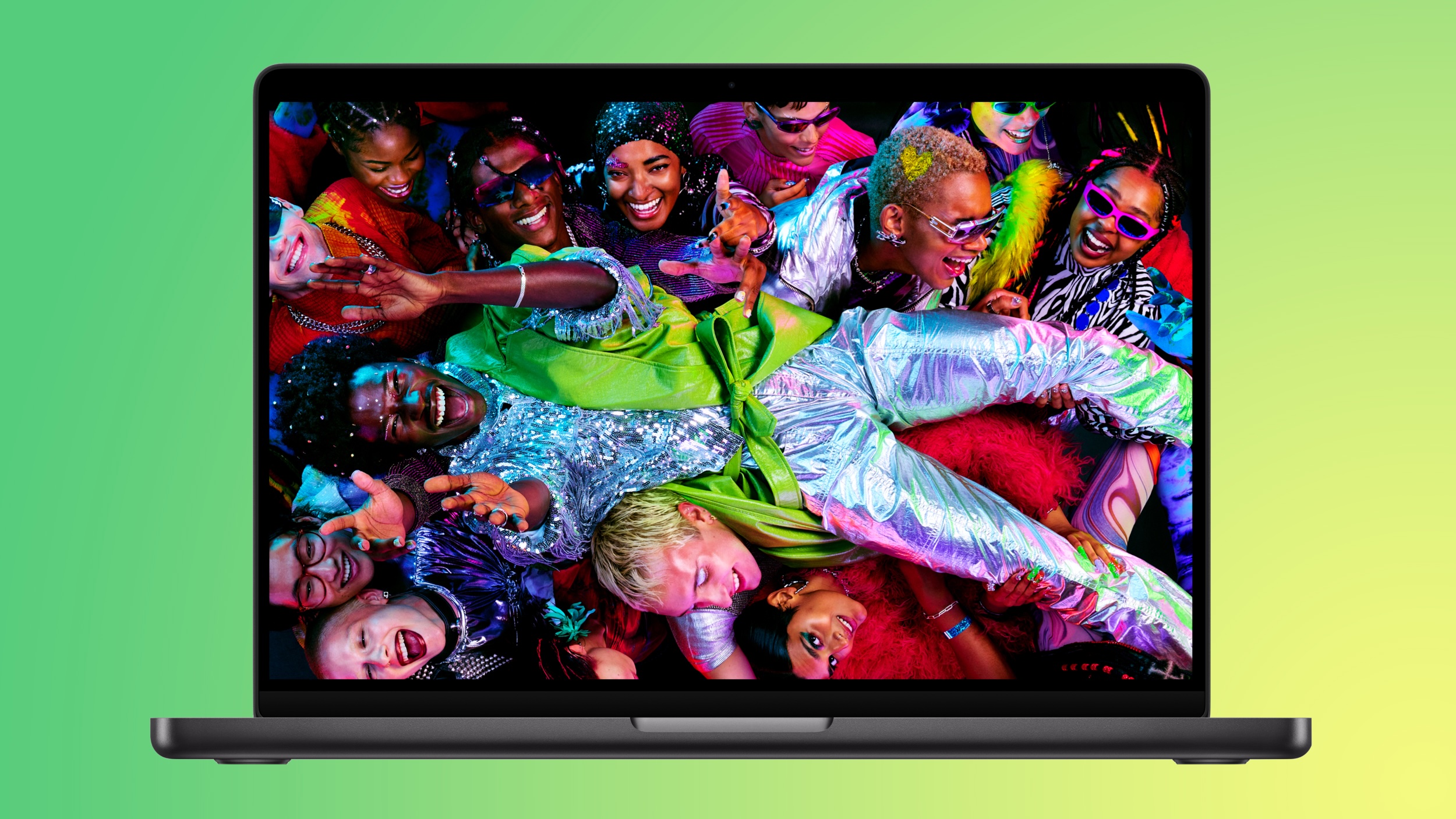
- 14-inch MacBook Pro (M5 Pro, 1TB) - $2,299.00 ($200 off)
- 14-inch MacBook Pro (M5 Pro, 2TB) - $2,499.00 ($500 off)
- 14-inch MacBook Pro (M5 Max, 2TB) - $3,599.00 ($500 off)
- 16-inch MacBook Pro (M5 Max, 36GB, 2TB) - $3,999.00 ($400 off)
- 16-inch MacBook Pro (M5 Max, 48GB, 2TB) - $4,499.00 ($500 off)
MacBook Pro
- What's the deal? Take up to $500 off MacBook Pro
- Where can I get it? Amazon
- Where can I find the original deal? Right here
Amazon's prices on the 2026 MacBook Pro have now joined in on Apple's recent price hikes, meaning we're no longer tracking pre-hike markdowns on these devices. However, there are still notable sales to be found if you're shopping for a MacBook Pro this month, with up to $500 off new prices available right now on Amazon.
AirTag
- What's the deal? Take $10 off AirTag 2
- Where can I get it? Amazon
- Where can I find the original deal? Right here
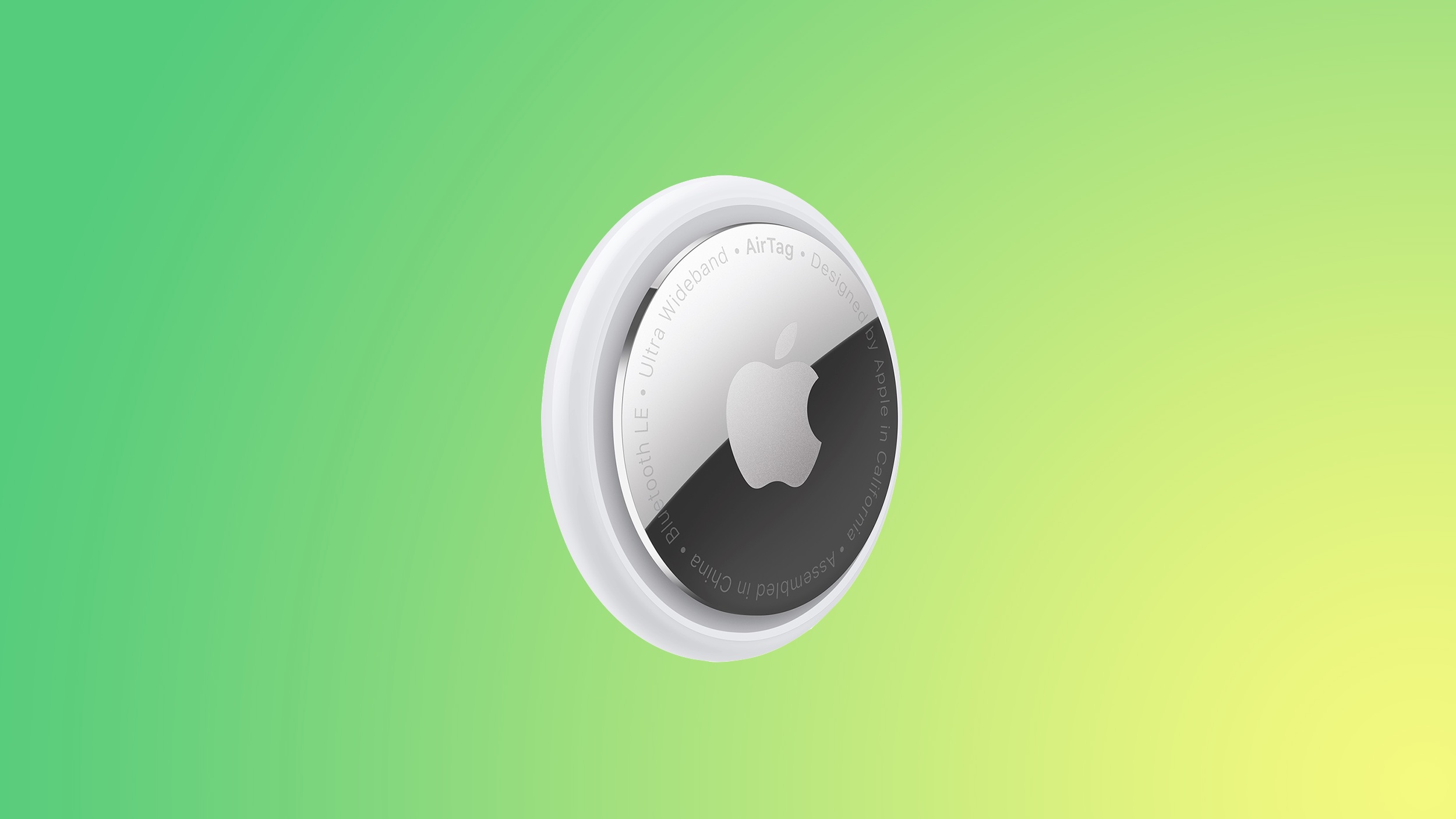
Apple's AirTag 2 is available for the all-time low price of $89.00 this week, down from $99.00. This sale is on the 4-Pack of the AirTag 2, and it's a match of the record low price first seen during Prime Day.
Apple Watch Series 11
- What's the deal? Take $99 off Apple Watch Series 11
- Where can I get it? Amazon
- Where can I find the original deal? Right here
Amazon this week has low prices on the Apple Watch Series 11, with $99 discounts across numerous models of the smartwatch. This sale includes a handful of 42mm and 46mm GPS aluminum models, but cellular devices are a bit more rare this time around.
If you're on the hunt for more discounts, be sure to visit our Apple Deals roundup where we recap the best Apple-related bargains of the past week.
Deals Newsletter
Interested in hearing more about the best deals you can find in 2026? Sign up for our Deals Newsletter and we'll keep you updated so you don't miss the biggest deals of the season!
This article, "Best Back to School Apple Bargains: MacBook Pro, AirPods, Apple Watch, and AirTag 2" first appeared on MacRumors.com
Discuss this article in our forums
Shazam Updated With iMessage Stickers Inspired by Ariana Grande's New Album
To send stickers in the Messages app, tap the plus sign in a conversation, select Stickers, tap on the Shazam app icon, and tap on a sticker. You can also send stickers in FaceTime and in other apps where the emoji keyboard is available.
Make sure to update the Shazam app to version 26.14.1 to see the stickers.
This article, "Shazam Updated With iMessage Stickers Inspired by Ariana Grande's New Album" first appeared on MacRumors.com
Discuss this article in our forums
iPhone 18 Pro Models Could Be Up to $300 More Expensive, Says Analyst
According to an earnings note by Jeff Pu of GF Securities, higher 2nm silicon and DRAM/NAND costs could drive the price hikes, as Apple grapples with global component shortages owing to the AI infrastructure buildout.
Currently, the iPhone 17 Pro and iPhone 17 Pro Max start at $1,099 and $1,199, respectively. In June, Apple increased the prices of iPads, Macs, HomePods, the Apple TV, and the Vision Pro. iPhone models were spared similar hikes. Pu believes price hikes on the next-generation Pro models could create "demand uncertainty." The analyst has subsequently downgraded AAPL from buy to hold.
It's a shift of tone from Pu, who in May said Apple could price the iPhone 18 Pro models "aggressively," despite rising memory costs.
During the company's Q3 earnings call on Thursday, outgoing Apple CEO Tim Cook did not comment on whether Apple plans to raise iPhone prices when the iPhone 18 Pro models and first foldable launch this September, but many analysts believe prices will go up.
This September, Apple is expected to unveil the iPhone 18 Pro models alongside its first foldable iPhone, which is expected to cost north of $2,000. The regular iPhone 18, iPhone 18e, and iPhone Air 2 are expected to launch in spring 2027.
This article, "iPhone 18 Pro Models Could Be Up to $300 More Expensive, Says Analyst" first appeared on MacRumors.com
Discuss this article in our forums
Russell Coker: Links July 2026
- [1] https://tinyurl.com/26cnn3og
- [2] https://tinyurl.com/22fewyml
- [3] https://tinyurl.com/2a5t693d
- [4] https://glasswings.com.au/blog/2026-07/05-185304.html
- [5] https://tinyurl.com/26qzcadm
- [6] https://tinyurl.com/2csg4huw
- [7] https://tinyurl.com/2blnzzxg
- [8] https://tinyurl.com/25v5j7v9
- [9] https://archive.md/Gq2jB
- [10] https://www.youtube.com/watch?v=3ddTIa-AhXE
- [11] https://tinyurl.com/2xt9dgfp
- [12] https://tinyurl.com/2y5f26rj
- [13] https://tinyurl.com/29ok2qsu
- [14] https://tinyurl.com/2yxzsp7s
Related posts:
- Links April 2026 Charles Stross wrote an interesting blog post about the apparent...
- Links July 2024 Interesting Scientific American article about the way that language shapes...
- Links February 2026 Charles Stross has a good theory of why “AI” is...
Otto Kekäläinen: Estonia, the country of the fit and the wit

While many Western democracies seem to be in a state of decay and are no longer the safe, civilized and prosperous countries they once were, there are still some European countries that are governed well. One of those that stand out is Estonia.
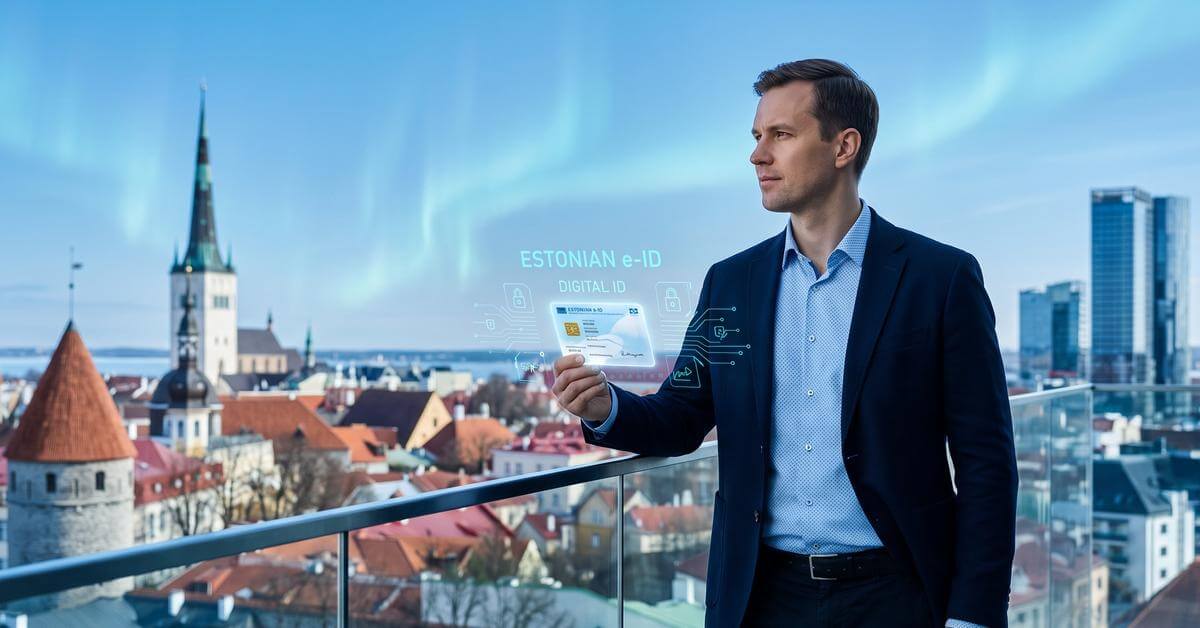
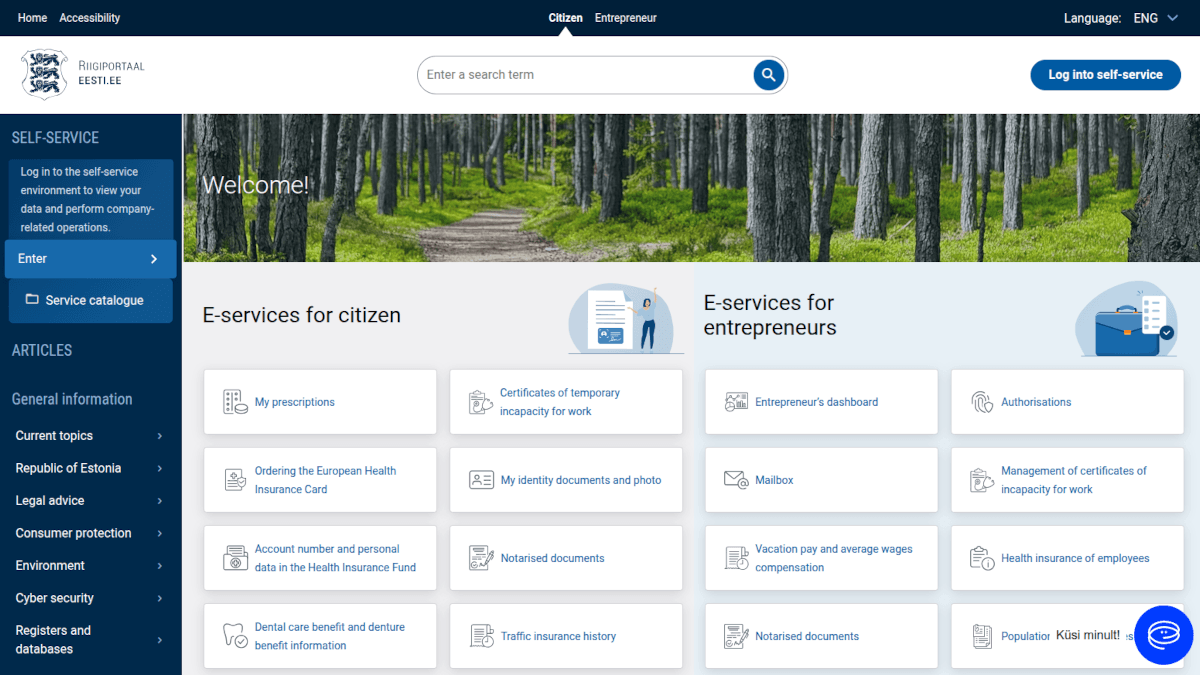
Estonia is probably most well known for multiple software companies that originated from there, such as Wise, Bolt, Pipedrive and Skype. The government itself is also famous for being early in issuing government IDs with an embedded smart chip for online authentication already in the 1990s. Via the national portal at eesti.ee all residents can access extensive eServices ranging from viewing their health benefits to filing taxes.
Estonia has also been running an e-Residency program since 2014, where they issue digital ID cards to foreigners, making it easy for them to remotely log into the government portals and for example, establish businesses, file annual reports and so forth. Note that the e-Residency is not a path to physical residency. Estonia does, however, have a separate Digital Nomad visa program that makes it easy for non-EU citizens to also physically establish themselves in Estonia, assuming, of course, you meet the criteria, which includes, among others, a minimum monthly income of 3960 € from outside Estonia. EU citizens naturally have free mobility inside the EU and can simply get an apartment and register as a resident in Estonia if they so choose. And there are plenty of reasons to do so.
Estonians value health, education and entrepreneurship
I moved to Estonia about one and a half years ago. In my observations Estonia strikes me as a country that values health, education (in particular programming and natural sciences) and entrepreneurship highly.
I don’t know how Estonians achieve it, but they look pretty fit and rarely obese. Estonia has rye bread and sauna in their culture just like Finland, and in addition the flat terrain and well-planned bike routes and extensive network of parks (and pull-up bars everywhere) seem to create an environment where it is easy to live in a healthier way. The consumption of processed foods and candy also seems relatively low among Estonians.
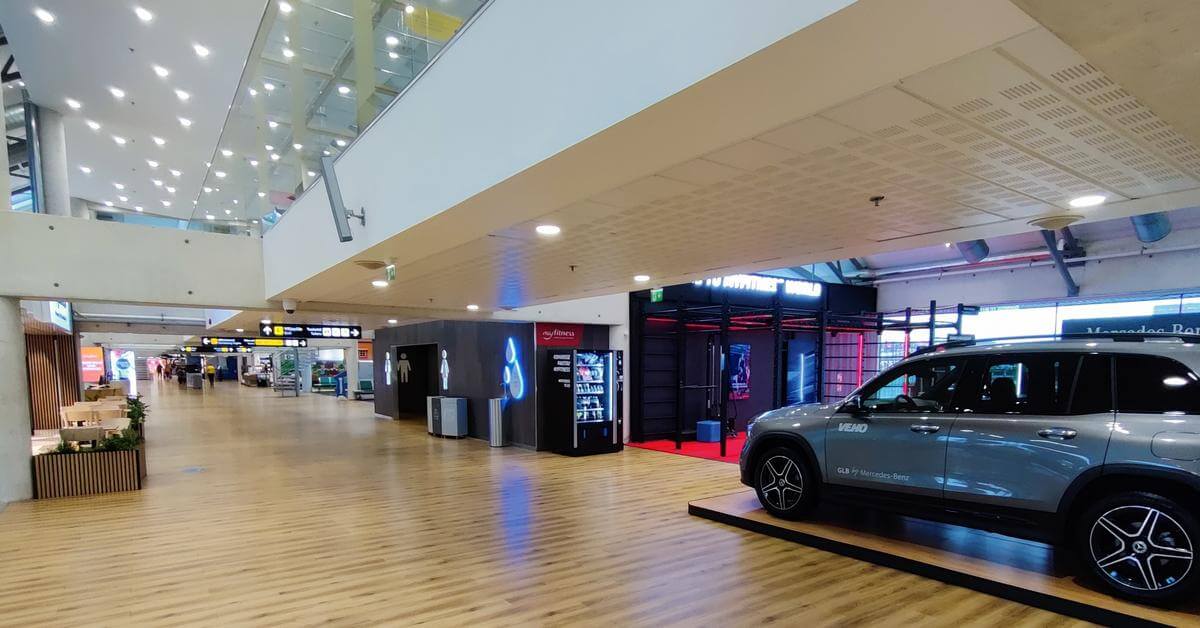
The gym chain MyFitness also seems to be present everywhere. Even the Tallinn airport has a calisthenics workout station right at the departure gates, which anyone is free to use while waiting for their flight to take off. One of the top longevity influencers in Europe, Siim Land, is Estonian.
Estonians also seem to value the school system highly. The government has been actively raising teacher pay and has a stated goal of reaching 120% of the national average by 2027. The students are also expected to value the education and respect their teachers. According to the TALIS 2024 survey (OECD’s international teacher survey), Estonian teachers spend significantly more time on actual teaching and learning and waste less time on interruptions or keeping classroom order compared to the OECD average. This is among the highest rates internationally, meaning they spend relatively little time on maintaining order or dealing with disruptions. While the international education benchmark PISA scores have been dropping globally, Estonia has consistently been climbing the ranks in past decades. In the latest PISA study (from 2022), Estonia ranked number one in Europe for reading, mathematics and science. In the overall results, Estonia ranked seventh globally, only behind countries such as Japan, Korea and Singapore.
Valuing entrepreneurship is evident in how the taxation system is set up in Estonia. Famously, in Estonia, companies can defer taxes on annual earnings and reinvest all of their profit in growing the company. Taxes are due only later, when paid out from the company, for example as dividends. For individuals, receiving dividends from any Estonian or foreign company is tax-free as long as the company paying dividends already paid corporate tax on the same income.
The tax system is also very simple. For all individuals, all types of income, including salary and capital gains, are always taxed at a flat rate of 22%. This removes the incentive for anyone to try to convert income into different types, setting up holding company structures and other optimizations as there is no gain. All entrepreneurs can simply focus on growing their business and forget extra bureaucracy. There is also no marginal tax rate cliff to stop working at – everyone is encouraged to always try to produce as much value as they can. A simple tax system is also reflected in the fact that anyone can easily read all tax rules that apply to individuals in plain English on the Estonian tax authority website, and one does not need to hire any accountants simply to file taxes.
Estonia also has a very straightforward investment account system: any person can freely open a self-directed investment account at any brokerage at no extra cost and report it as such to the tax authority, and then use it to save for an apartment, retirement, or other purposes, and defer all income taxes until withdrawal. There are no caps or time limits, and all residents are encouraged to save and invest as much as they can and thus take responsibility for their own wealth accumulation.
It seems that culturally Estonians respect people who are active and progress in their careers and businesses more than in other countries. Unlike in Finland, successful people are admired and living on government welfare is not romanticized. At the same time, the government benefits are less generous so people can’t live comfortably on them and, for example, many of the asylum seekers Estonia accepted have since left on their own initiative to other European countries in search of better benefits.
Low crime, high trust
Another thing that strikes me when walking the streets of Tallinn is that there are no drug addicts, beggars, thugs or the like. The difference compared to, for example, Vancouver (where I lived previously) is stark. In public buildings, people leave their coats and bags hanging in the lobby while visiting. Private houses and apartment block yards are not fenced. In my building, I noticed people even leave their bikes unlocked in the bike shed. I have also seen the staff of a coffee stall in a shopping mall going for a break and leaving everything unattended, not worrying that anyone would take anything while the staff is away.
This is not just my personal experience. According to the Numbeo crime index, Estonia has one of the lowest crime rates in the world. Also, comparing drug and property crime stats, for example, Finland has twice as much crime per capita, and places like Vancouver in Canada almost five times more.
I don’t have any clear explanation for why crime is so much lower in Estonia, but some suggest that higher social cohesion and lower levels of welfare contribute to people standing to lose more if they behave antisocially. Compared to Finland, Estonia also more readily jails repeat offenders, and those who are put on trial will experience a swifter court process thanks to simplified legal processes and more efficient governance.
Moving to Estonia: quick checklist
Moving to Estonia is very easy for any EU citizen, in particular if your work is not location-dependent (e.g., remote work or an online business) and you are simply looking for the cleanest and safest environment to live in.
First, check into a hotel in Tallinn, check out various neighborhoods to figure out what area you like (my favorites are Kalaranna, Kalamaja, Noblessner and Volta) and start browsing available apartments in English at kv.ee. Most professionals speak fluent English, so there should not be any difficulty in reaching out to people by email or phone.
The next step is to buy a local prepaid SIM card at e.g., an R-Kiosk or a convenience store as signing up for other matters later on will require an Estonian phone number. Once you have an apartment and e.g., signed a rental agreement, you can register in the population registry online.
After that, you have proof you are a local resident with an address and telephone number in Estonia. With local resident status, you can go to the police station to get a local ID card. Don’t bother scheduling an appointment, just go to the Tammesaare police station in Tallinn, take a queue number and wait. Once it is your turn, they will guide you on how to use the photo booth, fingerprint registration device, and file your application. A few days later you will receive an email confirming whether your application was accepted, and after a few more days, you will get another email notifying you that your ID card has been printed and is available for pick-up at the same location. This will also be your first practical experience of how fast and efficient the government in Estonia is.
Once you have the local ID card, you can use the smart card feature to log into all the government eServices and sort out the rest of the relocation process, such as registering tax residency and getting a family doctor.
How did Estonia evolve to be like this?
After Estonia regained its independence after the fall of the Soviet Union in 1991, the first elected government in 1992 was led by a very progressive 31-year-old Prime Minister Mart Laar, who managed to set up some very good policies and laid the foundation of a society that has evolved well in the decades since. Estonia was very lucky to have people in power in the 1990s who didn’t simply copy what other Western countries were doing, but who tried to think about things from first principles and create Estonia’s own model for efficient and fair governance. As a post-Soviet country, the population had also been vaccinated against overly socialist and unrealistic ideals, and everyone had a healthy distrust of the government’s ability to solve problems and emphasis was placed on people’s liberty to work for themselves as they best see fit. The improvement in living standards over the past 35+ years has also been witnessed by the population, and voting behavior supports keeping the country on the same trajectory.
General living standards still continue to improve as the nominal wage growth sits at around 6%, clearly above the annual inflation rate of about 3%. In 2026, the Estonian economy is expected to grow about 2.4%, which is faster than the EU average. The growth in Estonia is not the result of any accounting tricks - Estonia is part of the euro and can’t print its own currency, nor has it been funding the public sector with excessive debt. With a 24% debt-to-GDP ratio, Estonia consistently ranks as one of the most responsibly managed countries among advanced Western economies.
As wages in Estonia soon catch up with the EU average, and higher defence spending has forced the government to raise taxes in recent years, the economic growth that Estonia has enjoyed for 35+ years since it exited the Soviet Union might slow down a bit in future years. The policies that fueled this growth in living standards, however, are likely to stay.
The tiger leap
There is one specific government policy in Estonia’s history that I think should be highlighted in particular. Estonia was very progressive by announcing the Tiigrihüpe (Tiger Leap) program in 1996 with the goal of equipping all schools with computers and teaching all students the basics of programming. This surely had a large influence on why Estonia has so many successful software companies, why the government eServices are so mature that even neighboring countries like Finland are striving to copy the Estonian government’s IT architecture called X-road.
The Tiigrihüpe project was originally suggested in the mid-1990s by Toomas Hendrik Ilves, then ambassador of Estonia to the United States, Canada and Mexico, and later President of Estonia in 2006–2016. While he was a psychologist by education, he was also a self-taught amateur programmer and used his political influence to promote sensible adoption of information technology in both Estonia and the EU.
The history of Estonia has several prominent figures who were not lawyers by profession but engineers, scientists and historians who were very practical in their political decisions, which I think is now reflected in how government processes were formed.
The video below shows how the Estonian government advertises itself and what values they choose to highlight:
Should other countries adopt policies from Estonia?
Of course, not everything is perfect in Estonia either. The fertility rate of 1.16 in Estonia is very low. This trend is present globally, but in Estonia it is way below the EU average. Also, the service culture is something that needs to improve in Estonia. While services are in general fast and efficient, the attitude of people working in cafes and stores does not reflect a willingness to fill in gaps if the standard process falls short, nor are visitors actively made to feel welcome as individual humans, but are treated as mere process inputs.
However, many of the things listed earlier I think should be studied by policymakers elsewhere. Societies are complex systems and there is of course no guarantee that copying a single policy to another country with different ethnicities, history and ingrained culture would lead to the same policy outcomes. But considering that Estonia is a small country without favorable geography and no natural resources, and that it started out from a place of total chaos, low economic activity and high crime in 1992 to rise to what it is now in 2026, the success it has seen is surely largely a result of good policies, governance and culture that other countries can and should mimic.
Russ Allbery: Review: Painting the Blues in Gretna Green
Review: Painting the Blues in Gretna Green, by Linzi Day
| Series: | Midlife Recorder #2 |
| Publisher: | Linzi Day |
| Copyright: | November 2022 |
| ISBN: | 9798360228431 |
| Format: | Kindle |
| Pages: | 577 |
Painting the Blues in Gretna Green is a self-published fantasy novel and the second in the Midlife Recorder series. It picks up immediately after the end of Midlife in Gretna Green. I also read it almost immediately after, so I didn't pay attention to how good the recap of previous events was.
As before, this is urban fantasy except not urban. Day calls it paranormal women's fantasy, which I suppose is as good of a genre label as any. The other book I can think of off-hand that would go into that genre would be Nancy Springer's Larque on the Wing, although it is considerably more literary.
I suspect I'm going to read this whole series and it's going to be impossible to review these books without talking about Niki's job, so I'm not going to treat that as a spoiler. It's fairly well-advertised in the marketing for the book, so that feels justified. If you're particularly averse to any spoilers, though, you may want to stop reading here until you've gotten to the reveal in the first book.
Niki is now officially the Recorder, with the power, advice book, and sentient house to go with it. She's about to face her first test in managing interworld politics: There's something amiss in the world of the Picts. Her allies are dropping hints, there's a petition from a group on the Pict world that she can't make sense of, and although she likes the queen of the Picts, there is a great deal of tension beneath the surface that she doesn't understand. Meanwhile, after the incompetent disaster that she uncovered in the first book, Niki is determined to pick her new staff by her own criteria.
The second book leans even harder into giving Niki both a tangled mess created by previous incompetence and enough power to fix it. Watching that happen is very satisfying, particularly when it involves surprising people who are rather too used to getting their own way.
I was somewhat less convinced that Niki is getting the right training to make the decisions that she's making. Diplomacy and staff management are real skills that one needs to learn, not just wing on vibes and gut instinct. My love of competence porn occasionally wishes that Niki had a bit more structure around her competence. We do at least get a new fictional self-help book on how to rule that contributes the quotes that open each chapter. Not the ethics and management training that I would have chosen, but it's something!
In defense of Niki's technique, it becomes clear in this book that the last few recorders have been far too cautious, conservative, and content with a status quo that involved a minimum of work. One of the delights of this book is that Niki thinks power exists to be used to fix things and is determined to use it, not just sit on it. I had more suspension of disbelief issues with this book than with the first — some of the problems Niki is solving seem far too obvious to have been in stasis for this long while also having this easy of a solution, and the level of political power given to the Recorder is a bit unbelievable — but it is so satisfying to see Niki cajole and bully people into being sensible.
I have no idea if this is intentional on Day's part, but I will not be at all surprised if adult-diagnosed ADHD comes up at some point in this series. The way that Niki's focus jumps, her tendency to veer between focusing on a problem and forgetting about it, and something about the way she switches between trains of thought or misses important context because she's jumping to conclusions is making me wonder. This, to be clear, is not a complaint; I think it makes Niki more relatable and more interesting. It's a good thing that she has a sentient house to serve as her assistant. The glee with which she's delegating any task that involves keeping track of details or following up with other people feels like a bit of an indicator by itself.
I did get a bit frustrated with the plot structure of this book. Niki keeps mentioning that a critical petition submitted to her office makes no sense, but it takes half of this (rather long) book before she finally explains to anyone else, even the reader, what's deficient about it. The excuse within the book is that she's having a rather busy day, but by the third time Niki mentions and then fails to do anything about the petition, I was wishing Day would stop bringing it up until she was ready for that part of the plot.
This, as with a few issues in the previous book, feels partly like an editing problem. There is something joyful in indulgent, sprawling books, but only up to the point where they become repetitive. Painting the Blues was right at that line, and once again I wish someone had helped Day trim about fifty pages out of it.
All that said, and despite having more quibbles with this book than the previous one, this continues to be great fun. It's satisfying wish-fulfillment about fixing long-standing problems and having the power to not have to put up with abusive nonsense and ridiculous bullshit, and I am so here for that. I hope Niki realizes she's eventually going to need more refined skills than a heart-to-heart over wine, but she's learning on the job and I'm happily along for the ride. She's also capable of recognizing skill in other people, and that goes a long way.
Recommended if you liked the first one and are in the mood for another fantasy of "no, we're not going to leave it that way, we're going to fix that right now."
Followed by Ties that Bond in Gretna Green.
Rating: 7 out of 10
MacBook Ultra's New Design Won't Stay Exclusive for Long
Bloomberg's Mark Gurman last week laid out Apple's plan to refresh every Mac it sells over the next two years. In the report, he mentioned that the entry-level 14-inch MacBook Pro due in 2027, reportedly code-named K104, is said to resemble the design of the high-end K114 and K116 machines while using a standard M7 chip. The design debuting on the rumored "MacBook Ultra" would therefore reach a considerably cheaper Mac within roughly a year of launch, a pattern first reported at the start of July.
Apple last redesigned the MacBook Pro in 2021 alongside the introduction of the M1 Pro and M1 Max chips, and that overhaul ran in the opposite direction to this one. The machine grew thicker and heavier, and Apple restored the HDMI port, the SD card slot, and MagSafe charging that it had stripped out in the preceding generation. Five years on, the company is apparently trying to reverse the thickness.
The chassis is expected to be noticeably thinner and lighter. Swapping a mini-LED backlight for a hybrid OLED stack removes an entire physical layer from the lid, since OLED pixels emit their own light. There has so far been no indication that Apple intends to sacrifice ports to find the rest of the millimeters, which is just as well given how poorly that went last time.
The front of the machine is where the change should be most obvious. The notch is expected to disappear in favor of a much smaller hole-punch camera, a change first indicated on a roadmap from research firm Omdia and since corroborated by Bloomberg. The cutout is said to be pill-shaped, paving the way for an interactive Dynamic Island that expands contextually in the way it does on the iPhone.
Whether the screens themselves will grow is less settled. Omdia claimed that Samsung Display will supply 14.3-inch and 16.3-inch panels, marginally larger than the 14.2-inch and 16.2-inch displays on current models, which would imply slimmer bezels wrapped around a slightly bigger screen. A February report from Bloomberg, however, indicated that screen sizes were not expected to change, but that rumor may not have accounted for a slight reduction in bezels.
Apple is said to be fitting a reinforced hinge so the display does not wobble when tapped, but it is not clear if this will result in any external visual changes. Gurman described the approach to touch as "touch-friendly, not touch-first."
What will become of the high-end MacBook Pro is still a loose thread. Gurman's roadmap lists a high-end 14-inch and 16-inch "MacBook" without the Pro suffix, and no separate high-end MacBook Pro sits alongside it, though that phrasing is hard to lean on when the exact branding itself is unresolved. The new MacBook "Ultra" could replace the current M5 Pro and M5 Max models outright at a higher price point or arrive above them as a genuinely new tier while they stay on sale.
If the high-end MacBook Pro gains Apple's next-generation M7 Pro and M7 Max chips in late 2027, considering that the entry-level M7 model will gain the MacBook Ultra's design in the first half of that year, it seems inevitable that the high-end machines will follow, meaning that all five of Apple's most powerful laptops will share the same overall design.
This article, "MacBook Ultra's New Design Won't Stay Exclusive for Long" first appeared on MacRumors.com
Discuss this article in our forums
Jonathan McDowell: My CPU died
I built my current house server back in 2019. It had an upgrade from the original Ryzen 2700 to a 5700G in late 2021, but otherwise is still running with the original setup. Back in November it developed some erratic behaviour (initially manifesting as problems with the TPM, which is ironic as I’ve spent a bunch of time at my day job trying to improve TPM reliability), culminating in unreliable reboots. I had a limited amount of ability to swap parts out, but ultimately decided it was a motherboard issue (thinking perhaps VRM problems), found a replacement locally, and everything seemed fine.
Until May.
At that point I rebooted the machine for a Debian point release, and it failed to come back. Fans would spin, but there was no sign of actual life. I ended up pressing a temporary machine into service (that could at least run the Home Assistant container, and a few other critical bits) while I tried to work out what was wrong. I’d kept the previous motherboard, and still had the Ryzen 2700, so I did a bunch of swaps (and obtained a motherboard buzzer to try and get some indication about whether there were useful beep codes being emitted), and ultimately came to the conclusion that the CPU had died.
I’m not quite clear what happened here. I played it safe and replaced the PSU at the same time, in case that was the original cause back in November and ultimately damaged the CPU, but both old + new motherboards worked just fine with the 2700.
That left a decision about what to do. This previous server was from 2013, so this machine has now lasted longer than that and I could justifiably upgrade. However when I went to look at what the equivalent modern machine would be it’s only a couple of generations later (Zen 5 vs Zen 3), and 64GB RAM alone would have set me back ~ £1k. For not a lot of gain. So I ended up buying a replacement Ryzen 5700G, hopefully allowing me to put off thinking about an upgrade until Zen 6 is out, and RAM prices are saner (though I understand that might take a couple of years).
It’s not the first time I’ve had a faulty PSU be the cause of a dead machine, but it was a pretty frustrating experience.
Apple Says App Store Changes and Mobile Gaming Softness Affected Services Revenue
Apple's services revenue was $30.7 billion, a 12% increase over the $27.4 billion it earned in the year-ago quarter. Though the category saw growth, revenue came in under expectations, prompting analyst questions that led to Parekh's comments on the App Store.
We also had some factors that impacted the performance of the App Store. We did see some headwinds in mobile gaming, and then keep in mind, we also made some changes to the App Store business model in certain countries, and in the U.S., we do continue to operate under a court ruling impacting the link-out transactions. But we're pleased the Supreme Court will hear our appeal.
There have been App Store fee updates in Japan and Brazil as of late, with Apple collecting no fees on link-outs in the U.S. and lower fees from alternative app marketplace apps in the EU. Despite the rule changes, the App Store still set a June quarter revenue record. Apple saw double-digit growth in cloud services, video, payment services, and advertising, with a record level of Apple Pay users.
During the call, Apple also said it now has 1.5 billion paid subscriptions, with transacting and paid accounts hitting an all-time high.
Parekh said it wasn't the App Store alone that impacted services revenue, and Apple also took a hit from foreign exchange. Last year, Apple also had the theatrical release of F1, and no equivalent release this year, making for a tougher compare.
Services growth in the September quarter is expected to be similar to the June quarter when excluding an approximately 2.5 percentage point foreign exchange headwind.
This article, "Apple Says App Store Changes and Mobile Gaming Softness Affected Services Revenue" first appeared on MacRumors.com
Discuss this article in our forums
Apple Plans Paid iCloud+ Upgrades for Heavy AI Users
During today's earnings call for the third fiscal quarter of 2026, Apple CEO Tim Cook said it's early, but the company expects to offer options for people who want to make heavy use of AI services.
In terms of what it means for compute cost, it's obviously early going for us, and so I don't want to say that we have a complete plan for that. We do believe there will be people that want to use it a lot and we will have some kind of upgrade possibilities on iCloud+ where people can buy up the stack on iCloud+. We'll see how the pickup for that is.
At WWDC, Apple said there would be daily usage limits on features like Image Playground, but increased access would be available through iCloud+ plans. Cook's comments today suggest there may also be iCloud+ add-ons specifically for AI usage.
Apple hasn't offered any details on what it might charge to increase AI limits, and that's information that we might get when iOS 27 launches in September. Features like Siri AI are expected to remain free to use.
This article, "Apple Plans Paid iCloud+ Upgrades for Heavy AI Users" first appeared on MacRumors.com
Discuss this article in our forums
Tim Cook: Apple 'Reluctantly Raised Prices' Due to '100-Year Flood on Memory Pricing'
On the pricing front, you know, we reluctantly raised prices. I would say we did it because we're in what I would characterize as a 100-year flood on memory pricing with exponential increases in memory prices, so that was the rationale for it.
When asked whether Apple is aiming to protect gross profit dollars or product gross margins when considering pricing increases, Cook said it's multifactorial.
In terms of our philosophy on dollars or percentages, we look at units, revenue, and margin, and then come to a business judgment as to how to handle that, and so it's not a mathematical formula that gets us to a specific result, or just looking at one dimension of that. We look at all three dimensions and think about it over the long term instead of, you know, a 90-day clock.
Cook did not comment on whether Apple plans to raise iPhone prices when the iPhone 18 Pro models and first foldable launch this September, but multiple analysts believe prices will go up.
Cook said Apple is expecting to pay higher memory costs in the September quarter, though Apple will be able to partially offset it with lower costs on some non-memory components and a stockpile of inventory.
This article, "Tim Cook: Apple 'Reluctantly Raised Prices' Due to '100-Year Flood on Memory Pricing'" first appeared on MacRumors.com
Discuss this article in our forums
Tim Cook Thanks Shareholders on His Final Apple Earnings Call
I just wanted to take a moment to say thank you to all of you, from our shareholders, particularly our long-term shareholders who have put their trust in us for so many years, to the analysts who have followed our company so closely. As you know, this will be my final earnings call, and John will lead these calls going forward.
Cook said the transition to Ternus is "going seamlessly," and he is excited for Ternus to lead Apple into its next era.
As I've said, I couldn't be more confident in his leadership, in our executive team, and in the extraordinary people at Apple who are determined to enrich the lives of our users all over the world. We have a bright future ahead, and I truly have never been more optimistic.
While Cook is stepping down as Apple's CEO, he said earlier this year that he plans to serve as executive chairman "for a long time." He said Apple will continue to be his top priority.
This article, "Tim Cook Thanks Shareholders on His Final Apple Earnings Call" first appeared on MacRumors.com
Discuss this article in our forums
Apple Warns of Growing Supply Constraints for iPhone, iPad, and Mac
Supply constraints will impact the iPhone, iPad, and Mac. Cook said Apple is seeing less flexibility in the supply chain than normal and an issue with the availability of the advanced nodes that Apple's chips are produced on.
We continue to expect high levels of demand. However, with less flexibility in the supply chain, we expect the impact from the supply constraints to increase significantly sequentially.
He said the cause is not a regular supply issue, but a demand forecast issue. The iPhone and Mac are doing "remarkably better" than Apple expected.
Let me stress again. This isn't a partner or supplier issue... It's an incredibly strong iPhone and Mac product cycle that has really yielded a demand beyond our expectation.
Cook also commented on memory shortages. He said Apple paid more for memory in the June quarter than the March quarter, and the company expects to pay even higher memory costs in the September quarter. He said Apple will be able to partially offset the increased costs in two ways, but memory will continue to be problematic.
The first is, as you would expect, we have benefited from some carry-in inventory in the September quarter. However, we believe we will see decreasing benefit of this over time beyond the September quarter. The second is we're expecting lower cost on certain non-memory components. Then if you look beyond September, we see the market pricing for memory continuing to increase and have an increasing impact on our business. [...]
The DRAM market has three suppliers. Obviously, if there were more suppliers, that would be good, and it would help us on the supply side and perhaps the pricing side. It's unclear on the pricing side, but it could help on the supply side. And so we're evaluating all options.
Apple is planning to release new iPhone models in September, including the iPhone 18 Pro, iPhone 18 Pro Max, and its first foldable iPhone.
This article, "Apple Warns of Growing Supply Constraints for iPhone, iPad, and Mac" first appeared on MacRumors.com
Discuss this article in our forums
Apple Reports 3Q 2026 Results: $29.8B Profit on $109.4B Revenue
For the quarter, Apple posted revenue of $109.4 billion and net quarterly profit of $29.8 billion, or $2.02 per diluted share, compared to revenue of $94.0 billion and net quarterly profit of $23.4 billion, or $1.57 per diluted share, in the year-ago quarter.
Apple set new June quarter records for total revenue and earnings per share, as well as for iPhone, Mac, and Services revenue.
Gross margin for the quarter was 50.1 percent, compared to 46.5 percent in the year-ago quarter. Apple also declared a quarterly dividend payment of $0.27 per share, payable on August 13 to shareholders of record as of August 10.
"Today, Apple is proud to report our strongest June quarter ever, with double-digit revenue growth across iPhone, Mac and Services, and in every geographic segment," said Tim Cook, Apple's CEO. "At WWDC26, we were thrilled to introduce the all-new Siri AI, alongside all of Apple's latest software innovations and important new child safety features."
Apple will provide live streaming of its fiscal Q3 2026 financial results conference call at 2:00 p.m. Pacific, and MacRumors will update this story with coverage of the conference call highlights.
Conference call recap ahead...
1:38 pm: "We are very pleased with our record business performance during the quarter, which set new June quarter records for both EPS and operating cash flow," said Kevan Parekh, Apple's CFO. "Our installed base of active devices also reached a new all-time high across all major product categories and geographic segments."
1:39 pm: After declining around 1.4% in regular trading today, Apple's share price is currently down another 2.5% in after-hours trading following the earnings release.
1:42 pm: Mac revenue was up 28.7% year-over-year, while iPhone revenue was up 21.7%, Services revenue was up 12.1%, and Wearables, Home and Accessories revenue was up 6.5%. The only product segment that saw a year-over-year decline was iPad, which was down 5.9%.
1:45 pm: Looking at Apple's geographic segments, Europe and Greater China each saw a 22.4% increase in revenue, Japan was up 13.4%, and the Americas had an 11.1% increase. The Rest of Asia Pacific outside of Greater China and Japan had a 15.6% increase.
1:55 pm: Apple's stock price is now down nearly 4.5% in after hours trading, just minutes before Tim Cook's final quarterly earnings call as CEO.
2:01 pm: The call is now beginning with the standard warnings about forward-looking statements from Suhasini Chandramouli, Apple Investor Relations chief. On the call is CEO Tim Cook, CFO Kevan Parekh, and, for the first time, incoming CEO John Ternus.
2:02 pm: "Good afternoon everyone, and thanks for joining the call. Today, Apple is pleased to report $109.4 billion in revenue, up 16% from a year ago and a June quarter record."
2:03 pm: The company had supply constraints and foreign exchange headwinds, but still reached the record.
2:03 pm: "We achieved June quarter records in every geographic segment... We achieved June quarter records in both developed and emerging markets."
2:04 pm: Tim is going over the announcements from WWDC, including and especially Siri AI. "The reviews from early users have been phenomenal."
2:04 pm: "We are feeling incredibly enthusiastic about the impact it's going to have."
2:06 pm: Starting with iPhone, revenue was $54.3 billion, up 22% from last year. It was a June quarter record across every geographic segment and a record for upgraders. IDC says the company gained share globally during the quarter. "This is the most popular iPhone lineup we've ever had."
2:07 pm: Mac delivered its best June quarter yet, with $10.4 billion in revenue, up 29% from last year despite significant supply constraints. Driven by MacBook Pro and MacBook Neo. IDC says the company gained share globally and set a June quarter revenue record in developed markets and an all-time record in emerging markets, with particular strength in Greater China.
2:07 pm: "The Mac lineup delivers outstanding power-efficient performance, massive memory bandwidth, and next-level AI capabilities."
2:08 pm: MacBook Neo has been especially popular, with its distinctive design and excellent value resonating with customers around the world.
2:09 pm: iPad revenue was $6.2 billion for the June quarter. The addition of M4 to iPad Air "has made it even more capable, delivering a significant performance boost."
2:09 pm: Revenue for Wearables, Home and Accessories was $7.9 billion, up 6% from a year ago, growing in every geographic segment.
2:10 pm: "We continue raising the bar across our AirPods lineup... with Live Translation powered by Apple Intelligence, people are crossing language barriers and connecting like never before."
2:11 pm: "We began laying the groundwork for users to have the best possible experience with AI when we introduced a neural engine in 2017... Ever since then, we've innovated and invested deliberately in silicon systems and scalable unified memory architecture designed with AI at their core."
2:12 pm: "Apple has created the world's best hardware to experience AI, whether using Apple Intelligence, including Siri AI, or third-party offerings."
2:12 pm: Services revenue was $30.7 billion, up 12% from a year ago, "despite significant foreign exchange headwinds."
2:13 pm: Ted Lasso returns to Apple TV next week for its fourth season, and the company just won a Tony Award, and has 89 Emmy Award nominations.
2:14 pm: "We're halfway through an unforgettable year of F1, and Apple TV subscribers have been tuning in all season."
2:14 pm: In Retail, Apple Upgrade was just launched for customers in the US.
2:15 pm: "In honor of Global Accessability Awareness Day, we unveiled new features to help users get more out of the products they use every day."
2:16 pm: "We're doing our part to invest in innovation close to home. Last year we made a $600 billion commitment to the US over four years, and now we've planned to reinvest the tariff refunds we've received into the US." There's a new agreement with Broadcom to design and produce custom silicon components and cutting-edge wireless connectivity technologies. The agreement is expected to exceed $30 billion in US spending.
2:17 pm: Apple is going to make the Mac mini at the Advanced Manufacturing Center in Houston, and will train employees and suppliers in how to build products.
2:17 pm: "We will remain guided by our north star: building products and services to enable people to do magical things."
2:18 pm: "I couldn't be more excited to watch our phenomenal story of innovation continue to unfold, and I've never been more confident that the best is yet to come."
2:18 pm: Kevan is on now to go into more detail on financials. Revenue of $109.4 billion was up 16% year over year. Product revenue was $78.7 billion, up 18% year over year. Install base reached a new all time high of over 2.5 billion. Services revenue was $30.7 billion, up 12% year over year.
2:19 pm: Company gross margin was 50.1%, up 80bp sequentially, including a benefit of tariff refunds, with an impact of 2%. If you remove this impact, we would have been at the middle of the guidance range. Product margin was 40.1%, up 140 basis points. Tariff refunds had an impact of 2.5%.
2:20 pm: OpEx was $19.1 billion, up 23%, driven by investments in R&D. Net Income was $29.8 billion. $34.4 billion in operating cash flow, setting new June quarter records even when excluding tariff refunds.
2:20 pm: iPhone was $54.3 billion, up 22%. iPhone active install base grew to an all-time high and set a June quarter record for upgraders. iPhone was the top selling model in the US, urban China, the UK, France, Australia and Japan.
2:21 pm: Mac revenue was $10.4 billion, driven by the strength of MacBook Neo and MacBook Pro. Grew in both developed and emerging markets. Customer reception of MacBook Neo "has been incredible." Mac had its best quarter ever for customers new to the Mac and for upgraders.
2:22 pm: iPad revenue was at $6.2 billion, down 6% year over year against a difficult compare. More than half of customers who purchased an iPad were new to the product.
2:22 pm: Wearables, Home and Accessories revenue was $7.9 billion, up 6% year over year. More than half of customers purchasing an Apple Watch were new to the product.
2:23 pm: Services revenue was $30.7 billion, up 12%, despite "significant sequential FX headwinds."
2:23 pm: "We are optimistic about the long-term future of our Services business... we have an incredibly strong foundation for growth opportunities."
2:24 pm: Morgan Stanley has deployed more than 20,000 iPhone 17 devices, as part of a shift from employee-owned to corporate-owned devices for liability and security.
2:25 pm: Pinellas County Schools in Florida is transitioning 25,000 students from Windows devices to MacBook Neo.
2:25 pm: "About half of the MacBook Neo purchases by US education institutions replaced Windows and Chromebook devices."
2:26 pm: Ended the quarter with $147 billion in cash and $84 billion in debt. Returned $33 billion to shareholders, including $4 billion in dividends and $25.8 billion in share repurchases.
2:27 pm: Forward projections assume no changes to global tariff rates and that the global macroeconomic outlook does not get worse. "We also expect our September quarter total company revenue to be impacted by two main factors. First, we expect foreign exchange to be a sequential headwind of about two and a half percentage points to the year-over-year total company growth rate from the June quarter over the September quarter."
2:28 pm: Expect total company revenue to grow 9-11% next quarter, and expect iPhone revenue to be impacted by foreign exchange headwinds and supply constraints. iPhone reported growth rate is expected to be mid-teens year over year. Gross margin should be between 47% and 48%, with approximately 1% benefit related to tariff refunds. OpEx between $19.1 and $19.4 billion.
2:28 pm: Cash dividend of $0.27/share, payable on August 13.
2:29 pm: Tim is taking back over. "I just wanted to take a moment to say 'thank you' to all of you. From our shareholders, particularly our long-term shareholders, who have put their trust in us for so many years, to the analysts who have followed our company so closely."
2:29 pm: "I am beyond excited for John to step into his new role and lead Apple into its next era. He is truly one of the kind, and there is no better person to take the helm of the company."
2:29 pm: "I couldn't be more confident in his leadership, in our executive team, and in the extraordinary people at Apple that are determined to enrich the lives of our users all over the world. We have a bright future ahead, and I truly have never been more optimistic. So thank you all."
2:30 pm: Now we're moving to the Q&A with analysts.
2:32 pm: Q: Tim, best of luck, it's been a pleasure working with you over the years. On the 9-11% growth, that's a deceleration. How much of this is supply constraints vs FX?
A: We expect revenue to grow by 9-11% year over year, impacted by FX to be a sequential headwind of 2.5% to year over year total company growth rate. On supply constraints, we expect that to impact significantly, affecting iPhone, Mac and iPad. Combine those two factors, we get pretty close to the June overall company growth rate.
We did experience supply constraints primarily on the Mac and to a lesser extent to iPhone and iPad, driven by very high levels of demand and less flexibility in the supply chain than normal. The constraints are primarily driven by availability of the advanced nodes that our SOCs are produced on. Looking forward, we continue to expect high levels of demand, but with less flexibility on supply chain, and impact on the supply chain to increase significantly. To affect iPhone, Mac and iPad, we're seeing some very significantly constraints currently with limited flexibility in the supply chain to remedy it.
2:35 pm: Q: Apple has historically done a great job to deliver capability and utilty to customers without really making them pay disproportionately more. There are reports that suggest that you're seeking greater sourcing flexibility for memory. Can you just talk about is this building options really about ensuring that you have supply and it's a way to mitigate memory inflation, or is it more preserving a value proposition?
A: We paid more in March for memory than December quarter, and we paid more in the June quarter than March. We expect this to continue to get worse in September. We had some benefit from carry-in inventory, but we believe this will see decreasing benefit from this over time beyond the September quarter. Second, we are expecting lower costs on certain non-memory components that are in our BOM, and if you look beyond September we see the market pricing for memory continuing to increase which could drive an increasing impact on our business. In terms of sources of supply, primarily the DRAM market has three suppliers. If there were more suppliers, that would be good and it would help us on the supply side and perhaps the pricing side, though the pricing side is unclear. It could help on the supply side. We're evaluating all options.
2:37 pm: Q: On the Apple Upgrade program, do you see it shortening the replacement cycle for iPhone, and having an impact on Mac and iPhone and having an impact because those two haven't had benefits of subsidies?
A: If you look at the program, it makes it easier for customers to get their hands on our latest products with a leasing plan that's right for them. The residual values on Apple products tend to be much higher than residuals on the competition. It's a way to get into a product on an affordable basis, particularly for customers who want to upgrade on some kind of schedule. It is offered in our retail stores, not across all channels, so we'll see what the customer uptake is. The early feedback on it is quite positive, also it's only available in the US right now.
2:39 pm: Q: On Apple Intelligence and iOS 27, can you talk about learnings from the public beta, will the new Siri AI be a demand driver for the iPhone this holiday, how does Apple intelligence usage in the open beta drive your thinking on compute costs and your ability to recover costs through iCloud Plus?
A: We are off the charts excited about Siri AI. We released the developer beta immediately after the keynote. Developer feedback, reviewers and so forth have been overwhelmingly positive. Released as a public beta and the continued feedback is really great. I think it's a big idea to have AI based on your personal context and that's integrated across the operating system. It's early going and I don't want to say we have a complete plan for that, we do believe there will be people who want to use it a lot and so we will have some kind of upgrade possibilities on iCloud+ where people can buy up the stack, and we'll see how the pickup for that is. We could not be more excited about where the product is.
2:43 pm: Q: Wanted to ask about supply constraints, what we're struggling with after hours, how much do these supply constraints impact you in December and we did a pretty good job taking that number into the higher single digits, is there any guidance that you can give us there?
A: Let me talk about the constraints a little more, the primary issue is advanced nodes that we run our SOCs on. That's the primary supply constraint now. The root cause of it is not a regular supply issue. It's a demand forecast issue to be candid. Where iPhone and the Mac are both doing remarkably better than we thought they would do, and we had high expectations and it wasn't that our expectations were low. From iPhone's growth being 22% and Mac at 29%, these are extraordinary numbers and the supply chain has less flexibility than normal. We've been pulling supply ahead and at some point there's a limit to that. Now we have a quarter where we'll be scrambling on the supply side eventually.
Combined with foreign exchange impact, that's really what's built into the 9-11 percent growth rate. Beyond December we're not providing any color beyond the September quarter.
2:45 pm: A: This isn't a partner or supplier issue, it's a great issue in some ways, it's an incredibly strong iPhone and Mac product cycle that has yielded demand beyond expectations. In Arizona, we source more than 100 million components this year, so it is part of our $600 billion commitment to the US and we could not be more pleased with how that fab has ramped and is producing for us.
2:46 pm: Q: It is your intention to pursue some agreements to ensure access to supply at pre-agreed prices, when you approach product pricing, are you trying to protect margins or gross profit dollars? What's your thoughts on pricing?
A: We reluctantly raised prices and because we're in a 100-year flood on the memory pricing with exponential increases in memory prices. That was the rationale for it. In terms of our philosophy on dollars or percentages, we look at units revenue and margin and then come to a business judgement as to how to handle that. It's not a mathematical formula that gets us to a specific result or looking at one dimension of that. We look at all three dimensions, thinking about it over the long term instead of a 90-day clock.
2:49 pm: Q: 12% services growth was slightly below guidance, maybe FX played a role, can you help us understand the function factors underlying the deceleration, if that App Store, some third-party data sources, is that a function of AI reprioritizing time away from the App Store? Just looking at the moving pieces on Services.
A: Let's walk from our 16% to second quarter to 12% in the June quarter, FX was the main driver in the year over year growth rates. Last year we had the theatrical release of F1, we also had some factors that impacted the App Stores, some headwinds in mobile gaming and some change to the business model in certain countries, and in the US a ruling on the link out for transactions. App Store set a June quarter revenue record. Several positive trends, strong double digit growth in a number of sectors. Revenue records in every category. Apple TV viewership set an all time high in the quarter. Apple Pay saw a record number of users in both developed and emerging markets. Services continue to attract more customers, passing more than 1.5 billion paid subscriptions.
2:50 pm: A: When we step back and look at how we landed, I would say that we roughly met our expectations but saw some more softness on mobile gaming and the App Store. In September, FX will continue to be a headwind, impacting Services more than the whole company. FX will drive a 5% headwind from March to September quarter. We are going to see another 2.5% sequential headwind from June to September.
2:52 pm: Q: As you look at demand, how do you assess whether you're seeing pull-forward of demand from consumer or enterprise or education, and if you're factoring that into your views as we look forward.
A: You're talking about iPhone I presume, we've been running at this 24% growth rate for a while, it's not obvious that what you're asking is true. We've now had to increase prices on iPad and Mac, the price elasticity there it's too early to come to a conclusion of what happens there. It takes a little while for the channels to adjust since there's channel inventory, and takes a while for the consumer to respond so we'll understand that more in the weeks ahead.
2:53 pm: Q: Longer term, thematically, AI proliferates towards the edge, do you see AI opening additional opportunities and do you see other addressable markets evolving from AI over time?
A: These are enormous opportunities for Apple moving forward in AI. I'm so excited for Siri AI, where it is and where it's going. I'm excited about the feedback that we're getting there.
2:55 pm: Q: On Siri AI, do you expect that Siri AI will change the capital intensity despite you having the ability to do so much on the device, you have some requests that go into the back end in first and third-party cloud, is it right to think that the capital intensity will change in the future?
A: We use a hybrid model, so we use some third-party cloud and our own data centers, so there will be a mix but generally speaking, as you know, we have been growing OpEx and spending more on AI in general. Quite a bit more. There are other locations on the P&L besides OpEx that have AI expenditures, we'll see what Siri AI does from the cost side of it, but there's also the ability when people use it a lot for people to move up on an iCloud band as well. The balance of that is a bit uncertain at the moment.
2:56 pm: Q: To John, can you give us a high-level take on the competitive landscape, OpenAI hardware or SpaceX launching a phone that can bypass carriers?
A, from John Ternus: There's so much opportunity for us in this space, and we're very focused on our plans and very excited about it.
2:59 pm: Q: How do you launch Apple Intelligence and Siri AI in the rest of the world?
A: If you look at the EU, we're working closely with the commission. We want to launch everything, everywhere all of the time. We haven't been able to do that in the EU. We're trying to get to offer it there, we are allowed to offer it on the Mac there, it's not covered on the same regulations as the iPhone and iPad. We hope to reach some sort of solution.
If you look at China, last week we received approval to ship the original features of Apple Intelligence, things like cleanup and so-forth. We're working now through the rollout of those and there will be more work required down the road for Siri AI, but we're at the front end of that.
3:01 pm: Q: Not to beat this FX thing to death, but if we look at the gross margin, you delivered 48% in the quarter without tariffs, now guiding to 46.5%, how much of that is FX vs commodity costs etc?
A: On gross margin, we look at the change from 49.3 for March to 48.1 adjusted for June, that 120 basis point change, most of that is the memory cost impact. As Tim outlined earlier, we saw some partial offsets from carryin inventory and some favorable mix, we see the same dynamics as you go from 48.1 in June to the 46.5 midpoint of our range without any tariff refund impact. That 160 bp change, more than that is explained by memory offset by lower costs and favorable mix. FX was a pretty minimal impact versus memory, so the sequential change is really driven by memory.
3:01 pm: The call is now complete. Almost every analyst congratulated Tim on his tenure and wished him well for the future.
This article, "Apple Reports 3Q 2026 Results: $29.8B Profit on $109.4B Revenue" first appeared on MacRumors.com
Discuss this article in our forums
Apple reports third quarter results