Lees weergave

First macOS Golden Gate Public Beta Now Available

Apple today released the first public beta of macOS Golden Gate, expanding the macOS 27 beta test to non-developers. You can sign up to test the update on Apple's beta website, and then download it by going to System Settings > General > Software Update and toggling on the macOS 27 beta.


‌macOS Golden Gate‌ includes the same Siri AI features as iOS 27 and iPadOS 27, but you get to ‌Siri‌ through Spotlight with a Command + Space keyboard shortcut. ‌Siri‌ can search the web to answer questions, look through your personal data like photos, emails, and messages to help you find what you're searching for, and complete actions in and between apps. There is a dedicated ‌Siri‌ app, and you can hold ongoing conversations with ‌Siri‌.

Apple brought Visual Intelligence to the Mac, so ‌Siri‌ can look at what's on your screen and answer questions about it.

The Liquid Glass design introduced last year has been updated, and Apple added a slider for controlling overall system transparency. Liquid Glass opacity has been changed so it better diffuses complex content, and other design changes bring more depth and separation to the UI so it's easier to tell which window is active.

Apps now feature uniform toolbars with headings and controls that are easier to read, and windows no longer have such dramatically rounded corners. Sidebars are no longer floating and extend edge-to-edge, plus window positioning is more consistent across external displays.

Write with ‌Siri‌ is able to generate text from scratch, correct your grammar, or give you feedback on your writing, and there are new AI editing tools in the Photos app. In Shortcuts, you can create automations with natural language requests, and search has been improved in Mail and Messages. Apple made multiple performance improvements across ‌macOS Golden Gate‌ for a faster, smoother experience even on older Macs.

More on the new features in macOS 27 can be found in our macOS Golden Gate roundup.
Related Roundup: macOS Golden Gate

This article, "First macOS Golden Gate Public Beta Now Available" first appeared on MacRumors.com

Discuss this article in our forums

  •  

iOS 27 and iPadOS 27 Now Available to Public Beta Testers

Apple today released the first public betas of iOS 27 and iPadOS 27, allowing anyone with a compatible device to download and test the new software.


You can get started by signing up on Apple's beta website and then opting in to the public beta by going to Settings > General > Software Update and choosing the ‌iOS 27‌ or ‌iPadOS 27‌ Public Beta option. Today's public beta is identical to the third developer beta, and there's also a newly revised ‌iPadOS 27‌ third beta available for developers.

‌iOS 27‌ introduces Siri AI, a more capable version of ‌Siri‌ that can search the web, access your personal information, see what's on your screen, and take actions in and across apps. ‌Siri‌ in ‌iOS 27‌ is more similar to Claude or ChatGPT than the prior version of ‌Siri‌, with a dedicated ‌Siri‌ app for back-and-forth conversations. You can use ‌Siri‌ AI if you have a device that supports Apple Intelligence.

Apple updated the Liquid Glass design that debuted last year, adding a slider to adjust the transparency level and refining its look. There are new AI features in many of Apple's apps. Visual Intelligence moved to the Camera app and supports new features like getting the nutritional information for a meal or splitting a bill, and ‌Siri‌ is able to generate text for you or help you refine your writing with Write with ‌Siri‌.

There are new AI photo editing tools in the Photos app, Safari can organize your tabs automatically, and you can create Shortcuts and Safari extensions using natural language commands. AirPods have custom EQ, the Home app supports 4K video cameras, and there are new child safety controls for parents.

Apple made dozens of improvements to device performance, and everything feels faster, even on older iPhones. Apps launch quicker, AirDrop transfers are faster, the keyboard loads quicker, and more.

Additional information on the new features in ‌iOS 27‌ can be found in our dedicated iOS 27 roundup, with info on ‌iPadOS 27‌ available in our separate iPadOS 27 roundup.
Related Roundups: iOS 27, iPadOS 27

This article, "iOS 27 and iPadOS 27 Now Available to Public Beta Testers" first appeared on MacRumors.com

Discuss this article in our forums

  •  

tvOS 27 and watchOS 27 Now Available to Public Beta Testers

Apple today released the first public betas of tvOS 27 and watchOS 27, giving Apple TV and Apple Watch users a chance to try the new software ahead of its fall launch. There's also a new HomePod Software 27 beta for the ‌HomePod‌ and HomePod mini.


You can sign up for Apple's public beta testing program on the beta website, and then download the updates through the Settings app on each device. Today's public betas are the same as the third developer betas released last week.

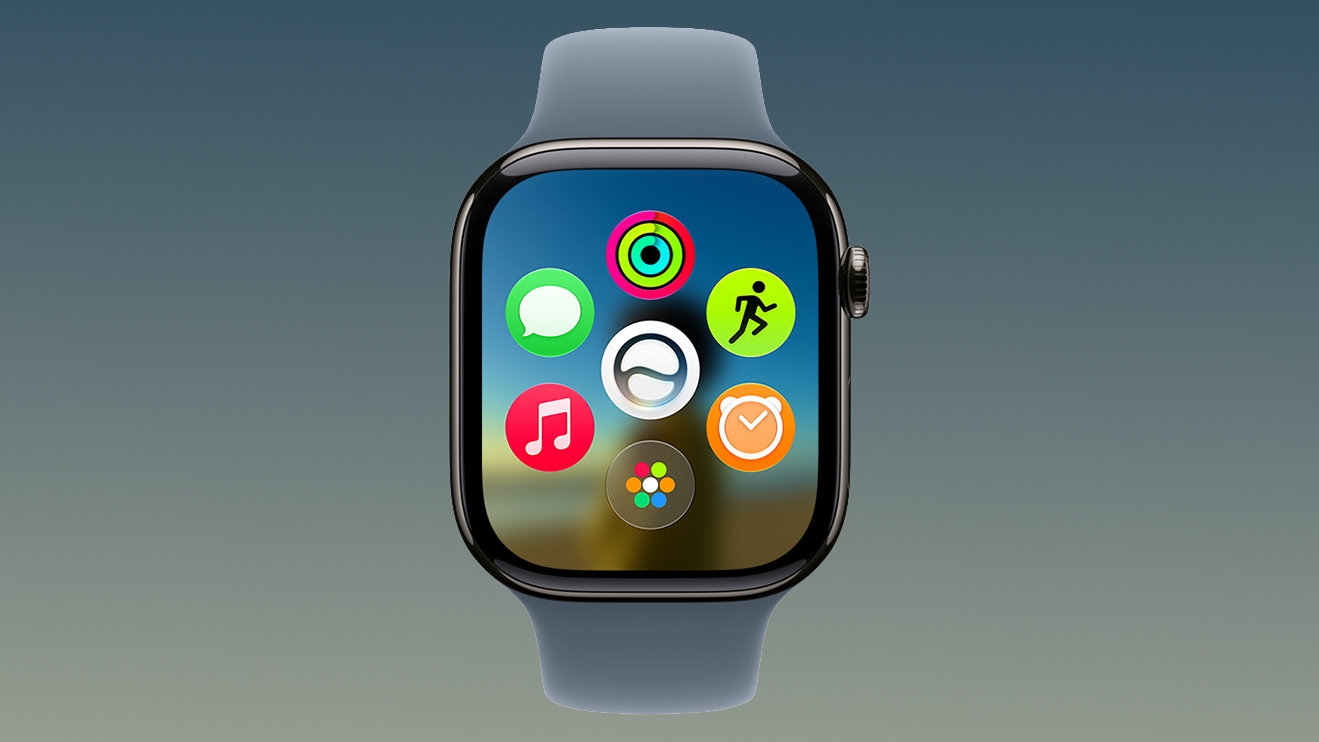
‌watchOS 27‌ adopts Siri AI, and you can use ‌Siri‌ from your wrist as long as you have an iPhone that supports it. ‌Siri‌ AI can access your personal information, answer all kinds of questions, and complete tasks for you. There is a dedicated ‌Siri‌ app that's front and center on the watch in the new dynamic app grid that comes up when pressing the Digital Crown.

There's a new gesture for selecting a widget in the Smart Stack, plus Apple added Smart Stack suggestions for finding a parked car, accessing a transit card, and getting a birthday reminder.

Workout Buddy works without your iPhone nearby, treadmill run and walk distances are tracked more accurately, and Apple added a unified Find My app that also supports Precision Finding.

tvOS 27 has a redesigned Podcasts app, Hi-Res Lossless audio and AutoMix song transitions in Apple Music, and easier profile switching. With performance improvements, apps launch faster, animations are speedier, and devices connect more quickly when AirPlaying content.

More on what's new in the updates can be found in our watchOS 27 roundup and Apple TV roundup.
Related Roundups: Apple TV, watchOS 26, watchOS 27
Buyer's Guide: Apple TV (Don't Buy)

This article, "tvOS 27 and watchOS 27 Now Available to Public Beta Testers" first appeared on MacRumors.com

Discuss this article in our forums

  •  

Improving Windows Search Box, with less clutter and more control

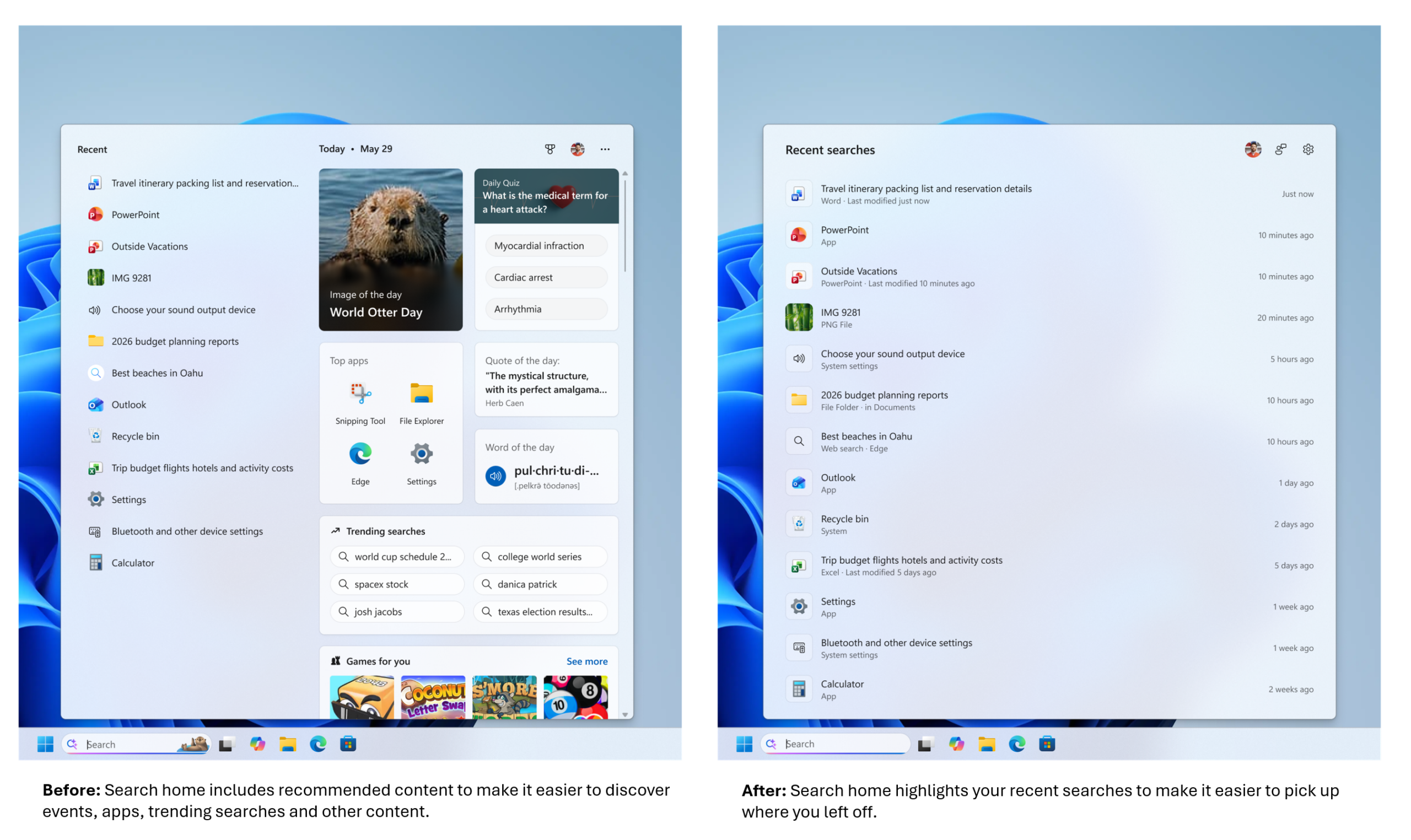
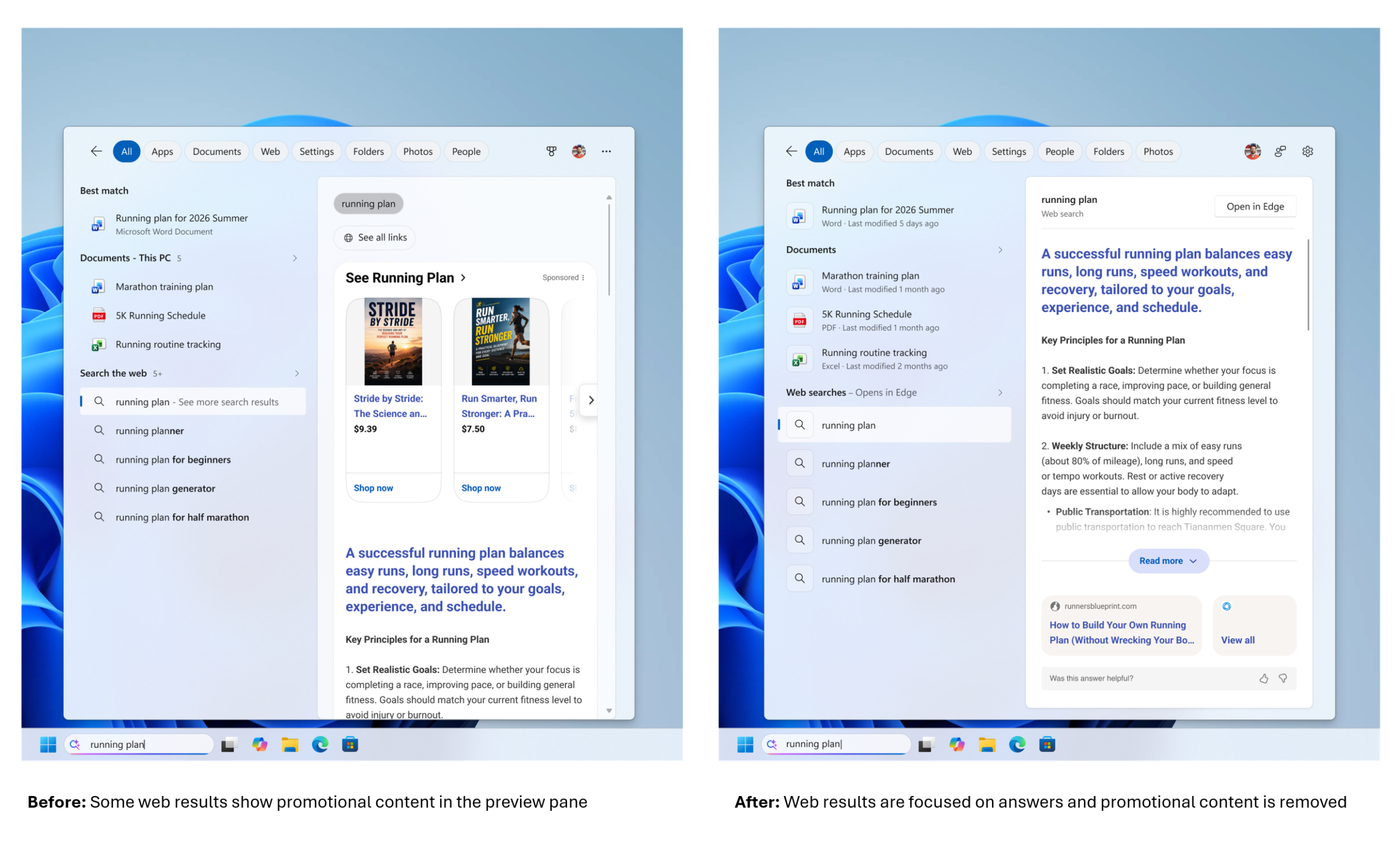
Hello Windows Insiders, You’ve been asking for search that is faster, more relevant, and easier to use—whether you’re opening an app, finding a file, or changing a setting. Because the Windows Search Box is where many people start, we focused first on making results more dependable, easier to scan, and clearer before you click.

Windows Search Box improvements gradually rolling out today to Windows Insiders

Today, we’re rolling out several improvements to Windows Search Box available to Windows Insiders in the Experimental channel. These improvements are gradually rolling out via Controlled Feature Rollout so not all Insiders will see them right away. You can reboot to see if you receive them today. They are also available via feature flags.
  • A calmer home screen. Search home has been simplified to reduce visual clutter and make it easier to get back to recent searches quickly.
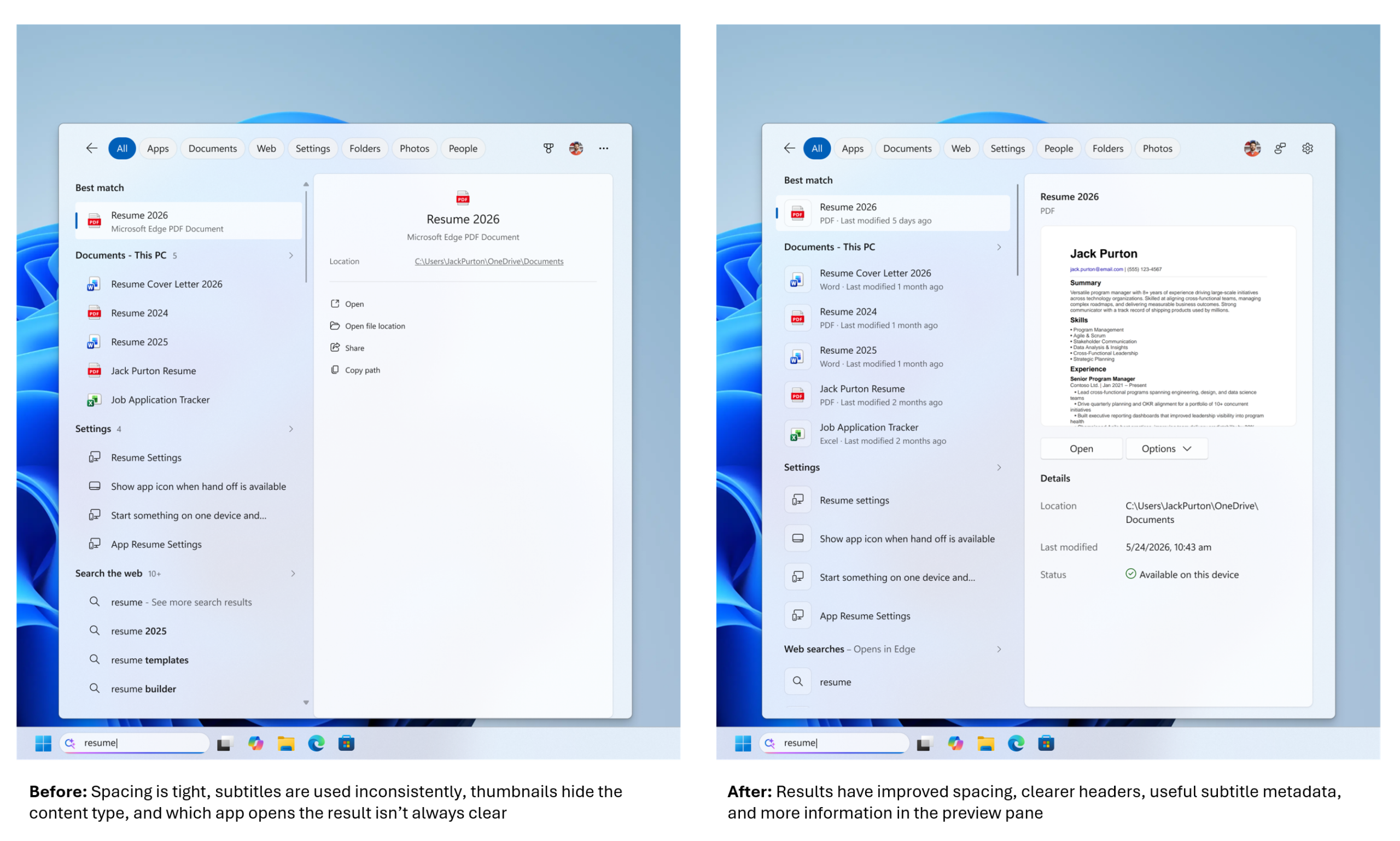
  • Clearer results. Search does a better job showing where a result comes from—app, setting, file, web result, or Store suggestion—so it’s easier to tell what you’re looking at and where you will go before you click.
  • Promotional content has been removed from web results. Web results show the most relevant answer, instead of first showing related products and promotions, helping search feel more focused and less distracting.
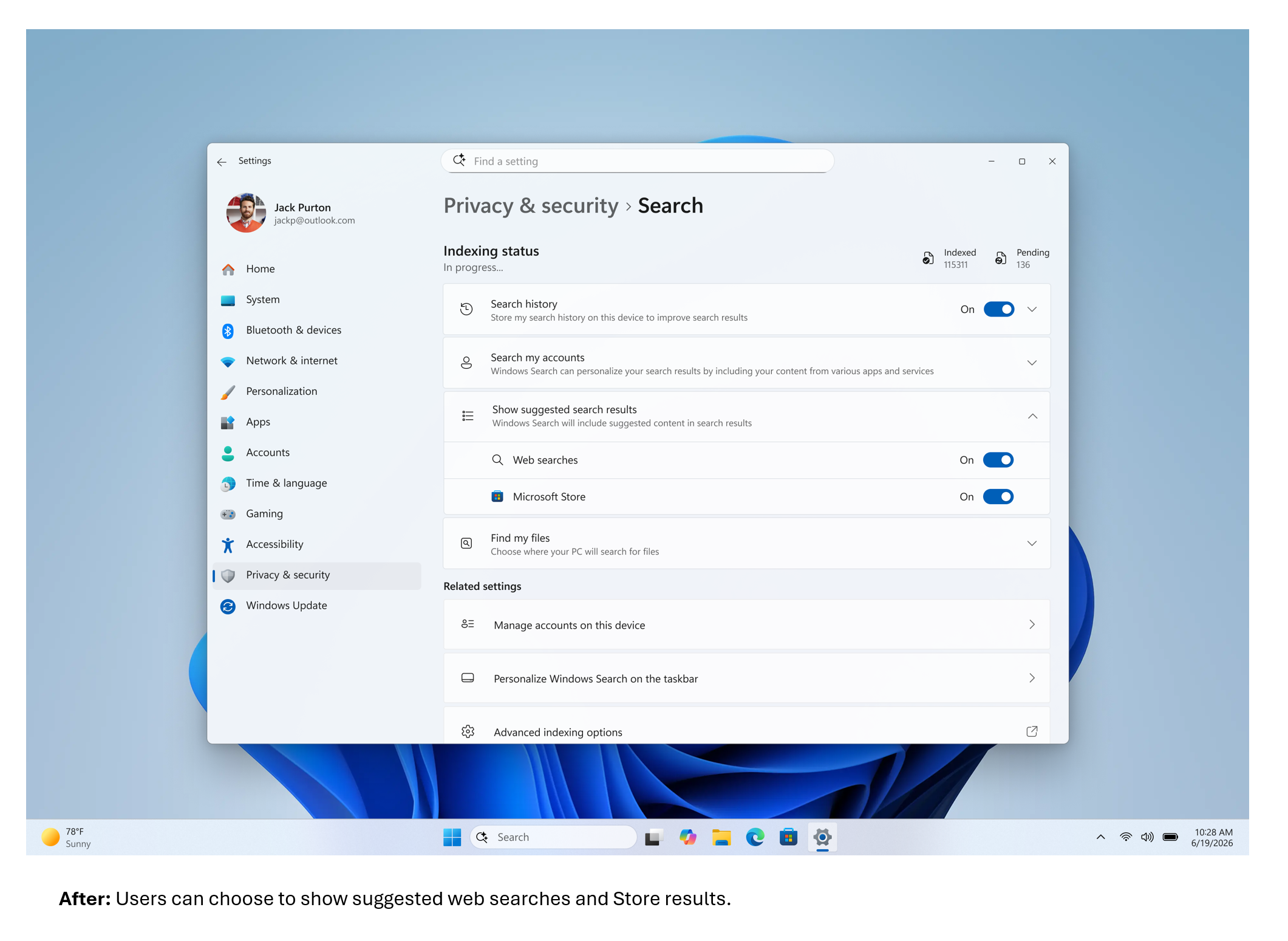
  • You’re in control of web and Microsoft Store results. A new setting in Settings > Privacy & Security > Search lets you choose whether web and Microsoft Store suggestions appear alongside local results.
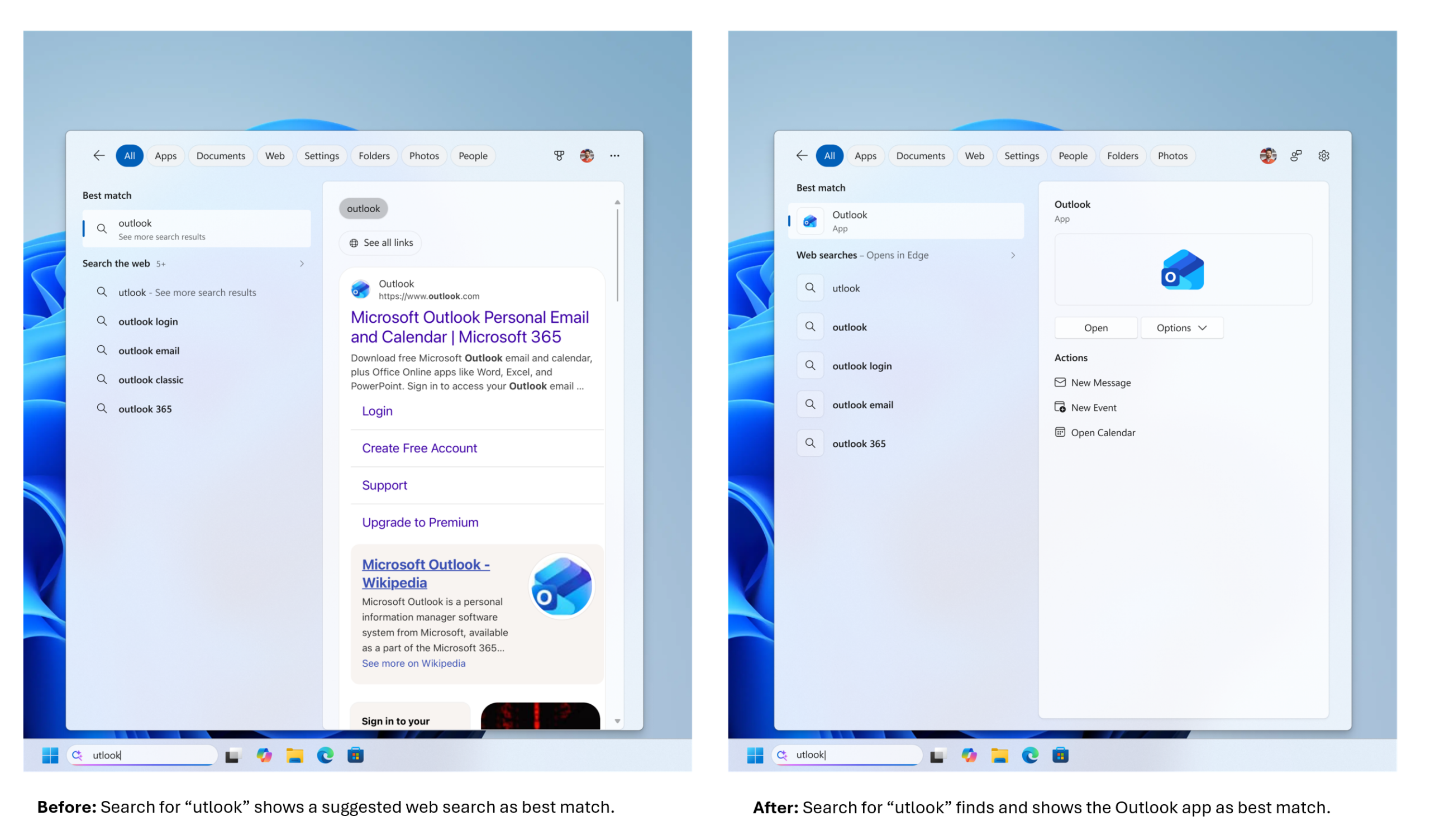
  • Local results prioritized when they’re the better match. Apps, settings, and files more reliably appear ahead of web and Store suggestions when your content is the stronger match. System items like This PC and Recycle Bin are easier to discover.
  • Finding apps is more forgiving. Search is better at handling typos, dropped letters, extra letters, and partial words for apps. Queries like “utlook” can still find Outlook.
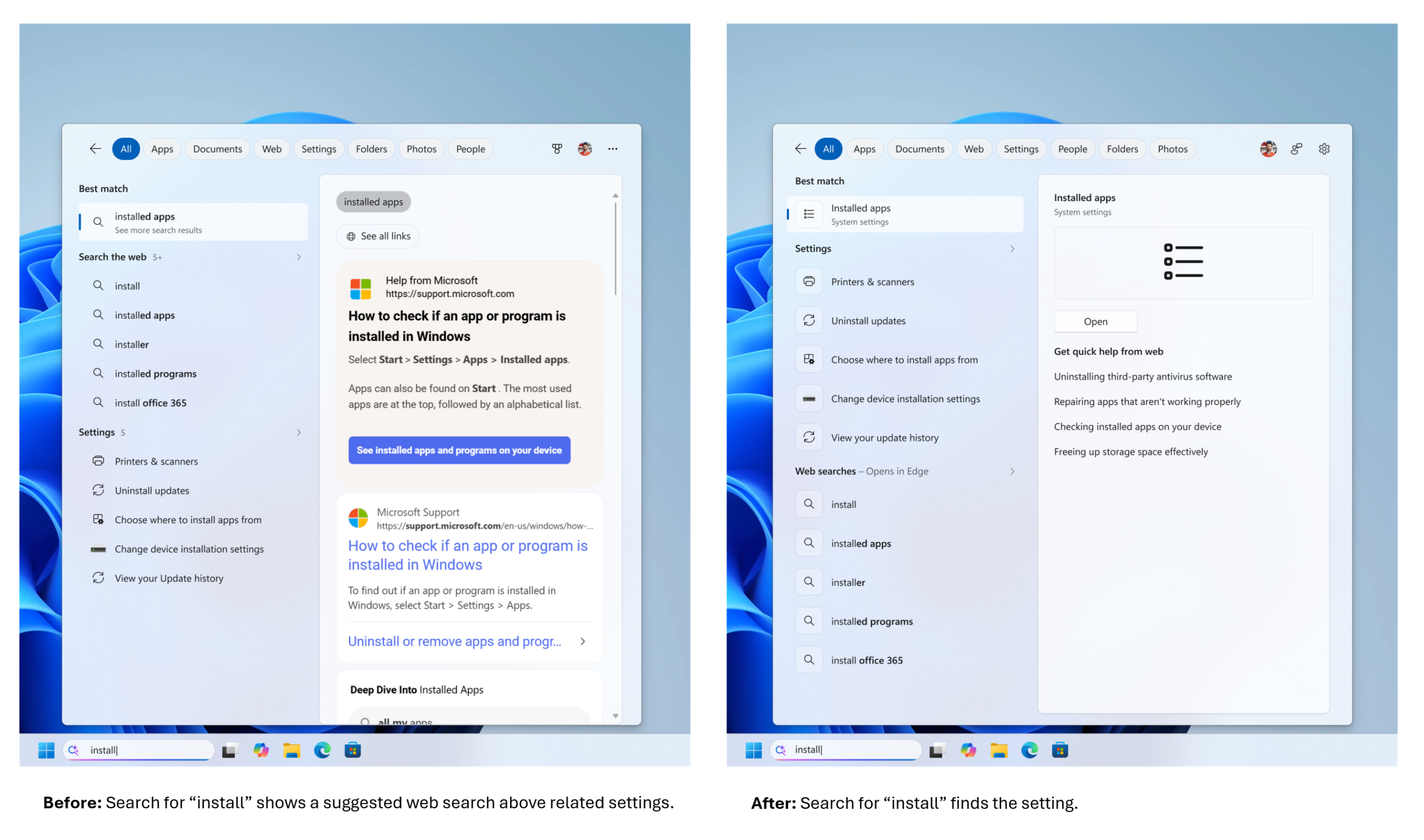
  • Settings results are improving. We’ve made a first round of ranking improvements to help more relevant settings appear higher in results, with more tuning planned in the coming months.
  • Finding files is improving. Search is better at surfacing the right local files with added support for two-character file searches. We’ve also made improvements to show cloud and connected files in results when they’re the stronger match. These changes help you get to the document, download, or folder you are looking for faster.
  • Reliability is improving. Improved search reliability, including reducing likelihood of crashing and loading issue, with more work underway.

Try the changes and give us feedback

These improvements become available to Windows Insiders today in the Experimental channel. The changes in this post reflect the feedback you’ve shared, and we’ll keep refining them as they roll out to more Insiders. Share your thoughts in Feedback Hub (WIN + F) under Desktop Environment > Search. Jeff & Anderson   NOTE: Experiences vary by region.
  •  

Apple Seeds Fifth iOS 26.6 and iPadOS 26.6 Betas to Developers [Update: Public Beta Available]

Apple today seeded the fifth betas of upcoming iOS 26.6 and iPadOS 26.6 updates to developers for testing purposes, with the software coming a week after Apple seeded the fourth betas.


Registered developers can download the betas from the Settings app on the iPhone or iPad by going to the General section and selecting Software Update.

With iOS 27 set to launch in September, Apple is wrapping up work on iOS 26. We are not expecting any major new features in the iOS 26.6 update, and it will primarily focus on bug fixes and performance improvements.

The update adds new wording around blocked contact limits, letting users know when they have exceeded the maximum number of blocked contacts. The update might also include a new anti-snatching feature that locks your iPhone if it's grabbed from your hand.
Related Roundups: iOS 26, iPadOS 26
Related Forum: iOS 26

This article, "Apple Seeds Fifth iOS 26.6 and iPadOS 26.6 Betas to Developers [Update: Public Beta Available]" first appeared on MacRumors.com

Discuss this article in our forums

  •  

Fifth macOS Tahoe 26.6 Beta Now Available for Developers [Update: Public Beta Available]

Apple today provided the fifth beta of an upcoming macOS Tahoe 26.6 update to developers for testing purposes, with the update coming a week after Apple seeded the fourth beta.


Developers can download the ‌macOS Tahoe‌ 26.6 update by opening up the System Settings app, selecting the General category, and then choosing Software Update. Beta Updates will need to be enabled, and a free developer account is required.

With macOS Golden Gate launching in just a couple months, Apple is likely focusing most of its attention on the new software. We are not expecting any major new features in ‌macOS Tahoe‌ 26.6.
Related Roundup: macOS Tahoe
Related Forum: macOS Tahoe

This article, "Fifth macOS Tahoe 26.6 Beta Now Available for Developers [Update: Public Beta Available]" first appeared on MacRumors.com

Discuss this article in our forums

  •  

Apple Releases Fifth watchOS 26.6, tvOS 26.6 and visionOS 26.6 Betas

Apple today provided developers with the fifth betas of upcoming watchOS 26.6, tvOS 26.6, and visionOS 26.6 betas for testing purposes. The software comes a week after Apple seeded the fourth betas.


The software updates are available through the Settings app on each device, and because these are developer betas, a free developer account is required.

There's no word on what's in the software as of yet. watchOS, tvOS, and visionOS often get few features in each new beta, with updates primarily focusing on bug fixes and performance improvements.
This article, "Apple Releases Fifth watchOS 26.6, tvOS 26.6 and visionOS 26.6 Betas" first appeared on MacRumors.com

Discuss this article in our forums

  •  

Report: Apple's OpenAI Lawsuit Threatens iPhone Rival Plans

OpenAI's ambitions to build a hardware rival to the iPhone are already running into trouble because of Apple's trade secret lawsuit, according to Bloomberg's Mark Gurman, who argues the damage is showing up well before any court ruling.


Apple sued OpenAI last week, accusing the company of pushing former employees, and even people it was trying to recruit, to hand over details on unreleased products. The suit also claims OpenAI coached new hires on how to dodge Apple's exit-interview security checks using a document tied to former iPhone design chief Tang Tan. Apple is asking the court to order OpenAI to stop the alleged conduct, destroy any proprietary material it obtained, and pay damages.

A courtroom resolution could take years, Gurman says, but he argues the suit is doing damage now, squeezing OpenAI's ability to recruit and creating drag on its device work long before a judge weighs in. OpenAI has declined to discuss its hardware roadmap directly, though in response to the suit the company said it has "no interest in other companies' trade secrets" and remains focused on its own technology.

The scale of the talent drain is a major part of why this matters to Apple. More than 400 former Apple employees now work at OpenAI, including former Apple design chief Jony Ive, and Gurman says the company poached so heavily from Apple's iPhone product design group specifically that Apple had to rebuild parts of the team. Apple has responded with bigger retention bonuses and executives personally working to keep engineers from leaving.

The trade secret situation has apparently become one of Apple's biggest internal concerns of the past several months, ranking alongside tariff exposure and the ongoing memory chip shortage. In its own court filing, Apple frames the case as narrowly about trade secrets and describes OpenAI's hardware business as still nascent, arguing that discovery is needed to expose "the pervasive theft of Apple's trade secrets."

The lawsuit is said to already be reshaping OpenAI's hiring, independent of anything a court eventually decides. Apple employees weighing a move to OpenAI may now think twice given the added scrutiny, and even interviewing there could draw attention from Apple's security team, which could keep more engineers at Apple and slow the flow of institutional knowledge to OpenAI.

Former Apple employees are likely to grow more guarded about discussing prior work, with managers avoiding technical questions that risk touching Apple's confidential information. New legal reviews, tighter internal controls, and compliance training could pull engineers away from actual development, while senior OpenAI leadership spends time on discovery and depositions.

Given Apple's leverage over Asia's consumer electronics manufacturers, suppliers may be reluctant to deepen ties with OpenAI for fear of jeopardizing bigger, longer-standing relationships with Apple or getting pulled into the litigation themselves.

Bloomberg Intelligence wrote that "Apple is likely to secure targeted preliminary relief tied to OpenAI's device effort." Any such order would likely require disputed materials to be isolated, evidence preserved, and compliance certified, which could slow OpenAI's hardware plans further. In the longer term, if Apple can prove its trade secrets made it into OpenAI's products, OpenAI could be forced to redesign them.

Regardless, a person familiar with OpenAI's plans told Gurman the company still expects to announce its first hardware product this year and release it in 2027, though that could shift as OpenAI reviews Apple's claims. That device is reportedly far along, but building out a wider family of products, the kind Bloomberg previously described as central to OpenAI's device ambitions, will likely get harder. OpenAI has reportedly explored categories including smart speakers and wearables with an iPhone-style device as the eventual goal, but a simpler, non-phone product is expected to ship first.
This article, "Report: Apple's OpenAI Lawsuit Threatens iPhone Rival Plans" first appeared on MacRumors.com

Discuss this article in our forums

  •  

Apple's Steady iPhone Pricing Pays Off as Rivals Scramble

Apple captured a record 20% share of the global smartphone market in the second quarter of 2026, even as worldwide shipments fell 4% year-over-year amid an ongoing memory chip shortage, according to a new report from Omdia.


It is Apple's best second-quarter showing on record, landing in what is normally its slowest stretch of the year. Omdia credits this to a strong iPhone 17 upgrade cycle, as well as Apple keeping prices flat across the lineup while rivals were forced to raise theirs. The firm still flagged that Apple raised prices on other products late in the quarter, which raises the question of whether iPhone pricing will follow suit later this year.

The wider industry slump traces back to a memory chip shortage that has pushed component costs sharply higher, with some vendors reportedly paying several times more for memory than a year ago. Samsung was the only other major vendor to grow, holding the top overall spot at 22% share as Chinese competitors pulled back their lineups and raised prices to cope.

Omdia expects the squeeze to worsen over the next two quarters as peak shopping season collides with tight supply, pushing vendors further upmarket to protect margins. That is expected to leave fewer affordable options for budget buyers, and adds another data point to observe as Apple heads into an iPhone 18 cycle already facing rising component costs of its own.
Tag: Omdia

This article, "Apple's Steady iPhone Pricing Pays Off as Rivals Scramble" first appeared on MacRumors.com

Discuss this article in our forums

  •  

Apple Acquiring SigScalr

In March, Apple informed the EU that it had agreed to acquire certain assets and hire employees from SigScalr, according to a notice published today on the European Commission's website.

SigScalr created the open-source observability platform SigLens, which companies can use to aggregate and analyze logs, metrics, and traces at massive scales for monitoring and debugging purposes. SigLens was known for being a cost-effective and fast solution compared to many competing platforms.
This article, "Apple Acquiring SigScalr" first appeared on MacRumors.com

Discuss this article in our forums

  •  

Missed the Last Apple Watch Sale? Series 11 Now $100 Off on Amazon

Amazon this week has low prices on the Apple Watch Series 11, with $100 discounts across numerous models of the smartwatch. This sale includes a handful of 42mm and 46mm GPS aluminum models, but cellular devices are a bit more rare this time around.

Note: MacRumors is an affiliate partner with Amazon. When you click a link and make a purchase, we may receive a small payment, which helps us keep the site running.

You can get the 42mm GPS Apple Watch Series 11 for $299.00, down from $399.00, and the 46mm GPS model for $329.00, down from $429.00. On Amazon, you'll find four of the 42mm GPS models and three of the 46mm GPS models on sale at these all-time low prices.


Compared to past sales, these are both solid second-best prices on the Apple Watch Series 11 and come within $20-$30 of those previous all-time low prices. Head to our full Deals Roundup to get caught up with all of the latest deals and discounts that we've been tracking over the past week.


Deals Newsletter


Interested in hearing more about the best deals you can find in 2026? Sign up for our Deals Newsletter and we'll keep you updated so you don't miss the biggest deals of the season!


Related Roundup: Apple Deals

This article, "Missed the Last Apple Watch Sale? Series 11 Now $100 Off on Amazon" first appeared on MacRumors.com

Discuss this article in our forums

  •  

Apple Plans AirPods-Like Pairing for Meta's Glasses and Quest

Apple is developing a new API that will let third-party accessories, including Meta's Ray-Ban ‌Meta‌ glasses and Quest headsets, automatically pair across a user's Apple devices the same way AirPods and the Apple Watch do today, according to Apple's EU Interoperability Request page.


The plan responds to a request ‌Meta‌ filed in October 2025 under the EU's Digital Markets Act, asking Apple to let a ‌Meta‌ device, once paired with one iPhone or iPad, automatically become available on a user's other Apple devices without extra prompts. Third-party accessories have never been able to tap into that ability, meaning owning non-Apple hardware alongside an iPhone has always involved more friction. If Apple builds this out, that gap will close, at least for whichever manufacturers get access to the new API.

Apple told ‌Meta‌ on February 4 that it plans to let third-party apps access cryptographic materials that make a pairing completed on one Apple device usable on another, secured by a session key and a one-time, per-accessory user consent. Apple expects to finish development by spring 2027 and ship it "shortly thereafter," which points toward an iOS 27.x update, possibly iOS 27.4, though Apple has not yet confirmed a version.

The feature runs on AccessorySetupKit and Proximity Pairing, infrastructure Apple built to comply with a March 2025 European Commission ruling and which only works in the EU today, the same infrastructure behind the proximity pairing feature already live for EU users. ‌Meta‌ has objected that adopting it would force the company to abandon Core Bluetooth, which it relies on for pairing everywhere outside Europe, and has asked Apple to decouple the two. Apple has declined so far, though it told ‌Meta‌ that support outside the EU "is something we are still considering."

The request remains in phase three as of Apple's most recent update. ‌Meta‌ hasn't yet invoked the DMA's formal dispute resolution process, which would trigger a review by Apple's Interoperability Request Review Board within 30 working days. Until then, Apple's plan proceeds with a spring 2027 rollout tied to AccessorySetupKit, in the EU only.
Related Roundup: AirPods 4
Buyer's Guide: AirPods (Caution)
Related Forum: AirPods

This article, "Apple Plans AirPods-Like Pairing for Meta's Glasses and Quest" first appeared on MacRumors.com

Discuss this article in our forums

  •  

Apple Stock Hits Record Territory as Traders Sour on AI Spending

Apple shares have rallied 15 percent since their worst day on the stock market in more than a year, adding almost $600 billion in value since June 25 and returning the stock to record territory (via Bloomberg).


The rebound comes as investors grow uneasy about the mind-boggling sums of cash continually being poured into the AI data center buildout, despite there being no obvious indicator for when investors will get a return on their investment.

Apple's decision to sit out the data center spending spree and instead pay Google for access to its frontier AI models is being increasingly seen by traders as an asset rather than a liability. Apple is using Google's Gemini to underpin the revamped version of Siri and new Apple Intelligence features across its platforms.

Apple's WWDC presentation last month of upcoming AI features in iOS 27 and macOS Golden Gate initially sent the stock lower, but it has since rebounded in impressive fashion.

The rally has occurred in spite of the fact that Apple is facing pressure from soaring memory chip costs, which was what prompted the company to raise prices on Macs, iPads, and its Home devices on June 25. That was the move that triggered the company's worst single-day stock drop since April 2025, with shares closing at $275.15. Apple's iPhone models were spared similar price hikes, but the company has hinted that further increases could follow.

Investors are also viewing Apple's upcoming foldable iPhone, expected in September, as a potential catalyst, according to Bloomberg. Nikkei reported earlier this month that Apple told suppliers to prepare for around 10 million units this year, up from a prior forecast of seven to eight million.

Apple shares are now up 16 percent in 2026, making it the best performer among the "Magnificent Seven" tech giants, which includes Microsoft, Amazon, Alphabet, Meta, Nvidia, and Tesla. AAPL closed at $315.32 on Friday, just shy of its all-time high of $317.40 set in early June.

In the coming days, MacRumors will be speaking with a prominent technology commentator about whether Apple's decision to avoid the AI data-center arms race is actually becoming a strategic advantage. Stay tuned.
This article, "Apple Stock Hits Record Territory as Traders Sour on AI Spending" first appeared on MacRumors.com

Discuss this article in our forums

  •  

Meta Pulls AI Image Feature From Instagram Days After Launch

Remember that new feature Meta announced last week that let people use public Instagram posts and reels to generate AI content? It didn't last long. Meta pulled the feature from Instagram late on Friday, following widespread criticism over privacy concerns.

"Our intent was to provide a useful creative tool and to give people control over whether their public ​content could be referenced in this way," Meta said in a statement. "We've ​heard the feedback that this feature missed the mark, so ⁠it's no longer available," the company added.
Tag: Meta

This article, "Meta Pulls AI Image Feature From Instagram Days After Launch" first appeared on MacRumors.com

Discuss this article in our forums

  •  

5 New Waze Features Rolling Out Now: Here Are All the Details

Google today announced that Waze is getting a handful of new features, including some Gemini-powered personalization enhancements for Conversational Reporting.


Conversational Reporting already uses Gemini when users report traffic incidents like slowdowns, but now you can use it to suggest map updates like road closures or outdated addresses. Saying something like "The road is closed here" will prompt Waze to send the information to local map editors, who then verify the suggestion and update the map for everyone.

Google says reporting road updates conversationally is rolling out now globally on iOS and Android.

Elsewhere, Gemini is being recruited in Waze to help users who know what they need to get, but don't know where to get it. Before navigating somewhere, you can tap the search voice icon to ask questions like "Find me a coffee shop that's open right now," "Find me parking close to Grand Mall" or something more specific like "Find me a gas station nearby with the lowest prices." Google says Waze will respond with a list of options that you can navigate using your voice.
The feature is also rolling out worldwide now on all platforms.

In addition, Waze is getting an option to adjust to a "less chatty" mode for voice prompts, so that interacting with the app's driving directions doesn't intrude as much on a driver's music or podcast listening.

Waze is also getting a new Motorcycle Mode that includes two-wheeled shortcuts and more accurate ETAs for more optimal routing.


Lastly, Waze will now suggest routes based on your previous trips, augmenting its hyperlocal understanding of a city's traffic patterns. So if you prefer driving on highways over local streets with multiple stops, you'll see those suggested first. It's an optional setting so it can be toggled off, and it's rolling out now in Argentina, Brazil, Colombia, Malaysia, Mexico, Peru and the Philippines on Android and iOS, with more countries coming soon.
Tag: Waze

This article, "5 New Waze Features Rolling Out Now: Here Are All the Details" first appeared on MacRumors.com

Discuss this article in our forums

  •  

Report: Apple Agreed to Intel Chips Amid White House Tariff Talks

Apple faced pressure from the White House to use Intel's chipmaking plants while it was negotiating relief from semiconductor tariffs last summer, reports The Wall Street Journal ($).


In August 2025, Apple CEO Tim Cook was in Washington to lobby the Trump administration to drop its proposed 100 percent tariff on semiconductor imports – a levy that would have raised costs across Apple's product line. Apple reportedly secured an exemption after pledging to invest hundreds of billions of dollars in the U.S., although many of those investments were already planned.

During the meetings, president Trump and commerce secretary Howard Lutnick are said to have urged Cook to use Intel's fabrication plants to make some of Apple's chips. The link between the tariff talks and the Apple-Intel deal had not been previously reported.

Almost a year later, Trump announced via his Truth Social platform that Apple would begin using Intel-made chips in some products. "We need to design and build our Chips right here in America," the president posted. The news sent Intel shares to record highs.

According to a person familiar with the negotiations cited by the WSJ, Apple plans to have Intel make chips for both Mac laptops and iPhones. The report doesn't say which chips or in what volume, and Apple is expected to remain reliant on Taiwan Semiconductor Manufacturing Company, or TSMC, for the majority of its custom silicon.

Apple hasn't looked to Intel as a supplier before, both because the chipmaker has trailed rivals like TSMC and Samsung and due to the rocky history between the two companies.

The report suggests the arrangement is part of a wider administration effort to prop up Intel, especially since the U.S. government converted $9 billion in federal grants into a 10 percent equity stake last year, making it the chipmaker's largest shareholder.

Nvidia and SpaceX have also signed deals with Intel since then, reportedly with similar pressure applied by the Trump administration.

Intel's foundry business posted $10.4 billion in operating losses over its last four fiscal quarters, and outside customers have in recent years doubted its ability to reliably produce usable silicon at a high volume. The WSJ report gives no timeline for when Intel-made chips might appear in shipping Apple products, and Apple has not commented on the arrangement.
This article, "Report: Apple Agreed to Intel Chips Amid White House Tariff Talks" first appeared on MacRumors.com

Discuss this article in our forums

  •  

Utkarsh Gupta: FOSS Activities in June 2026

Here’s my monthly but brief update about the activities I’ve done in the FOSS world.

Debian

Whilst I didn’t get a chance to do much, here are still a few things that I worked on:

  • Leading the DebConf Bursary team along with PEB.
    • This took most of my Debian time this month but we’ve been able to wrap that work now.
    • Got back to all the tickets on Zammad, too.
  • Assisted a few folks in getting their patches submitted via Salsa.
  • Mentoring for newcomers.
  • Moderation of -project mailing list.

Ubuntu

I joined Canonical to work on Ubuntu full-time back in February 2021.

Whilst I can’t give a full, detailed list of things I did, here’s a quick TL;DR of what I did:

  • Continued to push for infrastructure improvements:
    • Charming.
    • Artifact signing.
    • Reorganizing cdimage.
    • And so on.
  • Successfully released 26.10 Snapshot 2!
    • We landed a breaking change in the directory structure.
    • …whihc had consequences on the rsync, being run by the sysadmins.
      • The 30 GB rsync failed because of the load on the system and it resulted in things blowing up. Yay. Stress-testing the shit out of our infra. :)
      • We got it back under control in the next few days but oh wow, what a journey to get there.
  • Assisted a bunch of folks with my Archive Admin and Release team hats to:
    • Helped in archive opening tasks.
    • Promoting/demoting binaries to/from main.
    • Taking care of package removals and so on.
    • Reviewed the NEW queue.
  • Reviewed quite a lot of MPs, specs, and other people’s work.
  • Mentoring, coaching, and leading the Release Management team.

Debian (E)LTS

This month I have worked 15 hours on Debian Long Term Support (LTS) and on its sister Extended LTS project and did the following things:

Released Security Updates

Work in Progress

Other Activities

  • [LTS] Emilio pointed out that the gst-plugins-ugly1.0 binaries were still not fully released, so I ran dcut migrate to fully release them. The DLA had gone out earlier.

  • [ELTS] Did some more work on ruby-rack - a lot of new CVEs have opened up and, whilst I made some progress, Santiago let me know that ruby-rack is no longer supported and so it’ll be removed from the ela-needed list.

  • [E/LTS] Set up the security-tracker and a few other things on the new machine, and debugged the git repository size madness. Sent a summary here.

  • [E/LTS] Monitored discussions on mailing lists, IRC, and all the documentation updates.

  • [E/LTS] Attended the monthly LTS meeting on Jitsi. Meeting notes here.


Until next time.
:wq for today.

  •  

DistroWatch Weekly, Issue 1181

The DistroWatch news feed is brought to you by TUXEDO COMPUTERS. This week in DistroWatch Weekly:
Review: Artix 20260419
News: Google locks down Android, TUXEDO OS moves to Debian foundation, Mint updates Cinnamon on Wayland, Redox OS gets USB gamepad support, OpenMandriva recovers from repository deletion, OSNews author compares Windows and Linux
Questions and answers: Making migration to Linux easier
Released last....
  •  

Apple Stores to Expand Use of 'Tap to Pay on iPhone'

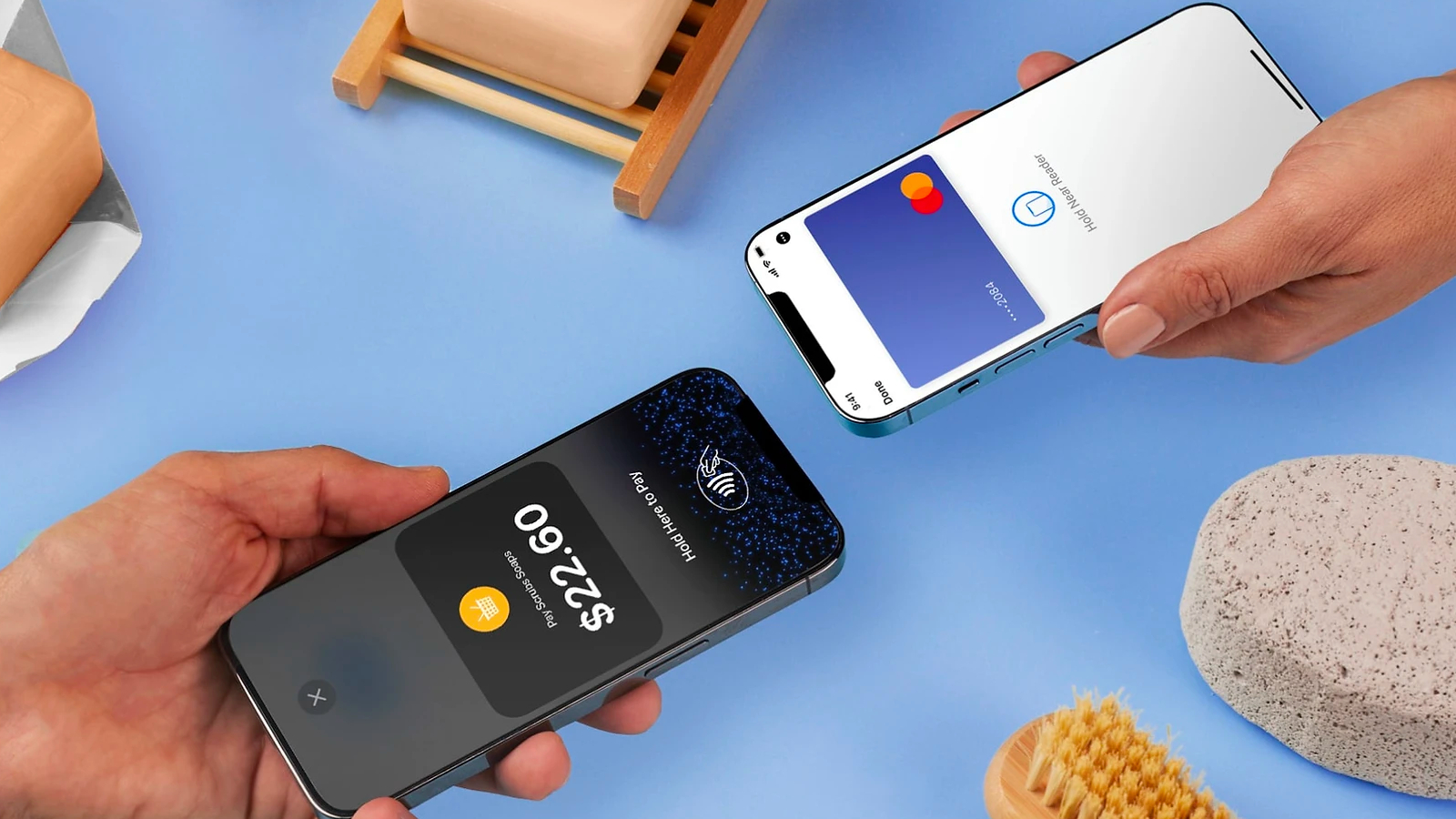
In 2022, Apple began rolling out Tap to Pay on iPhone, a system that allows small business owners and other merchants to accept contactless payments on an iPhone, with no point-of-sale hardware required. The feature allows customers to pay by simply tapping their iPhone or Apple Watch, credit card or debit card, or other contactless payment option on the merchant's iPhone. Payment is securely completed using NFC, like Apple Pay.


Some of Apple's retail employees have been provided with iPhone 14 units, allowing customers to check out with Tap to Pay on iPhone at the company's stores. Apple has been gradually phasing out its previous Bluetooth credit card readers as part of this transition, and now the company apparently plans to go a step further.

Bloomberg's Mark Gurman today said Apple will be giving more retail employees newer iPhone 16 units to expand its in-store usage of Tap to Pay on iPhone.

"The tap-to-pay system in the iPhone 14 can sometimes be finicky and not support metal cards like American Express Platinum or Chase Sapphire Reserve," he explained. "But Apple has found that the iPhone 16 does a better job and eliminates the need for store employees to carry around the specialized terminals."

iOS 27 builds upon Tap to Pay on iPhone with a new "Tap to Share" feature.
This article, "Apple Stores to Expand Use of 'Tap to Pay on iPhone'" first appeared on MacRumors.com

Discuss this article in our forums

  •  

Apple's M7 Ultra Chip Designed to Match a 2019 Mac Pro Feat

Apple's M7 Ultra chip coming in 2028 is designed to support up to 1.5TB of unified memory, according to Bloomberg's Mark Gurman. However, whether such a configuration is offered may depend on the state of the ongoing memory chip shortage.

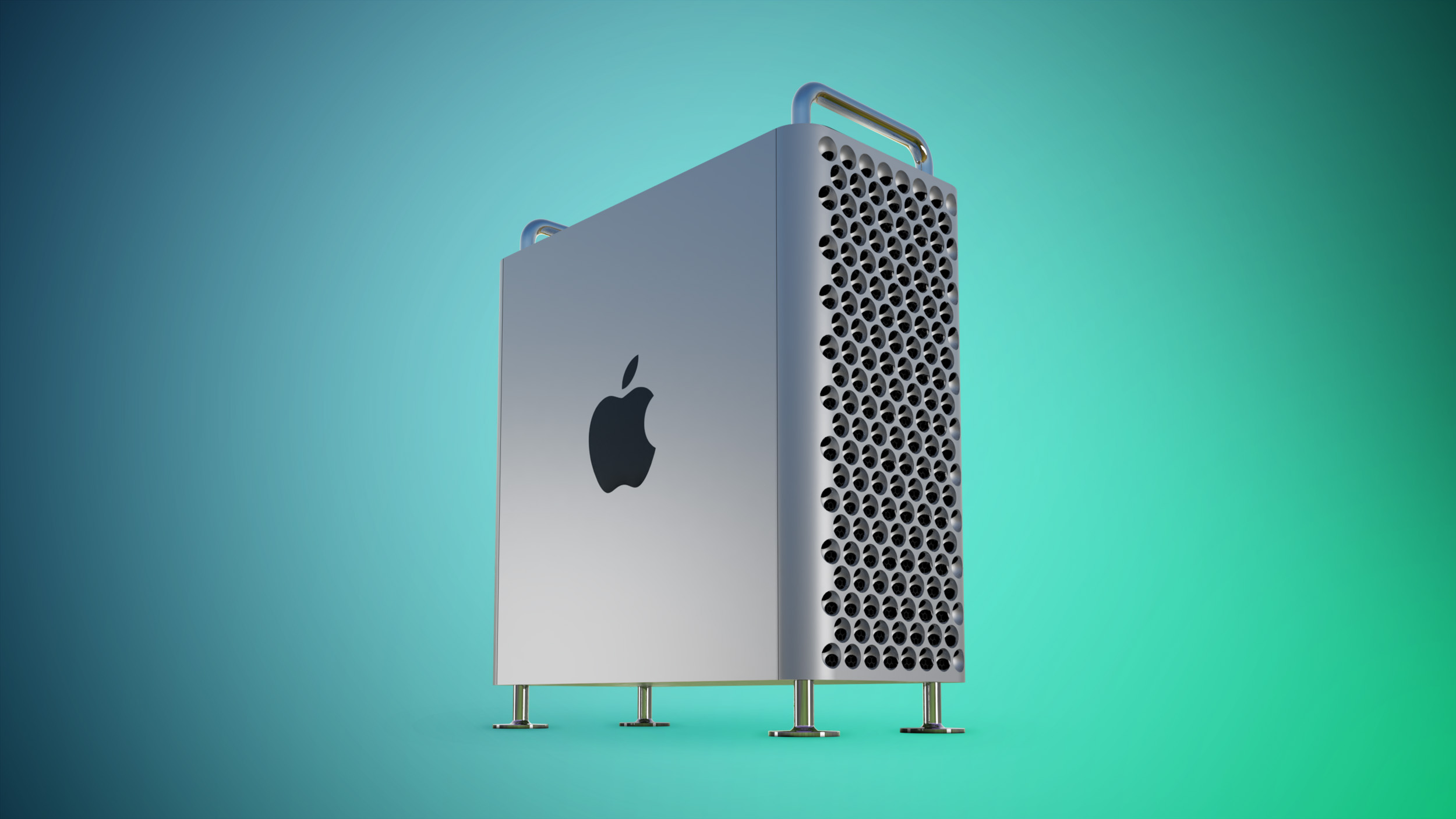
In 2019, Apple released an Intel-based Mac Pro with up to 1.5TB RAM.
This article, "Apple's M7 Ultra Chip Designed to Match a 2019 Mac Pro Feat" first appeared on MacRumors.com

Discuss this article in our forums

  •  

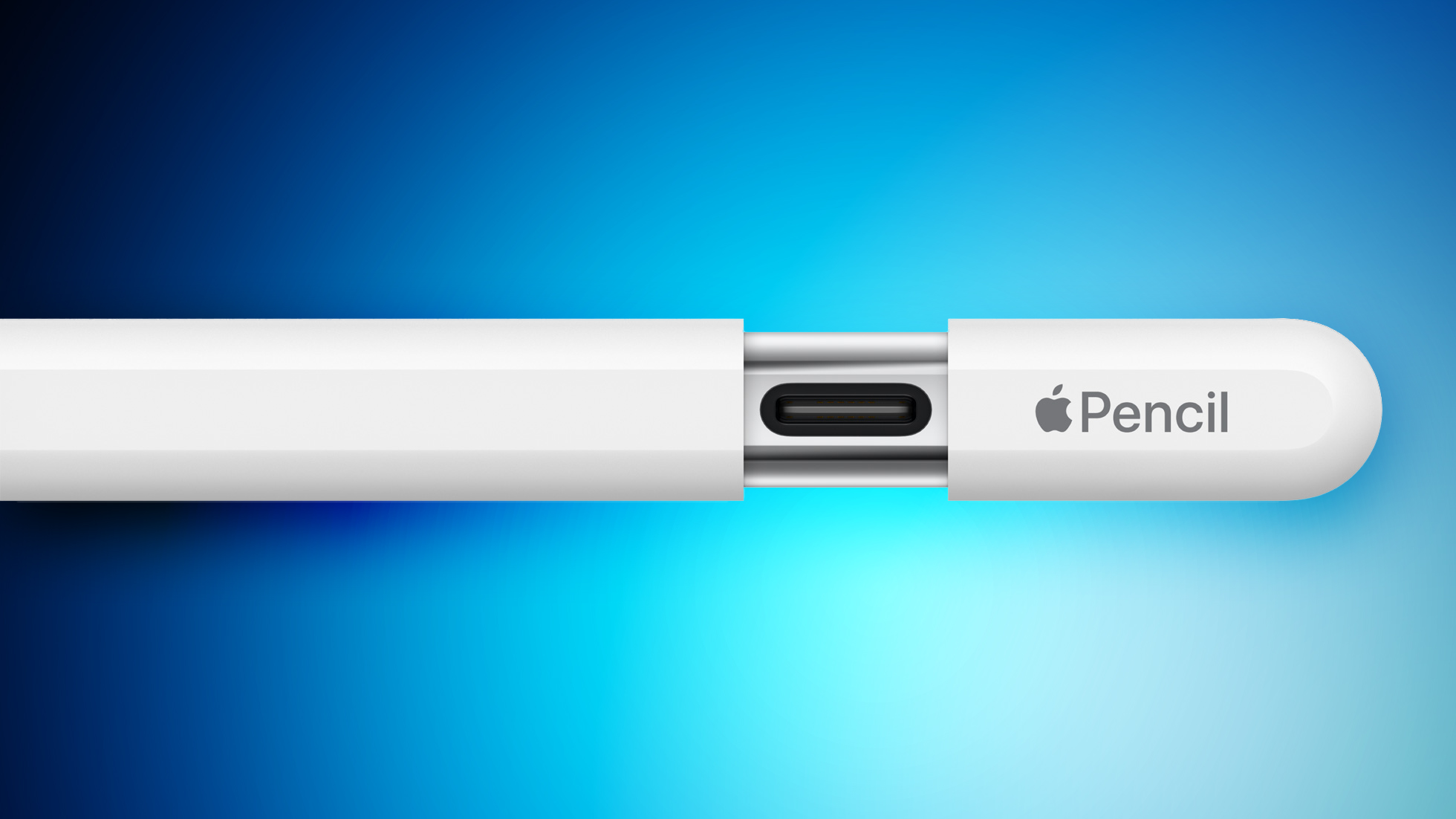
Two New Apple Pencils Reportedly Launching Next Year

Two new Apple Pencil models are in development for release alongside next-generation iPad Pro models next year, according to Bloomberg's Mark Gurman.


Specifically, he said new versions of the lower-end Apple Pencil with a USB-C port and the higher-end Apple Pencil Pro are in the works.

Apple is working to satisfy upcoming EU requirements related to making batteries more replaceable, leading Gurman to believe that the new Apple Pencil models could be equipped with "new battery systems." While that wording is vague, it seems to suggest that the next Apple Pencil models could have replaceable batteries.

No other details were provided, so we do not know of any potential design changes or other new features that are planned at this time.

The current Apple Pencil with a USB-C port was released in November 2023, while the Apple Pencil Pro followed in May 2024.
Related Roundup: iPad Pro
Buyer's Guide: iPad Pro (Neutral)
Related Forum: iPad Accessories

This article, "Two New Apple Pencils Reportedly Launching Next Year" first appeared on MacRumors.com

Discuss this article in our forums

  •  

iOS 27 Public Beta Reportedly Coming This Week

The first public betas of iOS 27, macOS Golden Gate, and more will be released this week, according to Bloomberg's Mark Gurman. This aligns with Apple's promised July timeframe.

If you have an iPhone 15 Pro or newer, the key new feature is Siri AI, but there is a waitlist if you want to try it.
Related Roundups: iOS 27, iPadOS 27

This article, "iOS 27 Public Beta Reportedly Coming This Week" first appeared on MacRumors.com

Discuss this article in our forums

  •  

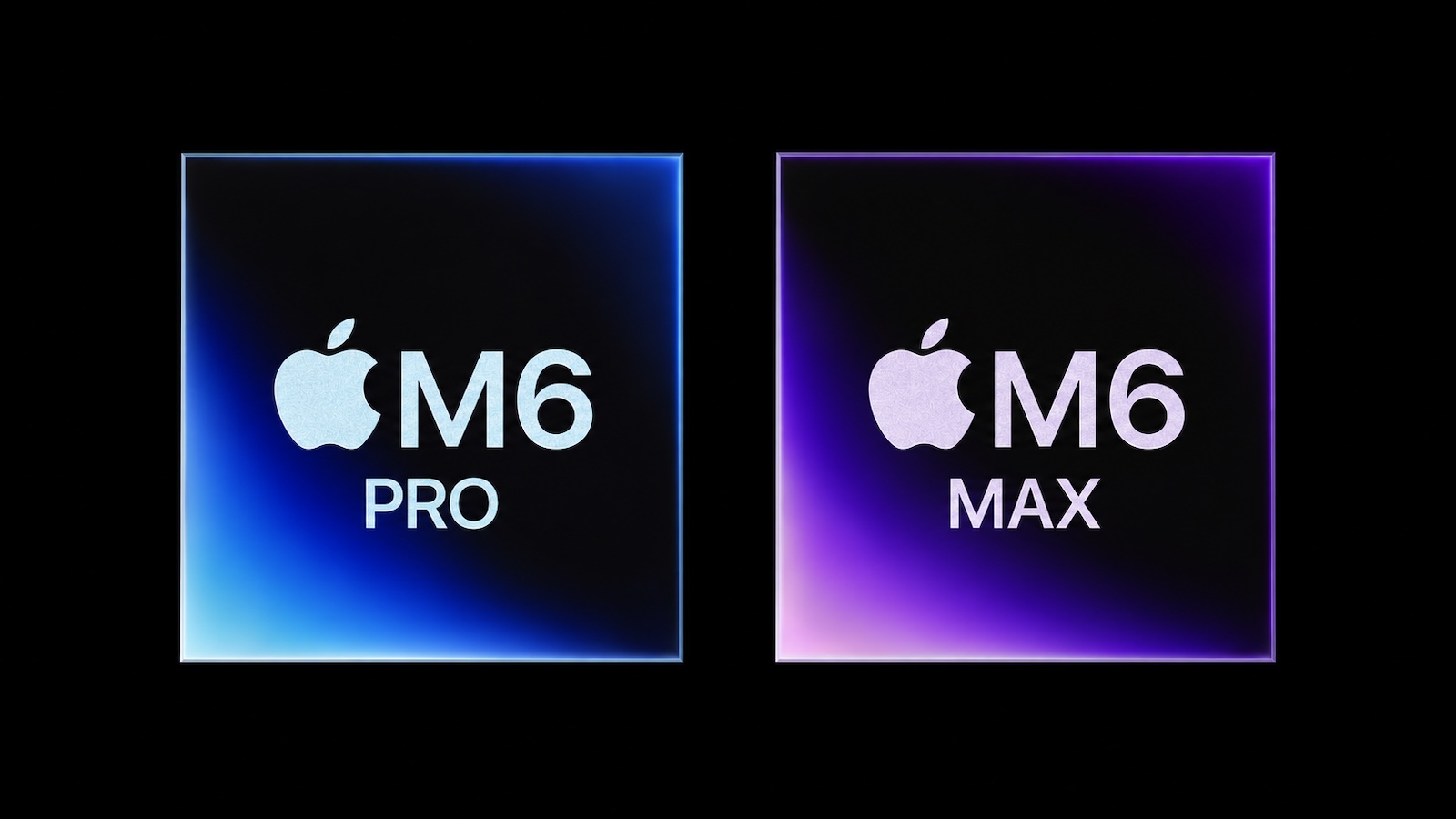
Here's Why Apple is Reportedly Skipping M6 Pro and M6 Max Chips

According to Bloomberg's Mark Gurman, Apple will be releasing a regular M6 chip, but it has no plans to offer higher-end M6 Pro and M6 Max chips. In his Power On newsletter today, he said the reason for this break in tradition is AI.


"Apple had been planning major neural-processing upgrades for the M7 family and ultimately decided those improvements were important enough to justify accelerating the next generation rather than completing the M6 lineup," he explained.

There won't be an M6 Ultra chip either, he said.

A new 14-inch MacBook Pro with a base M6 chip will be released later this year, and then Apple plans to move on to releasing the base M7 chip in the first half of 2027, M7 Pro and M7 Max chips in late 2027, and an M7 Ultra chip in 2028.

He said the M7 Ultra chip in particular "dramatically upgrades AI performance," and that it may power Apple Intelligence servers starting in 2029.

"AI is no longer just another feature Apple's chips need to support," said Gurman. "It is now shaping how those products are designed and when they are shipped."

The current M5 Pro and M5 Max chips launched in March, and Gurman still expects an M5 Ultra chip to debut in the Mac Studio as early as this year.

A summary:
  • M5 chip: October 2025

  • M5 Pro and M5 Max chips: March 2026

  • M5 Ultra chip: Late 2026

  • M6 chip: Late 2026

  • M7 chip: First half of 2027

  • M7 Pro and M7 Max chips: Second half of 2027

  • M7 Ultra chip: 2028
Related Roundups: Mac Studio, MacBook Pro
Related Forums: Mac Studio, MacBook Pro

This article, "Here's Why Apple is Reportedly Skipping M6 Pro and M6 Max Chips" first appeared on MacRumors.com

Discuss this article in our forums

  •  

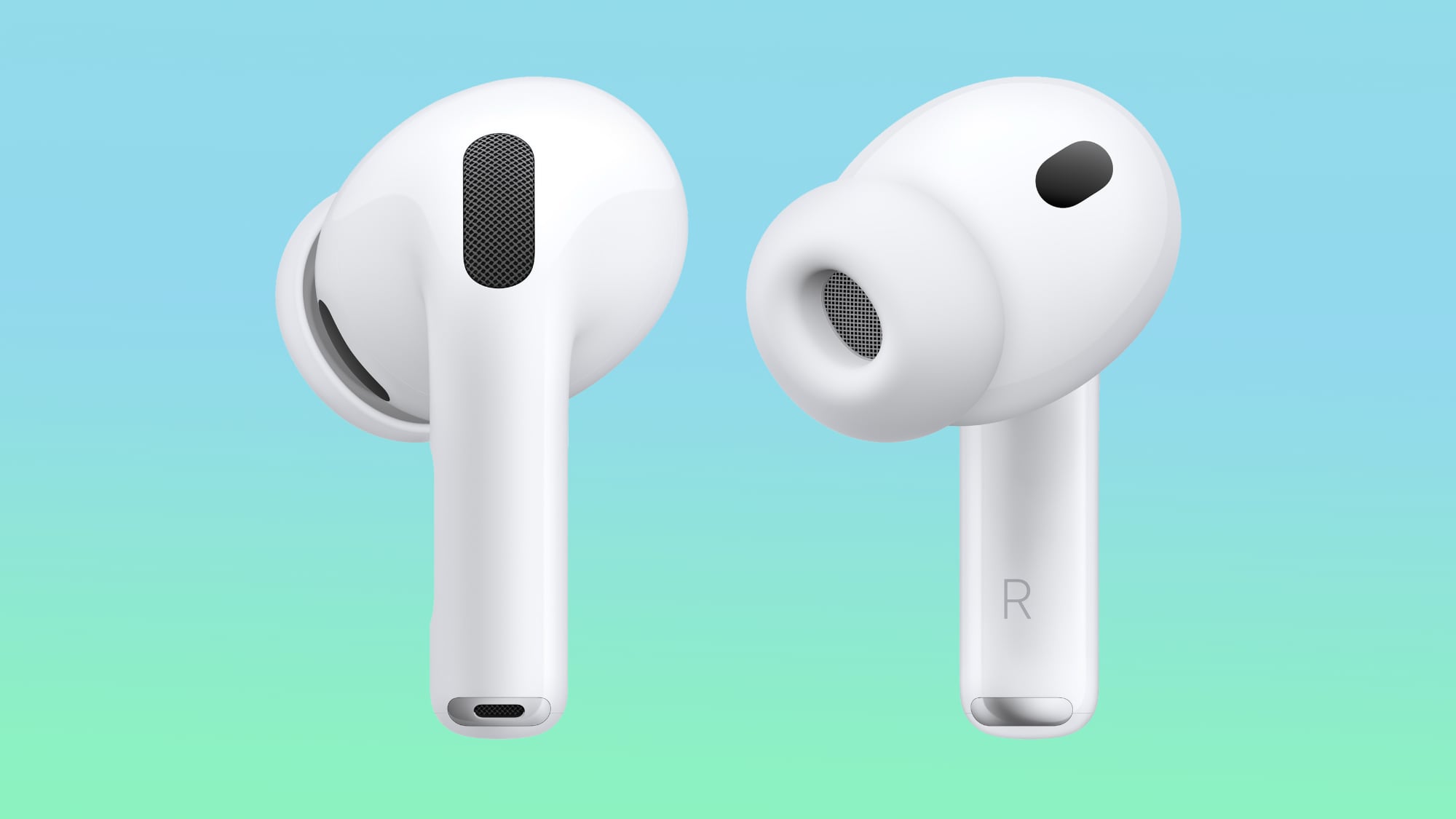
AirPods Pro 3 Hit Best Price Since Prime Day at $199.99

Amazon today has the AirPods Pro 3 available for $199.99, down from $249.00. This is the best price we've seen on the AirPods Pro 3 since Prime Day ended last month, coming in around $20 higher when compared to that all-time low price.

Note: MacRumors is an affiliate partner with some of these vendors. When you click a link and make a purchase, we may receive a small payment, which helps us keep the site running.

This model of the AirPods Pro launched in September 2025 and has 2x better Active Noise Cancellation than the previous generation, better audio quality, a revised fit that's meant to improve comfort and stability, Live Translation for in-person conversations, and heart rate sensing for workouts.


Head to our full Deals Roundup to get caught up with all of the latest deals and discounts that we've been tracking over the past week.


Deals Newsletter


Interested in hearing more about the best deals you can find in 2026? Sign up for our Deals Newsletter and we'll keep you updated so you don't miss the biggest deals of the season!


Related Roundup: Apple Deals

This article, "AirPods Pro 3 Hit Best Price Since Prime Day at $199.99" first appeared on MacRumors.com

Discuss this article in our forums

  •  

Apple's 2026 Back to School Offer is Coming Soon

Apple's stores will be rolling out Back to School marketing materials this week, according to Bloomberg's Mark Gurman. This suggests that the offer will begin in the U.S. in the next few days.

Last year, college students and educational staff could receive a free accessory like AirPods 4 or an Apple Pencil Pro with the purchase of a qualifying Mac or iPad model. The Back to School offer is in addition to the discounted prices already available through Apple's education store year-round, but it will be a bittersweet situation this year given that Apple recently raised prices on all Macs and iPads.
This article, "Apple's 2026 Back to School Offer is Coming Soon" first appeared on MacRumors.com

Discuss this article in our forums

  •  

Kentaro Hayashi: Try to build Mozc with Bazel 7.7.1

Introduction

Recently, I've got a chance to try building Mozc (Most famous Japanese input method editor) with Bazel.

As you know, recently newer Bazel related packages were landed into debian/unstable. Then now I'm planning to update Mozc from 2.29.5160.102 to 3.33.6133.

Background story about Mozc and Debian

The upstream of Mozc had released 3.34.6239, but on Debian, we stick to Mozc 2.29.5160.102.

Mozc requires newer Bazel but we only had Bazel 4.2.3 at that time on Debian, so even though the upstream of Mozc switched from GYP to Bazel, we had patched Mozc with GYP based package.

We even did make an effort to restore build options that had been already removed. :-( And needed to migrate from GTK2 renderer to GTK3 renderer.

That is why the version of Mozc is diverged from upstream on Debian.

  • 2.29.5160.102 (Now on Debian)
  • 2.29.5268.102
  • 2.29.5374.102
  • 2.29.5544.102
  • 2.30.5544.102
  • 2.31.5712.102
  • 2.31.5851.102
  • 2.32.5994.102
  • 3.33.6089
  • 3.33.6133 (Target to upgrade for)
  • 3.34.6239

How to switch from GYP to Bazel?

At first, we needed to decide what Mozc version to work with it.

Now latest version of Mozc is 3.34.x, but it requires Bazel 9.x. Please recall that Bazel 7.7.1 was introduced Debian/unstable. And more, newer dependency libraries are required.

You might feel that target version (3.33.6133) is too high from 2.29.5160.102, but if we upgrade to more older Mozc, it means that it requires to backport Mozc to older libabsl compatible codes and so on.

That is why Mozc 3.33.6133 was chosen.

Even once the target version has been decided, you can't let your guard down.

There are many technical tasks to solve.

  • Revisit patch sets to apply
  • Porting uim mozc patch and fix FTBFS
  • Porting fcitx5 mozc patch and fix FTBFS
  • Fix src/third_party vendoring
  • Switch from GYP to Bazel build systems
  • ...

At least, it will likely require several rounds of testing in the Debian experimental.

Conclusion

Currently, gbp buildpackge has succeeded finally on local machine, but need to tidy and cleanup stuffs.

I didn't know packaging with Bazel best practice yet, to remove many third party vendor/ bundles, I've found that it requires pile of patch to eliminate them.

In the current version of Debian, as a one of build system, further work — such as support from debhelper - will be needed.

I'll file working progress on #1085173

  •  

Vasudev Kamath: Releasing debvulns-exporter: Prometheus exporter for Debian System Vulnerabilities

Following up on my previous post, I am releasing debvulns-exporter, a Prometheus exporter for tracking Debian system vulnerabilities. The underlying vulnerability analysis logic remains identical to the previously released MCP server and CLI utility.

Why an Exporter?

In my engineering workflows, I frequently deal with Debian and vulnerability management. Most enterprise environments rely on commercial, paid vulnerability platforms like Tenable or Rapid7. While these platforms provide extensive feature sets, I noticed a distinct lack of open-source tools tailored for this specific pipeline. While debsecan exists, it lacks a structured, parseable format suitable for building dashboards aimed at management consumption. What started as an experimental MCP server for learning purposes evolved into a practical question: why not convert it into a Prometheus exporter? Given that Prometheus is the de facto standard metrics platform across the industry, this architecture was the logical next step.

Design and Exported Metrics

The exporter is implemented as a native Prometheus exporter utilizing the prometheus-client library. It operates using two threads: one handles fetching the vulnerability data, parsing EPSS feeds, and cross-referencing installed packages to identify local vulnerabilities; the second handles serving the metrics endpoint. The full architecture details and metrics specifications can be found in the design doc. The specification was drafted during a technical brainstorming session with Claude 4.6 Sonnet on Antigravity prior to writing the implementation.

Testing and Dashboarding

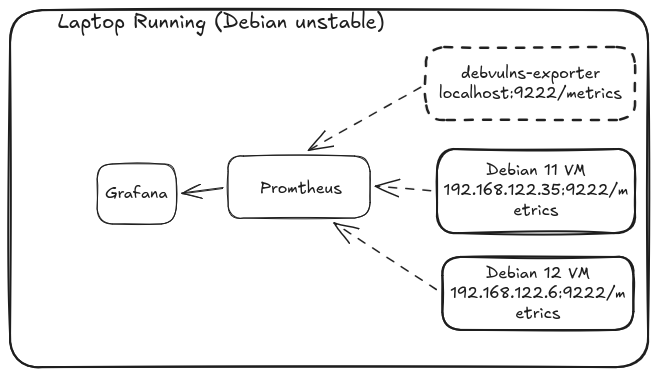
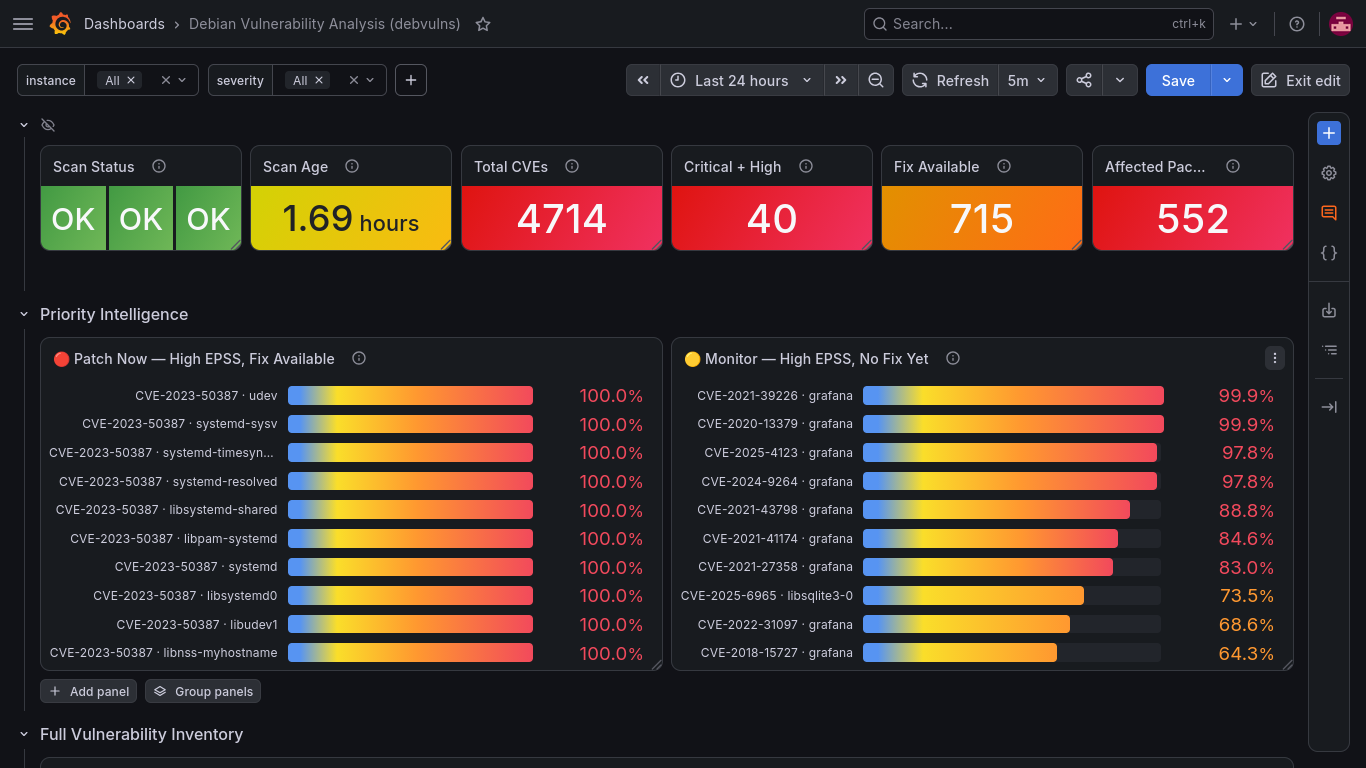
To validate the exporter, I spun up older Debian 11 and Debian 12 cloud images sourced from the Debian Cloud team. The older image was intentionally selected to guarantee a standard baseline of unpatched vulnerabilities for testing. The local evaluation topology is structured as shown below:

Rather than constructing the Grafana dashboard from scratch, I used Claude 4.6 Sonnet via Antigravity to generate the layout configuration. The generated dashboard for the local testbed functions effectively:

The complete, ready-to-import Grafana dashboard configuration is included directly in the debvulns source code.

Renaming the project

To prevent namespace conflicts and confusion with the native debsecan utility in Debian, I have unified the ecosystem under the debvulns moniker. The core CLI is named debvulns, the exporter is debvulns-exporter, and the MCP component is debvulns-mcp. The migration release has been published to PyPI, and the new consolidated repository is active at debvulns.

Conclusion

While this began as a personal utility to fill a niche tool gap, I expect it will be useful for others managing Debian infrastructure at scale. My next objective is to formalize Debian packaging for both the CLI and the exporter. The MCP component will likely remain available as an independent artifact. Until then, happy hacking.

Note: As a core design choice, `debvulns` still uses native `debsecan` as its ground-truth standard. The tool continuously cross-verifies its output against `debsecan` to ensure perfect functional parity and data consistency.

  •  

Jamie McClelland: DNS, OG of high availability

At May First, we recently received (all within a single week) three different complaints about domain names that previously worked fine suddenly not resolving to our servers.

While that isn’t terribly uncommon, we discovered that in each case, the domain name’s authoritative name servers were pointing to our mail servers (a.mx.mayfirst.org, b.mx.mayfirst.org and c.mx.mayfirst.org) instead of our name servers (a.ns.mayfirst.org, b.ns.mayfirst.org and c.ns.mayfirst.org). The weird part: this mistaken configuration was happening at the registrar level, protected by each member’s own credentials that we don’t have access to.

Each affected member fixed their records to resolve the problem but also made very clear that they had not logged into their registrar in years, sugggesting that the DNS authoritative records in their registrar accounts spontaneously changed on their own. The first time was weird, the second time could possibly be a coincidence? But by the third time this happened, we started to panic. How could registrar records spontaneously change? All three domain names were registered with different companies - so it couldn’t be a single registrar problem? Are we going to get a flood of these complaints? What is going on!?!?

We did an inventory to see if this was happening with other domain names in use by our membership and that’s when we discovered just how hard it is for our mostly non-technical users to set a domain’s authoritative name servers. The error rate was less than 1% but still that was a lot of domain names with typos:

  • raise your fist in the air with a.ns.mayfist.org!
  • or just plain give up and hit the floor with a.ns.matfirst.org
  • Or more commonly people added our name servers, but also left the default name servers in place.
  • Also, one person added as their authoritative name servers: a.ns.mayfirst.org, b.ns.mayfirst.org, c.ns.mayfirst.org, a.mx.mayfirst.org, b.mx.mayfirst.org, c.mx.mayfirst.org, and even a.webproxy.mayfirst.org - in other words, all the domain names we tell you do to anything with.
  • And lastly, I did find two more domains just pointing to a.mx.mayfirst.org, b.mx.mayfirst.org and c.mx.mayfirst.org.

That’s when it occurred to me: for years we have maintained an offsite server that provides both c.ns.mayfirst.org and c.mx.mayfirst.org. It hangs out in case something terrible happens to our main colo. The week before we started receiving these complaints, I separated these services, moving c.mx.mayfirst.org to a dedicated MX server. As a result, these two domain names stopped pointing to the same IP address. And that’s when the complaints started rolling in. In other words: the affected members set the incorrect name servers years ago, but because just one of the name servers resolved to an IP that happened to provide the correct authoritative lookup services, it went undeteced all this time.

So… mystery solved. Nobody’s authoritative registrar records “suddenly” changed. They were mis-configured for years but thanks to the amazing resilience of the DNS system, nobody noticed because just one working DNS server is all you need.

  •  

Reproducible Builds: Reproducible Builds in June 2026

Welcome to the June 2026 report from the Reproducible Builds project!

In these reports, we outline the most important things that we have been up to over the past month. As a quick recap about what problem our project intends to solve, whilst anyone may inspect the source code of free software for malicious flaws, almost all software is distributed to end users as pre-compiled binaries. The motivation behind the reproducible builds effort is to ensure no flaws have been introduced during this compilation process by promising identical results are always generated from a given source, thus allowing multiple third-parties to come to a consensus on whether a build was compromised or not.

If you are interested in contributing to the project, please visit our Contribute page on our website.

In this month’s report, we cover:

  1. Only installing reproducible packages with repro-threshold
  2. Distribution work
  3. diffoscope development
  4. From our mailing list…
  5. Documentation updates
  6. Patches
  7. Four new scholarly papers


Only installing reproducible packages with repro-threshold

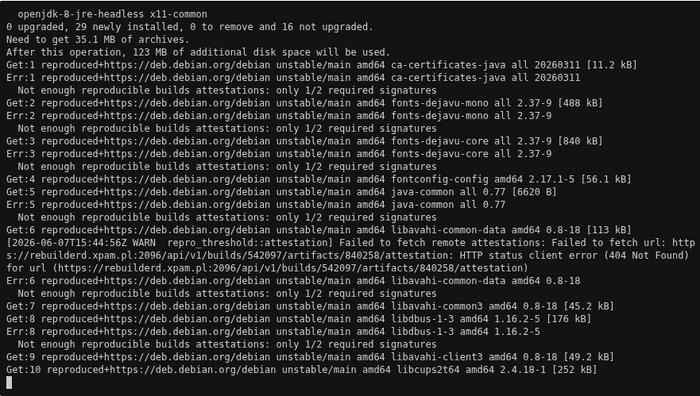
A very interesting demonstration is now available showing how you might configure your Debian system to only install packages that have been reproduced by m/n rebuilders.

This is implemented via a reproduced+https:// APT transport ( a mechanism for communicating between the APT client and its repository source — commonly HTTP):

Every package download is intercepted by repro-threshold, which queries two independent rebuilders for a signed attestation before allowing installation to proceed. [It] is important to note that [an] install will only succeed if all package dependencies are also reproducible.

The demo gives examples of how to quickly experiment with this using a Docker container.


Distribution work

In Debian this month:

The IzzyOnDroid Android APK repository reached its next milestone this month, now covering 2 out of every 3 apps (66.7%) with reproducible builds. Their documentation for debugging and fixing failed builds has steadily grown as well. More clients have picked up showing reproducibility results (e.g. Droid-ify), and Neo Store now can be configured to stick to only reproducible applications. Further, an independent builder has been added to the build farm, increasing the trust level even more as APK builds can have multiple confirmations now.

At the same time, IzzyOnDroid’s rbtlog got several new features. The most outstanding is caching for frequently used resources such as reproducible-apk-tools, command-line tools and NodeJS in order to counter ongoing issues with GitHub availability, while at the same time saving bandwidth and build time. This change also enables some other some smaller enhancements such as being able to configure build timeouts per recipe for those builds running longer than the average, release pattern filtering for update checks or having a field for maintainer notes to shortly summing up e.g. why a reproducible build failed.


Lastly, Bernhard M. Wiedemann posted another openSUSE monthly update for their reproducibility work there.


diffoscope development

diffoscope is our in-depth and content-aware diff utility that can locate and diagnose reproducibility issues. This month, Chris Lamb made the following changes, including preparing and uploading versions 319, 320, 321, 322 and 323 to Debian:

  • Debian adds an extra Flags: line in the output of ocamlobjinfo, so adjust the test for cross-distribution compatibility. []
  • Bump debhelper compatibility level to 14. []
  • Fix compatibility with Ocaml 5.4.1. []
  • Use --long-form-style arguments when calling apktool in order to support apktool version 3. []
  • Support Androguard version 4 and previous versions at the same time. []
  • Update copyright years. []

In addition, Jochen Sprickerhof added better header detection for the Sphinx documentation system [], Michael Daniels fixed the tests when run with zipdetails version 4.006 [] and Zbigniew Jędrzejewski-Szmek added a version of the deprecated os.path.commonprefix method [].

In addition, Vagrant Cascadian updated diffoscope in GNU Guix to version 321 and 323.


Chris Lamb also made the following changes to strip-nondeterminism, our tool to remove specific non-deterministic results from a completed build:

  • Skip symlinks when manually called via /usr/bin/strip-nondeterminism. (#1139000)
  • Update debian/watch format. []
  • Drop Rules-Requires-Root: no and Priority: optional fields. []
  • Bump Standards-Version to version 4.7.4. []


From our mailing list…

On our mailing list this month:

  • kpcyrd posted to our mailing list regarding the “waves of malware uploads to aur.archlinux.org”. Curiously, “every incident I looked at used npmjs.com for malware delivery”, specifically where the npm package includes an (automatically executed) preinstall script that is an ELF binary.

  • kpcyrd also announced the release of debian-repro-status version 0.4.0, a tool written “to give you an approximate idea of how viable it would be to enforce a ‘reproducible packages only’ update policy for the computer system you’ve built”:

    The change updates dependencies to the latest versions, and adds support for multiple -H options, to query results from multiple rebuilderd instances. The results are also now fetched concurrently.

  • kpcyrd also reported that, whilst taking a screenshot for the above release, they noticed that the debian:sid container now is 100% reproducible.

  • Finally, kpcyrd also created a pull request against the add-determinism package to update the itertools and zip Python dependencies.


Documentation updates

Yet again, there were a number of improvements made to our website this month including:

  • Chris Lamb added a reminder re. using the UTC variants of the Javascript Date methods. []

  • Mattia Rizzolo moved OTF to the ‘old’ sponsors list. Thank you for your support!. []

  • kpcyrd updated the Rust documentation to recommend using the --release argument for consistency. []


Patches

The Reproducible Builds project detects, dissects and attempts to fix as many currently-unreproducible packages as possible. We endeavour to send all of our patches upstream where applicable or possible. This month, we wrote a large number of such patches, including:


Four new scholarly papers
Kenichiro Muto and Kuniyasu Suzaki of the Institute of Information Security in Yokohama, Japan published an interesting paper this month titled Attestable Build Chain: Enabling Trust in Reproducible Builds (PDF). Their abstract is as follows:

Ensuring trust in software supply chains requires verifying not only artifacts but also the processes that produce them. Although Reproducible Builds (R-B) require rebuilding to validate artifacts, they cannot verify whether the build was executed with the intended toolchain and inputs and may reproduce unintended or compromised builds without detection. We present Attestable Build Chain, a framework for externally verifying build-time execution without rebuilding. Rather than preventing compromise, it provides verifiable, tamper-evident evidence of actual build-time execution, enabling verification of build process integrity from observed file accesses during the build. []


Julien Malka, Stefano Zacchiroli and Théo Zimmermann published a 50-page report detailing A Decade of Software Reproducibility in the Nix Package Ecosystem:

We find that functional package management enables extremely high rebuildability over time (near-universal ability to reconstitute historical build environments and rebuild software packages), while bitwise reproducibility has steadily improved and reaches a high point in recent years (up to 93% in 2024). Early years show substantially lower bitwise reproducibility, indicating that functional package management alone does not guarantee bitwise-identical outputs, and that the observed high level of bitwise reproducibility is not solely due to the package management approach. Common causes of unreproducibility, both in the rebuildability and bitwise reproducibility dimensions, include management of dates in build and test processes; we quantify their prevalence and other common causes using manual analysis of logs of rebuild failures and automated analysis of diffoscope.

A PDF of their report is available online


Tim Bastin of L3montree GmbH and Jacek Galowicz of Applicative Systems GmbH from DevGuard published a paper detailing How We Built a Sovereign, Reproducible Container Supply Chain for DevGuard:

This paper presents how the DevGuard project rebuilt its OCI container pipeline around reproducible Nix builds and independent dual-platform digest verification. DevGuard images are built hermetically from pinned source revisions, signed with Sigstore/Cosign, and verified through digest comparison across GitHub Actions and sovereign GitLab infrastructure hosted on container.gov.de. We describe the practical integration of reproducible OCI image builds into existing CI/CD workflows and argue that independently reproducible container digests provide a stronger integrity guarantee against build tampering than provenance alone. The paper further discusses remaining trust assumptions and the relevance of sovereign build infrastructure for government and regulated environments.

Finally, Yiseul Choi, Junga Kim, Jun-Ho Hong and Seongmin Kim of the Department of Convergence Security Engineering at the Sungshin Women’s University in Seoul, Korea titled Attestation-based verification of SBOM integrity via consumer-side reproducibility:

Software bills of materials (SBOMs) support supply chain transparency, but they do not prove that a delivered SBOM reproducibly corresponds to its software artifact. Existing signing and provenance mechanisms protect integrity and traceability, yet lack consumer-side reproducible verification. We propose an SBOM integrity verification framework combining procedure disclosure, consumer-side reproduction, authority-generated reference evidence, and digest comparison. A trusted authority records a reference digest, and consumers compare it with locally reproduced and delivered SBOM digests. Experiments on 100 real-world container images show detection of artifact tampering, SBOM substitution, distribution modification, and adaptive tampering beyond signature-based approaches


Finally, if you are interested in contributing to the Reproducible Builds project, please visit our Contribute page on our website. However, you can get in touch with us via:

  •  

Score Summer-Ready Anker Accessories at Rare Low Prices This Weekend

Anker's Prime 3-in-1 Wireless Charging Station has dropped to $99.74 on Amazon, down from $149.99. This is one of Anker's newest accessories, and Amazon's sale today is a match of the all-time low price that we last tracked during Prime Day.

Note: MacRumors is an affiliate partner with some of these vendors. When you click a link and make a purchase, we may receive a small payment, which helps us keep the site running.

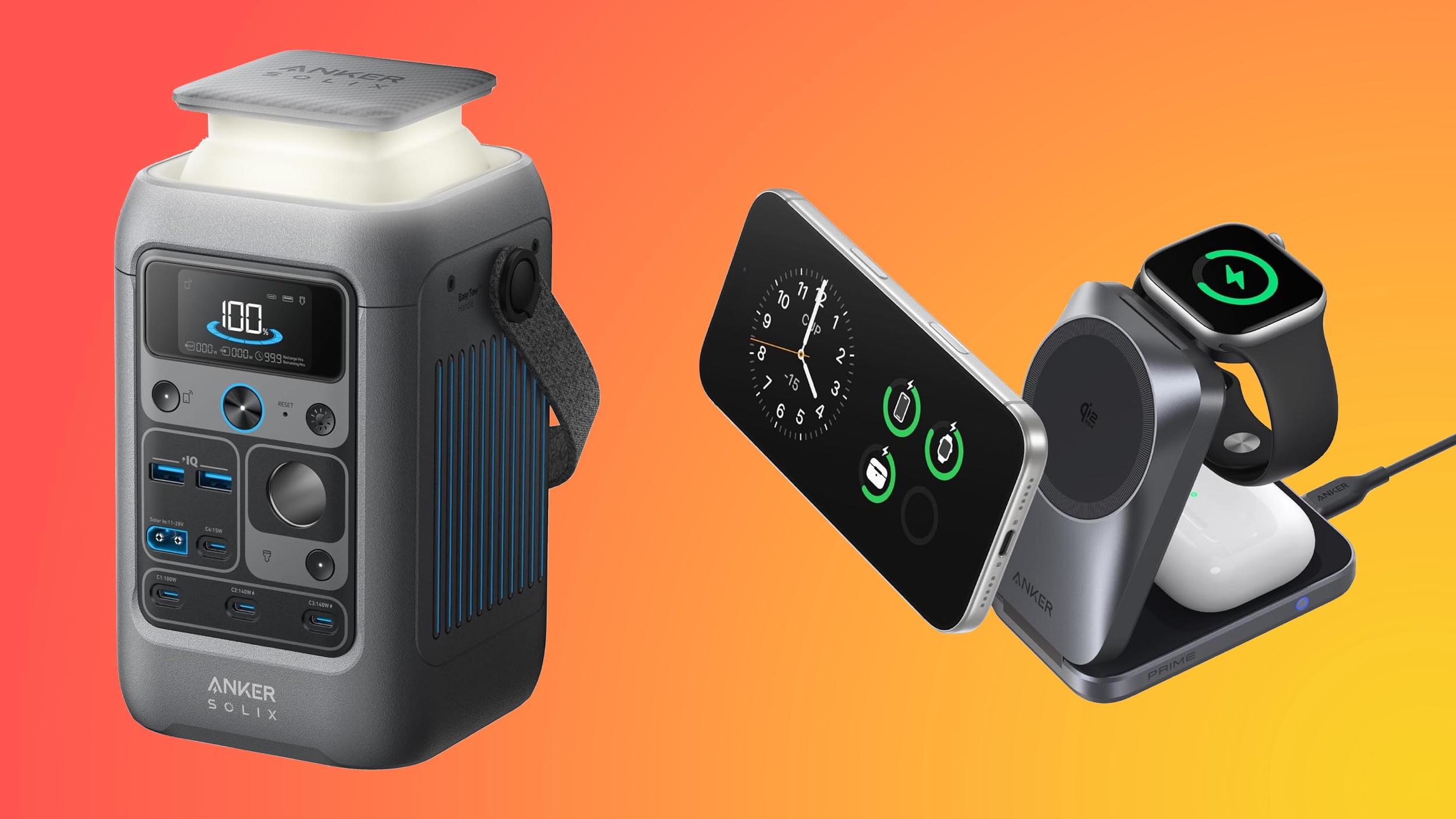
The Prime 3-in-1 Wireless Charging Station features Qi2.2 support, which lets a compatible MagSafe ‌iPhone‌ charge at up to 25W. It's the same speed as Apple's ‌MagSafe‌ charger, and it is 10W faster than the standard Qi2 ‌MagSafe‌ chargers. You can also simultaneously charge an Apple Watch and AirPods with the device.


Below you'll find a list of the best Anker discounts on Amazon this week, also including wall chargers, portable batteries, and more. There are a few more accessories that are matching their Prime Day prices, including Anker's SOLIX Power Station with Lantern. You can get this accessory for $189.99, down from $249.99.

Wall Chargers


Wireless Chargers


Portable Chargers


Portable Power Stations


If you're on the hunt for more discounts, be sure to visit our Apple Deals roundup where we recap the best Apple-related bargains of the past week.


Deals Newsletter


Interested in hearing more about the best deals you can find in 2026? Sign up for our Deals Newsletter and we'll keep you updated so you don't miss the biggest deals of the season!


Related Roundup: Apple Deals

This article, "Score Summer-Ready Anker Accessories at Rare Low Prices This Weekend" first appeared on MacRumors.com

Discuss this article in our forums

  •  
❌