
 Log in
Getting the most out of your Steam Controller: Grip Sense
There are lots of features we're excited about when it comes to Steam Controller, and Grip Sense is one of them.
Grip Sense is what we're calling the two capacitive touch sensors inside the handles of Steam Controller. They sense when your fingers are touching the locations highlighted in the image below.

Because it's, like, cool! Actually, our driving motivation in building these was to provide another way to activate/deactivate Gyro quickly when you've moved it past your comfortable zone and need to recenter it (called "ratcheting").
It's similar to when you're using your mouse and reach the end of your mousepad: you naturally pick it up and put it back down in the middle. With ratcheting, when you get to the "edge" of your comfortable zone while using Gyro, you can lift your fingers up off the back of the controller, recenter the controller, and then put your fingers back on the controller.

The threshold for activation is adjustable. You can make it so a very slight lift of the fingers will deactivate gyro; or you can make it so you almost need take your whole hand off the controller (like in the animation above). We outline more on how to do that later in this article.
While the original intent was for ratcheting (and it does work for that!) we have found a few other cool use cases, like using it to bring up a weapon wheel, map, or menu. You can lift your fingers off the controller, the weapon wheel will pop up, then you can make your selection and put your fingers back to lock it in. We'll show you how to do that too.
Navigate to the layout editor for a game in the Steam App or in Big Picture Mode (we outline this in our blog post on the Steam Input Configurator). Once there, ensure Gyro is set to "Gyro to Mouse", then click on the Gyro Behavior settings gear


Once in here, you will see the Gyro to Mouse settings. The first option is "Choose Gyro Button(s)". It will default to right trackpad touch and right thumbstick touch. Click in the box to the right to access the button selector menu:

This window will show all options for activating Gyro. If you are unsure what an icon means, you can hover over it and a text description will appear on top. The Grip Sense sensors are the two circled in the image below. When a button is selected, it will turn blue. To deselect, click on the button again; it will turn gray.


Once the button is selected, it will work to disable/enable gyro in game. In this example, when you lift your right fingers off of the controller, gyro will be disabled. When your fingers are on the controller, gyro will be enabled.
Multiple activation buttons
If there are multiple buttons selected (see example below where both grip sensors were picked), an option will appear to let you choose whether Any or All buttons are required to Enable, Suppress or Toggle the gyro. By default, it will choose Any. For grip sense, "Any" means you need to extend the fingers on both hands to disable gyro. "All" would mean you only need to extend the fingers on one hand.

In order to use Grip Sense like you would a "press and hold" button to bring up things like weapon wheels, menus, maps, etc, you need to access it a little bit differently.
Within the game of your choice, navigate to the Layout Editor (read more in our "How to make the most of the Steam Input Configurator" blog post). Once inside the layout editor, in the Buttons section, navigate down to the grip buttons.

Pick whichever one you want to use and assign it to the button that opens up menu, weapon wheel, etc.

Here's the tricky part: Grip Sense looks like a pressed button when your fingers are touching the grip, and we want the opposite. We want it to look like a pressed button when your fingers lift off of the grip. To do that, click on the gear icon next to the button; click on settings; then towards the bottom of the settings screen you will see an "Invert Input" toggle. Turn that on (blue).


Now, whenever the grip is released, it will activate as a button press and hold until the grip is touched again!
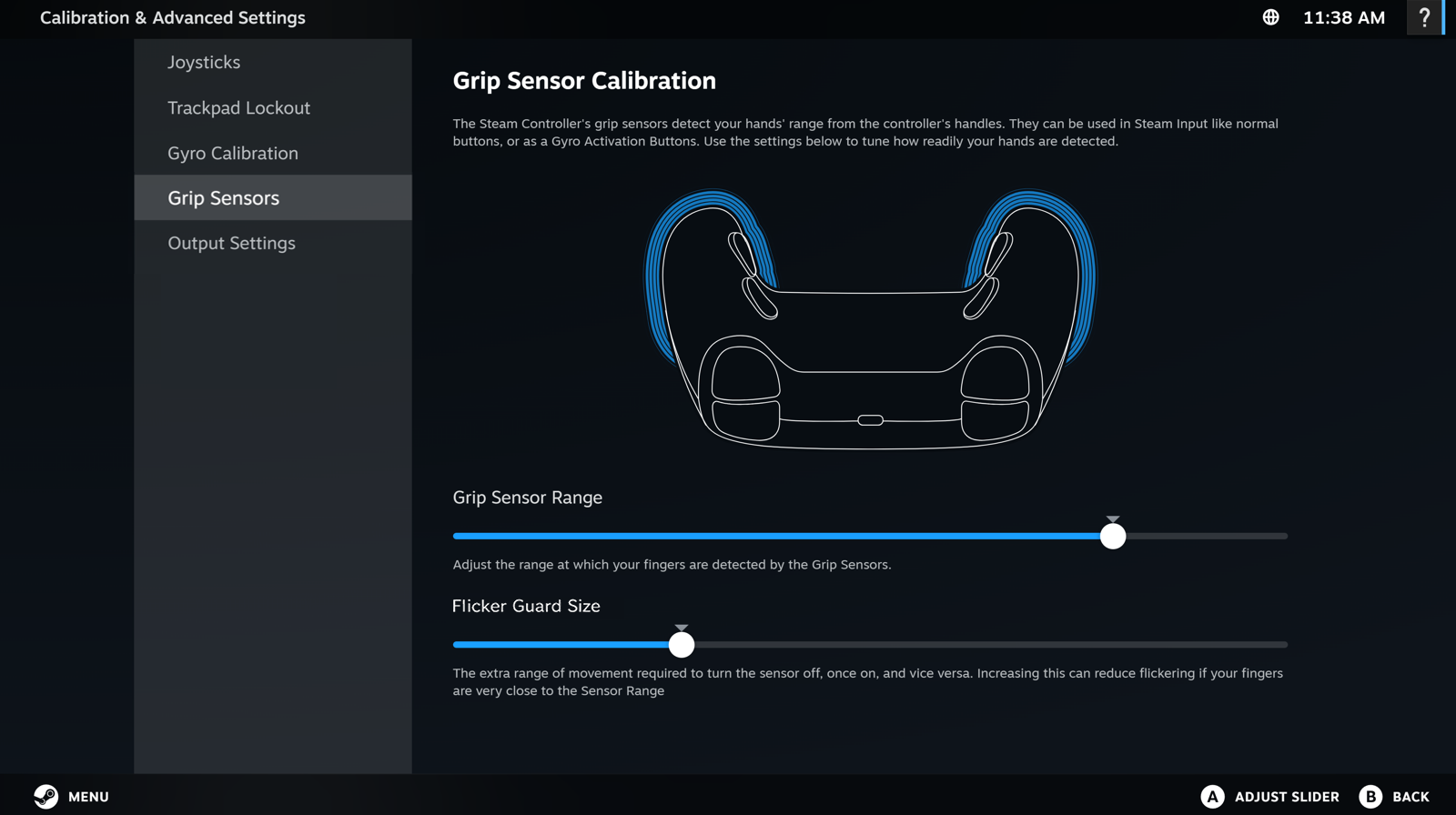
Everybody's hands and preferences are different, so we provided a way to adjust the Grip Sense sensitivity. If you want to change the sensitivity, you can do so by navigating to Calibration and Advanced settings for the controller.
From the Steam App
From the menu in the top left, click Steam > Settings > Controller > Click "details" for the controller you want to modify > Scroll down until you see "Calibration & Advanced Settings" and click on "Open" > Navigate down to "Grip Sensors" where you will see the sensor adjustment interface.


From Big Picture Mode
Hit Steam to open the Steam menu > Settings > Controller > Click "details" for the controller you want to modify > Scroll down until you see "Calibration & Advanced Settings" and click on "Open" > Navigate down to "Grip Sensors" where you will see the sensor adjustment interface.

Adjusting the sensitivity
On the Grip Sensor Calibration page, you will see two sliders:
Grip Sensor Range - The further the slider is to the left, the closer your fingers need to be to the controller grips for them to be sensed. If you want slight lifts of the fingers to turn off the sensor, move it to the left. If you want to move your fingers substantially before deactivating the sensor, move it to the right.
Flicker Guard Size (aka Hysteresis) - This makes the states (on vs off) a bit more sticky around your sensor range. The further this slider is to the right, the more sticky the sensor state is. Meaning, if the sensors are on and the slider is far to the right, you need to move your fingers further to turn them off. If you're looking for very snappy quick response, keep this low. If you're looking for very stable performance with no accidental activations, put it higher.
As you adjust, the UI will provide real time feedback when the sensor is "on" (blue line on grips) vs "off"
Note: if you move the Flicker Size Guard slider all the way to the left, you may have issues with the grip sense flickering or responding to touch events on the trackpads or thumbstick. Moving it slightly to the right can help resolve this issue.
Learn more about Steam Controller on its product page, and keep an eye on the Steam Hardware Blog for other how-to guides and closer looks.


 ...Or at the bottom of the Controller Settings Quick Settings, or, alternatively, inside the Steam Controller Calibration settings.
 If you still encounter drift, double check that the source of the drift isn't coming from your joysticks - you can temporarily set your Joystick mode to "None" to make sure.


