Normale weergave

Dirk Eddelbuettel: RcppMsgPack 0.2.5 on CRAN: Minor Maintenance

19 Augustus 2026 om 22:07

Another maintenance release of RcppMsgPack got onto CRAN today. MessagePack itself is an efficient binary serialization format. It lets you exchange data among multiple languages like JSON. But it is faster and smaller. Small integers are encoded into a single byte, and typical short strings require only one extra byte in addition to the strings themselves. RcppMsgPack brings both the C++ headers of MessagePack as well as clever code (in both R and C++) Travers wrote to access MsgPack-encoded objects directly from R.

This release is once again chiefly maintenance. Besides standard upkeep to the README.md and continuous integration setup we had to add one #include. The clang++-23 compiler, when also running with its own library, now now needs the type_traits.h header file (in the upstream MessagePack code) so we added that. No other changes, so no user-facing changes. Details follow from the NEWS file.

Changes in version 0.2.5 (2026-08-19)

  • Explicitly include header "type_traits.h" to appease clang++-23

  • Standard maintenance updating continuous integration, adding minor helper script, and updating README.md

Courtesy of my CRANberries, there is also a diffstat report for this release. For questions, suggestions, or issues please use the issue tracker at the GitHub repo.

This post by Dirk Eddelbuettel originated on his Thinking inside the box blog. If you like this or other open-source work I do, you can now sponsor me at GitHub.

  •  

Antoine Beaupré: The people vs the AI overlords

19 Augustus 2026 om 16:14

Also in this series:

In a post to oss-security, my (Debian) co-developer Russ Allbery stated that "open source software [OSS] is coming face to face with a motivation crisis that has been building for a long time". His point is essentially that large language models (LLMs1) are making the existing OSS community crisis worse. For him, it's the flood of code reviews, but he argues that varies according to people's desires, for others it's security issues and so on.

I think Russ is right, but I would argue there's something much bigger than our open communities going on here, and it's about the entire field of computing. This pressure is on all of us, regardless of whether we work on open source software or not.

How people use models

People using LLMs in their workflow have radically changed how programming works, even for people who claim to avoid vibe-coding. And I'm sorry to single out one poor maintainer here: it's not you, Brian, you're just one example among many. But this is typical use of those models nowadays:

Once it’s done, I’ll use /code-review and let Claude spawn sub-agents to do a full review of the new code. This usually finds some problems, even problems that the “main” Claude instance didn’t find during its validation. I usually keep running /code-review again and again after finding and fixing issues, until there aren’t any left.

Think about what that means for a minute. This is automation built to fire up dozens of agents crunching at a problem for minutes if not hours of GPU compute time, in parallel. This is essentially a couple of shelves in a datacenter rack, totally maxed out on power and cooling, abstracted behind a cute little /code-review command.

The author, here, is rightly concerned that "Anthropic could pull the rug out and require API pricing", which is perhaps a code word for "charging something closer to actual costs". Brian also pays lip service to environmental and societal costs but those are largely abstracted away, so let's keep that conversation aside here as well, as we have discussed it before anyways.

But clearly, this way of working has an (externalized) cost, to say the least.

Paying for non-free tools

For decades my work has been focused on free and open source software. I've long stopped using proprietary operating systems like Windows or Mac, and even before that switch, I was mostly using free software on those platforms, partly out of principle, but also because I was too poor. So the tools of my trade are free, and I build free tools with them.

It feels like we're going backwards: when I was in school, a millennia ago, my classmates didn't have access to a compiler and were wondering how they would scrape the money to buy a compiler like Borland's or Microsoft's. I had a compiler built into my operating system (FreeBSD at the time), so that wasn't a problem for me. For them, it was a significant expense, but at least those expenses (or more shady sourcing of programs) were a one-shot deal.

Fast forward 30 years, and software is rented: you pay monthly for Adobe's Photoshop and Microsoft's office suite just like you pay for Netflix, Disney+ or Spotify2. And now you need to add dozens (if not hundreds of dollars) of monthly credits to access LLMs on top of that.

So, now we have to pay to get anything done? This is peak enshitification of our job: first they steal our work to train their models, and then they sell it back to us at a profit.

Attacking the engineers

AI is coming for our jobs, as engineers, if not everyone, according to the narrative. For a while now, our job market has deteriorated: less jobs, for less pay. Lots of skilled engineers looking for work and finding crap jobs then still looking while working.

This is not by accident.3 We engineers have a lot of power, it is not organized, but that's just a couple of unions away (easy!). Tech overlords know this, so they are attacking our profession, directly, by forcing us to train and use models that they can control.

Even in environments where programmers are not forced to use LLMs, the mere pressure of other people's LLM-generated work is huge. One can be forced to review LLM outputs, or just peer pressured you into producing more.

We're now supposed to accelerate delivery, because models can presumably do things so much better and faster. With supply chain security becoming such a large vector that we now have worms crawling around developers accounts on NPM, increasing the delivery cadence seems like a really bad idea.4

The LLM hype is part of the larger wave of cyberwar against workers, against water, against the Earth, against all the people. This is not a matter of individually "adapting to the reality" or personal choice, but a political, social, hard problem we need to address collectively.


  1. I again prefer the term LLM to "AI" because models do not possess intelligence. I did use it in the title because click baiting is apparently important, but I stopped short of calling this one "Rage Against the Machines" because that would be the title of every blog post I have ever made.
  2. Yes, I know that Visual Studio is kind of free now, but I wouldn't be surprised if they turn that into a rental as well, because why not.
  3. Beyond sabotaging the job market, Sam Altman event wants to sell "intelligence as a utility" something that is just a really bad idea but especially shows how megalomaniac those people are.
  4. This brings back memories of another era, walking us back decades in terms of computer security.
  •  

Thomas Lange: LLM usage in Debian

18 Augustus 2026 om 15:41

After spending many hours on reading all the proposals and discussions the best choice for me is NOTA (None of the above).

We do not need to create new rules for LLM usage, we already have our DFSG and our social contract.

Keep it simple, stupid. Avoid more rules!

  •  

Andy Simpkins: My first go at tracking down a kernel bug…

18 Augustus 2026 om 12:50

A couple of weekends back, I upgraded my home sever. It failed to restart after running apt dist-upgrade

The only update that was performed was to the kernel, it went from 6.12.88+deb13-amd64 to 6.12.100+deb13-amd64. I had previously performed an apt-get upgrade, and rebooted the machine, so I was pretty sure that this was to blame. This blog entry (is a late) attempt to document how I went about finding a fix for this issue so that next time I don’t need as much hand holding as I did this time around :-)

(1)
Having my machine not boot following an upgrade is pretty rare, but has happened before. Usually it is because I have done something wrong so as always confirming I haven’t broken something by accident is always my first step…

I plugged in a keyboard an monitor to the machine and watched it boot. Being a server this takes a long time (I guess because at this stage of system initialisation we want to test things sequentially)

Watching the system boot I see the usual BIOS/UEFI stages for this machine, followed by the grub menu and the the local screen showed:

            Loading Linux 6.12.100+deb13-amd64 ...
            Loading initial ramdisk ...

Nothing else. That was it. OK that looks like I have a broken system all right, and at very early stage of the boot process process.

(2)
Breaking into the grub menu and removing the quiet option yields a little more information (but not much):

            Loading Linux 6.12.100+deb13-amd64 …
            Loading initial ramdisk ...
            

            	EFI stub: Loaded initrd from LINUX_EFI_INITRD_MEDIA_GUID d
            	evice path
            		EFI stub: Measured initrd data into PCR 9

and nothing else.

(3) Initial debugging

  • Confirmed that I could still boot the machine with the old kernel 6.12.88+deb13-amd64 (During boot select Advanced options from the grub menu followed by the kernel image wanted)
    • Yes – the system starts happily with the previous kernel
  • Checked that /boot had enough space
    • Yes – plenty of space
  • Is anyone else reporting this problem?
    • Nothing jumps out on Debian’s bug tracker
    • Actually not mush referenced for my search “EFI stub: Measured initrd data into PCR 9 apart” other than the usual rantings to “turn off secure boot” (on this server that currently isn’t turned on – bad me)

(4) Triage

Start looking for where the fault first occurred. At this point I needed help, and given that Sledge was visiting I asked if he would sanity check what I was doing. His initial thoughts were that that /boot had run out of space, but replaying my step (3) with him acting as a ‘rubber duck’ showed that this was something other than PBKAC

Sledge had a quick look, then informed me that between kernel images 6.12.88+deb13 and 6.12.100+deb13 Debian stable has only had shipped .90 .94 .95 and .96 kernels. We could easily try them all:

  • wget each kernel package then install (dpkg -i) followed by an update-grub, checking that there was sufficient space on disks especially my small /boot partition)
  • I started with image 6.12.95+deb13 and this worked
  • 6.12.96+deb13 yielded the same lock up on boot as 6.12.100+deb13

OK I now have the first kernel image that doesn’t boot on my system, time to raise a bug…

Up until now I have been walking to my garage where the server is located and standing in front of a rack
with a monitor and keyboard plugged into the machine. However this machine supports IPMI so I spent a little time getting that up and running so that I can continue from the relative comfort of my desk (with lights, a chair and not needing to hold the keyboard with one hand)

Great I can now grab screen shots from the confort of my desk (unfortunatly they are only screen shots not text files, but at least we can seen the early stage of boot, Post, grub menu and then initramfs before system log happens)

(5) Collating information for the initial bug report

Sledge had mentioned my problem in irc/#debain-kernal where iam_tj suggested that we try appending
‘debug earlycon=efifb’ to the kernal command line. This yielded 15 seconds worth of messages before the system locked up the last few messages being (vmlinuz-6.12.96+deb13-amd64):

[ 14.663477] RCU Tasks: Setting shift to 5 and lim to 1 rcu_task_cb_adjust=1 rcu_task_cpu_ids=20.
[ 14.750474] RCU Tasks Rude: Setting shift to 5 and lim to 1 rcu_task_cb_adjust=1 rcu_task_cpu_ids=20.
[ 14.838024] RCU Tasks Trace: Setting shift to 5 and lim to 1 rcu_task_cb_adjust=1 rcu_task_cpu_ids=20.
[ 14.929752] NR_IRQS: 524544, nr_irqs: 584, preallocated irqs: 16
[ 15.016814] rcu: srcu_init: Setting srcu_struct sizes based on contention.
[ 15.104011] Console: colour dummy device 80×25
[ 15.191236] printk: legacy console [tty0] enabled
[ 15.278249] printk: legacy bootconsole [efifb0] disabled

Booting the working kernel with the same kernel options yields the SAME messages with slightly differing times, but then continues to login prompt:

 [   14.697466] RCU Tasks: Setting shift to 5 and lim to 1 rcu_task_cb_adjust=1 rcu_task_cpu_ids=20.
 [   14.784936] RCU Tasks Rude: Setting shift to 5 and lim to 1 rcu_task_cb_adjust=1 rcu_task_cpu_ids=20.
 [   14.872067] RCU Tasks Trace: Setting shift to 5 and lim to 1 rcu_task_cb_adjust=1 rcu_task_cpu_ids=20.
 [   14.964000] NR_IRQS: 524544, nr_irqs: 584, preallocated irqs: 16
 [   15.051482] rcu: srcu_init: Setting srcu_struct sizes based on contention.
 [   15.226079] printk: legacy console [tty0] enabled
 [   15.313751] printk: legacy bootconsole [efifb0] disabled
 [   15.400831] ACPI: Core revision 20240827
 [   15.401415] clocksource: hpet: mask: 0xffffffff max_cycles: 0xffffffff, max_idle_ns: 79635855245 ns
 [   15.401464] APIC: Switch to symmetric I/O mode setup
 
... and so on

iam_tj also suggested adding keep_bootcon – with ‘debug earlycon=efifb keep_bootcon’ on vmlinuz-6.12.96+deb13-amd64:
We get a LOT further – and we see a crash / trace-back:

[ 34.285342] BUG: kernel NULL pointer dereference, address: 0000000000000000

I raised bug #1143721 and followed it up with screen captures of the boot sequence (captured from the IPMI client) and files containing the output of dmidecode, lscpu and lspci to kive the kernel team as much information as possible:

[6.12.96+deb13-amd64 debug earlycon=efifb keep_bootcon.tar.gz (application/gzip, attachment)]
[dmidecode.txt (text/plain, attachment)]
[lscpu.txt (text/plain, attachment)]
[lspci.txt (text/plain, attachment)]

(6) Tracking down the bug Git Bisect

The problem with this type of bug is that it is hardware (class) specific, whilst the kernel doesn’t boot on my system, it clearly has worked on machines used by the kernel team, the Debian test and build infrastructure, (otherwise this kernel would never have been released) and everyone else who has upgraded to the newer kernel before I did (otherwise we would be drowning in fails to boot bug reports). Carnil’s excellent response to my bug: Message #15 (and help in IRC) provided me with a detailed step by step guide in how to track down the individual git commit that fails on my system. I had already (with Sledge’s suggestion) made a clone of the stable branch, but was struggling to follow the steps in the Debian Linux Kernel Handbook to re-build a duplicate kernel because I didn’t understand how to obtain the same configuration that Debian used to build the kernel; Carnil’s email provided me the missing steps (Highlighted).

git clone --single-branch -b linux-6.12.y https://git.kernel.org/pub/scm/linux/kernel/git/stable/linux-stable.git
cd linux-stable
git checkout v6.12.95
cp /boot/config-$(uname -r) .config
yes '' | make localmodconfig
make savedefconfig
mv defconfig arch/x86/configs/my_def
test 6.12.96 to ensure this is "bad"
git checkout v6.12.96
make my_defconfig
make -j $(nproc) bindeb-pkg
… install the resulting .deb package and confirm it fails to boot and triggers the NULL pointer dereference.

Right I can now start to Bisect the problem:

git bisect start
git bisect good v6.12.95
git bisect bad v6.12.96

Rather than use the half step point’s git bisect suggested I was advised in irc to jump straight to the a given commit that from the git log was suspected as the culprit:

git checkout 977855894bca4b87afa50d21e3f3e85a5a0e901f
build and install….
fails…
git bisect bad

git checkout 977855894bca4b87afa50d21e3f3e85a5a0e901f~1 ## ~1 is the commit beforehand
build and install….
fails…
git bisect good

The entire test tree can shown with git bisect log and this was submitted as an email to the bug report, we have found our smoking gun :-)

Finally I would like to thank Carnil, Iam_tj for their time patience and fantastic support in guiding me through finding this regression. Right now kernel bugs are coming in thick and fast with a lot of AI assisted bug hunting, the increased numbers of bugs mean that the kernel team are especially busy. Hopefully our paths will cross and I’ll be able to buy you some beers (or whatever) soon. thank you. Sledge also deserves thanks for putting up with me and pointing me in the right direction (as ever). Lucky for me that he lives nearby so I can provide beers on a regular basis :-)

  •  

John Goerzen: AI in Debian: The Vote, Proposals, and Nuance

18 Augustus 2026 om 03:39

Let me start with a hypothesis:

For human developers, using coding LLMs magnifies their difference in skill levels.

I am one that rarely thinks things are always black and white. Back in March, I wrote Artifial Intelligence: Shades of Gray. Since then, I’ve had more of a chance to experiment with LLMs myself. I also happen to work for an employer that is taking a very pragmatic approach to LLMs: teams and individuals use it as they see fit, but if they are causing considerable expense, they have to justify it.

In various settings, I have seen the egregious examples of AI slop we all know about. As I wrote in March, “I have seen it both waste more time than it saves, and save a ton of time.”

I have come to see that, as a tool, it is most valuable when it is running under the supervision of an experienced engineer. It is at its worst when it has no such supervision; the “vibe coding” and other low-quality slop we see.

A coding agent is like a junior developer or research assistant. When properly supervised, they help projects move along more quickly by letting a senior developer focus on the more difficult, less mundane aspects of the project. But one couldn’t expect a junior developer to consistently deliver high-quality code and architecture on their own.

Let’s put a pin in this idea and look at the story in Debian.

LLM use in Debian

There is a vote happening in Debian around the use of LLMs. In typical Debian fashion, there are 8 options to choose from, many of them similar. Most of these proposals acknowledge there are different types of tasks done in Debian, but the proposals don’t differentiate between them well. Let me do so here. These are some of the LLM-relevant tasks people in Debian perform:

  • Packaging upstream software for Debian (by far the largest task)
  • Writing Debian-specific code (eg, apt or the Debian installer)
  • Maintaining Debian infrastructure (build systems, for instance)
  • Writing documentation and translations

I’m going to focus my remarks here on packaging upstream software for Debian, since this is by far the most time-consuming developer task project-wide.

It matters to our users that we get this right, and packaging quality is one of the things that sets Debian apart from other distros. Packaging things for Debian requires knowledge of some specific tools, such as debhelper, that aren’t widely used anywhere else. In most cases, it is fairly rote time-consuming work. In other words, by its design, it requires people with senior-level skills to do grunt work.

I can’t overstate how massive a burden this grunt work is. I maintain some packages for Go and Rust. By Debian policy, all of those packages’ dependencies must also exist as Debian packages, and be used to build against. When upstream adopts a newer version of some library, it can unleash cascading dependencies that can take hours to sort out. Worse, the Rust team and the Go team use entirely different ways of managing packages (Go uses one Git repo per package, while Rust has a monorepo with specialized scripts to import Cargo packages and generate Debian ones). On top of that, we can’t just modify things like usual; we have to use quilt. And on top of that, I’m also a backports maintainer, so all the work (and usually even more) has to be done there also.

Now let’s pull on that pin from the earlier conversation. This is exactly the kind of scenario that a well-supervised coding LLM is most effective in. I could see a seasoned developer saving hours, maybe even days, by turning over the mundane tasks of managing trees of cascading dependencies over to a coding tool — and verifying and directing the process. (Yes, I have been using em-dashes for years; LLMs have copied people like me, not the other way around! This post was not written with any AI assistance.)

Actually, this is almost a dream scenario for a coding assistant. The result is time-consuming to formulate but easy to review, which is the opposite of the way these things often go.

I can assure you with 100% certainty that humans aren’t adding a lot of value in this process. It would be wrong to believe that a human is carefully reading every line of code in dozens of updated or new library packages. The problem set is too big, the time too short, and the code too varied and complex.

Coding agents seem to be most effective when there are strong test suites that they can test changes against. Debian builds, especially of modern packages, tend to have this property. Many packages have test suites that are run during build. And, if the package builds in an isolated environment (and especially if its downstream dependencies do also), then there is a decent chance that it’s fairly correct. Maybe needing some manual tweaking here and there, but generally a successful build is a reasonable indicator.

You can argue that it would make more sense for Debian to just include dependencies in source packages, along with some version information to support security rebuilds, and I’d tend to agree with you. But we are where we are. This would be one of the more significant leaps forward in developer productivity, but it complicates things like copyright reviews.

Where are LLMs run? What is the environmental impact?

Most of the proposals seem to make the assumption that LLMs must always run in some large, hosted datacenter. As I noted in my March article, I have had credible results on even an older GPU running on solar power.

That said, it is undeniable that LLMs are fueling a datacenter boom, and this in turn is producing a significant new demand for resources. Most notably for the global scale: electricity, which is sometimes generated using carbon-emitting technologies.

Bill McKibben, who has been a leading voice in the fight against climate change since the 1980s, has made some interesting points recently: he’s noted that solar power is the fastest kind of generation we can build, and a number of large AI companies are investing heavily in solar, even to the point of fully offsetting new datacenter’s needs. On the other hand, he’s also noted that some companies are buying inefficient and dirty gas turbines. It is decidedly a mixed bag. The heavy investment in solar can have knock-on positive effects for infrastructure. Obviously, not every picture here is rosy. This analysis doesn’t touch on the real land and water use situation, either.

On the other hand, if an LLM allows me to do in an hour what I would have done in a day, that’s a day of not heating or cooling the work area — generally not sustaining a human for the purpose of writing code for Debian. HVAC energy consumption dwarfs my GPU, and I’d imagine probably also the slice of LLM energy used.

Holistically, I would have to conclude the picture is mixed. It is possible to use LLMs in a pretty green way, and also in a pretty dirty way.

Assuming Conditions Never Change

A flaw in most of these proposals is they assume that the conditions at this present moment will always hold. In fact, that the conditions at the present moment will not continue is something both AI cheerleaders and AI skeptics agree on.

For instance:

Ed Zitron has done a ton of research into the financing side of AI, and has concluded that the current model is unsustainable and headed for a significant bubble burst. I’m not positioned to personally evaluate those claims, but if that happens, what is the result? Perhaps it is a steeply increasing cost of inference for the frontier models, slower pace of training/evolution for them, etc.

In a recent episode of Oxide and Friends, Simon Willison discussed the open weight models that are now available. They have been making remarkable strides in efficiency and capabilities, to the point where $50,000 of hardware can now run high-end open weight models with capabilities that are at least in the same ballpark as the American frontier models. This puts running high-end models locally squarely within reach of universities and small- to medium-sized businesses, with power requirements that can be met with standard commercial solar and wind installations.

The lack of nuance in the more restrictive proposals is particularly concerning. Proposal A doesn’t allow “the use or assitance of… LLMs”. So it bans my solar-powered GPU. It bans using LLMs to find security issues. It bans all sorts of things that don’t seem to be ban-worthy, alongside the things that do. And it codifies it in the very hard-to-change social contract.

That proposal, and some like it, seem to imply that all LLM output is bad. I grant you that AI slop is a real and legitimate concern, and many Open Source projects have to deal with it. On the other hand, we have all seen first-hand how the security of the Linux kernel has benefited dramatically from AI analysis. It is certain that black hats are using these tools. If we refuse to use modern security tools, our security will be compromised (and what is the environmental and social impact of THAT?)

I find the statement “Generative AI is characterized by producing output of a nature that would ordinarily be produced and consumed by humans” to be particularly interesting. The same was once said of compilers.

The Real Concerns

You might think from reading this that I am some AI cheerleader. I’m not. I share the ethics of the FLOSS movement, and have for decades. I abhor the power and lack of ethics that many big names in the field are running with at the moment. I’ve had to put up Anubis on this blog, for instance.

I have personally experienced the effects of AI slop, especially at review time. This is a real problem, though I don’t think the more draconian policies are likely to help (the looser “you must disclose” stand a fighting chance, but I’m not sure they would help, either.) Done poorly, AI threatens developer burnout by overwhelming them with poor code and verbose but useless explanations. Done well, AI can help prevent developer burnout by automating tedious and low-value tasks.

Shouldn’t our goal be that humans submit work to Debian, using tools they prefer, and take responsibility for it? Does it matter if someone uses ed, vim, emacs, or vscode? If they use LSP or just run gcc manually? I’d say we benefit from the diversity. Wouldn’t we be better off to benefit from the diversity here, and judge work as we always have: on its merits, not what tools were used to create it?

Fundamentally, a GR is a long and arduous process. It’s not easy to reverse later. Amending the Social Contract is even longer and more arduous (I should know; I may have been the first one to try). The LLM landscape is fast-moving. None of us can really predict where it will be in a year. Will the current market leading companies even still exist? Will it be at all credible to refuse to use AI-assisted security tools? What is the most effective way to deal with AI slop? What level of utility will we be able to achieve with models run locally?

Some of these proposals would make sense if drafted in some way short of a GR, which would allow more maneuverability as the landscape changes.

Brief analysis of the options

Considering the proposals:

  • Proposal A: seeks to amend the social contract, which I am opposed to for reasons already laid out above. It names some real concerns about AI that I agree with, but implies that all LLM uses and models are guilty of the problems, which is not the case with all of the claims. It also sets us behind the curve on security and stability by forbidding the use or assistance of those tools, even if run by others. It requires us to ignore reports of actual security bugs, or correct fixes, if those reports were generated with the assistance of an LLM, which I find to be absolutely untenable.
  • Proposal B: This is the “AI with accountability” approach. It notes the real concerns with LLMs without painting with an overbroad brush. It strikes me as level-headed and sensible.
  • Proposal C: It paints with an over-broad brush and makes some non-binding requests. Then it winds up largely like proposal B, though while it is worded more strongly, has fewer binding requirements (for instance, it lacks proposal B’s prohibition on transmitting sensitive information to untrusted providers)
  • Proposal D: Seems broadly similar to proposal B, an “AI with accountability” approach. I’m not really clear why we need both.
  • Proposal E: Largely the status quo. It is like proposals B and D in that it says humans are accountable for their contributions. It encourages disclosure of LLM use, but does not mandate it. Like proposal B, it prohibits disclosing sensitive information to third-party AI services. Note that both proposals B and D have an appropriate nuance: a local model is fine, a third-party one is not.
  • Proposal F: This seems really similar to proposal E. I’m not sure why we have these two.
  • Proposal G: Disallows “the output of generative AI as direct contributions to Debian.” This is something of a weakened proposal A; it doesn’t seek to amend the social contract, nor does it ban all use; it simply bans the use as a direct contribution.
  • Proposal H: Ban due to climate impacts. “How is this even an argument” is disrespectful to reasoned conversation. I have already noted that LLMs can be and are used in ways that are not climate-harming. It explicitly contains no binding requirements at all, and is effectively a rant. While I agree with the sentiment that climate change is an urgent problem, and that some LLMs are exacerbating it, I disagree with that all LLM usage does so and therefore disagree with the conclusion.

In favor of nuance

I find that black-and-white thinking is almost always something to be avoided. I see it too often. I see it in politics, I see it in our software, I see it in discussions around AI. Are there deeply unethical things happening in AI? Absolutely. Are they doing some impressive things? Also yes.

We have accepted this nuance in other areas. For instance, almost all the hardware Debian runs on has closed-source hardware, and has components manufactured or assembled in countries with some of the worst human rights records on the planet. I’m not saying this is a great state of affairs. It is something we should speak up about and act upon. But the worse state of affairs would be “no Debian because the hardware is impure”.

  •  

Ian Jackson: Debian LLM GR - Summary of the options

26 Augustus 2026 om 11:11

Debian LLM GR - Summary of the options

Introduction

LLMs have finally made it to the ultimate stage of Debian’s governance processes, a General Resolution of all the project’s full governing members (DDs).

There are a lot of options on the ballot, and they all have a different structure and approach the question in a different way. It can be hard to see the wood for the trees. I have made a summary table to try to capture the main differences, both in effect, and sentiment.

A plea to the undecided voter

Suspending briefly my attempt to be neutral:

Before voting, I encourage you to read the passionate rationales in options H and A, or at least the summary in my option C.

Few of the LLM defences in the discussion threads, and none of the LLM-positive proposals, provide answers to any of these profound ethical concerns, many of which ought individually to be a deal-breaker. Instead, these crucial questions are simply dismissed or even ignored.

Some will tell you we should “keep politics out of software” but as we can see in the world around us, software is political - now more than ever. Debian’s mission is a highly political one: developing a fully-free operating system, and defending its freeness as we do, is far from neutral!

And of course many of LLMs’ harms affect Debian directly.

Table

A G C H F D B E
LLM harms Robustly discussed Discussed Robustly summarised Robustly discussed; especially re climate Summarised Accepted as inevitable Disregarded [1] Ignored
Direct contributions of LLM-generated code Forbidden Forbidden Strongly discouraged Strongly discouraged Discouraged Permitted Permitted Permitted
Direct use of LLM output in communications (bugs, mailing lists, etc.) Forbidden Forbidden Forbidden (with possible exceptions) Strongly discouraged Discouraged Permitted Permitted Permitted
LLM use where LLM output does not end up in the code/message Forbidden No position, so permitted Strongly discouraged Strongly discouraged Discouraged Permitted Permitted Permitted
Disclosure of LLM use LLM use forbidden LLM use largely forbidden, no further disclosure requirement Disclosure required Disclosure encouraged Disclosure encouraged Disclosure required Disclosure required Undisclosed LLM use is OK
Use of LLMs by upstreams Condemned “Not recommended”
Positive statements about LLMs “Here to stay” Moderate Strong

Notes

Ordering

I have tried to present the options in semantic order, with most LLM-negative proposals to the left, and the most LLM-positive to the right.

I have not quoted the one-line titles for the options. These have generally been provided by the proponents of each option, and, unfortunately, some of them are IMO quite misleading.

Note that, unfortunately, the voting software likes to assign numbers to options but also to preferences. Be mindful of this possible confusion when casting your vote. For clarity I quote only the option letters.

Upstream LLM code contributions

Some of the proposals acknowledge the uncertain legal status of LLM output. But all of them implicitly or explicitly assume that LLM output is or can be DFSG free. So none of the proposals forbid upstream projects with LLM-generated contents.

None of the proposals would require us to go back to pre-LLM versions of the upstream projects we use, and attempt to fork and maintain them. I very much think there is room in the world for people to try to do that, but I don’t think the Debian project can be that effort.

Given that the conclusions are the same in each case, whether the matter is discussed does not seem to me to be a significant difference. I have therefore not included a column for it.

Ability of individual teams to set their own rules

My proposal has a specific paragraph (7) explicitly permitting teams to set a “no LLM” policy. The other proposals do not discuss this point specifically. During the discussion, it seemed that most participants agreed that even options which explicitly permit LLM use generally do not prevent a team from setting its own more restrictive LLM policy.

I have therefore not tabulated this aspect.

Exceptions and nuances

Few of the permissive texts are absolute or unconditional. To summarise I have necessarily left out some nuance.

So for example when an entry says “permitted”, that generally means “permitted with conditions which are believed by LLM users to be readily satisfiable” (for example, DFSG-compatibility - see above).

[1] Footnote re proposal B

Proposal B does mention that there are “concerns” about LLM use. But it fails to make an explicit statement about whether these concerns are justified.

It then proceeds exactly as if they are not justified. IMO “disregarded” is a relatively mild term for such a rhetorical technique.


Edited 2026-08-18 09:02 UTC to make the proposal letters in the table be links; 2026-08-26 09:11 UTC to fix typos.


comment count unavailable comments
  •  

Bits from Debian: Debian turns 33!

16 Augustus 2026 om 15:00

It has now been thirty-three years since the Debian project was announced to the world by Ian Murdock, on August 16, 1993. This anniversary is an opportunity to reaffirm the goals, characteristics, and qualities of the Debian project: it’s an association of individuals who have made common cause to create a free operating system. Our distribution is characterized by a commitment to software freedom, as enshrined in the Debian Social Contract and the Debian Free Software Guidelines. It focuses on security and stability. This stability is crucial to Debian position in the free software ecosystem.

With our users as our priority, Debian makes special efforts regarding accessibility with Debian-Accessibility and diversity with our Outreach Programs.

Debian Day is a great opportunity to get together, whether for a local meetup, or simply to grab a coffee with other members of the Debian community. Check out the Debian Day wiki to see if there is a celebration near you. And if there isn't, maybe you can organize it next year!

Today is also an opportunity for you to start or resume your contributions to Debian. For example, you can install the how-can-i-help package and see if there is a bug in any of the software that you use that you can help to fix, contribute small tips on how to install Debian on your machines to our wiki pages, or put a Debian live image in an USB memory and give it to some person near you, who still didn't discover Debian.

Thanks to everybody who has contributed to develop our beloved operating system in these 33 years, and Happy birthday Debian!

  •  

Vasudev Kamath: Releasing debvulns-exporter and debvulns CLI 0.2.2

16 Augustus 2026 om 13:30

I made another minor release with several enhancements: handling non-Debian origin vulnerabilities, improving data caching, and sharing the cache between the debvulns CLI and the exporter. Additionally, there are a few improvements on the dashboard front. Here is a breakdown of what changed.

Handling Vulnerabilities in Non-Debian Origin Packages

During the previous release, I noticed that the grafana package—which is not in Debian and was installed via an upstream repository—was reported as vulnerable with multiple issues. Looking into why this happened, I found that all the CVEs reported in the dashboard were indeed listed on security-tracker.debian.org, but without a fixed version or status description. The logic assumed no fix was available and marked the package as vulnerable on the dashboard.

How Did I Solve This?

Google maintains a distributed vulnerability database for open-source projects called osv.dev. I checked the generic vulnerability data for those CVEs on OSV (unbound to any specific distribution) and found that the issues were already fixed in the upstream version I was running. What I needed was a way to differentiate native Debian packages from non-Debian packages, which corresponds to the Origin field in APT metadata.

Pitfall

The AI-generated code initially attempted to differentiate package origin using apt_pkg.PackageRecords and its origin field. However, many native Debian packages were incorrectly flagged as non-Debian. On closer inspection, when an upgrade is available for a package, the installed version's origin field can be unset. I had to resolve this by detecting available upgrades and inspecting the candidate version's origin instead, which was implemented in this patch. This solution was proudly crafted by me ;-) (partly because I ran out of API limits and had to wait 6 hours for the next reset).

Caching OSV Data

Initially, the AI implemented the exporter to re-download the entire OSV dataset on every run, which was unnecessary. Since vulnerability data does not change rapidly once published, caching it on disk for longer than the standard 24-hour Debian/EPSS cache makes sense. OSV vulnerability data is now cached for 7 days before a refresh is triggered.

All cache expiration thresholds remain configurable via CLI flags.

Catch

One caveat with this approach: I have not yet verified whether every upstream CVE is tracked on security-tracker.debian.org. In the case of grafana, the entries existed. This feature operates on the assumption that security-tracker.debian.org indexes CVE metadata regardless of whether the package is native to Debian. I plan to re-evaluate this and add fallback handling if that assumption fails.

Unified Cache Directory for CLI and Exporter

Another issue was cache segregation: the debvulns CLI utility defaulted to /var/cache/debvulns, while the Prometheus exporter used /var/cache/debvulns-exporter. While harmless when running only one tool, installing both led to duplicated cache storage and redundant network requests. Since the core evaluation logic is identical across both tools, they now share a unified cache directory to eliminate duplicate downloads.

Dashboard Changes

During the initial dashboard rollout, my test environment (my laptop alongside Debian 11 and Debian 12 VMs) reported a high aggregated vulnerability count. It was not immediately obvious whether these were distinct vulnerabilities or the same CVEs replicated across all three machines. This mirrors common questions raised during vulnerability reviews:

  • How many unique vulnerabilities are present across the fleet?
  • Which unique packages are affected?

The dashboard has been redesigned to surface unique vulnerability counts alongside affected package lists. The updated dashboard is shown below:

What's Next?

A few planned items remain to make debvulns a comprehensive vulnerability reporting toolkit for Debian systems:

  1. Kernel Vulnerability Handling: Currently, installing a patched kernel marks the vulnerability as resolved, even if the system has not rebooted into it. The system remains exposed while the vulnerable kernel is executing in memory. Factoring in running kernel versions is crucial.
  2. Reboot and Service Restart Tracking: Similar to kernel upgrades requiring a reboot, userland library and binary fixes require running services to be restarted. This is typically detected via needrestart. Integrating this behavior directly into debvulns will provide complete visibility in a single dashboard metric.
  3. Debian Packaging: Once the above features are stable, the final step is packaging debvulns for Debian so it can be installed directly from the archive.

Until then, happy hacking.

  •  

Sven Hoexter: FrOSCon 2026: TLS Talk

15 Augustus 2026 om 20:02

Info: German content only, sorry.

I was pondering for the past three years if I should give some sort of TLS basics talk at FrOSCon. I finally stepped up this year and gave that talk today, with the title "TLS, mTLS, SNI, ECH, CAA, HTTPS, PKI, Zertifikate und ein bisschen PQC". I was too optimistic with my 50 slides, and had to drop the Post Quantum Cryptography part at the end. Still got positive feedback from Zugschlus and others - thanks a lot for that <3 - and was asked for the slides. It's not a piece of art, but maybe it helps to release the LibreOffice odp file as well, so others can use it as a base for other events or corp internal talks. So here is the froscon-tls-2026.pdf and froscon-tls-2026.odp, both released under the CC BY-NC license.

The video is also available at media.ccc.de if you want to watch it.

Thanks to everyone who made FrOSCon happen for the 21th time!

  •  

Russell Coker: Hacked by Chinafans

15 Augustus 2026 om 11:31

What Happened

On 2026/08/10 at 2:11 am Australian eastern standard time (2026/08/09 16:11 UTC) someone created a post titled “Hacked by Chinafans” on my documents blog [1]. The person in question created an account named “67965e42a3c3” on that site with the email address 67965e42a3c3@google.com associated with it (I tried emailing that address and it bounced).

At 04:28:41am Australian eastern standard time (18:28 UTC) I was sent an email titled “Have you been hacked” by a reader of my blogs who subscribed to the RSS feed of my documents blog (a blog that I never expected anyone to read by RSS). Along the lines of “the wisdom of crowds” should we have “the unexpected observation and problem reporting of crowds”? I appreciate the notification, I might not have noticed until the next time I watched an unusually good movie otherwise.

The account in question was apparently created on 2026-07-21 at 16:43:47 (presumably UTC) even though at the time I believe creating accounts was not permitted. As an aside the timestamp of account creation is stored in the user_registered column of the wp_users table in the database, there doesn’t appear to be a way to access this in a standard WordPress installation other than doing a SQL query.

2026-07-24 15:43:17 status triggers-pending wordpress:all 7.0+dfsg1-1
2026-07-24 15:43:19 upgrade wordpress:all 7.0+dfsg1-1 7.0.2+dfsg1-1

Above are the relevant sections of my dpkg log showing the WordPress versions in use. I was running version 7.0+dfsg1-1 at the time the account was apparently created. I am confident in the accuracy of the dpkg logs and believe that they did not compromise the OS, I am not sure whether they ran hostile SQL code to change fields in the MySQL database so had to consider the possibility that the account creation time could have been set to a deliberately misleading value. I checked backups of the MySQL database stored off-site and found that the account in question was not in the 2026-07-21 backup (which was done before 16:43) but in the 2026-07-22 backup.

The WordPress release history [2] has version 7.0.1 released on 2026-07-09 and version 7.0.2 released on 2026-07-17. So presumably the attacker diffed the code on those releases, found an exploitable bug, and used it to create an account on my blog with admin privs. Then they waited a few weeks to see if I would notice and published a blog post when I didn’t notice.

WordPress Deficiencies

  1. WordPress doesn’t seem to store the version it’s running at the time of operations. So anyone who doesn’t have a suitable external log of versions deployed (such as the dpkg.log file for a Debian managed installation) won’t know for sure which version was running. It supports automatic updates but you can’t be sure that they happened soon after the release.
  2. There is no log of IP addresses used for operations. There are apparently some 3rd party modules to log such things and web pages documenting how to modify the PHP to add it but nothing in the standard distribution.
  3. Software should have a standard distribution with some support for logging of security relevant data. The typical situation is that people don’t plan for logging such things until after they have been attacked so the data should be recorded without users going out of their way to log it.
  4. A log of security relevant data should be stored in a database table with only insert access (no update, delete, or drop).
  5. Ideally a CMS would support different database accounts for different purposes. Someone from an internal network or VPN could talk to an instance of the web server which has a database username and password giving full access. Everyone from outside the trusted range gets an instance of the web server with database access only allowing to read the posts and appearance configuration and to enter comments. If the database didn’t allow the account used for public access to create new admin users or create posts then it would be a lot harder for attackers.
  6. Ideally for everything that stores user account data there would be an easy way of getting a list of users in a plain text format to allow running diff. The design of WordPress has two tables, one for users and one for encoded metadata about users of which one will be the access level. The following SQL command will give a list of all users that aren’t subscribers (everyone above the minimum level of access which is typical for new users) along with their encoded password and access level. This could be used in a monitoring system to alert about new privileged users. The TABLE_PREFIX variable is for the prefix for WordPress tables, which is “wp_” by default but can be any legal value.
    select $TABLE_PREFIXusers.user_login, $TABLE_PREFIXusers.user_pass, $TABLE_PREFIXusermeta.meta_value from  $TABLE_PREFIXusers join $TABLE_PREFIXusermeta on $TABLE_PREFIXusers.id = $TABLE_PREFIXusermeta.user_id and meta_key='$TABLE_PREFIXcapabilities' and meta_value != 'a:1:{s:10:"subscriber";b:1;}';

What Next?

The blog post they created had a couple of links to Telegram which could presumably be used to contact them. If anyone involved in computer security wants a copy of the original post to do so then they can contact me by any of the usual methods.

I am interested in communication with the attacker if they wish, Telegram is not a service I use but I presume that anyone capable of doing this sort of attack is also capable of finding other ways of contacting me.

I have idly considered changing to a static site generator, here is a good list of static site generators [3].

I have also idly considered other platforms for blogging such as Lemmy. I don’t know if Lemmy is better than WordPress for security and updates, but there are plenty of free instances running where it wouldn’t be an issue I have to work on.

15 Years

It’s been 15 years since my blog server was cracked by a trojaned ssh client [4]. At least this time it was only one service that was compromised.

Related posts:

  1. blogging software Previously I asked for advice about running an Intranet blog,...
  2. WordPress and Thumbnails I have just had a lot of trouble with Thumbnails...
  3. WordPress Maintainability For a while I’ve been maintaining my own WordPress packages....
  •  

Russell Coker: AMD Video Drivers, LLMs, and Debian Kernels

15 Augustus 2026 om 10:09

The AMD GPU Problem

For a while I’ve been having issues with AMD GPUs, video locking up periodically. I blogged about this late last year but I first had noticeable problems early last year [1]. The problems hadn’t only concerned my workstation but also my home server which is also used as a workstation. I’ve recently upgraded my machines to Debian/Testing, my home server has been generally OK but my workstation has been crashing a lot. Every second day when on kernel 7.1.6 and then when on 7.1.7 it crashed at least once a day.

The AMD GPUs I have are “[AMD/ATI] Baffin [Radeon RX 460/560D / Pro 450/455/460/555/555X/560/560X] (rev e5)” in my main desktop workstation, “[AMD/ATI] Lexa [Radeon 540X/550X/630 / RX 640 / E9171 MCM] (rev c1)” in my build server, and “[AMD/ATI] Baffin [Radeon RX 460/560D / Pro 450/455/460/555/555X/560/560X] (rev cf)” in my home server. They aren’t new GPUs, but also aren’t really old and they all support 4K and better resolution.

Chat GPT Was Useful

When I googled the errors I was seeing I found nothing useful. On the suggestion of a friend I tried asking ChatGPT. Generally I don’t recommend asking LLMs about such things, but it can be a last resort as long as you know what you are doing. ChatGPT asked me to run a number of commands to get information for it to make more informed decisions. I know that the output of lspci and similar commands isn’t a risk, but a novice could be tricked into running commands that expose sensitive data.

ChatGPT did give me some useful information, not a solution but an indication that the problem was due to driver bugs.

Upgrading to Experimental

Debian/Experimental is for packages that are expected to have problems and generally aren’t recommended even for the people who usually use Debian/Unstable. It’s commonly used for packages that are needed to develop other packages, EG new libraries that aren’t fully usable but which are needed to package newer versions of applications.

I upgraded my workstation to the Debian/Experimental kernel 7.2~rc7-1~exp1 after having tried every other convenient option. Generally I wouldn’t recommend that anyone run an Experimental kernel without a really good reason, but crashing more than once a day is a fairly good reason. That kernel has now given me over 4 days of uptime on a system that previously wouldn’t last a day. I installed it on my dual-socket build server that has an old AMD GPU in it for test purposes and that also hasn’t crashed since. I installed it on my ML test machine which has an Intel B580 Battlemage GPU with 16G of VRAM and was repeatedly getting a kernel panic related to the GPU a few seconds after boot and now it also works correctly.

It seems that the 7.1.x kernels have bugs in the AMD video drivers and in some part of the code that affects Intel video drivers and that the bugs in question are fixed in the tree that will become 7.2. I would not recommend anyone who has a 7.1.x kernel working fine for them try 7.2 RC kernels at this time, but anyone who has GPU related problems (particularly Intel and AMD GPUs) should definitely test it out.

I also don’t recommend upgrading any system with an AMD GPU to Debian/Testing or Debian/Unstable at this time unless you are also prepared to install an Experimental kernel if it becomes necessary.

There are a several kernel log dumps related to this after the break (which won’t be in RSS feeds). This is mainly for Google so that other people who have such issues can get more useful results out of Google searches than I got.

Future Support Options

Separate from the issue of whether commercial LLMs like ChatGPT can be useful for solving technical problems there is the issue of whether they are desirable. I think that we really don’t want people solving problems in FOSS systems with closed-source LLMs. This leads to loss of privacy, loss of the control users deserve to have over their own systems, and an implied promotion of non-fee software.

I think that the ideal would be to have a cross distribution effort to generate training data for a support LLM system which can then be further trained by each distribution for a greater emphasis on distribution specific issues.

Errors on AMD GPUs

2026-08-09T23:03:06.004792+10:00 xev kernel: amdgpu 0000:02:00.0: GPU fault detected: 147 0x00024802
2026-08-09T23:03:06.004792+10:00 xev kernel: amdgpu 0000:02:00.0: Process kscreenlocker_g pid 42037 thread kscreenloc:cs0 pid 42044
2026-08-09T23:03:06.004793+10:00 xev kernel: amdgpu 0000:02:00.0: VM_CONTEXT1_PROTECTION_FAULT_ADDR 0x00000800
2026-08-09T23:03:06.004794+10:00 xev kernel: amdgpu 0000:02:00.0: VM_CONTEXT1_PROTECTION_FAULT_STATUS 0x0F048002
2026-08-09T23:03:06.004795+10:00 xev kernel: amdgpu 0000:02:00.0: VM fault (0x02, vmid 7, pasid 130) at page 2048, write from 'TC0' (0x54433000) (72)
2026-08-09T23:03:06.008762+10:00 xev kernel: amdgpu 0000:02:00.0: GPU fault detected: 147 0x00004802
2026-08-09T23:03:06.008768+10:00 xev kernel: amdgpu 0000:02:00.0: Process kscreenlocker_g pid 42037 thread kscreenloc:cs0 pid 42044
2026-08-04T01:13:37.505839+10:00 xev kernel: ------------[ cut here ]------------ 
2026-08-04T01:13:37.505859+10:00 xev kernel: amdgpu 0000:02:00.0: [drm] drm_WARN_ON_ONCE(cur_vblank != vblank->last) 
2026-08-04T01:13:37.505862+10:00 xev kernel: WARNING: CPU: 6 PID: 210534 at drivers/gpu/drm/drm_vblank.c:362 drm_update_vblank_count+0x2f1/0x3c0 [drm] 
2026-08-04T01:13:37.505866+10:00 xev kernel: snd_intel_dspcfg wmi_bmof rc_core snd_intel_sdw_acpi drm_ttm_helper uas realtek snd_usbmidi_lib snd_hda_codec ttm mdio_devres snd_hda_core snd_seq_midi drm_kms_helper usb_storage mc snd_hwdep libphy snd_seq_midi_event intel_uncore snd_pcm_oss i2c_algo_bit serio_raw snd_rawmidi pcspkr snd_mixer_oss i2c_i801 video snd_seq snd_pcm i2c_smbus lpc_ich snd_seq_device mei_me e1000e snd_timer mei snd tpm_infineon soundcore joydev bnx2 wmi button nfsd auth_rpcgss nfs_acl lockd grace sunrpc coretemp br_netfilter bridge stp llc sg ghash_clmulni_intel loop msr i2c_dev drm efi_pstore configfs nfnetlink ip_tables x_tables autofs4 btrfs blake2b_generic dm_crypt dm_mod raid10 raid456 async_raid6_recov async_memcpy async_pq async_xor async_tx libcrc32c xor raid6_pq raid1 raid0 md_mod ext4 crc16 mbcache jbd2 crc32c_generic virtio_blk evdev hid_generic usbhid hid sd_mod xhci_pci xhci_hcd ahci ehci_pci ehci_hcd libahci crc32c_intel libata usbcore aesni_intel nvme psmouse scsi_mod gf128mul crypto_simd nvme_core cryptd 
2026-08-04T01:13:37.505879+10:00 xev kernel: nvme_auth scsi_common usb_common efivarfs 
2026-08-04T01:13:37.505880+10:00 xev kernel: CPU: 6 UID: 1008 PID: 210534 Comm: sshd-session Tainted: G D 6.12.88+deb13-amd64 #1 Debian 6.12.88-1 
2026-08-04T01:13:37.505881+10:00 xev kernel: Tainted: [D]=DIE 
2026-08-04T01:13:37.505883+10:00 xev kernel: Hardware name: Hewlett-Packard HP Z640 Workstation/212A, BIOS M60 v02.61 03/23/2023 
2026-08-04T01:13:37.505884+10:00 xev kernel: RIP: 0010:drm_update_vblank_count+0x2f1/0x3c0 [drm] 
2026-08-04T01:13:37.505885+10:00 xev kernel: Code: 48 8b 5f 50 48 85 db 75 03 48 8b 1f e8 68 eb 2b cf 48 c7 c1 70 3e cb c0 48 89 da 48 c7 c7 f9 6f cb c0 48 89 c6 e8 af d7 a6 ce <0f> 0b e9 4b fe ff ff 48 8b 4c 24 18 e9 31 fe ff ff 31 f6 48 85 db 
2026-08-04T01:13:37.505887+10:00 xev kernel: RSP: 0000:ffffd3cc8681fca0 EFLAGS: 00010082 
2026-08-04T01:13:37.505888+10:00 xev kernel: RAX: 0000000000000000 RBX: ffff8c6b42b13710 RCX: 0000000000000027 
2026-08-04T01:13:37.505889+10:00 xev kernel: RDX: ffff8c89ef521788 RSI: 0000000000000001 RDI: ffff8c89ef521780 
2026-08-04T01:13:37.505890+10:00 xev kernel: RBP: 0000000000000000 R08: 0000000000000000 R09: ffffd3cc8681fb20 
2026-08-04T01:13:37.505891+10:00 xev kernel: R10: ffff8c8a6fef3628 R11: 0000000000000003 R12: 0000000000000000 
2026-08-04T01:13:37.505892+10:00 xev kernel: R13: ffff8c6c07853828 R14: 0000000000000003 R15: 0000000000000000 
2026-08-04T01:13:37.505893+10:00 xev kernel: FS: 00007ffaf2fd5880(0000) GS:ffff8c89ef500000(0000) knlGS:0000000000000000 
2026-08-04T01:13:37.505895+10:00 xev kernel: CS: 0010 DS: 0000 ES: 0000 CR0: 0000000080050033 
2026-08-04T01:13:37.505896+10:00 xev kernel: CR2: 00007fb1718c8000 CR3: 000000074521a004 CR4: 00000000003706f0 
2026-08-04T01:13:37.505897+10:00 xev kernel: Call Trace: 
2026-08-04T01:13:37.505898+10:00 xev kernel:  
2026-08-04T01:13:37.505899+10:00 xev kernel: drm_crtc_accurate_vblank_count+0x41/0xc0 [drm] 
2026-08-04T01:13:37.505900+10:00 xev kernel: dm_pflip_high_irq+0x155/0x330 [amdgpu] 
2026-08-04T01:13:37.505901+10:00 xev kernel: amdgpu_dm_irq_handler+0x85/0x1f0 [amdgpu] 
2026-08-04T01:13:37.505902+10:00 xev kernel: amdgpu_irq_dispatch+0xd2/0x230 [amdgpu] 
2026-08-04T01:13:37.505903+10:00 xev kernel: amdgpu_ih_process+0x84/0x100 [amdgpu] 
2026-08-04T01:13:37.505904+10:00 xev kernel: amdgpu_irq_handler+0x23/0x60 [amdgpu] 
2026-08-04T01:13:37.505905+10:00 xev kernel: __handle_irq_event_percpu+0x4a/0x190
2026-08-04T01:13:37.505907+10:00 xev kernel: handle_irq_event+0x38/0x80 
2026-08-04T01:13:37.505908+10:00 xev kernel: handle_edge_irq+0x8b/0x230 
2026-08-04T01:13:37.505909+10:00 xev kernel: __common_interrupt+0x45/0xe0 
2026-08-04T01:13:37.505910+10:00 xev kernel: common_interrupt+0x42/0xa0 
2026-08-04T01:13:37.505911+10:00 xev kernel: asm_common_interrupt+0x26/0x40 
2026-08-04T01:13:37.505912+10:00 xev kernel: RIP: 0033:0x7ffaf3c5fd7b 
2026-08-04T01:13:37.505913+10:00 xev kernel: Code: 70 c7 00 66 0f 6e f8 c1 ef 02 66 0f 70 f7 e0 83 c7 01 66 0f ef ff 66 0f fa f2 0f 1f 44 00 00 f3 0f 7e 01 66 0f 6f ce 83 c6 01 <48> 83 e9 08 f2 0f 70 c0 1b 66 0f 6f e0 66 0f 6f e8 66 41 0f f9 c0 
2026-08-04T01:13:37.505915+10:00 xev kernel: RSP: 002b:00007fff86a5e0e0 EFLAGS: 00000202 
2026-08-04T01:13:37.505916+10:00 xev kernel: RAX: 0000000000008000 RBX: 0000562614a04050 RCX: 0000562614982ed8 
2026-08-04T01:13:37.505946+10:00 xev kernel: RDX: 0000000000007fe2 RSI: 0000000000000fad RDI: 0000000000002000 
2026-08-04T01:13:37.505948+10:00 xev kernel: RBP: 0000000000000000 R08: 000056261498ac40 R09: 0000000000008000 
2026-08-04T01:13:37.505949+10:00 xev kernel: R10: 0000000000000066 R11: 0000000000007fe1 R12: 0000000000007efa
2026-08-04T01:13:37.505950+10:00 xev kernel: R13: 0000000000008000 R14: 0000000000008000 R15: 000000000000ffe0 
2026-08-04T01:13:37.505951+10:00 xev kernel:  
2026-08-04T01:13:37.505953+10:00 xev kernel: ---[ end trace 0000000000000000 ]--- 
2026-08-04T01:55:40.844110+10:00 xev kernel: pcieport 0000:00:03.3: AER: Multiple Correctable error message received from 0000:00:03.3 
2026-08-04T01:55:40.844130+10:00 xev kernel: pcieport 0000:00:03.3: PCIe Bus Error: severity=Correctable, type=Data Link Layer, (Receiver ID) 
2026-08-04T01:55:40.844132+10:00 xev kernel: pcieport 0000:00:03.3: device [8086:6f0b] error status/mask=00000040/00002000 
2026-08-04T01:55:40.844134+10:00 xev kernel: pcieport 0000:00:03.3: [ 6] BadTLP
2026-08-11T09:33:33.473855+10:00 xev kernel: amdgpu 0000:02:00.0: GPU fault detected: 147 0x00024802
2026-08-11T09:33:33.473871+10:00 xev kernel: amdgpu 0000:02:00.0: Process kscreenlocker_g pid 150905 thread kscreenloc:cs0 pid 150912
2026-08-11T09:33:33.473871+10:00 xev kernel: amdgpu 0000:02:00.0: VM_CONTEXT1_PROTECTION_FAULT_ADDR 0x00000800
2026-08-11T09:33:33.473873+10:00 xev kernel: amdgpu 0000:02:00.0: VM_CONTEXT1_PROTECTION_FAULT_STATUS 0x0F048002
2026-08-11T09:33:33.473873+10:00 xev kernel: amdgpu 0000:02:00.0: VM fault (0x02, vmid 7, pasid 63) at page 2048, write from 'TC0' (0x54433000) (72)
2026-08-11T09:33:33.473874+10:00 xev kernel: amdgpu 0000:02:00.0: GPU fault detected: 147 0x00004802
2026-08-11T09:33:33.473874+10:00 xev kernel: amdgpu 0000:02:00.0: Process kscreenlocker_g pid 150905 thread kscreenloc:cs0 pid 150912
2026-08-11T09:33:33.473875+10:00 xev kernel: amdgpu 0000:02:00.0: VM_CONTEXT1_PROTECTION_FAULT_ADDR 0x00000800
2026-08-11T09:33:33.473876+10:00 xev kernel: amdgpu 0000:02:00.0: VM_CONTEXT1_PROTECTION_FAULT_STATUS 0x0E048002
2026-08-11T09:33:33.473876+10:00 xev kernel: amdgpu 0000:02:00.0: VM fault (0x02, vmid 7, pasid 63) at page 2048, read from 'TC0' (0x54433000) (72)
2026-08-11T09:33:35.481863+10:00 xev kernel: amdgpu 0000:02:00.0: Dumping IP State
2026-08-11T09:33:35.481875+10:00 xev kernel: amdgpu 0000:02:00.0: Dumping IP State Completed
2026-08-11T09:33:35.481875+10:00 xev kernel: amdgpu 0000:02:00.0: [drm] AMDGPU device coredump file has been created
2026-08-11T09:33:35.481876+10:00 xev kernel: amdgpu 0000:02:00.0: [drm] Check your /sys/class/drm/card0/device/devcoredump/data
2026-08-11T09:33:35.481877+10:00 xev kernel: amdgpu 0000:02:00.0: GPU fault detected: 146 0x0110040c
2026-08-11T09:33:35.481877+10:00 xev kernel: amdgpu 0000:02:00.0: Process kscreenlocker_g pid 150905 thread kscreenloc:cs0 pid 150912
2026-08-11T09:33:35.481878+10:00 xev kernel: amdgpu 0000:02:00.0: VM_CONTEXT1_PROTECTION_FAULT_ADDR 0x00000022
2026-08-11T09:33:35.481879+10:00 xev kernel: amdgpu 0000:02:00.0: VM_CONTEXT1_PROTECTION_FAULT_STATUS 0x0E00400C
2026-08-11T09:33:35.481879+10:00 xev kernel: amdgpu 0000:02:00.0: VM fault (0x0c, vmid 7, pasid 63) at page 34, read from 'TC3' (0x54433300) (4)
2026-08-11T09:33:35.489845+10:00 xev kernel: amdgpu 0000:02:00.0: ring gfx timeout, signaled seq=5123619, emitted seq=5123621
2026-08-11T09:33:35.489853+10:00 xev kernel: amdgpu 0000:02:00.0: Process kscreenlocker_g pid 150905 thread kscreenloc:cs0 pid 150912
2026-08-11T09:33:35.489854+10:00 xev kernel: amdgpu 0000:02:00.0: GPU reset begin!. Source: 1
2026-08-11T09:33:35.493839+10:00 xev kernel: amdgpu 0000:02:00.0: [drm] ERROR Failed to initialize parser -125!
2026-08-11T09:33:35.737848+10:00 xev kernel: amdgpu: cp is busy, skip halt cp
2026-08-11T09:33:35.897842+10:00 xev kernel: amdgpu: rlc is busy, skip halt rlc
2026-08-11T09:33:35.897852+10:00 xev kernel: amdgpu 0000:02:00.0: BACO reset
2026-08-11T09:33:36.485849+10:00 xev kernel: amdgpu 0000:02:00.0: GPU reset succeeded, trying to resume
2026-08-11T09:33:36.485859+10:00 xev kernel: amdgpu 0000:02:00.0: [drm] PCIE GART of 256M enabled (table at 0x000000F402000000).
2026-08-11T09:33:36.485860+10:00 xev kernel: amdgpu 0000:02:00.0: VRAM is lost due to GPU reset!

Errors on Battlemage

Aug 11 17:01:47 ami kernel: ------------[ cut here ]------------
Aug 11 17:01:47 ami kernel: xe 0000:23:00.0: [drm] DMC 1 mmio[0]/0x5f074 incorrect (expected 0x96fc0, current 0x0)
Aug 11 17:01:47 ami kernel: WARNING: drivers/gpu/drm/i915/display/intel_dmc.c:696 at assert_dmc_loaded+0x275/0x430 [xe], CPU#0: kworker/0:3/215
Aug 11 17:01:47 ami kernel: Modules linked in: intel_rapl_msr intel_rapl_common intel_uncore_frequency intel_uncore_frequency_common xe(+) skx_edac snd_h>
Aug 11 17:01:47 ami kernel:  msr i2c_dev configfs efi_pstore efivarfs autofs4 btrfs libblake2b raid6_pq xor mpt3sas raid_class scsi_transport_sas megarai>
Aug 11 17:01:47 ami kernel: CPU: 0 UID: 0 PID: 215 Comm: kworker/0:3 Not tainted 7.1.7+deb14-amd64 #1 PREEMPT(lazy)  Debian 7.1.7-1 
Aug 11 17:01:47 ami kernel: Hardware name: HP HP Z4 G4 Workstation/81C5, BIOS P61 v03.00 04/15/2026
Aug 11 17:01:47 ami kernel: Workqueue: sync_wq local_pci_probe_callback
Aug 11 17:01:47 ami kernel: RIP: 0010:assert_dmc_loaded+0x291/0x430 [xe]
Aug 11 17:01:47 ami kernel: Code: 24 10 e8 f2 e5 a3 ce 48 8d 3d bb 85 0d 00 8b 54 24 0c 45 89 e9 45 89 e0 48 89 c6 52 8b 4c 24 2c 51 8b 4c 24 30 48 8b 54>
Aug 11 17:01:47 ami kernel: RSP: 0018:ffffd27ac0b87b80 EFLAGS: 00010282
Aug 11 17:01:47 ami kernel: RAX: ffffffffc1743dfd RBX: ffff8c5b80e54000 RCX: 0000000000000001
Aug 11 17:01:47 ami kernel: RDX: ffff8c5b81df5a10 RSI: ffffffffc1743dfd RDI: ffffffffc1605860
Aug 11 17:01:47 ami kernel: RBP: ffff8c5b86955000 R08: 0000000000000000 R09: 000000000005f074
Aug 11 17:01:47 ami kernel: R10: 0000000000000000 R11: 0000000000091050 R12: 0000000000000000
Aug 11 17:01:47 ami kernel: R13: 000000000005f074 R14: 0000000000000001 R15: 0000000000000000
Aug 11 17:01:47 ami kernel: FS:  0000000000000000(0000) GS:ffff8c673e172000(0000) knlGS:0000000000000000
Aug 11 17:01:47 ami kernel: CS:  0010 DS: 0000 ES: 0000 CR0: 0000000080050033
Aug 11 17:01:47 ami kernel: CR2: 00007ffed1fdcd00 CR3: 0000000ae942a003 CR4: 00000000003706f0
Aug 11 17:01:47 ami kernel: Call Trace:
Aug 11 17:01:47 ami kernel:  
Aug 11 17:01:47 ami kernel:  intel_dmc_enable_pipe+0xe4/0x290 [xe]
Aug 11 17:01:47 ami kernel:  ? drm_crtc_vblank_reset+0x4d/0x120 [drm]
Aug 11 17:01:47 ami kernel:  intel_modeset_setup_hw_state+0xb50/0x1e10 [xe]
Aug 11 17:01:47 ami kernel:  ? intel_display_driver_probe_nogem+0x138/0x1a0 [xe]
Aug 11 17:01:47 ami kernel:  intel_display_driver_probe_nogem+0x138/0x1a0 [xe]
Aug 11 17:01:47 ami kernel:  xe_display_init_early+0xb2/0x140 [xe]
Aug 11 17:01:47 ami kernel:  xe_device_probe+0x3c8/0xb50 [xe]
Aug 11 17:01:47 ami kernel:  ? xe_pm_init_early+0x152/0x160 [xe]
Aug 11 17:01:47 ami kernel:  xe_pci_probe+0xc26/0x1150 [xe]
Aug 11 17:01:47 ami kernel:  local_pci_probe+0x3e/0x90
Aug 11 17:01:47 ami kernel:  local_pci_probe_callback+0x16/0x20
Aug 11 17:01:47 ami kernel:  process_one_work+0x19d/0x3a0
Aug 11 17:01:47 ami kernel:  worker_thread+0x1af/0x320
Aug 11 17:01:47 ami kernel:  ? __pfx_worker_thread+0x10/0x10
Aug 11 17:01:47 ami kernel:  kthread+0xe3/0x120
Aug 11 17:01:47 ami kernel:  ? __pfx_kthread+0x10/0x10
Aug 11 17:01:47 ami kernel:  ret_from_fork+0x2b2/0x340
Aug 11 17:01:47 ami kernel:  ? __pfx_kthread+0x10/0x10
Aug 11 17:01:47 ami kernel:  ret_from_fork_asm+0x1a/0x30
Aug 11 17:01:47 ami kernel:  
Aug 11 17:01:47 ami kernel: ---[ end trace 0000000000000000 ]---

Related posts:

  1. AMD Video Driver Issues I have had some graphics hangs on my HP z640...
  2. Kernel issues with Debian Xen and CentOS Kernels Last time I tried using a Debian 64bit Xen kernel...
  3. PCIe Problems HP z840 Dead Slot I just had an issue with...
  •  

Reproducible Builds (diffoscope): diffoscope 328 released

14 Augustus 2026 om 02:00

The diffoscope maintainers are pleased to announce the release of diffoscope version 328. This version includes the following changes:

[ Chris Lamb ]
* Don't require python3-guestfs in the autopkgtests on 32-bit architectures.
  (Closes: #1144372)

[ Jochen Sprickerhof ]
* Use the XML comparators for SVG vector image files. (Closes: #1144242)

You find out more by visiting the project homepage.

  •  

Gunnar Wolf: File recovery in process...

13 Augustus 2026 om 19:47

Ohai,

I have some pending, encrypted mails to answer. And some of my answers for the next few days (particularly to what pertains to the current in-discussion vote on LLM usage in Debian) will be unsigned, even though I’d like otherwise.

My desktop system at work is showing some data corruption, and I’m slowly backing up my data. Fortunately, it seems I haven’t lost any data, but still, given I’m letting rsync run until it starts spewing I/O errors, then power down and let the machine cool a bit, and start again… it is a potentially long process.

And yes, this makes me somewhat angry. Why angry? Because I’m working on a brand-new computer (well, have used it for slightly over six months), custom-built to specs requested by my workplace. Specs that I don’t really need, this machine is an utter luxury (i.e. an AMD Ryzen 9 9950X processor with 16 real cores / 32 threads; 128GB RAM in this day and age of RAM shortage, quite recent 32GB GPU, and lots of shiny lights seen in its huge fishbowl cabinet, liquid-based cooling…). The specs came not from me, but from people who had no idea what we would use them for. And yes, I expect the little fortune spent on this machine to be good for my use for probably a decade, as my previous computer was, but the amount paid was… exorbitant.

But still, what I learned recently is that the 4TB nVME SSD it has (a T-Force TM8FFJX34T) is… a very cheap brand, bought because it was close to half the price of other offerings similar in capacity. According to smartctl’s output, th SSD operates with a Warning Comp. Temp. Threshold: 90 Celsius and Critical Comp. Temp. Threshold: 110 Celsius, which sounds sensible, even too high for my standards (my last two laptops have been fanless… yes, an ARM system is very different from a high-end gaming machine). I’m right now typing from my laptop, which shows 78°C and 82°C for warning/critical thresholds.

And as expected, under heavy sustained reads (backing up to my NFS server), the desktop’s smartctl shows Temperature: 83 Celsius and, further down, Temperature Sensor 1: 107 Celsius and Temperature Sensor 2: 82 Celsius (don’t know which of these would make the threshold jump). The SSD has sustained Media and Data Integrity Errors: 20 and Warning Comp. Temperature Time: 21 (although Critical Comp. Temperature Time: 0). At least one of my colleagues have shrugged and installed a SATA SSD, laying the huge nVME basically to waste.

Anyway… I also learned I am not the first, but the fourth person to notice this kind of issues in this system (out of ten similar purchased systems AIUI). It is completely unacceptable, and I’ll be pushing our Institute’s authorities to demand the provider to provide either good component quality for this very expensive system that has many luxury items, or to fix the system’s build in a way the nVME does not heat as much as it currently does.

Anyway, sigh, I only wanted to say, please excuse me for not using my cryptographic keys for a couple of days 🙃

PS- I’m also currently not connected to IRC and Jabber (and some similar technologies), as my bouncer runs from my usual workstation.

  •  

Jonathan Dowland: DIY skate punch-out

13 Augustus 2026 om 10:28
The punch set-up
the punched boot

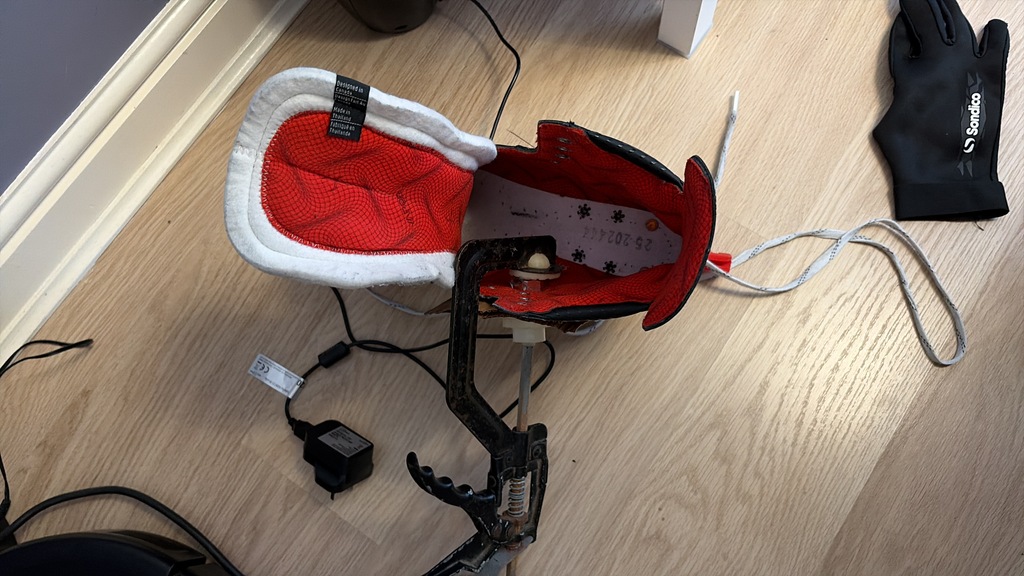
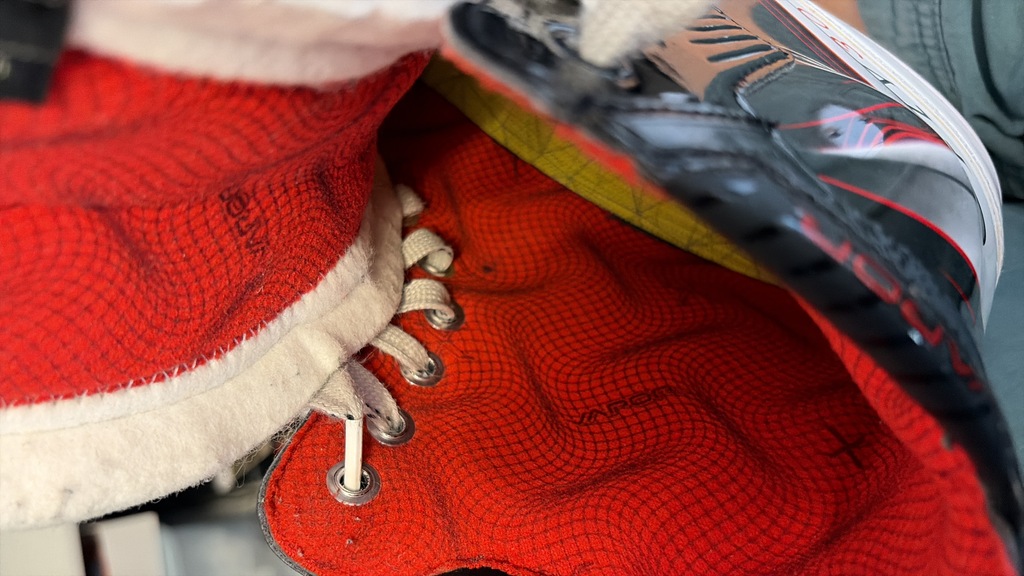
Since I wrote about my fly30 ice skates, I'd continued to battle pain around the navicular bone in my feet. The action that seems to have finally fixed it was to perform a "punch out": a very localized remoulding of the area of the boot that presses against the sore area.

I basically followed the process from this helpful YouTube video.

I narrowed down the exact spot by borrowing some lipstick and transferring it from my navicular bone to the boot lining, then making that more permanent with a sharpie.

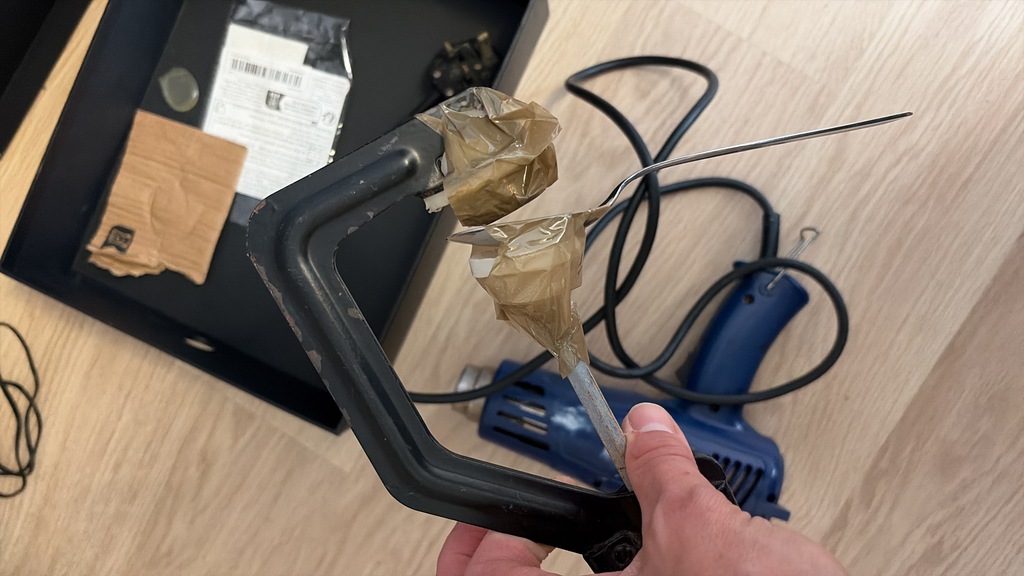
My punch was a spare part from a radiator valve which I packed with US cents (I couldn't fit any UK coins in). For the receiving-end, I tried another part from the radiator valve but I think it wasn't sufficiently larger than the punch to work well, so I swapped that out for a spoon.

take 2

take 2

I didn't have a temperature sensor I could use and I used a heat gun rather than a hairdryer, so I YOLO'd it a little. Some of the wrap on one of my boots is now distorted from where I didn't move the heat gun enough. It only took a minute or two to get the boot hot enough to be flexible. I set a 15 minute timer once the clamp was in place.

I've only skated one session since I did this but the pain seems to have gone! It's remarkably freeing to be skating without constantly trying to manage pain. Now I can focus on technique.

  •  

Freexian Collaborators: Debian Contributions: DebConf 26 organization, d-i VLAN support and more! (by Anupa Ann Joseph)

11 Augustus 2026 om 02:00

Debian Contributions: 2026-07

Contributing to Debian is part of Freexian’s mission. This article covers the latest achievements of Freexian and their collaborators. All of this is made possible by organizations subscribing to our Long Term Support contracts and consulting services.

DebConf 26 organization, by Lucas Kanashiro, Santiago Ruano Rincón, Stefano Rivera and Antonio Terceiro

The 27th Annual Debian Conference was held in Santa Fe, Argentina, and several Freexian fellows were quite busy by being involved in the organization team.

  • Santiago continued helping with duties related to the local team, e.g. preparing or proof-reading some announcements, reviewing the proposed food and the menus for the different diet required.
  • During the conference, Kanashiro and Santiago also carried over tasks related to the content of the conference, including updating the schedule as it became necessary during the event.
  • Stefano worked within the core video team, setting up equipment in talk rooms and coordinating the live video streaming. Stefano also supported the front desk and local organisers as a website developer and conference book-keeper.
  • Antonio kept working on website maintenance, specially in support of the content team. During DebConf he also ran a hands-on workshop to help interested contributors get started with developing the DebConf websites.

d-i VLAN support, by Colin Watson

In environments that use IEEE 802.1Q VLANs, some hosts (such as routers attached to “trunk” ports) may need to apply VLAN tags themselves rather than relying on switches to do so. There has been a long-running request to add support for these to the Debian installer with a proposed patch set put together by several people over the years, and a Freexian customer asked us to help get this over the line. Colin reviewed the latest version of the patch set, applied a number of corrections, added Netplan support, spent some time testing a variety of possible paths through the installer, and landed this. There’s also now documentation for this in the next version of the installation guide.

Miscellaneous contributions

  • Carles wrote documentation for installing Mailman3 and migrating from Mailman2. Added it into Mailman3 upstream documentation.
  • Carles, using po-debconf-manager: reviewed 2 packages, submitted 2 packages
  • Carles organized Catalan translation update. Created a Debian Wiki page to have an overview of the work / coordination during next months. Reviewed and submitted some pages.
  • Carles improved the documentation for building the debian.org Web in MR 1154 and MR 1557. Fixed debian-reference documentation. Added sections on Mutt Wiki page (handling of mailto, viewing HTML parts web browser), update and improve bash-completion Wiki page. Added a troubleshooting section in Signal Wiki.
  • Thorsten did another upload of hplip to fix RC bugs. He also spent some time taking care of older bugs. Most of the time such bugs had been fixed in a previous upload but haven’t been closed in the BTS. He also uploaded a new upstream version of foomatic-db. Last but not least, he gave some user support with the package epson-inkjet-printer-escpr. There seems to be a new software available for Epson printers. Unfortunately the license is not compatible with DFSG and so this software will never make it into Debian.
  • During DebCamp 26, the Golang team had a dedicated Sprint to transition the Golang toolchain (namely on dh-golang) to make builds aware of the module defined upstream with the aim of solving important issues. To help in these efforts, Santiago made changes in the Salsa CI pipeline and documented on how to use it to check if a package requires adjustments after the toolchain update.
  • Santiago continued co-mentoring Aryan Karamtoth on the Linux livepatching project, specifically providing feedback about the implementation of dlp-tools.
  • Stefano reviewed and merged a migration of Debian reimbursements from wkhtmltopdf to weasyprint, unblocking an upgrade to Debian trixie.
  • Stefano’s cPython upstream merge request adding multiarch tags to stable ABI extensions was finally merged.
  • Stefano iterated on his upstream cPython merge request to add CI coverage for Debian’s multi-arch expectations.
  • Stefano uploaded Python 3.15.0 beta 4 to Debian experimental.
  • Stefano uploaded Python 3.13 to trixie, fixing a regression in a previous trixie point update he made.
  • Helmut continued to report undeclared file conflicts.
  • Helmut sent patches for three cross build failures.
  • Helmut proposed a MR to port piuparts to pathlib.
  • Antonio has done quite some work on Debian CI, including rebuilding the Debian CI armhf/armel worker VMs, and releasing debci 4.2, implementing a backup scheme, and several improvements to the codebase such as improving the incus-lxc backend in preparation for switching to the upcoming switch to using it by default as announced in the latest bits from the ci.debian.net operators.
  • Emilio helped with transitions, particularly with Python 3.14 as default and Perl 5.42. During the Perl transition, an issue was identified with how britney schedules autopkgtests for binNMUs, and that testing was reverted for the time being.
  • Colin restructured openssh-* binary packages to better support the upcoming GSS-API package split. This caused several autopkgtest regressions in other packages because openssh-server no longer depends on openssh-client, all of which have fixes either pending review or merged now.
  • Lucas started a discussion around the creation of a Debian packaging video course for newcomers in the context of the Outreach team.
  • Lucas reviewed some contributions to ruby3.4 and provided feedback.
  • Anupa worked with Jean-Pierre Giraud on the point release announcements for Debian 13.6 and Debian 12.15.
  • Anupa joined Jean-Pierre Giraud to prepare the Micronews for DebConf 26 press coverage.
  •  

Reproducible Builds: Reproducible Builds summit 2026 to take place in Gothenburg

12 Augustus 2026 om 02:00

This event is happening soon — see below for registration instructions!

We are extremely pleased to announce the upcoming Reproducible Builds summit, which will take place from September 22nd—24th 2026 in the city of Gothenburg, Sweden.

This year, we are thrilled to host the tenth edition of this exciting event, following the success of previous summits in various iconic locations around the world, including Vienna (2025), Hamburg (2023—2024), Venice (2022), Marrakesh (2019), Paris (2018), Berlin (2017), Berlin (2016) and Athens (2015).

If you’re excited about joining us this year, please make sure to read the event page which has more details about the event and location. As in previous years, we will be sending invitations to all those who attended our previous summit events or expressed interest to do so. However, even if you do not receive a personal invitation, please do email the organizers and we will find a way to accommodate you.

About the event

The Reproducible Builds Summit is a unique gathering that brings together attendees from diverse projects, united by a shared vision of advancing the Reproducible Builds effort. During this enriching event, participants will have the opportunity to engage in discussions, establish connections and exchange ideas to drive progress in this vital field. Our aim is to create an inclusive space that fosters collaboration, innovation and problem-solving.

Schedule

Although the exact content of the meeting will be shaped by the participants, the main goals will include:

  • Update & exchange about the status of reproducible builds in various projects.
  • Improve collaboration both between and inside projects.
  • Expand the scope and reach of reproducible builds to more projects.
  • Work together and hack on solutions.
  • Establish space for more strategic and long-term thinking than is possible in virtual channels.
  • Brainstorm designs on tools enabling users to get the most benefits from reproducible builds.
  • Discuss how reproducible builds will be usable and meaningful to users and developers alike.

Logs and minutes will be published after the meeting.

Location & date

Registration instructions

Please reach out if you’d like to participate in hopefully interesting, inspiring and intense technical sessions about reproducible builds and beyond!

We look forward to what we anticipate to be yet another extraordinary event!

  •  

Steinar H. Gunderson: The PSX GPU is wild

12 Augustus 2026 om 16:45

Inspired by some recent reverse-engineering, here are some things I find wild by the original PlayStation GPU:

  • VRAM is a flat 1024x512 16-bit image (555 + 1 bit alpha). You want more than just a framebuffer? Figure out yourself what goes where.
  • Yes, that means you'll need to allocate two framebuffers and double-buffer everything yourself.
  • Quads are common. No “triangles only” business here.
  • Vertex coordinates are screen-space x/y integers. No floats or fixed-point. (I'm ignoring the GTE here, plus higher-level libraries.)
  • Wait, where's z? There's no z. So there's no perspective correction. (This one is pretty famous)
  • OK, so how do you give in subpixel coordinates? You don't. There's no AA after all.
  • Texture coordinates (u/v) are uint8_t. There's no texture filtering either; everything is nearest-neighbor only.
  • OK, so that means you can't have textures larger than 256x256 (pretty common in that era), but how do you give in the handle to the texture?
  • You don't, it points directly to the 1024x512 VRAM. You manage yourself what goes where, remember?
  • So can you an only have textures in the top-left 256x256? Hah, no, we give you a bit-packed “texture page” system that offsets all your u/v coordinates.
  • Most textures are paletted to save VRAM (so instead of 555+1, your pixels now mean something like “two palette indexes”). Where does the palette live?
  • Well, duh, that's a 256x1 (or 16x1, or whatever) area of VRAM too. The GPU does not care, you can use another texture's pixels as a palette if you feel like it.
  • OK, so you said there's no z, how do you do z-buffering? You have a z-buffer, right… right?
  • Yeah, sure, we're not cavemen. We have an “ordering table” that is your Z-buffer, drawn back-to-front. If you want 256 levels of Z, you just allocate an array of 256 linked-list pointers, and then you put your polygon into the one corresponding to the correct right Z.
  • But, eh, what if my polygon is not completely flat in Z-space?
  • Hello?
  • Hello…?
  •  

Colin Watson: Free software activity in July 2026

11 Augustus 2026 om 12:42

About 95% of my Debian contributions this month were sponsored by Freexian.

You can also support my work directly via Liberapay or GitHub Sponsors.

OpenSSH

Now that Ubuntu 26.04 LTS has been released, I’ve been getting back to the GSS-API key exchange package split in our OpenSSH packaging. Once I started testing my draft openssh-gssapi source package, I realized that I needed to make some changes in the main openssh source package first in order to support it. The dependency from openssh-server to openssh-client was awkward, as was the (related) fact that openssh-client contained shared documentation for other OpenSSH binary packages. After some thought, I created a new openssh-common binary package, moved shared documentation and the ssh-keygen program to that, and dropped dependencies on openssh-client which were no longer necessary (fixing #699473 and #1070098 in the process).

This caused a couple of regressions (#1141420 and #1141550) that I had to fix, and more subtly it also caused a number of autopkgtest regressions in other packages because openssh-client is no longer in base images as a result of a dependency from openssh-server. I believe I have fixes for all of these either pending review or merged (one of which I did in August rather than July):

I upgraded from 10.3p1 to 10.4p1, and in the process contributed a GSS-API option handling fix upstream.

I made openssh-ssh1’s package description more accurately describe the package, thanks to suggestions from Matthias Lang.

Installer team

With support from a Freexian customer, I reviewed, tested, edited, and merged a patch to add VLAN support. I described the details of what I did in a comment.

This has been vaguely on my to-do list since, er, about 2014, so it was very satisfying to get it sorted out.

Python packaging

New upstream versions:

Other build/test failures:

I fixed some other bugs:

I adopted transaction for the Python team.

I attended the Python BoF at DebConf remotely, although a badly-timed fibre outage in the village I live in really didn’t help.

Code reviews

Other bits and pieces

Dan Poltawski pointed out in a Fediverse post that the project history didn’t list Sruthi as the current DPL. I fixed that, although it doesn’t look as though the fix is in the published version yet.

I upgraded yubihsm-shell to 2.8.0.

  •  

Bits from Debian: DebConf26 Local Team says goodbye

10 Augustus 2026 om 23:50

On Saturday 25 July 2026, the annual Debian Developers and Contributors Conference came to a close. The Debian Press team would now like to share this personal and beautiful message from the Santa Fe Local Team.

Words from DC26 Local Team

DebConf26 is over, and those of us who were part of the Local Team are trying to return to “normality”, if such a thing exists after organizing a DebConf.

This event changed our lives and would not have been possible without the help of many great people.

We would especially like to thank everyone who became part of our extended local team. Our endless thanks go to Gunnar —who also instigated this whole adventure—, Santiago, Nattie, Stefano, and Olasd. Thank you for supporting and guiding us, sharing your experience, and helping us find solutions throughout the entire process.

It was also made possible thanks to the great work, strong support and patience of international teams: Fundraising, Bursaries, Content, Video, Treasury, Visa, Website, Accommodation, Front Desk, Cheese and Wine, Publicity as well as all the other teams and individuals who contributed. We apologize if we have forgotten to mention anyone; many people helped make this event possible.

Our deepest thanks also go to everyone who joined us in working on the event, especially Fer, José, and Julián, who showed great commitment and took responsibility for several important tasks.

We would also like to extend our gratitude to FICH, the Universidad Nacional del Litoral, the institutions, organizations, sponsors, suppliers, and everyone who contributed in one way or another to welcoming the Debian community to Santa Fe.

And finally, a very special thank you to our families, to whom we dedicated little time these past few weeks, who supported us on this adventure, enduring the exhaustion, the calls and messages at all hours, and the occasional stressful situation. Always giving us that much-needed, encouraging hug with so much love.

These were very intense weeks, during which we tried to give our best so that everyone could enjoy their stay and so that the Debian community had the necessary conditions to meet, work, share knowledge, and continue creating the magic that characterizes community life and the development of Debian.

As happens at every DebConf, there were difficulties, unexpected situations, and challenges that required us to improvise, learn, and perform a few juggling acts. There were also moments that will certainly remain as memorable anecdotes: the “antisocial room”, some gas heaters worthy of a museum, and newly unlocked powers for negotiating with suppliers.

We have no evidence, but also no doubt, that for many people the Conference Dinner was one of the best moments of the event.

A few ingredients we had hoped would happen naturally were missing, such as more wine nights and at least one in-person football match.

During the two weeks of DebConf, we experienced every kind of weather and a wide range of emotions. Above all, however, we saw people enjoying themselves and building friendships, which fills us with pride.

Thank you very much to everyone who came and helped DebConf26 leave such a beautiful mark on our hearts.

We hope our paths cross again somewhere in life.

Best regards,

Leonardo, Emmanuel, Mariano, Pablo, and Martín DebConf26 Local Team

About Debian

The Debian Project was founded in 1993 by Ian Murdock to be a truly free community project. Since then the project has grown to be one of the largest and most influential Open Source projects. Thousands of volunteers from all over the world work together to create and maintain Debian software. Available in 70 languages, and supporting a huge range of computer types, Debian calls itself the universal operating system.

About DebConf

DebConf is the Debian Project's developer conference. In addition to a full schedule of technical, social and policy talks, DebConf provides an opportunity for developers, contributors and other interested people to meet in person and work together more closely. It has taken place annually since 2000 in locations as varied as Scotland, Bosnia and Herzegovina, India, Korea, France. More information about DebConf is available from https://debconf.org/.

Contact Information

For further information, please visit the DebConf26 web page at https://debconf26.debconf.org/ or send mail to press@debian.org.

  •  

Uwe Kleine-König: PGP Keysigning on Linux Plumbers and OpenSource Summit Europe 2026

10 Augustus 2026 om 16:37

I'm going to this year's LPC and Open Source Summit Europe 🥳.

I will organize sessions on two days after the conference program to exchange PGP fingerprints for keysigning to improve the kernel's web-of-trust (but of course everyone is welcome).

For details see my announcement on LKML. Note the registration deadline at 2026-09-27 08:00 UTC.

  •  

Jonathan Dowland: time-delayed scifi roundup feed

10 Augustus 2026 om 16:44

I enjoy reading The Guardian's monthly round-up of new SF novels, which can be found in their Science Fiction Books section, and can also be read via feed. Since the round-up is of new books, at the time the round-up is published they're usually only available in hardback.

When it comes to choosing a book to read, these days I am tending towards paperbacks: I've largely ran out of room for hardbacks. So I decided to apply a time delay to their feed. Six months is roughly enough that a book mentioned in a round-up should be shortly available in paperback.

The first obstacle was that The Guardian only publish roughly the last six months of articles in their feed, and so the posts I want have disappeared. However, my Feed Reader (FreshRSS) had older copies stored in its database, and I am able to re-publish those using User Queries. (This also gives me an opportunity to filter out non-roundup articles from the Guardian's feed).

It's then a nice short piece of scripting (this time, using Ruby) to filter the republished feed on the publication date. To make the most recent articles appear new, I also modify the metadata for filtered entries to appear 6 months newer than they are.

#!/usr/bin/ruby
require 'rss'

# replace with the user query feed URI
uri       = 'https://www.theguardian.com/books/science-fiction/rss'
now       = Time.now
sixMonths = 6 * 30 * 24 * 60 * 60
feed      = RSS::Parser.parse(uri)

feed.items.select! do |item|
  item.date + sixMonths < now
end
feed.items.collect! do |item|
  item.date += sixMonths
  item
end

puts "Content-Type: text/xml\r\n\r"
puts feed

I stuck that up on my private web server, subscribed to it in my FreshRSS and voila, a time-delayed list of books to read, most likely available in paperback.

  •  

Elana Hashman: Managing virtualenvs with a little bash

9 Augustus 2026 om 22:00

When you need to install something directly from PyPI, Python virtualenvs have been my go-to for over a decade.

A quick virtualenv intro

Most of my readers are probably already familiar with virtualenvs, but for completeness, I'll give you a brief introduction. A virtualenv (short for "virtual environment") is an isolated distribution of Python packages, where you can independently install packages without disturbing your system packages or other virtualenvs.

You can set one up like this, assuming you are using Python 3.3 or higher:

python3 -m venv ~/.venv/my-virtualenv

The directory specified here is just a convention. I keep all my virtualenvs in the .venv folder in my home directory, but you can pick whatever location you like.

To use the virtualenv, you must activate it:

source ~/.venv/my-virtualenv/bin/activate

This activation script is a special shell script that configures your current shell, pointing at all the right paths in order to use the virtual environment. source runs this script in your current shell session to set it up. You will notice that this adds (my-virtualenv) to the beginning of your shell prompt, reminding you that the "my-virtualenv" virtualenv is active. Now when you pip install amazing-package, the software will only be available in this virtual environment.

When you're done, you can deactivate it like so:

deactivate

Wonderful!

Managing many virtualenvs gets annoying

Over time, I end up accumulating many virtualenvs, which can become harder to manage. Maybe something like this:

$ ls ~/.venv/
my-virtualenv cool-project snakes-ahoy

I also don't want to type source ~/.venv/my-virtualenv/bin/activate every time I use the virtualenv, because it gets very repetitive—only the name of the venv is really needed.

But luckily, we can write a little bit of bash to make managing this less annoying. (Or you can use one of many Python developer tools that are designed to manage this, like pipx, but when I merely want to consume Python software, I might not have a development environment set up. So that's beyond the scope of this post!)

If you add the following shell function to your ~/.bashrc or ~/.bash_aliases file, it will nicely wrap our activation command:

setup-venv() {
        source "$HOME/.venv/$1/bin/activate"
}

Now all we need to run is

setup-venv my-virtualenv

So much quicker!

Spicing it up with tab completion

The first thing I noticed after writing this wrapper was that I started hitting tab on the virtual environment name, but... nothing happened. Wouldn't it be nice to know what virtualenvs I had available, and to not have to type out the whole long thing?

Well, we can write it ourselves 😄

If for some reason you don't already have bash completion installed, on a Debian-based system, you will need to install it with

apt install bash-completion

In order to configure our bash completion, we will create a new file, /etc/bash_completion.d/venv, with the following contents:

_list_venvs()
{
    local cur prev opts
    COMPREPLY=()
    cur="${COMP_WORDS[COMP_CWORD]}"
    prev="${COMP_WORDS[COMP_CWORD-1]}"
    opts=$(find $HOME/.venv/ -mindepth 1 -maxdepth 1 -type d -printf "%f ")

    COMPREPLY=( $(compgen -W "${opts}" -- ${cur}) )
    return 0
}
complete -F _list_venvs setup-venv

This file defines another shell function order to determine how to autocomplete the options for our setup-venv function.

$opts is where we define the options for our function. We generate it with a find command—looking at the .venv folder in the current user's home directory, then only including child folders (excluding the current directory itself, .venv, in our results) by using the min/max depth and type arguments, and printing just the individual directory names, deliminated by spaces using our print formatter.

Everything else is the standard scaffolding required to use bash completions.

Once you save this file and reload your shell, you'll see that you are able to use completions as expected!

setup-venv <tab>
my-virtualenv cool-project snakes-ahoy

setup-venv s<tab>
setup-venv snakes-ahoy

Complaints, comments, questions?

Hope this was helpful! If it wasn't, that's too bad. But don't worry—you can safely ignore this post.

  •  

Reproducible Builds: Reproducible Builds in July 2026

9 Augustus 2026 om 21:12

Welcome to the July 2026 report from the Reproducible Builds project!

In our reports, we try to outline the most important things that we have been up to over the past month. As a quick recap about what problem our project intends to solve, whilst anyone may inspect the source code of free software for malicious flaws, almost all software is distributed to end users as pre-compiled binaries. The motivation behind the reproducible builds effort is to ensure no flaws have been introduced during this compilation process by promising identical results are always generated from a given source, thus allowing multiple third-parties to come to a consensus on whether a build was compromised or not.

If you are interested in contributing to the project, please visit the Contribute page on our website.

In this month’s report, we cover:

  1. Tool development
  2. Distribution work
  3. Three new scholarly papers
  4. Patches
  5. Misc news

Tool development

diffoscope is our in-depth and content-aware diff utility that can locate and diagnose reproducibility issues. This month, Chris Lamb made the following changes, including preparing and uploading versions 324, 325 and 326 to Debian:

  • Fix tests to work with zipdetails 4.0008. (#1141359)
  • Bump debhelper compatibility level to 13. []
  • Update copyright years. []

In addition, Paul Spooren made changes to allow trailing garbage in Gzip files [] and Vagrant Cascadian added an external tool reference for the pedump binary to use the mono package under GNU Guix. []


disorderfs is our FUSE-based filesystem that deliberately introduces non-determinism into system calls to reliably flush out reproducibility issues. This month, Christelle Gloor added the option to sort by ctime as returned by the lstat(2) syscall. [], which Chris Lamb uploaded whilst bumping the Standards-Version to version 4.7.4 []. Bernhard Wiedemann also updated disorderfs to version 0.7.0 in openSUSE.


Yet again, there were a number of improvements made to our website this month as well. For example, Chris Lamb, by request of Digital Ocean, changed the target of a referral link so that they can manage incoming referrers [] and pushed a number of changes to the Tools page [].


Distribution work

In Debian this month, 32 reviews of Debian packages were added, 26 were updated and a total of 21 were removed this month, adding to our extensive knowledge about identified issues.

A number of issue types were added by Chris Lamb, including:

  • python_towncrier_build_date [][]
  • log_files_installed_in_package []
  • fontforge_varies_by_timezone [][]

Chris also added a further note for the build_date_in_manpage_generated_by_spf13_cobra issue. []


In addition, there is a new page showing verification rebuilds of OpenWrt APK packages and firmware images, powered by rebuilderd:


Three new scholarly papers

Yan Li, Nan Jiang, Qihang Zhou, Shaowen Xu, Yamin Xie and Xiaoqi Jia of the Chinese Academy of Sciences published a paper titled VCAligner: Aligning Source Distribution Versions with Upstream Git Commits to Secure Supply Chain:

We present VCAligner, a content-based alignment methodology that constructs inverted indexes over VCS histories to precisely map released artifacts to their originating commits, independent of fragile version tags. We evaluated VCAligner on a dataset of 2,984 verifiable PyPI packages derived from the 4,000 most-downloaded projects linked to public GitHub upstreams. Our results reveal a critical weakness in conventional tag-based heuristics: while they appear effective on 85% of the dataset, the residual 15% failure rate generates a catastrophic downstream audit workload of over 10.3 million commits. In contrast, VCAligner reduces this burden by two orders of magnitude (≈ 158×), bounding the total workload to under 65,000 commits. Furthermore, we provide the large-scale characterization of “Packaging Noise,” classifying artifact divergence into structural additions (Path Phantoms) and content mutations (Blob Phantoms), thereby isolating the distinct attack surfaces of malicious injection and code tampering.


Jens Dietrich and Spencer Sun from the Victoria University of Wellington together with Tim W. White and Behnaz Hassanshahi from Oracle Inc pre-published their paper No Snake Oil: Verifying Python Package Builds (PDF):

Python has become the default language for interacting with AI, with packages being distributed through registries like the Python Package Index (PyPI). This creates a need to analyse supply chains comprising such packages. One such analysis is to rebuild packages in order to identify compromised builds injecting malware. Independent rebuilds in hardened environments have the added advantage that they can generate and record provenance in order to increase the trustworthiness of packages. Two tools that are designed to automate such rebuilds and run them at scale are macaron and oss-rebuild. We study 12,180 popular releases from PyPI and find that the byte-for-byte equivalence rate is generally low. We analyse the reasons why they produce different wheels, and find that equivalence between the original and rebuilt wheels can often still be established, preserving most of the guarantees users expect from rebuildable releases. We present and evaluate daleq4py, a tool to establish the equivalence of Python wheels through the kernel of a normalisation function that is based on provenance-preserving datalog rules. Experimental results show that daleq4py substantially expands the set of rebuilds that can be accepted as equivalent. Although only 15.4% of macaron rebuilds and 19.1% of oss-rebuild rebuilds are byte-for-byte identical to the published PyPI wheels, daleq4py establishes wheel equivalence for 60.2% and 78.9% of source-equivalent rebuilds, respectively.


Denise Nanni, Julien Malka, Stefano Zacchiroli and Théo Zimmermann from Télécom Paris together with Gabriele D’Angelo from the University of Bologna pre-published their paper Understanding Build Reproducibility in the F-Droid Ecosystem (PDF), which was accepted at the 2026 ACM Conference on Reproducibility and Replicability:

The security of open source applications benefits considerably from the possibility of rebuilding their source and verifying the output. F-Droid, a prominent distribution for open source Android applications, systematically rebuilds them from source and tests their bitwise reproducibility at app publishing time. However, F-Droid offers no guarantee that app reproducibility will continue to hold in the future. As software ecosystems evolve, reproducibility may degrade, with potential negative consequences for software preservation and security. We present the first empirical study of build reproducibility in the F-Droid app ecosystem. Analyzing historical reproducibility logs, we find that the overall bitwise reproducibility rate has been steadily increasing over time (as new versions of apps are published). We then evaluate how reproducibility holds in time for fixed app versions, by attempting to rebuild 18 904 app versions that F-Droid had previously confirmed bitwise reproducible, published between September 2018 and February 2026, achieving an 83% rebuild success rate, and identify missing dependencies as the dominant cause of failure, accounting for 76% of non-rebuildable cases. Among successfully rebuilt apps, 94% are also bitwise reproducible-i.e., they still yield bitwise identical artifacts upon rebuild. Together, these results show that while bitwise reproducibility largely holds for apps that can be rebuilt, rebuildability itself is highly sensitive to temporal decay.


Patches

The Reproducible Builds project detects, dissects and attempts to fix as many currently-unreproducible packages as possible. We endeavour to send all of our patches upstream where applicable or possible. This month, we wrote a large number of such patches, including:


Misc news

On our mailing list this month, Colin Winter of Markovian Protocol wrote to our mailing list on the topic of Reproducible verification for retained logs:

Reproducible builds remove trust in the builder: anyone re-derives the same artifact from the same source, byte for byte. The same shape applies one layer over, to a retained record. Most record-keeping regimes (the EU AI Act’s Article 12 logging is the current example) require that events be recorded and logs retained, but not that a retained log be verifiable, by a party who was not present, as unaltered and existing when claimed. That leaves an integrity obligation resting on trusting the party being audited.

(Full thread)


Finally, if you are interested in contributing to the Reproducible Builds project, please visit our Contribute page on our website. However, you can get in touch with us via:

  •  

Gunnar Wolf: Subscription Bombing • Email under Attack

6 Augustus 2026 om 02:17
This post is an unpublished review for Subscription Bombing • Email under Attack

One of the most important inputs one can have when designing a response strategy against a security attack is a good characterization. This article describes a relatively newly described attack mode (subscription bombing), hypothetizes on the motivations that can lie behind it, and presents some countermeasures that can be taken by different actors to reduce its impact.

At its core, suscription bombing is a classical reflection attack: it uses a third party service so that the answer to a relatively simple request is amplified and results in a distributed denial of service (DDoS) for the victim. And, as with most DDoS attacks, its effectivity lies in that there is not much a person can do against traffic coming from seemingly random different providers all around the world.

The core differentiatof for subscription bombing is that the attack’s victim is not a network port, but an individual’s e-mail address. The attacker builds a database of service providers that allow interested users to sign up for newsletter on their activities, or a mailing list, or even just to create a new account on a given Web system. This action will generate a (seemingly legitimate) confirmation mail sent to the victim. But the attacker scripts together hundreds of thousands of such request, creating a deluge of confirmation mails sent to the unsuspecting victim.

The authors explain the goals an attacker might pursue by performing this kind of attack. They suppose this can be due to harassment (a disgruntled employee being denied a salary raise, a political adversary, or even a romantic ex-partner wanting to inconvenience the victim’s use of their e-mail). More worryingly, the attack can be used as a distraction: by sending a high volume of mails in a controlled timeframe, the attacker can reduce the probability of the victim noticing a specific attack warning them of, i.e., financial fraud, unwanted purchases, or break-in attempts into their accounts. Attacks targetting mailboxes at private mail servers can also lead to overloading an account’s limit, causing it to reject mails after the attack is delivered and before the folder is cleaned. And it can also pave the way for follow-up, targetted deception attacks, where the attackers call the victim pretending to be the company’s IT department, and get them to install a remote desktop monitoring and management tool, with which they can effectively seize control of the victim’s data.

To do this, they present a study they made over 24 cases of victims, from which 47,970 total e-mails were received between October and December 2024, with individual attacks receiving between 81 and 3,387 e-mails per hour, from where they presented several descriptive analysis.

The authors explored cyber criminal’s offers on underground websites, comparing flooding services and pricing schemes.

Finally, mitigation strategies are discussed. Mitigation is quite problematic, as none of the mail servers is acting in either a hostile way or lacking permissions — they are performing just the task they should. The authors suggest four mitigation strategies for mail server operators to reduce the burden on their users, although none of them is easily automatizab (rate-limit the number of emails a given inbox can receive from previously unseen senders; educate users about this kind of attacks; group similar newsletter or account reset mails during active attacks; and automatically unsubscribe or bounce newsletter messages when a surge is detected). They also recommend newsletter providers and services accepting the unrestricted creation of user accounts to provide some hardening to increase the effort wrongdoers need to spend to abuse their services, such as requiring CAPTCHAs or requiring users to take several steps before requesting a subscription, although they recognize this adds friction to the process providers are most interested in providing; filtering and triaging known-good and known-bad domains, although this is hard to implement on a preemptive fashion, and adhering to easy unsubscription standards, such as easily identifiable headers with which mass unsubscription could be performed more easily victims, instead of hunting for the right places to click, potentially even in mails written in an unknown language.

The described problem is interesting, and properly tackling it can be a game changer for many users who will suffer this kind of abuse, and the article is easy to read and soundly supports its claims.

  •  

Thorsten Alteholz: My Debian Activities in July 2026

7 Augustus 2026 om 19:02

Debian LTS/ELTS

This was my hundred-forty-fifth month that I did some work for the Debian LTS initiative, started by Raphael Hertzog at Freexian.

During my allocated time I uploaded or worked on:

  • [DSA 6402-1] hplip security update to fix two CVEs in Trixie related to privilege escalation and/or arbitrary code execution. I sent the debdiff to the security team, which resulted in this DSA.
  • [#1142351] trixie-pu of libnfs has been uploaded.
  • [DLA 4689-1] libnfs security update to fix one CVE in Bookworm and Bullseye related to an integer overflow.
  • [DLA 4699-1] hplip security update to fix two CVEs in Bookworm and Bullseye related to privilege escalation and/or arbitrary code execution.
  • [ELA-1775-1] libnfs gimp security update to fix one CVE in Buster and Stretch related to an integer overflow.
  • [ELA-1784-1] hplip security update to fix two CVEs in Buster and Stretch related to privilege escalation and/or arbitrary code execution.

Unfortunately the number of assigned hours was rather low this month. So besides doing some days of FD at the end of the month, where I also had to process a new package list for ELTS, and a review of the rsync package (prepared by Sylvain), not much happened here.

Debian Printing

This month I uploaded a new upstream versions:

Besides the package upload, I also took care of some older bugs of hplip.

This work is generously funded by Freexian!

Debian Lomiri

This month I continued the upload of lomiri packages with new upstream versions. Thanks to the help of my other colleagues, this project could be finished now.

This work is generously funded by Fre(i)e Software GmbH!

Debian Astro

This month I uploaded a new upstream version or a bugfix version of:

Debian IoT

Unfortunately I had no time to work in this category this month.

Debian Mobcom

This month I uploaded a new upstream version or a bugfix version of:

Next month I intend to upload new upstream versions of all Osmocom packages. As far as I can tell, these uploads will happen without soname changes. I like that :-).

misc

This month I uploaded a new upstream version or a bugfix version of:

  •  

Bits from Debian: DebConf26 closes in Santa Fe and DebConf27 announced

6 Augustus 2026 om 23:50

DebConf26 group photo - click to enlarge

On Saturday 25 July 2026, the annual Debian Developers and Contributors Conference came to a close. Over 270 attendees representing 35 countries from around the world came together for a combined 90 events (including some which took place during the DebCamp) including more than 27 Talks, 21 Short Talks, 29 Birds of a Feather sessions ("BoF" – informal meeting between developers and users), 8 workshops, and activities in support of furthering our distribution and free software, learning from our mentors and peers, building our community, and having a bit of fun.

The conference was preceded by the annual DebCamp hacking session held 13 through 19 July where Debian Developers and Contributors convened to focus on their individual Debian-related projects or work in team sprints geared toward in-person collaboration in developing Debian.

As has been the case for several years, a special effort has been made to welcome newcomers and help them become familiar with Debian and DebConf by organizing a sprint "New Contributors Onboarding" every day of Debcamp, followed more informally by mentorship during DebConf. Half a dozen new contributors joined the sessions and learned about Debian, free software, packaging and much more.

This year, a week-long DebCamp session was dedicated to auditing, patching, and modernizing the Go ecosystem in Debian and enable the transition triggered by the recent upload of dh-golang enabling GO111MODULE=on by default in Experimental.

In order to make the conference more accessible for local participants, a local language track was included in the schedule for talks in Spanish, as was done at DebConf19 in Brazil.

The actual Debian Developers Conference started on Monday 20 July 2026.

In addition to the traditional "Bits from the DPL" talk, the continuous key-signing party, lightning talks, and the announcement of next year's DebConf27, there were several update sessions shared by internal projects and teams.

Many of the hosted discussion sessions were presented by our technical core teams with the usual and useful "Meet the Technical Committee", three talks about Linux Kernel, early boot and improving Debian’s kernel and installer support for Chromebooks, and about twenty BoFs and talks about Debian packaging policy, Debian infrastructure, security and privacy.

This year, and echoing ongoing discussions within the Free Software community, Artificial Intelligence and Age Verification have been the subject of several talks. The Python, Perl, Ruby, Go, and Rust programming language teams also shared updates on their work and efforts.

More than 17 BoFs and talks about community, diversity, and local outreach highlighted the work of various teams involved in not just the technical but also the social aspect of our community

The schedule was updated each day with planned and ad hoc activities introduced by attendees over the course of the conference. Several traditional activities took place: a poetry performance, the traditional Cheese and Wine party, the Group Photos, and the Day Trip.

For those who were not able to attend, most of the talks and sessions were broadcasted live and recorded. One can find the seventy hours of recorded videos available via the conference schedule, or alternatively through this link.

Almost all of the sessions facilitated remote participation via IRC and Matrix messaging apps or online collaborative text documents which allowed remote attendees to "be in the room" and ask questions or share comments with the speaker or assembled audience. DebConf26 saw over 341 T-shirts, a day trip, and up to 130 meals planned per day.

All of these events, activities, conversations, and streams coupled with our love, interest, and participation in Debian and F/OSS certainly made this conference an overall success both here in Santa Fe, Argentina and online around the world.

The DebConf26 website will remain active for archival purposes and will continue to offer links to the presentations and videos of talks and events.

Next year, DebConf27 will be held in Asahikawa, Hokkaido, Japan, from Sunday September 5th to Saturday September 11th, 2027. As tradition follows before the next DebConf the local organizers in Japan will start the conference activities with DebCamp with a particular focus on individual and team work towards improving the distribution.

DebConf is committed to a safe and welcome environment for all participants. See the web page about the Code of Conduct on the DebConf26 website for more details on this.

Debian thanks the commitment of numerous sponsors to support DebConf26, particularly our Platinum Sponsors: Infomaniak, and Proxmox, and our Gold Sponsors : Freexian, and Viridien.

We also wish to thank our Video and Infrastructure teams, the DebConf26 and DebConf committees, our host nation of Argentina, and each and every person who helped contribute to this event and to Debian overall. Thank you all for your work in helping Debian continue to be "The Universal Operating System".

See you next year!

About Debian

The Debian Project was founded in 1993 by Ian Murdock to be a truly free community project. Since then the project has grown to be one of the largest and most influential Open Source projects. Thousands of volunteers from all over the world work together to create and maintain Debian software. Available in 70 languages, and supporting a huge range of computer types, Debian calls itself the universal operating system.

About DebConf

DebConf is the Debian Project's developer conference. In addition to a full schedule of technical, social and policy talks, DebConf provides an opportunity for developers, contributors and other interested people to meet in person and work together more closely. It has taken place annually since 2000 in locations as varied as Scotland, Bosnia and Herzegovina, India, Korea, France. More information about DebConf is available from https://debconf.org/.

About Infomaniak

Infomaniak is an independent, employee-owned Swiss technology company that designs, develops, and operates its own cloud infrastructure and digital services entirely in Switzerland. With over 300 employees — more than 70% engineers and developers — the company reinvests all profits into R&D. Its public cloud is built on OpenStack, with managed Kubernetes, Database as a Service, object storage, and sovereign AI services accessible via OpenAI-compatible APIs, all running on its own Swiss infrastructure. Infomaniak also develops a sovereign collaborative suite — messaging, email, storage, online office tools, videoconferencing, and a built-in AI assistant — developed in-house and as a privacy-respecting solution to proprietary platforms. Open source is central to how Infomaniak operates. Its latest data center (D4) runs on 100% renewable energy and uses no traditional cooling: all the heat generated by its servers is captured and fed into Geneva's district heating network, supplying up to 6,000 homes in winter and hot water year-round. The entire project has been documented and open-sourced at d4project.org.

About Proxmox

Proxmox develops powerful, yet easy-to-use open-source server solutions. The comprehensive open-source ecosystem is designed to manage divers IT landscapes, from single servers to large-scale distributed data centers. Our unified platform integrates server virtualization, easy backup, and rock-solid email security ensuring seamless interoperability across the entire portfolio. With the Proxmox Datacenter Manager, the ecosystem also offers a "single pane of glass" for centralized management across different locations. Since 2005, all Proxmox solutions have been built on the rock-solid Debian platform. We are proud to return to DebConf26 as a sponsor because the Debian community provides the foundation that makes our work possible. We believe in keeping IT simple, open, and under your control.

Contact Information

For further information, please visit the DebConf26 web page at https://debconf26.debconf.org/ or send mail to press@debian.org.

  •  

Russell Coker: TV Control etc

6 Augustus 2026 om 06:01

In 2008 I wrote a blog post “The Problem is Too Many Remote Controls” [1] about the issues of controlling a TV and related things. It recently got some comments on Mastodon so I think it’s time for an update.

The first issue I raised was “Now it’s not uncommon to have separate remote controls for the TV, VCR, DVD player, and the Cable TV box – a total of four remote controls” which seems to have alleviated. VCRs seem to have almost entirely gone away. The VHS Wikipedia page [2] is worth reading for everyone who hasn’t seen a VCR in operation, which I expect to be more than a few readers now and an increasing number over the next 18 years. I personally don’t have Cable TV, I own a DVD player which isn’t connected to my TV because I haven’t used it for years, I don’t own a VCR, and I don’t watch free to air TV. So I have one remote control for the TV which I use for Netflix and sometimes YouTube.

When viewing YouTube on TV there are significantly more adverts and longer adverts. I presume that is because installing an ad-blocker on my TV isn’t a viable option for me and it’s a total impossibility for most users. Generally my desktop PC is a much better platform for YouTube than my TV, it has a better quality display, is more user friendly (my previous post addressed the difficulty of getting to the data source that’s desired), and doesn’t require entering search terms via a slow on-screen keyboard. Netflix on Linux is limited to 720p at low bitrate which is obviously of low visual quality while on the TV it’s in 4K. I have Netflix so I use that only on the TV.

In my previous post I wrote a thought experiment on how to use a cheap laptop ($500 at the time – equivalent to $777 in 2025 money according to the Reserve Bank of Australia) to control a $5000 TV ($7770 in 2025 money). Now you can buy a new 65″ 4K TV for under $800 and a new laptop capable of 4K output for under $400 so the options are very different. For a $800 TV the manufacturer isn’t going to develop a remote control interface and Google (who develops the software the TVs run) won’t do it because it could reduce their advertising revenue. But a typical home user could setup a cheap laptop connected to their TV via HDMI providing a familiar and efficient user interface for themselves and visitors. For a Windows laptop 4K Netflix should work and for a Linux laptop the options of a laptop for everything apart from Netflix and the TV for Netflix are bearable, two controls are worse than one but better than the 3+ that used to be common.

In my previous post I raised the issue that “it’s often the case that you don’t want to stop watching one show while trying to find another”. This is still an unsolved problem and is not addressed in modern software. I am not aware of a Linux music player that supports such functionality and this would be much easier for a music player than for a video player where the screen would have to be shared between the interface for finding the next thing to play and the space for playing the end of the current one. Maybe I should file a bunch of wishlist bugs against music players asking for this.

I suggested that “cable modem” and “cable TV box” could be integrated into a single device. That has not happened, in fact it’s got worse. A relative who has Foxtel has a cable modem, a cable TV box, and a Wifi AP with VOIP to provide landline phone service and to make it more exciting the latter two both have bugs that require a periodic hardware reset to fix. Hopefully cable TV will go away in the next 18 years.

Regular PCs have become less noisy in recent years. I am currently using a HP Z640 to write this post and I have HP Z840 and HP Z4G4 systems behind me running as servers and the background noise is still very low. The allegedly 8K TV [3] that I have in my lounge room has cooling fans that make more noise than those three high-end HP computers combined. Using a quiet PC like one of those HP systems to drive a TV is a very viable option and I did just that for a couple of years. Kogan has currently got a selection of refurbished Lenovo ThinkStation systems on sale for under $400, they are quiet and would do well for this, it’s also nice that Kogan is selling systems with ECC RAM at home user prices.

TV does seem to be going away. YouTube and streaming services seem to get more watching time and many people don’t use TV at all.

Since my previous post the number of streaming services has increased so torrenting offers increasing benefits as no-one wants to subscribe to 6+ services. For anyone who wants to get all the content that interests them while paying the user interface situation is much worse now than it used to be in 2008.

If you use KDE on a PC then the kconnect program allows a phone to be used to remotely control some aspects of a PC and has a good interface for pause/resume of a video and seeking 10 seconds forwards/backwards. The interface for controlling volume is hard to get to and doesn’t work on my installation. If you want to use a keyboard to start something playing and then a phone for pause control then kdeconnect is a decent option. A comment on my previous post by Michael Croes raised the issue of remote control which is now a solvable problem. Justin also wrote a comment suggesting a Nokia N800 as a remote.

Jason suggested a programmable remote, which would be a good option for a power user and a viable option for someone setting things up for their grandparents. But the amount of pain is greater than I’m interested in as lounge room TV isn’t an important thing to me. It may appeal to more people than having a dedicated lounge room PC though.

Related posts:

  1. Netflix and IPv6 It seems that Netflix has an ongoing issue of not...
  2. Big Smart TVs Recently a relative who owned a 50″ Plasma TV asked...
  3. The Problem is Too Many Remote Controls I am often asked for advice about purchasing TVs and...
  •  

Iustin Pop: Yes-yes, still alive!

5 Augustus 2026 om 19:34

I am not sure what happened, but my interests have changed significantly, and… I haven’t blogged, I haven’t done any open source work, and didn’t even process any pictures for the entire year. Not because anything went bad, just… new stuff, new interests, life changes.

However, still alive, and still struggling with sports, and with sleep :)

On the positive side, on a recent mid-length flight, I thought — I haven’t done any work on Corydalis, since last year I closed quite of a few of my “must have” features, so probably, nothing else to do for now, right? I opened an editor and started thinking about ideas, and surprised! One hour later, I had written down enough ideas for a couple of months of work. So now just need to find the time… but can’t wait for the planned things!

Stay well!

  •  
❌