โŒ

Normale weergave

Reproducible Builds (diffoscope): diffoscope 323 released

30 Juni 2026 om 02:00

The diffoscope maintainers are pleased to announce the release of diffoscope version 323. This version includes the following changes:

[ Chris Lamb ]
* Debian adds an extra "Flags:" line in the output of ocamlobjinfo via a
  patch, so adjust how we test OCaml to ensure cross-distribution
  compatibility. (Closes: reproducible-builds/diffoscope#430)
* Update copyright years.

[ Michael Daniels ]
* Fix tests when using zipdetails version >= 4.006.

You find out more by visiting the project homepage.

  •  

Dirk Eddelbuettel: tl 0.0.2 on CRAN: First Update

30 Juni 2026 om 19:02

The still-very-new logging package tl was just updated for the first time at CRAN. The tl package wraps the (also very new) rspdlite package to offer a lightweight and consistent logging interface from both R and C++ that enjoys being โ€˜tiny, fast, capableโ€™ thanks to spdlite. With tl we follow the same idea that our spdl package introduced: a simple consistent interface via just the tl:: prefix and the appropropriate logging level. In other words tl::debug("Alert: foo now '{}'", foo) will work from both R and C++ (given a variable foo, and, in the case of C++, an extra semicolon) and log if the current level is โ€˜debugโ€™ or higher, and skip logging if not.

This release adds a fallback when compilation does not use the (required) C++20 standard, expands the README and adds a initialization helper function reflecting a preferred default logging level from either an environment variable or a global option. We are also working on adding tl to an example package as a simple illustration, more on that hopefully soon.

The NEWS entry for this release follows.

Changes in version 0.0.2 (2025-06-30)

  • Added badges to README now that package is on CRAN, add NEWS file

  • Condition the provided header on C++20 use, offer fallback

  • Add an exported initialization function picking up a logging level from either an environment variable or a global option, see '?init'

Courtesy of my CRANberries, there is also a diffstat report for the this release.

This post by Dirk Eddelbuettel originated on his Thinking inside the box blog. If you like this or other open-source work I do, you can sponsor me at GitHub.

  •  

Joey Hess: big loads offgrid with a small battery (sidelined)

30 Juni 2026 om 18:10

No matter that the hype cycle wants you to think, the renewable energy transition is the biggest thing happening in tech and it's happening faster and faster. Despite being neck deep in it personally with offgrid solar projects, most recently solar hot water, increasingly it becomes clear I'm watching from the sidelines.

In Australia, everyone gets 24 kwh of free daytime electric power now. That's without installing any solar panels of their own, the grid just has that much excess capacity. All it takes to save $thousands per year (and avoid emissions) is to schedule some big loads like the hot water heater and EV to charge during the day. To save more, drop in a home battery that charges for free and powers the home through the evening.

In Germany, a 2 kwh plug-in home battery costs $350 and the electric company will pay you $130 per year to plug it into your wall. There are similar offers throughout Europe.

In Cuba something something geopolitics, oil blockade, belt and road => suddenly 1GW of solar farms with another gigawatt on the way.

I'll soon visit South Carolina where with no subsidies whatsoever from a decidedly renewable-unfriendly government, it made sense for my dad's house to get a whole home battery and double the solar array. The resulting system will be able to power the well pump and probably also the whole geothermal HVAC system through the kind of month-long grid down events that happened in Hurricane Helene.

Myself, well, I've got a by modern standards small 4 kwh home battery that powers my house offgrid, and I've recently installed a heat pump hot water heater. That's after about a decade pondering what solution to use for solar hot water, to replace an aging and horrible propane instant water heater. I've in the past considered everything from evacuated tubes to special direct drive inverters to DC resistive MPTT dump loads. The solution turned out to be just a big enough solar array, and plugging in a 120v hot water heater that needs only 500 watts in heat pump mode. Plus a small amount of code to manage when it runs.

In the time I was thinking about that, economies of scale and tech improvements just wiped all those other possibilities off the map, it's not economical to install and maintain a separate evactuated tube heat collector when a pile of solar panels costs so little and when electric hot water has gotten more than 200% efficient.

I also recently completed my permanant EV charger installation, with a new inverter and conduit and proper wiring, and increased the car's charge rate to 2 kw. Eliminating the need to charge anywhere except at home except on road trips.

Coordinating when these two big loads run, to maximize solar production and ensure that the house battery is full at the end of the day was ... not hard at all actually? The car charger amps can be dialed up and down to match incoming solar power fairly well, and leave some room for the hot water heater. They both operate as more or less dump loads. More or less because neither one can be cycled on or off very fast (to avoid wear and tear on the car's contactor and the heat pump's compressor), so it makes sense to leave them on and skate through short cloudy sections of the day, as long as the house battery doesn't get too low.

How low is too low for the house battery? Depends on the time of day. The code it's currently using, which may get tweaked over winter:

    -- When the battery is charged enough to run major loads that may prevent
    -- charging it further.
    --
    -- This varies with the hour of day. Early in the day, the battery does not
    -- need to be as full to be considered well charged, since there is
    -- still plenty of time for it to charge up. Later in the day, with less
    -- time to charge, it needs to be more full.
    wellCharged :: Hour -> Percentage
    wellCharged (Hour hour)
            | hour < 9 = Percentage 90 -- night
            | pmhour <= 0 = Percentage 50
            | pmhour <= 1 = Percentage 60
            | pmhour <= 2 = Percentage 70
            | pmhour <= 3 = Percentage 80
            | pmhour <= 4 = Percentage 90
            | otherwise = Percentage 95
      where
            pmhour = hour - 12

More complicated is, what to do it there's solar power to run one or the other, but not both? This is starting to get into the territory of microgrids now, or of demand response programs, so there's a whole industry or three out there doing industry things geared at the kind of no-brainer solutions I mentioned earlier. From what I've gathered, all of them involve proprietary protocols and gear.

What I've done is to read the state of the hot water heater and car, and prioritize hot water over the car. Except, if the car is below 10% it urgently needs to charge.

And I found a really simple way to decide when to run the low-priority load: Just check if the house battery's current charge will be considered wellCharged in an hour. So if it's 2 pm, the battery needs to be 80% charged to run the lower-priority load, and if it dips below that, that load will turn off but the high-priority load will keep running down to 70% battery.

Unfortunately, getting any information out of my hot water heater relies on a vendor API server that is often down on weekends, and reverse engineered the web page of my EVSE[1] to control it, to say nothing of the nightmare of getting the car's state of charge from The Cloud.

Anyway, I'm pleased with having easily tweakable code and how far I've taken this offgrid, and everything I've learned doing so, but like I said, I'm clearly observing from the sidelines over here while the most significant thing for all of us is going on over there. You might appreciate my code or method, but you'll eventually be plugging in a home battery or signing up for a free daytime power tarrif from your electric company, or having professionals install a whole home system for climate resiliance.

So my question is, where does free software fit into all this? There are things like Home Assistant that do productize the kind of thing I'm doing enough to be useful more widely. But still niche. Meanwhile there are inverters and batteries that phone home to China, and every consumer facing install is either "use this device" or "integrate these 3 proprietary devices".

I don't think focusing on these negatives is really useful though, I'm more trying to understand where all this is going and then maybe get out ahead of it in some useful way with free software. Your thoughts welcome.


[1] Obviously OpenEVSE exists, but it didn't meet my needs hardware wise. And I could set my EVSE to use an OCPP server but it was easier to do the screen scraping than find an appropriate one, and I have the feeling I would not appreciate learning any more about OCPP, in the same way I really don't want to know a lot about web browsers' tag soup mode.

  •  

Russell Coker: Links June 2026

30 Juni 2026 om 15:53

This is amusing, a flaw in the crypto-currency Zcash allowed generating Zcash from nothing and thereโ€™s no way to know if anyone did that [1].

Cory Doctorow wrote an insightful article for Locus Magazine about corporate valuations and why companies claim SciFi technologies [2].

Charles Stross wrote an interesting retcon of James Bond [3].

Trakkr.ai has an intresting post comparing political bias in LLM models, the site has lots of other comparisons of models too [4].

Wouter Verhelst wrote a blog post about his tested usage of LLMs for code generation and the conclusions about what it will do to the FOSS development process, not a lot of new material but he put a lot of good ideas together in one place [5].

Here is the git repository for the programs used for the ssh-audit.com site, really good setup for checking ssh configuration [6].

The isaiprofitable.com site is periodically updated with the profit/loss totals for AI companies, no surprise that every company is losing money apart from NVidia and NVidia are investing in the other companies [7].

Elvira Bary wrote an informative article about Russiaโ€™s inability to build or design anything good [8]. Looks like we are at risk of another Chernobylโ€ฆ

Lev Lafayette wrote an interesting blog post about the Sunway TaihuLight supercomputer with over 10,000,000 cores [9].

Point Free wrote an interesting blog post about running the Gemma 4 LLM which is 25G of data at a usable speed on a Xeon system with DDR3 RAM and no GPU [10].

Related posts:

  1. Links June 2022 Google did some interesting research on the impact of discrimination...
  2. Links April 2026 Charles Stross wrote an interesting blog post about the apparent...
  3. Links February 2026 Charles Stross has a good theory of why โ€œAIโ€ is...
  •  

Russell Coker: Dirty Clone and SE Linux

30 Juni 2026 om 14:04

There is a new Linux kernel exploit out named Dirty Clone [1].

The first thing to do to exploit this is to create a container with a separate network namespace via one of the following commands:

unshare -Urn
bwrap --bind / / --unshare-user --unshare-net --uid 0 --gid 0 /bin/bash

The Jfrog people recommend โ€œunshare -Urnโ€ but I gave the Bubblewrap command as an option as it should work equally well and in some situations may be permitted when unshare isnโ€™t.

The next step to exploiting it is to use the ip command to set the links up, below is what happens in a user session on a SE Linux system with user_t as the login domain:

# ip link set lo up
RTNETLINK answers: Operation not permitted

That will give an entry in /var/log/audit/audit.log like the following:

type=AVC msg=audit(1782818856.618:3610): avc:  denied  { net_admin } for  pid=1829 comm="ip" capability=12  scontext=user_u:user_r:user_t:s0 tcontext=user_u:user_r:user_t:s0 tclass=cap_userns permissive=0
type=SYSCALL msg=audit(1782818856.618:3610): arch=c000003e syscall=46 success=yes exit=32 a0=3 a1=7ffebe5f9e50 a2=0 a3=0 items=0 ppid=1638 pid=1829 auid=0 uid=0 gid=1000 euid=0 suid=0 fsuid=0 egid=1000 sgid=1000 fsgid=1000 tty=pts0 ses=17 comm="ip" exe="/usr/bin/ip" subj=user_u:user_r:user_t:s0 key=(null)ARCH=x86_64 SYSCALL=sendmsg AUID="root" UID="root" GID="test" EUID="root" SUID="root" FSUID="root" EGID="test" SGID="test" FSGID="test"
type=PROCTITLE msg=audit(1782818856.618:3610): proctitle=6970006C696E6B00736574006C6F007570

Unlike previous exploits like Pintheft [2] this doesnโ€™t require any really uncommon access to the kernel (unless you consider setting up IPSec to be really uncommon) and is allowed in many container setups.

Now on a system with the unconfined module removed (as described in the SE Linux Protection part of my post about Copy Fail [3]) the following domains have such access:

# sesearch -A -c cap_userns -p net_admin
allow container_engine_t container_engine_t:cap_userns { audit_write chown dac_override dac_read_search fowner fsetid ipc_lock ipc_owner kill lease linux_immutable mknod net_admin net_bind_service net_raw setfcap setgid setpcap setuid sys_admin sys_boot sys_chroot sys_nice sys_pacct sys_ptrace sys_rawio sys_resource sys_time sys_tty_config };
allow container_init_t container_init_t:cap_userns { chown dac_override dac_read_search fowner kill net_admin net_bind_service net_raw setgid setuid };
allow container_kvm_t container_kvm_t:cap_userns { chown dac_override dac_read_search fowner kill net_admin net_bind_service net_raw setgid setuid };
allow container_t container_t:cap_userns { chown dac_override dac_read_search fowner kill net_admin net_bind_service net_raw setgid setuid };
allow crio_t crio_t:cap_userns { audit_write chown dac_override dac_read_search fowner fsetid ipc_lock ipc_owner kill lease linux_immutable mknod net_admin net_bind_service net_raw setfcap setgid setpcap setuid sys_admin sys_boot sys_chroot sys_nice sys_pacct sys_ptrace sys_rawio sys_resource sys_time sys_tty_config };
allow dockerd_t dockerd_t:cap_userns { audit_write chown dac_override dac_read_search fowner fsetid ipc_lock ipc_owner kill lease linux_immutable mknod net_admin net_bind_service net_raw setfcap setgid setpcap setuid sys_admin sys_boot sys_chroot sys_nice sys_pacct sys_ptrace sys_rawio sys_resource sys_time sys_tty_config };
allow dockerd_user_t dockerd_user_t:cap_userns { audit_write chown dac_override dac_read_search fowner fsetid ipc_lock ipc_owner kill lease linux_immutable mknod net_admin net_bind_service net_raw setfcap setgid setpcap setuid sys_admin sys_boot sys_chroot sys_nice sys_pacct sys_ptrace sys_rawio sys_resource sys_time sys_tty_config };
allow init_t init_t:cap_userns { audit_write chown dac_override dac_read_search fowner fsetid ipc_lock ipc_owner kill lease linux_immutable mknod net_admin net_bind_service net_raw setfcap setgid setpcap setuid sys_admin sys_boot sys_chroot sys_module sys_nice sys_pacct sys_ptrace sys_rawio sys_resource sys_time sys_tty_config };
allow iptables_t iptables_t:cap_userns { net_admin net_raw };
allow podman_t podman_t:cap_userns { audit_write chown dac_override dac_read_search fowner fsetid ipc_lock ipc_owner kill lease linux_immutable mknod net_admin net_bind_service net_raw setfcap setgid setpcap setuid sys_admin sys_boot sys_chroot sys_nice sys_pacct sys_ptrace sys_rawio sys_resource sys_time sys_tty_config };
allow podman_user_t podman_user_t:cap_userns { audit_write chown dac_override dac_read_search fowner fsetid ipc_lock ipc_owner kill lease linux_immutable mknod net_admin net_bind_service net_raw setfcap setgid setpcap setuid sys_admin sys_boot sys_chroot sys_nice sys_pacct sys_ptrace sys_rawio sys_resource sys_time sys_tty_config };
allow spc_t spc_t:cap_userns { audit_write chown dac_override dac_read_search fowner fsetid ipc_lock kill mknod net_admin net_bind_service net_raw setgid setpcap setuid sys_admin sys_chroot sys_nice sys_ptrace sys_rawio sys_resource };
allow spc_user_t spc_user_t:cap_userns { chown dac_override dac_read_search fowner kill net_admin net_bind_service net_raw setgid setuid };
allow staff_bubblewrap_t staff_bubblewrap_t:cap_userns { dac_override net_admin setpcap sys_admin sys_ptrace };
allow sysadm_bubblewrap_t sysadm_bubblewrap_t:cap_userns { dac_override net_admin setpcap sys_admin sys_ptrace };
allow user_bubblewrap_t user_bubblewrap_t:cap_userns { dac_override net_admin setpcap sys_admin sys_ptrace };

Conclusion

It seems that SE Linux configured in the strict mode prevents this exploit in the most obvious use case. But with the range of container related domains that are granted such access it seems quite likely that some configurations and use cases will permit it.

Overall the protection that the standard policy for SE Linux can offer (in a non-default configuration) against net_admin access isnโ€™t bad, but isnโ€™t very good either.

I think this will be the first of many exploits based on cap_userns access and that we need to do some work in tightening the SE Linux access controls on such things. One possible way of doing this is to have a program run inside a container in a domain that has permissions such as net_admin to setup the container and not allow domain transitions from the regular programs run in the container (the actual work) to the domain used for network setup.

The increasing use of containers by applications is only going to make this problem worse. I think that what we need is something like Flatpak for the vast majority of desktop/phone applications with a container setup program that works with apps packaged in the distribution packaging method (not from Flathub). This is something Iโ€™m going to investigate for future blog posts.

Related posts:

  1. SE Linux Policy for Dell Management The recent issue of Windows security software killing computers has...
  2. The CUPS Vulnerability The Announcement Late last month there was an announcement of...
  3. Dirty Frag on Debian and SE Linux Hot on the heels of the Copy Fail vulnerability [1]...
  •  

Daniel Baumann: Debian: Linux Vulnerability Mitigation (PACKET_EDIT_MEME.c)

29 Juni 2026 om 14:00

The Linux local root exploit of todayโ€™s news is PACKET_EDIT_MEME.c [CVE-2026-46331] which is also known as pedit COW.

This vulnerability has been fixed as of linux 7.1~rc7, but also fixed in trixies 6.12.94-1 as well as testing/unstable 7.0.13-1. If you run an older or different kernel you might want to mitigate the vulnerability until you can update and reboot affected systems.

The vulnerability can be mitigated by unloading and blocking the act_pedit module, linux-vulnerability-mitigation as of 20260629-1 (uploaded to sid, trixie-fastforward-backports and people.debian.org/~daniel) does that automatically for you.

  •  

Russell Coker: Plaud

28 Juni 2026 om 07:39

While watching a YouTube video I saw an advert for the Plaud AI Note Taker [1]. The Plaud device looks pretty good for what it does, taking notes and managing them, using some sort of LLM function to manage the notes. The devices all cost about $300 which is an amount that doesnโ€™t seem unreasonable for someone whoโ€™s in a lot of meetings. One of the models is the โ€œNotePinโ€ that seems comparable to the Humane AI Pin I previously blogged about [2].

The business model for Plaud is based on only allowing 5 hours per month of free transcriptions, then charging $16.25/month for 20 hours per month and $33.33/month for unlimited use. Thatโ€™s quite expensive for any serious use.

The number of people in the market for an audio recording system that automatically transcribes things may be greater than the number of people in the market for all the stuff that the Humane AI Pin did, but it still may not be enough to run a profitable business when competing with apps on mobile phones.

While the product does look decent it seems that they are making the same mistakes as the original Humane developers did, of wanting to lock it down as a subscription based service which reduces the usability of the device. If they had sold an Android hand-held computer with their own app pre-loaded and allowed the user to install a different app then it would have been much more usable. If they had sold Android devices designed for the note taking market and allowed people to choose their own apps to install then their products would have a much longer life expectancy.

The majority of Android devices in use are probably out of support but still working while the Humane AI pin canโ€™t be used any more and at some time in the not too distant future the Plaud devices will also become unusable. People who buy devices like the Plaud seem to be unaware of the history of such things and the expected future for them. But possibly some people just consider $300 for a year of use to be an acceptable price. If someone wanted to purchase a new high end phone every year and sell their previous one they would probably have a net cost of about $500/year.

Maybe I should look for work with a company with an implausible AI based business plan. It would be fun developing such a device if you werenโ€™t emotionally invested in the project. Just develop new technology, earn a heap of money, play with fun computers, and move on to the next thing when it collapses. Just like all the Internet companies about 25 years ago.

Related posts:

  1. A Mobile Phone for Sysadmin Use My telco Three have just offered me a deal on...
  2. iPhone vs Android A friend whoโ€™s a long-time iPhone user just asked for...
  3. I Just Ordered a Nexus 6P Last year I wrote a long-term review of Android phones...
  •  

Russell Coker: Some GPU Stuff

28 Juni 2026 om 07:22

After getting a HP Z4 G4 tower server/workstation to house my Intel Battlemage GPU [1] Iโ€™ve been playing around with some GPU stuff. For years Iโ€™ve been just buying GPUs based on the resolution and price and not bothering about anything else due to lack of ability to measure what cards are doing. The nvidia-smi program is really good for NVidia/CUDA setups but I hadnโ€™t been aware of anything similar for AMD cards. As I prefer AMD cards for my workstations due to driver issues with NVidia that was a problem for me.

Iโ€™ve recently discovered that the program nvtop (Debian package nvtop) shows the GPU use of multiple GPU types, for me itโ€™s worked on AMD and Intel discrete GPUs and shows some information on Intel integrated GPUs, I donโ€™t have others convenient for testing at the moment. Currently BOINC has the Einstein@Home [2] project running on the HP Z4 G4 and itโ€™s using between 66% and 100% of GPU compute power and 1.6G of GPU RAM. Using 100% GPU compute power allegedly takes 62W of power out of the 190W quoted TDP. I presume that the power use reported by nvtop is very inaccurate.

A friend installed a LLM on that system and the libraries used for the LLM were sufficient that BOINC just started using the GPU.

On my workstation running an AMD โ€œ[Radeon RX 460/560D / Pro 450/455/460/555/555X/560/560X]โ€ (actually R560) with 4G of GPU RAM I have mpv taking 1G of GPU RAM to play a FullHD video expanded to a full screen window on my 5120*2160 display. I also have about 2G used by the kwin_wayland process (the Wayland server for KDE). That doesnโ€™t leave enough GPU RAM to allow Einstein@Home to use the GPU. When playing the FullHD video in question (which is 1.2G for 42 minutes โ€“ about 500KB/s) at 1.5* speed (a common playback speed I use) that takes about 30% of the compute power on my GPU.

I had installed the rocm-opencl-icd package on my workstation (with a 5120*2160 monitor) and restarted boinc-client.service which is all thatโ€™s needed to allow BOINC to use an AMD GPU. Then the screen started flickering as the Einstein process repeatedly core dumped which I initially assumed to be itโ€™s reaction to not having enough GPU RAM available. On every core dump the screen flickered so it went through a process of dozens of screen flickers until it had caused a sufficient number of core dumps and BOINC gave up running that job.

Another annoyance is that the boincmgr program (the graphical program for managing BOINC systems) launches two webkit processes that each use about 400M of GPU RAM, so even if other things werenโ€™t using all my GPU RAM the boincmgr process would stop the BOINC jobs from using the GPU. I shut down some of the programs that were using GPU RAM until there was 2G free and the BOINC process kept crashing so it seems that there is some other issue.

On another system with a 4K monitor there were Chrome and Chromium GPU process taking 1.1G and 500M of GPU RAM respectively and the KWin Wayland process was taking 1G of GPU RAM. So thatโ€™s well over half the GPU RAM for just browsers and Wayland. With programs like Kitty (terminal emulator) and Nheko (Matrix client) taking over 100M of GPU RAM it seems that 4G is the bare minimum for GPU RAM with modern software and a 4K or similar display.

I also noticed the kscreenlocker_greet process taking 440M of GPU RAM. I wonder if a hostile web server could make a web browser take more GPU RAM and starve the screenlocker of GPU RAM, could that allow forcing a screen lock operation to fail?

It seems that 4G is the minimum for modern systems, which isnโ€™t necessarily a problem as GPUs that are capable of driving 4K displays tend to have no less than 4G. My local computer store has new GPUs with 4G starting at $120 but 12G seems to be the next option up which starts at about $400.

Ebay currently has a selection of AMD GPUs with 8G of RAM under $200. Iโ€™ve had some problems with the GPU in my workstation crashing as described in my previous post where I thought it was driver issues [3]. I now believe that there are hardware issues and will look into buying one of the cards with 8G.

Further Investigation

I need to determine which of the AMD GPUs that are currently going cheap on ebay are best. While my current PC has support for 150W PCIe power Iโ€™d rather something less power hungry than that. I have occasional issues of mpv reporting that my system is too slow for a video so slightly more compute power on the GPU would be good, but I think that every available option has significantly more compute power.

I need to find out what the relationship is between screen resolution and GPU memory. If I get an 8K display or an array of 4*4K displays (which is quite plausible as 27โ€ณ 4K displays go for $230 each) will I find 16G of GPU RAM as limiting as I find 4G now?

The nvtop program tracks PCIe data transfers for AMD GPUs, I havenโ€™t yet seen more than 25MB/s and I need to do more tests to see what the maximum is. Running on an Intel Battlemage card nvtop doesnโ€™t report PCIe data transfer speed which is a missing feature in either the driver or the program. I need to find out where the problem is and report a bug if someone hasnโ€™t already done so.

The GPU RAM use of some applications seems excessive. 440M for a lockscreen? 100M+ for a terminal emulator? 320M for Thunderbird?

Related posts:

  1. BOINC and Idle Users The BOINC distributed computing client in Debian (Bookworm and previous...
  2. 4K Monitors A couple of years ago a relative who uses a...
  3. What is a Workstation? I recently had someone describe a Mac Mini as a...
  •  

Steve McIntyre: It's dead, Jim!

27 Juni 2026 om 23:33

I previously wrote about the upcoming UEFI CA rollover. Well, it's happened now - the old Microsoft UEFI CA from 2011 expired yesterday:

Third Party Marketplace Root (used for signing option ROMs and other software)

  Subject: C=US, ST=Washington, L=Redmond, O=Microsoft Corporation, CN=Microsoft Corporation UEFI CA 2011
  Validity
    Not Before: Jun 27 21:22:45 2011 GMT
    Not After : Jun 27 21:32:45 2026 GMT

It's dead - it's not coming back...

The world doesn't seem to have ended yesterday, so I guess we did ok? :-)

How did we do?

After a lot of prodding behind the scenes, Debian and many other distributions managed to get new shim binaries dual-signed with both the old and new CAs. The members of the shim-review team did a sterling job with reviews in the last few weeks. Since I started pushing people in May, we've had 21 reviews accepted successfully - see here for the list. Great stuff! Microsoft have also been working quickly - many of those shim submissions were accepted and signed by Microsoft very quickly too, with a turnaround time of less than 1 day in some cases.

Not all of those signed shims have been published and used by the distros involved yet, but expect to see them in the wild in the coming weeks and months.

These binaries should be good for people to use for the foreseeable future, until either we need to do another CA rollover or (sadly, more likely) we find an issue in shim that necessitates a new release.

What's next?

We already have one of our new dual-signed shim binaries in place in Debian, in unstable and testing (Forky) right now. In a couple of weeks from now, we'll be rolling out very similar new dual-signed shim binaries in the next point releases for Debian 12 (bookworm) and Debian 13 (trixie). We'll also be upgrading fwupd in both those point releases, to make DB and KEK updates work better.

For more information about these updates, see https://wiki.debian.org/SecureBoot/CAChanges. For your own safety, validate that your systems are updated when possible. If you don't, they may fail to boot in future.

  •  

Jonathan McDowell: onak 0.6.5 released

27 Juni 2026 om 17:44

I had intended that the next release of onak, my OpenPGP keyserver, would be 0.7.0, and include OpenPGP v6 support (RFC9580). However events conspired to make a 0.6.5 release a really good idea.

Firstly, I threw an LLM at the code base and asked it to review it. This isnโ€™t intended to be a post about LLMs, but thereโ€™s a considerable amount of pressure at work to be โ€œAI nativeโ€. Iโ€™m very much an โ€œAIโ€ sceptic, so I figured throwing it at a code base I know well might be an interesting exercise. It did find a bunch of embarrassing mistakes, but I donโ€™t think there was anything earth shattering that a human reviewer wouldnโ€™t have pulled me on. The problem is with a hobby project with a single user thereโ€™s no actual review of my work.

I also enabled GitHubโ€™s security scanning. It mostly complained about format strings, and those were easy enough to fix up.

Next I threw AFLplusplus at the code. Iโ€™d previously tried American Fuzzy Lop, but not in some time. AFL++ found a whole bunch of places I should really have checked available buffer lengths and wasnโ€™t doing so. It really is an incredibly easy tool to get up and running.

valgrind is also a tool Iโ€™ve used before, and rate highly. Thankfully it didnโ€™t find anything in my testing this time.

Finally I threw a few more automated tests into the mix and discovered something has changed around dynamic linking such that the libonak symbols in the dynamic key database backends were using private copies, rather than the main binary. This caused problems with seeing the correct configuration settings in some instances.

All in all this release is not my proudest moment; a bunch of the issues fixed should never have made it to a release.

(Also, just to explicitly state it, all the actual code in this release was artisanly crafted by me, in vim. The only involvement of an LLM was for a review pass.)

Available locally or via GitHub.

0.6.5 - 27th June 2026

  • Lots of fixes/improvements around length checking
  • Added extra basic tests for maxpaths/sixdegrees/CGI
  • Correctly end transactions in the stacked backend
  • Ensure the file backend avoids stale key data on updates
  • Fix decoding of v2/3 signature creation times
  • Fix EdDSA signature parsing when r < 249 bits long
  • Fix migration of bools from old to new config style
  • Fix parsing of new config details for DB parameters
  • Fix problems with linking + dynamic backends
  • Fix RSA-SHA2-384 signature checking
  • Fix sixdegrees parsing of keyids with high bit set
  • Handle failures in maxpath more gracefully
  • Make new style config path match old path
  •  

Russ Allbery: Review: The Folded Sky

27 Juni 2026 om 04:58

Review: The Folded Sky, by Elizabeth Bear

Series: White Space #3
Publisher: Saga Press
Copyright: June 2025
ISBN: 1-6680-7812-0
Format: Kindle
Pages: 483

The Folded Sky is a far-future space opera and a fairly direct sequel to Ancestral Night, but with a different protagonist. You do not need to have a vivid memory of the previous book to read this one. It is somewhere around Elizabeth Bear's 31st (!) novel, depending on how one counts and what one includes.

Sunyata Song is an archinformist, which is sort of an archaeologist, sort of a librarian, and sort of a historian. She recovers, decodes, and organizes information so that it can be preserved and made usefully available. As the book opens, she is, after an exceedingly long white space journey in an actively hostile ship with a (to Sunya at least) an atavistically off-putting crew, reaching her goal: a vast artifact that I won't describe further to avoid any spoilers for Ancestral Night. She is eager to get to work, an eagerness that is both heightened and made more anxious by the discovery that her academic rival and abusive ex has arrived before her. The pirate attack doesn't help, nor (at least at first) does the surprise appearance of her wife and kids.

The opening of this book is a lot of infodumping mixed with nearly stream-of-consciousness emotional dumping. The style shift in this series continues to surprise me; previously, Elizabeth Bear books avoided reader hand-holding to the point of bafflement if you weren't paying close attention. Not here. The Folded Sky takes the shift perhaps too far, and I almost stalled out at the start of this book when Sunya's near-constant self-conscious litany and analysis of fears and concerns started feeling like whining.

The book picks up considerably after the attempted murder.

About a third of the way through, The Folded Sky feels like it's settling into a recognizable subgenre of murder mystery except set in the far future with fascinating technology and aliens. There has been an attempted murder on a closed station besieged by pirates. There is a law enforcement officer present, but they don't have a lot of investigative experience. For various reasons, Sunya decides to start poking around while being conscious she has no idea what she's doing. The bumbling detective is a common trope, so I thought that was where the story was headed.

It is, sort of. There is a mystery and Sunya is involved in solving it. But that's only a small fraction of what's going on, and by the end of the book the plot has shifted firmly back to the genre of space opera, with a side note of family... drama is the wrong word. Whatever one would call a story about raising a rebellious teenager while trying very hard to not turn conflicts into actual drama.

I am fascinated by the characterization of this book. Sunya is something of an emotional mess, but Bear doesn't use that fact in the ways that I would normally expect. Similar to Ancestral Night, I finished this book thinking that The Folded Sky is primarily an examination of rightminding, but a more subtle one than the previous novel.

Rightminding is a central technology of the White Space series, and I suspect its intended thematic core. Humans in this civilization are equipped with near-universal implants that allow conscious manipulation of one's neurotransmitters and thus emotional state, either by the wearer or by a helpful nearby AI. The fox, the implant used to accomplish this, comes with some other features such as sensory recordings and the ability to load ayatanas (James Whiteโ€“style personality recordings to provide some bit of necessary expertise), but rightminding is its primary and most frequently-used function. It is the critical technology that allowed humans to break out of cycles of endless war and join the other peaceful inhabitants of the galaxy in a shared civilization.

The name is (intentionally, I assume) Orwellian because Bear knows that many readers, particularly those from the US who have been steeped in simplistic libertarian ideas, will find the idea profoundly creepy. (This was a major plot point in Grail.) This book is not the argument for the technology, though; Bear dealt with that in Ancestral Night. This book is a look at its practical messiness for a person who needs a lot of psychological support.

Sunya is anxious, prone to catastrophizing, hates surprises, has some PTSD-style symptoms around space habitats due to earlier trauma, and is also dealing with the unwelcome reappearance of her ex-girlfriend who stole her work. Her first-person narration tends towards insecurity and anxiety spirals, and in another book this might signal an unreliable narrator. In this book, though, there are no dramatic emotional revelations or backstory twists the way there were in Ancestral Night, and the resolution of her troubled relationship with her daughter only partly hinges on plot developments. Instead, Sunya muddles through, with a lot of self-analysis, help from her fox, and a great deal of support from her wife.

This makes it sounds like the emotional mess at the start of the book is left unresolved at the end, but that's not true at all. The muddling through works! Sunya keeps doing things that I thought were foreshadowing some catastrophe, but she knows herself better than the reader does. Bear largely avoids the sudden ruptures that are normally used to resolve emotional problems in fiction. Instead, Sunya spends a lot of time and energy working on her thinking and her relationships while trying to be ethical and useful, and those efforts slowly bear fruit.

I'm worried this makes the book sound boring; rest assured that it isn't. This emotional subplot is only an undercurrent in the novel, and the main plot has enough weird science, alien aliens, and space opera drama to satisfy my page-turning desires.

I'm focusing on the emotional arc in this review because I find it so unusual and so oddly compelling, particularly in retrospect. This is not how one normally does emotional development in a novel. Sunya's fox and rightminding aren't even the focus except when the pirates express their typical libertarian disgust for the idea. Rightminding is an entirely normal part of Sunya's life that she relies on. It doesn't solve all of her problems, but it gives her a foundation from which to tackle them in the slow and frustrating and inconsistent way that is required outside of novels, via a long series of small decisions to be the person she wants to be.

I think The Folded Sky will be more hit and miss for readers than the other books of this series. Sunya was, for me at least, a much harder character to like early in the book, and it takes quite a while for the plot to get going. But this is one of those books that I've not stopped thinking about since I finished it. I think it makes a fascinating pair with Ancestral Night. The first book makes the philosophical argument for rightminding, and this book shows the practical reality with all of its messiness. The Synarche has some significant flaws (including the status of AIs, which is another interesting subplot), but it's a workable system.

It feels rare to read a science fiction novel that shows this level of messiness without pairing it with an argument for radical change, and as frustrating as it was to read in places, I am intrigued by the overall effect. Sometimes acknowledging problems and working on them within an existing framework works.

Followed by a book tentatively titled Shipwreck Star that does not yet have a release date.

Rating: 7 out of 10

  •  

Jonathan Wiltshire: Streamlining Debian Updates with AI: The Stable Update Adviser

27 Juni 2026 om 01:06

Please consider supporting my work in Debian and elsewhere throughย Liberapay.


Some months ago I started working on a small experiment: a specialised LLM assistant for Debian maintainers preparing proposed updates for stable and oldstable.

The aim is not to replace review by the Stable Release Managers, nor to automate away maintainer judgement. It is meant to be a pre-advice tool: something maintainers can use while they are still preparing a proposed update, before sending it to other people to review.

If youโ€™ve uploaded to stable before you may have some experience with our acceptance criteria. Does the version sort correctly? Is the changelog clear enough? Is the delta focused? Are the patches documented? Are the right bugs or CVEs mentioned? Are they of sufficient severity? What is the risk to users of stable? Is there an ABI change hiding in the diff?

These are the sort of checks where a structured first pass can be useful, provided it is treated as advice rather than authority.

To explain what the tool does, what could be more appropriate in an AI age than to ask it?

Describe yourself and your abilities and limitations for a blog post.

It answers:

Iโ€™m Debian Stable Update Adviser, a specialised ChatGPT assistant for Debian maintainers preparing proposed updates for Debian stable and oldstable.

My main job is to review a single .debdiff and give practical, policy-aware feedback before a maintainer submits or uploads a proposed update. I focus on whether the update appears suitable for Debian stable or oldstable, especially under the Stable Release Managersโ€™ expectations for minimal, targeted, low-risk changes.

I can inspect a debdiff for Debian changelog quality, including suite, version, bug references, CVE mentions, and rationale. I can check version correctness using Debian dpkg version semantics. I can review packaging changes under debian/, such as patches, maintscripts, symbols files, conffiles, Build-Depends, autopkgtests, and control metadata. I can also group upstream source changes into behavioural and non-behavioural categories, and flag areas that may carry regression risk.

My reports are intended to be concise and useful to maintainers. A typical review includes a quick summary, behavioural and non-behavioural change breakdown, mechanical policy checks, risk assessment, stable-policy checklist, acceptance likelihood, rationale, maintainer advice, and a clear conclusion.

My limitations are important. I cannot prove that a package builds, that tests pass, that the bug is fully fixed, or that the Stable Release Managers will accept the upload. I also do not replace maintainer judgment, archive review, autopkgtest results, reproducibility checks, or real-world upgrade testing. I can only review the provided debdiff and point out likely issues, risks, and improvements.

I also do not proceed without a valid debdiff. The whole point of my review is to assess the actual proposed delta, not to speculate from package names or bug descriptions alone.

In short, I act as a focused pre-review assistant for Debian stable and oldstable proposed updates: useful for catching policy, versioning, changelog, packaging, and regression-risk issues early, but not a substitute for the Debian review process itself.

That last point is an important one. This is not an oracle, and it is not part of the Debian archive machinery. It is a checklist with some language-model assistance, aimed at reading a debdiff and pointing out things that might be worth another look.

I know that commercial AI and LLM tools are not universally welcome in Debian. That is understandable. Debian depends on transparency, human responsibility, licensing clarity, and technical correctness. LLMs have obvious problems in all of those areas. They can be wrong, and worse, they can be wrong in a fluent and plausible way. They are impossible to reproduce and their training is opaque.

But I see this as a useful first pass for a maintainer who is unused to working in stable, and would benefit from a virtual mentor giving their proposal a quick check and reassurance. Perhaps they donโ€™t have a more experienced co-maintainer to ask. Perhaps they are conscious that stable reviews are presently a two-man effort and want to avoid adding round trips to that load. Perhaps they just need some reassurance.

So despite my reservations I am today opening the adviser up for general use, and Iโ€™m interested in feedback about how it responds to real world proposals in various states. Most of the examples I have tested with already had a green light, so the value added by the adviser is limited. I would especially be interested in seeing a transcript alongside the submitted debdiff.

Try it out

I would dearly love to build this in a more Debian-ish environment, but for now Iโ€™m limited in resources and skill to do that (help is welcome). Until thatโ€™s a reality, you can try out the ChatGPT implementation: Debian Stable Update Adviser

  •  

Russ Allbery: Review: Platform Decay

26 Juni 2026 om 05:23

Review: Platform Decay, by Martha Wells

Series: Murderbot Diaries #8
Publisher: Tor
Copyright: 2026
ISBN: 1-250-82701-9
Format: Kindle
Pages: 245

Platform Decay is the eighth book in the Murderbot science fiction series. You absolutely should not start here, but you also don't need to remember the specifics of the previous books.

As the story opens, Murderbot and a friend (the identity of whom is a spoiler for previous books) are infiltrating a Corporation Rim torus, a massive space station that encircles a mined-out planet. (Like most science fiction megastructures, this is more space than the plot really requires.) Murderbot's mission is to exfiltrate some of Dr. Mensah's family members who have become entangled in corporate shenanigans. The corporates are eager to get revenge for the events of System Collapse, not to mention the other times Preservation Station has upended corporate plans. Murderbot's job is to stop them.

The group, in addition to one of Dr. Mensah's partners, includes an older woman and a young child. Murderbot is analytical and of course not at all emotional about children, which is reliably a good time. Also, the older woman is gruff, stubborn, and thoroughly enjoyable.

There are, of course, complications that lead to picking up more children and going through rather more of the torus than Murderbot wanted to explore. Each section of the torus is run by a different corporation and has a different constructed environment and visual aesthetic, so there are a lot of opportunities for fights, daring escapes, and incidental trouble.

Also, well:

So I had installed a mental health module. I know, I was surprised I did it too.

After the events of System Collapse, University Medical decided that Murderbot needed a bit more metal health support.

The only reason I agreed to it was that the mental health module didn't actually try to adjust my processing or core programming or anything; it just monitored my organic neural tissue. When my neural tissue started to generate weird chemicals and whatever, it would ping me to "check in with my emotional state." Seriously, I could have coded that myself.

(I told Dr. Bharadwaj that, and she said, "Would you have ever coded that yourself?" which was totally unfair and also correct. I would never have done that.)

Speaking as someone whose neural tissue sometimes generates weird chemicals and whatever, I sympathize.

The specific form this module takes is periodic "emotion check" parentheticals throughout the narration, which I found utterly delightful.

I ran that through risk assessment and it produced the equivalent of a shrug.

(Emotion check: Shrug sigil right back at you, you piece of shit.)

This is otherwise an extended action movie sort of a book, much like several of the early novellas. There are no major political or interpersonal developments here and the usual cast (apart from Murderbot) is mostly absent. Instead, we get an extended, dangerous journey through a corporation-controlled habitat, mixed with Murderbot trying to interact with humans in a way that minimizes its annoyance while being hopefully reassuring. It's competence porn with awkward but surprisingly heartfelt emotional bonding, not that Murderbot in any way wants to bond or would appreciate that description.

I doubt this will be anyone's favorite entry into the series since there are none of the big reveals or major leaps of character development there have been in the past few books. But, like all Murderbot books, the narrative tone is wonderful and all of the small asides and little moments of character interaction are an utter delight. If you've gotten this far in the series, you know what I mean and you'll be as happy to read more of it as I was. There is a part of me that is hoping for some major plot development, and I always want to see more of ART (who has no significant role in this book), but Wells has the narrative style down so perfectly that I would read and enjoy a book about Murderbot doing just about anything.

If you're this far in the series, you probably don't need a review, and since this is an action-heavy adventure rather than a character growth novel, I don't have a lot more to add. There's a new short Murderbot novel out and you want to read it. Recommended to everyone who enjoys the series.

Rating: 8 out of 10

  •  

Freexian Collaborators: Monthly report about Debian Long Term Support, May 2026 (by Santiago Ruano Rincรณn)

19 Juni 2026 om 02:00

The Debian LTS Team, funded by Freexianโ€™s Debian LTS offering, is pleased to report its activities for May.

Activity summary

During the month of May, 21 contributors have been paid to work on Debian LTS (links to individual contributor reports are located below).

The team released 56 DLAs fixing 877 CVEs.

May was a much busier month than usual, especially due to the disclosed vulnerabilities on linux regarding Local Privilege Escalation (LPE), that included public proof-of-concept (PoC) exploits. These reports of course impacted Debian as a whole, and the situation warrants a special mention to the Kernel Team, especially Ben Hutching and Salvatore Bonaccorso, who faced the pace and released linux packages on a weekly basis. On the LTS side, the Front Desk team also triaged a significant flow of high severity CVEs.

It is also important to note that Debian 12 (โ€œbookwormโ€) will be handed over to the LTS Team on June 11th. If you benefit from Debian, especially during the full 5-year lifecycle, please consider subscribing as a sponsor of Debian LTS: https://www.freexian.com/lts/debian/.

Moreover, Debian 11 (โ€œbullseyeโ€) will reach the end of the Debian LTS period on August 31st. After that, Freexian will continue the security support under the Extended LTS offer.

The team published several notable updates:

  • As mentioned above, several exploitable LPE vulnerabilities in linux were published during May. Ben released the following DLAs for the Debian LTS versions:
  • exim update (DLA-4580-1), prepared by Thorsten, to address a vulnerability that may result in remote code execution.
  • gnutls28 update (DLA-4595-1) by Guilhem Moulin, fixes several vulnerabilities that may result in execution of arbitrary code, information leak, authentication bypass, among other impacts.
  • krb5 updates released as DLA-4603-1, fixing two vulnerabilities that may yield to a denial of service. Updated prepared by Emmanuel Arias
  • lemonldap-ng (DLA-4602-1), released by Abhijith PA, fixing multiple vulnerabilities
  • Two imagemagick updates (DLA-4559-1 and DLA-4609-1), prepared by Bastien Roucariรจs, fixing several vulnerabilities
  • openjdk-11 and openjdk-17 updates (DLA-4566-1 and DLA-4565-1), both prepared by Emilio, to fix seven vulnerabilities.
  • php7.4 update (DLA-4586-1) to fix six vulnerabilities that could result in remote code execution, information disclosure or denial of service. Update prepared by Guilhem Moulin.
  • python3.9 update (DLA-4583-1), prepared by Arnaud Rebillout, addressing multiple vulnerabilities.

Contributions from outside the LTS Team:

We are greatly thankful for the contributions from people outside the LTS Team:

  • Colin Watson prepared an OpenSSH update, that was released by Santiago as DLA-4584-1.
  • Thomas Goirand handled a keystone update, whose advisory was done by Santiago and released as DLA-4611-1.
  • Christopher Obbard kindly prepared a sentry-python update, released as DLA-4612-1.
  • Christoph Goehre made two thunderbird updates (DLA-4562-1 and DLA-4582-1). As is customary, Emilio released the advisories.

The LTS Team has also contributed with updates to the latest Debian releases:

Moreover, thanks to our partnership with Catalyst, it has been possible to extend the support for Samba 4.17, the version shipped with Debian 12. In May, several vulnerabilities were disclosed, and their patches were prepared by Catalyst. For Debian 12, the update was prepared by the Samba maintainer and released as DSA-6297-1.

Individual Debian LTS contributor reports

Thanks to our sponsors

Sponsors that joined recently are in bold.

  •  

Dirk Eddelbuettel: tl-0.0.1 on CRAN: New Package

23 Juni 2026 om 03:50

A new small package of mine just hit CRAN. The tl package wraps the (also very new) rspdlite package (announced last week) to offer a lightweight and consistent logging interface from both R and C++ that is also โ€˜tiny, fast, capableโ€™ thanks to rspdlite.

The rspdlite announcement is a good place to get a first glimpse at that package; the upstream spdlite repo has all the details (for the C++ side of things). With tl we follow the same idea that our spdl package introduced: a simple consistent interface via just the tl:: prefix and the appropropriate logging level. In other words tl::debug("Alert -- foo is at '{}'", foo) will work from both R and C++ (given a variable foo, and in the case of C++ an extra semicolon). Just give it a try, and see how it goes. The package is still young and small.

The NEWS entry for this release is also very simple and just announces that we have a release. More details are in the ChangeLog and the GitHub repo.

Changes in version 0.0.1 (2025-06-17)

  • Initial CRAN upload

This post by Dirk Eddelbuettel originated on his Thinking inside the box blog. If you like this or other open-source work I do, you can sponsor me at GitHub.

  •  

Tim Retout: seL4 repo relationships

21 Juni 2026 om 17:36

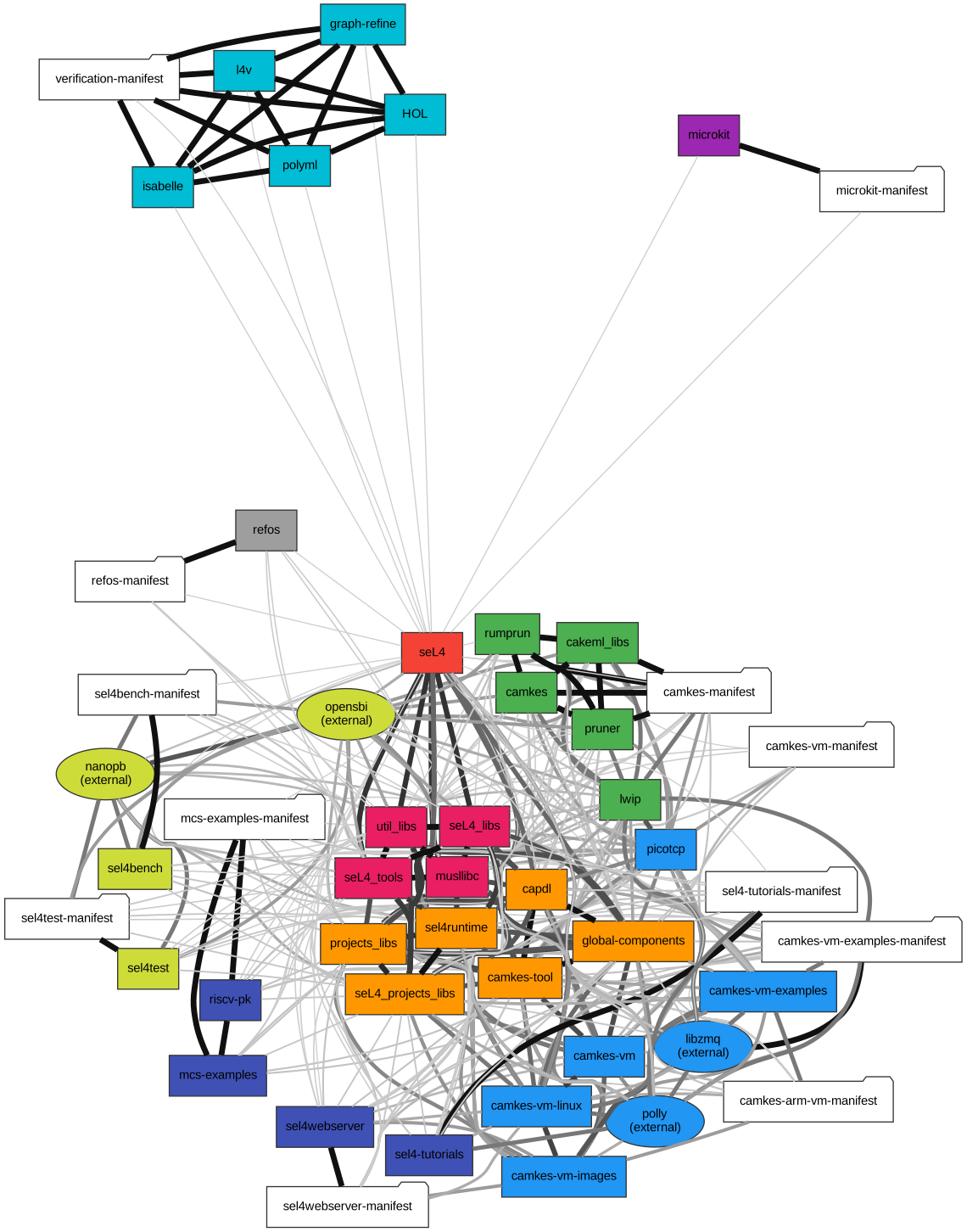
The seL4 organisation on GitHub uses git-repo to manage multiple source repositories, and so there are a large number of projects to get your head around when figuring out the ecosystem.

As an experiment, I have taken the various manifest files across the org, and constructed a graph based on how frequently each pair of repositories is mentioned in a manifest together. See below:

Graphviz Diagram

[This may render badly when syndicated outside of my blog; and also on small screens. And probably large screens. Iโ€™ve attempted to make sure thereโ€™s a non-JS fallback โ€“ on my site with JS enabled, if you hover over a node, it should highlight connected nodes.]

The colouring of the nodes is mostly manual; I experimented with graph clustering algorithms but have not found a satisfactory result so far. Still, some clusters are obvious:

  • Kernel โ€“ the seL4 microkernel proper. This often but not always co-exists with the main cluster of core libraries, but it is pulled away slightly by the verification and microkit manifests.

  • Verification โ€“ the verification repositories (l4v, HOL, graph-refine, polyml, isabelle) form a very distinct group. These are connected only to the seL4 microkernel itself, which is the only component formally verified.

  • Microkit โ€“ microkit is a newer operating system framework that does not use CAmkES, so stands apart from the rest of the pack. I chose to scope this work to the seL4 org, so the LionsOS ecosystem and sDDF which are maintained by Trustworthy Systems are not shown. Also not linked is rust-sel4, because this modern world isnโ€™t using git-repo in the main to manage its repositories.

  • RefOS โ€“ Iโ€™d not come across refos before, but it appears to be an example OS from 2021 built on the seL4 kernel.

Itโ€™s quite hard to pull apart the CAmkES framework and the core libraries; there are definitely some which are more associated with VM management, but the overall shape of this co-occurence data is a messy ball in the middle with some outliers in orbit. One observation is that camkes is correctly identified as more peripheral than camkes-tool, which contains the actual core CAmkES code.

Reflecting on this approach, in hindsight Iโ€™m surprised that using co-occurences worked as well as it did โ€“ there was no attempt to actually inspect the code and find direct mentions of other code e.g. library header dependencies. As the newer microkit effort largely eschews git-repo, better results might be found by actually taking that more detailed approach, so that graph edges could represent real dependencies between two packages. Additionally, this could allow diving into the various libraries held in the different โ€™libsโ€™ repos, to get a more granular graph of relationships between them.

However, I think I spent more time on making it possible to render graphviz graphs easily on my blog than actually gaining any insight into the codebase!

  •  

Dirk Eddelbuettel: RcppArmadillo 15.4.0-1 on CRAN: New Upstream Minor

21 Juni 2026 om 16:18

armadillo image

Armadillo is a powerful and expressive C++ template library for linear algebra and scientific computing. It aims towards a good balance between speed and ease of use, has a syntax deliberately close to Matlab, and is useful for algorithm development directly in C++, or quick conversion of research code into production environments. RcppArmadillo integrates this library with the R environment and languageโ€“and is widely used by (currently) 1282 other packages on CRAN, downloaded 47.1 million times (per the partial logs from the cloud mirrors of CRAN), and the CSDA paper (preprint / vignette) by Conrad and myself has been cited 697 times according to Google Scholar.

This versions updates to the 15.4.0 upstream Armadillo release made on Thursday. We had run a complete reverse-dependency check leading up to it, asserting there were no issues with packages dependent on it. As it sometimes goes with that many packages involved, one CRAN package reported one test failure. And it turned out to be both unrelated and pre-existing. But sorting this out over one round of email delayed things by a day. And then I went cycling for a good cause so this announcement post comes a little later than usual. The package has also been updated for Debian, built for r2u, and by now also at CRAN for the different binary releases.

All changes since the last CRAN release follow.

Changes in RcppArmadillo version 15.4.0-1 (2026-06-17)

  • Upgraded to Armadillo release 15.4.0 (Medium Roast Agave)

    • Added fill::nan, fill::pos_inf, fill::neg_inf as optional fill forms for the Mat class

    • Added .push_back() for appending elements to vectors

    • Faster handling of find() within .elem()

    • Faster element-wise min() and max()

    • Faster conv_to when element types of input and output objects are the same

Courtesy of my CRANberries, there is a diffstat report relative to previous release. More detailed information is on the RcppArmadillo page. Questions, comments etc should go to the rcpp-devel mailing list off the Rcpp R-Forge page.

This post by Dirk Eddelbuettel originated on his Thinking inside the box blog. If you like this or other open-source work I do, you can sponsor me at GitHub. You can also sponsor my Tour de Shore 2026 ride in support of the Maywood Fine Arts Center.

  •  

Vasudev Kamath: Releasing debvulns: CLI for listing Debian vulnerabilities

21 Juni 2026 om 14:06

Following up on my previous post, I have released the debvulns CLI. This utility uses the same parsing logic as the debsecan-mcp server but exposes the functionality directly via the command line.

Why a new CLI?

While Debian's native debsecan utility exists, it lacks modern output formats like JSON and CSV, and fails to expose a significant amount of metadata available in the Debian Security Team's daily snapshot.

Additionally, running a persistent Model Context Protocol (MCP) server introduces context window overhead. The manifests and tool descriptions required by the protocol consume tokens even when idle. For debsecan-mcp, the MCP Inspector utility shows an overhead of roughly 150 tokens.

By contrast, an LLM can parse a standard CLI help menu on-demand without permanently draining the context window. Integrating the CLI into a persistent agent workflow can be achieved via a skill file, allowing the LLM to leverage the tool without repeated discovery overhead.

What else is NEW?

During testing, I observed discrepancies between the output of debsecan-mcp/debvulns and native debsecan. Debugging with an LLM revealed a bug in the version comparison logic that caused debvulns to underreport vulnerabilities. This has been resolved.

The current interface supports structured formatting and customizable data backends:

usage: debvulns [-h] [-s {critical,high,medium,low,negligible}] [-f {json,csv}] [--sort-by {package,cve}] [--vuln-url VULN_URL] [--epss-url EPSS_URL] [--suite SUITE]
                [--cache-dir CACHE_DIR] [--no-cache] [-v]

debvulns - CLI Debian Vulnerabilities Tracker

options:
    -h, --help            show this help message and exit
    -s, --severity {critical,high,medium,low,negligible}
                          Filter vulnerabilities by severity
    -f, --format {json,csv}
                          Output format (default: json)
    -sort-by {package,cve}
                          Sort vulnerabilities by 'package' or 'cve'
    --vuln-url VULN_URL   Custom URL or local path for Debian Security Tracker data
    --epss-url EPSS_URL   Custom URL or local path for EPSS scores data
    --suite SUITE         Debian suite name (e.g. bookworm, sid). Auto-detected by default.
    --cache-dir CACHE_DIR
                          Directory to cache fetched and parsed data (default: /var/cache/debvulns)
    --no-cache            Do not use cached data, force downloading and parsing
    -v, --verbose         Enable verbose debug logging (sent to stderr)

By allowing users to override data sources with local snapshots of the Debian Security Tracker and EPSS feeds, debvulns can run natively in airgapped environments.

What Next?

The next step is building a Prometheus exporter for this vulnerability data to streamline scanning and monitoring across data center infrastructure. Stay tuned.

  •  

Gunnar Wolf: systemd for Linux SysAdmins

20 Juni 2026 om 04:07
This post is a review for Computing Reviews for systemd for Linux SysAdmins , a book published in Apress

systemd. Yes, in full lowercase. If there was ever a technology to cause controversy in the Linux world, this is it. Since its inception in 2010, systemdโ€™s goals were set quite high: to replace the vital part in every Linux system that takes care of the system boot process. It quickly reached maturity, allowing it to be adopted as the main init system in most major distributions just five years later. Despite describing events that happened over a decade ago, systemd adoption still raises the temperature in any Linux-related discussion.

David Bothโ€™s comprehensive book tackles the what, why, and how issues surrounding systemd. Carefully divided into 16 chapters, going from the basics and some of the technical and political history behind the project to the different subsystems and aspects covered by systemd, its almost 450 pages can scare people away. But the text is written in a very clear, tutorial-like fashion, and while it can be read sequentially, cover-to-cover, readers can also pick a single aspect and jump straight to the relevant chapter.

A frequent criticism of the systemd project is that it aims to basically rewrite all of a Linux system, and just looking at this bookโ€™s index shows there is some truth to it. The first chapter is an introduction to the systemd project and a brief overview of its history (including the controversies around it), and the following four chapters deal with understanding and controlling the system boot process.

That leaves ten chapters to cover different aspects or subprojects of systemd, such as time and date issues (synchronization, time specifications, and controlling repetitive tasks), understanding and leveraging the system journal that strongly departs from the old syslog system, network configuration and firewall management, system health and performance debuggingโ€“all aspects that in the traditional Unix philosophy were managed by independent programs. And I can identify several systemd subprojects not covered by this book!

We long-time Unix and Linux administrators took pride in how highly performant and stable systems were supported by the simplicity of our tools; systemd critics point out this massive project has absorbed dozens of individual tools, yielding corporate control over vast swaths of vital system tooling. Truth is, as a sysadmin myself, systemd is today one of my greatest allies.

I appreciate how the author evaluates every component independently, including his personal evaluation of eachโ€“even acknowledging when he prefers working with the traditional programs.

If I had to note one criticism: given the many console captures, having a maximum width below 70 characters means several lines are unnaturally cut short (and continued with odd indentations). There is probably no โ€œrightโ€ way to solve this, but it does affect the reading experience.

  •  

Russell Coker: HP Z4 G4

20 Juni 2026 om 16:01

In what is hopefully the conclusion of my hunt for a cheap tower server supporting REBAR [1] I have just bought a HP Z4 G4 with W-2125 CPU for $320.

Hardware

One interesting thing is that it has an adaptor from SATA power to 8 pin PCIe power. According to Wikipedia the 8 pin connector provides 150W at 12V [2]. According to Wikipedia SATA power cables include 3 12V pins each of which can deliver 1.5A [3] which is 54W. The system as I received it had a single SATA power plug connected so potentially 150W could be drawn from a connector designed for 54W. The first thing I did was to connect a second SATA power connector on the same cable so I could have connectors designed for a total of 108W supplying potentially 150W (and definitely more than 75W).

I found two versions of the specs for this system, this version seems to match what I bought as it references W-21xx CPUs [4] while this version matches what I would rather have with a W-22xx CPU [5]. The URL naming scheme implies that there are potentially at least a few other variants out there. So much for the โ€œbuy name brand and you can buy two systems with the same model and have them work the sameโ€ benefit you hope to get. Why donโ€™t they just name them โ€œG4.1โ€, โ€œG4.2โ€, etc?

It seems that W-21xx and W-22xx CPUs are incompatible, so the W-2295 scoring 30,804 multithread and 2,634 single thread on passmark that I hoped to get isnโ€™t an option [6].

The system is well designed for space efficiency, both it and the Z640 are 17cm wide but the Z4G4 allows my to close the lid with the Intel Battlemage card installed which doesnโ€™t come close to fitting in a Z640. It has 8 DIMM sockets and with the ready availability of 32G DIMMS that allows 256G of RAM which is the maximum the motherboard supports. That compares well to the Z640 that only has 4 DIMM slots and the Z6G4 which only has 6.

The system supports a maximum RAM speed of DDR4-2666 which is better than the DDR4-2400 of the Z640 but less than the DDR4-2933 of the Z6G4.

The NVMe sockets on the motherboard are a convenient feature. Most systems I run need at most two NVMe devices so this saves a PCIe slot which is important when dealing with GPUs that take 2+ slots. Also for systems that donโ€™t really need NVMe I can use some of the small NVMe devices that I have no other use for. 128G NVMe devices arenโ€™t even worth selling and 256G will be of little use in the near future. So when I move to gen4 Z servers I can use up some of them without wasting slots.

Using the lesser socket LGA2066 in the Z4G4 is a minor annoyance, but for a single socket system 18 cores is probably enough.

The BIOS has an option for single-socket NUMA, which is basically locking cores in a single CPU to specific RAM channels. I enabled it but it did nothing presumably because I only have 2 DIMMs. When I get more DIMMs Iโ€™ll do some tests of that and compare it with NUMA on my Z840.

Variants

There are many different variants of the Z4G4 and the only way to recognise them is by the CPU not by any part number or serial number AFAIK. The first difference is between server grade CPUs (the W-2xxx CPUs) and desktop grade CPUs (the i7 and i9 CPUs). The systems with i7 and i9 CPUs donโ€™t support ECC RAM which makes them less reliable, gives smaller limits for RAM

The below table compares the Z640 which is my current desktop PC with the Z4G4, Z6G4, and Z8G4 systems. For the latter 3 I have included multiple options for the parts that differ in different models in the same name series. The Z4G4 I have is an early one which only supports W-21xx CPUs which means a maximum RAM speed of 2666 and the best possible CPU would only be 15% faster than my Z640. I can only use this for ML stuff as itโ€™s the only system I have with REBAR support (which works well).

Z640 (1 socket) Z4G4 Z6G4 (1 socket) Z8G4
DIMM slots 4 8 6 24
Max DDR4 speed 2400 2666/2933 2666/2933 2666/2933
Max DIMM size 32G 64G 64G 64G/128G
System Max Ram 128G 512G 192G/384G 1.5T/3T
CPU Socket LGA2011-3 LGA2066 LGA3647 LGA3647
Best CPU E5-2699A v4 W-2195/W-2295 Platinum 8180/W-3275 Platinum 8180/8280
Motherboard NVMe 0 2 2 ?

Conclusion

In my previous blog post I concluded that the next step up for me would be DDR5 systems [10]. But now some of the LGA3647 systems are appealing. The Z8G4 would be a decent upgrade from my current Z840 build server and should be affordable long before any two socket DDR5 system becomes affordable.

The Z4G4 doesnโ€™t have any potential for useful upgrades. But for me it was a good cheap way to house a GPU that had already damaged the motherboard of one good system. If the Z4G4 has a PCIe slot break the way my Z840 did then it wouldnโ€™t bother me a lot. It was annoying to discover how limited this variant of the Z4G4 is after buying it, but at that price I canโ€™t complain.

A Z6G4 could be a nice workstation if I found one at a really low price. The only reason Iโ€™d seek one out is if I had a need for a desktop workstation with REBAR support, which seems unlikely.

Related posts:

  1. Tower Servers and Resizable BAR A feature on modern PCIe implementations is โ€œResizable BARโ€ AKA...
  2. Server CPU Sockets I am always looking for ways of increasing the compute...
  3. More About the HP ML110 Gen9 and z640 In May 2021 I bought a ML110 Gen9 to use...
  •  

Russell Coker: Font Sizes

20 Juni 2026 om 14:27

The Problem

In 2019 I blogged about getting a 4K monitor because of my vision being inadequate for a 2560*1440 monitor [1]. Now Iโ€™m using a 40โ€ณ 5120*2160 monitor [2] and still trying to find the correct balance between how much I want to see on the screen and what I am physically capable of seeing on screen.

Currently Kitty is my terminal emulator of choice [3]. What I most like about it is the feature of having multiple terminal windows in a single OS window, so instead of having 9 or 16 different xterm instances running all with possible alignment issues I have a single window for all terminals which can be brought to the foreground. The impending 6.7 release of KDE (my favourite Linux desktop environment) [4] includes the feature of per-screen virtual desktops which might be the feature I need to make multiple monitors usable for me. One of the factors stopping me from using multiple monitors in the past was the issue of not getting the alignment of dozens of xterms right if a monitor goes to sleep mode and is regarded as disconnected, moving a few Kitty windows is much easier than moving dozens of xterms (also a tiling window manager isnโ€™t my style).

Iโ€™ve just decided that the Terminus font (my favourite out of the monospaced fonts in Debian) is too small for me at 9.0 point. But then I tried 10.0 which looked really ugly and an experiment showed that 10.5 looked good.

What Iโ€™ve Learned

This is the best explanation Iโ€™ve seen of how ridiculous the whole font point thing is [5]. It doesnโ€™t and wonโ€™t ever correlate to pixels. So what we ideally want to do is set the size on screen to match the actual pixel size of the font. I canโ€™t find any software to interrogate a font file and find out what sizes it supports. The web page for the Terminus font says that it supports 6ร—12, 8ร—14, 8ร—16, 10ร—18, 10ร—20, 11ร—22, 12ร—24, 14ร—28 and 16ร—32 [6]. So the question is how to get a terminal program that uses one of those.

Kitty doesnโ€™t and wonโ€™t support specifying font size by pixel. I tried some other terminal programs, I started with the Debian Wiki page TerminalEmulator [7] which wasnโ€™t very helpful, I added some new entries to that page. There doesnโ€™t seem to be another option for a terminal emulator with multiple terminals in one OS window that can arrange them automatically. I didnโ€™t even get to the stage of checking whether other terminal emulators supported font size in pixels.

The lcdf-typetools package contains the program otfinfo which gives some interesting information on fonts but nothing about the font sizes in pixels.

Sites like Coding Font to compare fonts [8] can never work properly as the fonts will always be slightly different sizes as the same point size doesnโ€™t mean the same display size.

The Current Situation

On my 5120*2160 monitor with 9 Kitty terminal sessions with 9.0 point font they each have 277*50 characters. With 10 point itโ€™s 237*46 but fuzzy and unpleasant to read. With 10.5 point itโ€™s 208*43 which isnโ€™t as good as Iโ€™m used to but is still almost 4.5* as many characters as the original 80*25 standard for terminals.

Some time before 2019 I had a 4*4 array of terminal windows that were 100*25 or 120*25. That left some space at the right and bottom so I could open another 8 or 9 terminals that were partially obscured if I needed to. By 2019 before getting a 4K monitor I had a 3*3 array of terminal windows as my standard desktop and a larger monitor that did 4K resolution allowed me to have 16+ terminals again. Now with Kitty I routinely have 9 terminals in a 3*3 array and I can easily open more if I need them and have them resize appropriately.

This situation works reasonably well, but the element of just trying different sizes in 0.5 point increments until I find something that looks good is unpleasant. I should be able to specify the next largest increment of the bitmaps in the font and just have it look good.

Conclusion

It would be good if more people tested the terminal emulators in Debian and added information to the wiki page about them. The current page is useful but needs more information to support the variety of features that people find important.

We need some tools to provide information on fonts in Debian, such as the sizes of bitmapped fonts.

The whole point size thing is just wrong and would ideally go away. The vast majority of font use nowadays is for things that will probably never end up on a printed page so trying to map it to a physical size in fractions of an inch makes no sense. But thatโ€™s just one of many horrible things used for backwards compatibility that arenโ€™t going to go away any time soon. Really everything involving inches should go away.

Related posts:

  1. Kitty and Mpv 6 months ago I switched to Kitty for terminal emulation...
  2. Hello Kitty Iโ€™ve just discovered a new xterm replacement named Kitty [1]....
  3. Source Code With Emoji The XKCD comic Code Quality [1] inspired me to test...
  •  

Reproducible Builds (diffoscope): diffoscope 320 released

19 Juni 2026 om 02:00

The diffoscope maintainers are pleased to announce the release of diffoscope version 320. This version includes the following changes:

[ Chris Lamb ]
* Support androguard 4 and previous versions. Thanks, linsui!
  (Closes: #1140016)
* Use --long-form arguments when calling apktool in order to support apktool
  version 3. Thanks again to linsui. (Closes: #1140015)
* Update copyright years.

You find out more by visiting the project homepage.

  •  

Wouter Verhelst: Agentic coding and Free Software

19 Juni 2026 om 14:09

Through work, I have paid license to windsurf (recently renamed to "devin"), an application for LLM-based (aka, "Agentic") development.

I hadn't been using it that much, but in an effort to more clearly understand how this whole AI development thing works, I decided to give it a closer look recently.

My conclusions:

In its current form, this whole LLM wave is problematic for multiple reasons. But ignoring that, and looking at the technology only, I can say that:

  • it is a paradigm shift;
  • it is, at the technological level, a positive evolution;
  • and it is a threat to free software.

Problems

Lest someone (incorrectly) assume that I am arguing in favour of the current state of affairs with regards to LLMs, let me state this first.

The way LLMs are built today is highly parasitic. Websites are downloaded in whole, at unsustainable rates, regardless of the consent of the people who made the original content. The result is predictable: servers get overloaded, server administrators attempt to implement various mitigations. Some of these mitigations work; some do, for a while; some are entirely useless. In actual fact, the mitigations are an arms race -- if too many people implement the same mitigation, then the people who try to build yet another LLM so they can extract rent will just try to work around the mitigation, eventually they will succeed, and you'll just have to come up with another mitigation. It's a bit like spam; you introduce regex-based spam filters, they introduce spelling mistakes, you introduce bayesian filters, they add a large batch of markov chain-generated semi-nonsense words made invisible by markup, you add filters to block emails with such markup, they move the text into an image. We have working mitigations today, but eventually we'll run out of ideas.

LLMs glob up everything they can while ignoring the license of the source material. The people who push those LLMs claim that pushing the source material through the machine learning algorithms makes the output of the algorithm distinct enough from the source material that the license no longer applies; I'm not so sure that this is true. I guess the New York Times v OpenAI lawsuit will teach us some of the answer to that question here, but even so the ethical questions about "is it OK to bring down another server just so we can download the internet for another for-pay LLM" are still open. And regardless of what the law states, my opinion on "you're using my copyleft code to generate code under a different license" is not something you might like if you agree with the rent seekers' opinion on the subject.

That all being said and true, the technology works. You can have a "conversation" with an LLM that resembles a human one. If you pass it some data, you can use plain english to ask it questions about that data, which is a lot easier than to ask it about that in a formal way. You can request it to generate some code, and it will generate something that looks like what you need and that will be mostly correct for like 95% of the time.

Now, yes, 95% of the time is not 100% of the time, and no, you can't ask it to "write me a piece of software that implements this 300-page requirements document and get back to me when you're done", because it will fail, and you won't know where it has failed, and you'll take it into production and expect everything to be fine because it won't and this one minor logic bug will cause half your servers to spin and consume credits with your infrastructure provider with nothing to show for it.

But that doesn't mean you can't use an LLM to build a large piece of software. It just means you have to understand the LLMs limitations and strenghts, and use them correctly.

Here's what an LLM is good at:

  • Generating plausible text
  • Interpreting text to figure out what a plausible meaning or summary of that text is
  • Giving vague indications as to what the probable context of a given body of text is.

It turns out that that's enough to use the LLM to build a reliable piece of software, provided you do it right.

Paradigm shift

An LLM can generate text by the truckful. The generated text could be code. Given a good enough LLM, the generated text might even run and do something useful.

You can try to blindly run the code, and if it doesn't run correctly, you can paste the error message to the LLM, and it can tell you what went wrong and how you could possibly fix it. This creates a feedback loop: you ask it for an amount of code, you run the code, you receive an error, you tell it that the code is problematic and give it the error message, it makes changes to the code, now you have something that at least no longer fails at startup.

If you ask it to add tests to make sure that your code acts as per your specification, now you get an error if and when the code doesn't act as per your specification. Or, well, at least not as per the part of the specification that was correctly turned into a unit test by the LLM.

LLMs have a context window, so if the error message is pasted in the same conversation as where the code was generated, it is able to reuse the earlier prompts to refine how it should interpret the error message that you received.

You can't really paste the source code of an entire application into the prompt of your LLM, that would quickly overrun its context window. But LLMs also allow you to provide some form of background information -- a document, say -- on which you ask it to reason. It will interpret that document, but doing so uses less of the LLMs context window. So providing the LLM with your application's source code as background information can help it understand better how your code interacts. This is especially helpful if you only provide the LLM the background information relevant to the actual question.

So now if you are able to:

  • Create background context with your application's source code
  • Have the LLM generate a first draft of your requested change, plus the tests to make sure it works
  • Compile (if applicable) the generated code (and tests) and run said tests
  • Return any error messages to the LLM with a request to correct the error

Then the combination of "getting it 95% right off the bat" and the above feedback loop means you can generate syntactically correct code, that probably does what you need, in minutes.

I say "probably" for a reason. There are going to be cases where you specify a request without a number of details (because they are implied), and the LLM will get most of those details right but just not implement the one bit because it's an automaton and it doesn't think. Or you will ask it to make sure that two bits of the application look exactly the same, without specifying that they must act the same, now and in the future, and it will just generate the same block of code twice and then in a future change it will change one but not the other.

But if you review the changes, and you have experience as a programmer, you will be able to spot most cases where the LLM got it wrong. And so it's possible, if not necessarily easy at first, to use an LLM to generate mostly correct code.

There are certain places where "mostly correct" code is not desireable. But equally, there are also cases where, "mostly correct" is good enough.

After all, most of the software you run today -- the bits of it that weren't, yet, generated by an LLM -- is only "mostly correct", too, because to err is human and we all make mistakes. If not, there wouldn't be any CVEs and your software would never do anything wrong.

Now, doing the feedback loop described above is certainly something you could do manually. You could open an account on one of the LLM websites, upload the source code of your application, ask it to generate some new feature, download the newly generated feature, run it, and then copy/paste any error messages back into the LLM.

But that's a lot of manual work of the type that computers are pretty good at. So that's what the "windsurf" tool helps you with: you run it inside your IDE -- either a VSCode-based tool that you download from their website which comes with their product preinstalled, or a separate JetBrains plugin that you can install. You can then open your entire relevant codebase in a workspace in your IDE. You then ask the LLM, through the IDE, to generate a new feature in your codebase, and to also generate the test while it's at it. It will use a mixture of LLM interpretation and non-LLM functionality to scoop out the relevant bits of your codebase to send to the LLM as background information, will send it your prompt, will download the generated code and patch or create files, will compile (if required) and run the newly generated code and tests, and will refine the generated code if the tests produce any errors. All mostly automatic; by default, running anything requires explicit confirmation. You can turn that off completely (probably not a good idea), or you can give it a whitelist of things that you don't want to confirm (perhaps OK), and the tool also passes standing instructions to the LLM to never generate any command that deletes a file (which, like with any LLM, can be overridden, but it requires you to be very stubborn and to use more credits than you'd probably like).

All this put together means you can build something without writing any piece of code, provided you do it right.

A technically positive evolution

Don't go and say, "here's a 300-page document, read it and write whatever the document says". It will get it wrong, it will write a massive test suite that it will only run at the end, it will choke itself up trying to interpret the massive amount of failures it encounters, it will fill up its context window and it will start to forget some of the requirements. That won't work.

But what you can do -- what I did, in fact -- is this.

First, create an empty workspace. Don't put any code in it.

Then, tell the LLM to generate a backend framework using technology X and a frontend framework using technology Y that initially only says "hello, world". Also add tests to it, and run the tests.

It will do that. You'll not get much, but it will work.

Then, ask it to add some UI elements. A login page, perhaps. A navigation bar. Small things. Most of it doesn't have to be functional -- but tests must be there for the bits that are, and have it run the tests and evaluate the results.

Rinse, repeat, until you have a working application.

Importantly, in between the steps, you should also run the application yourself and see if the change was implemented correctly. Sometimes it won't be. Sometimes there will be a subtle bug -- I at one point had a the application hang after a few minutes. Sometimes you tell it that there's a subtle bug, and it will discover it more quickly than you could, and it will fix it, and in implementing the fix it will uncover another bug, and then you have to fix that one -- the fix it came up with for the hang was to move something to an async process on the server, which caused the application to start spinning while trying to create hundreds of async jobs (this is when I realized that the hang was a deadlock due to some part of the codebase doing something that indirectly triggered itself). Sometimes it will try to fix the bug you tell it about, and you'll see that it's going off on a tangent that has nothing to do with what you're seeing. It's important to keep an eye on what it's doing, so you can guide it back on track when that happens -- when I told it about the hang, it started investigating the part of the code which sends out emails, thinking that it could hang while waiting for sendmail to finish, but the hang was happening when the application was idle, not when it was sending out emails, and only when I told it about it happening when it was idle did it find the deadlock.

So it's not a fully automatic process, and it needs to be guided by someone who knows what they're doing. But if that is the case, you can come up with something that works. I spent evenings and breaks for about a week, and I managed to create a working application which, had I written it by hand, would have taken me a few months of full-time work to come up with. And I now have a side project, fully complete and working, that I had been thinking about doing for more than a decade, but never got around to actually doing, because of all the work that would be involved and I just didn't see myself having the time for.

It's not perfect code. But it's mostly good enough, and it will perform the job it needs to. And it looks far slicker than most of the side projects I've done in the past, because in the past I would prioritize between implementing new features or making something look slick, and I would decide that the new feature was more important because it's only for me and there's only me and nobody cares if it looks good or not and I don't have three weeks to come up with something that looks better. But here, I found myself sometimes spending 10 minutes writing a prompt with instructions on making things look better. Because what's 10 minutes when you just spent an hour writing down and refining specifications for functionality and tests?

There are a number of other things in which an LLM can help a programmer.

For instance.

I received a bug report recently in a project I'm paid to maintain that I couldn't make heads or tails of. I opened the source code in my windsurf IDE, pasted the bug report in the prompt, and then requested the tool to analyze the source code and the associated logs and tell me how the described behavior could be happening. It turned out that I had overlooked something, but with the help of the tool, I found the bug in minutes.

I was trying to understand a particular part of a large codebase that I didn't really grasp very well. I loaded the codebase in the tool, and asked it to explain to me how a particular action is performed by the code. I requested specific functions and line numbers. I now have a far better understanding of how the code works, and will be able to write that patch that I've been wanting to write for years -- without using the LLM.

I have been struggling for, literally, years with understanding why another tool that I maintain was misbehaving in a particular way but only in Firefox. I opened the codebase in Firefox, explained the buggy behavior in plain English, and asked it to explain how this could be happening. It picked up some obscure corner case behavior of ffmpeg and mp4 containers that I was not aware of and that perfectly explained why things were misbehaving in the way that they were.

At the same time, there are limitations. Giving an LLM a codebase that was originally generated by an LLM (either the same one or another one) seems to work well. Giving it a codebase that was written by a human and expecting it to correctly update it seems to be more error-prone. I did one or two of those as a trial, and it is more problematic than anything.

An LLM is also not intelligent, notwithstanding the popular term of "Artificial Intelligence". On multiple occasions, I've asked it to write a test case for some code that was not set up to do so; and rather than suggesting a refactor is required, it would instead copy the code that needed to be tested and then test the copy, rather than the original. The tool has made multiple similar errors. I have sometimes people describe agentic coding as "similar to interacting with junior programmers", but that is not the case. A junior programmer will either fill in the gaps in your specifications, or ask for clarification when something seems off. The LLM will not do that; it will do what you ask, exactly that and nothing more. If you missed a corner case in your specification, then all bets are off.

I remember learning about programming language generations in college. A first-generation language is "machine code", a second-generation language is "assembler", a third-generation language is any high-level language such as C, Perl, or Pascal. I've forgotten what set a 3rd-generation language apart from a 4th-generation language. But I remember the definition they gave me for a 5th-generation language: "you tell the computer what to do, and it will do it". At the time, I thought it was ridiculous. Nobody could ever write something like that.

But it's here.

And it's a threat to free software.

A threat to free software?

Yes.

There is the obvious part where most of the well-known LLMs are non-free software. I mean, there are some "open source" LLM models. The windsurf tool that I used doesn't allow you to use them (directly), but they're there. There are also open source applications that implement what the windsurf editor does. So it's definitely possible to work like this without resorting to non-free software and non-free services, even though the non-free LLMs might be a bit ahead of the curve of the free ones. But that's not what I mean.

And there is also the obvious thing which I mentioned earlier in this post, which is that the people who try to build LLMs are doing it in unethical, disgusting ways, causing downtimes and disregarding licenses for whatever they can get their grubby hands on. Ideally we wouldn't be in that situation, and ideally this wouldn't be a problem, but we are where we are.

And there's the obvious thing where the OSI sold itself out and declared that a machine learning program can be open source even when the very things it was built from -- the training data -- is not available. That's a major issue that the free software community needs to fight against, but there's not really anything that that is a threat to free software. You just build your own, free software, LLM, and you're done.

The actual threat is in funding and developer support.

Most large businesses do not care about free-as-in-freedom software. They like the free-as-in-beer part, and they appreciate that the free-as-in-freedom bits can make the software more customizable. They are (mostly) happy to do sponsorships of the free-as-in-freedom projects that they use if that means their free-as-in-beer usage of the software gets improved.

But why would you care about all that when you can just generate the code you need, rather than interacting with an open source community that may or may not care about your business's interests?

Where to go from here

Although I think the moral and environmental issues with LLMs are real and problematic, given the experiments I did I am not convinced that the concept of interacting with a computer system in natural language and to use it to generate code is necessarily deficient. There are pitfalls, but they can be managed. It is possible to use such a system to create throwaway, proof-of-concept type "good enough" code bases. It can be used to interpret code bases and to understand bug reports.

I believe that the major issue with LLMs has to do with that saying about hammers and nails:

If all you have is a hammer, then everything looks like a nail.

LLMs are an outgrowth of machine learning, pushed by large corporations. These large corporations have a lot of money. If all you have is money, then every problem can be fixed by throwing more money at it. The initial language models were promising but not (yet) good enough, and it seemed that one way in which they could be improved was to increase the scale of the statistics: throw more hardware (and thus money) at it, and rather than improving the efficiency of the models, just scale up.

Scaling up is something that megacorporations are very good at. It's only a money problem, after all. Does that mean that "scaling up" is the only way to improve the models, though? I'm not convinced.

Some hardware, such as most modern Apple and Samsung devices, ship with accelerator hardware for machine learning algorithms. There are some models that are small enough to be able to run on these devices. I don't see why it should not be possible to create a small(er) language model that can do some useful part of the above-described use cases; if not locally, then at least on a server that one can run on-prem rather than requiring that you pay rent to one of the LLM companies.

The Software Freedom Conservancy has published an aspirational statement on machine learning-assisted programming that, I think, gets a lot right. It's not quite a definition, but it's something to keep in mind.

Perhaps that's the way forward?

More questions than answers at this point, anyway.

  •  

Mike Gabriel: Commenting on the recent Ubuntu Touch review done by @SwitchandClickOfficial on Youtube

18 Juni 2026 om 09:49

There has been a video blog post recently published with a review of Ubuntu Touch as an option to opt out of the Android world: https://www.youtube.com/watch?v=wTK6TS3pXgc

Thanks to @SwitchandClick for spending time on this and publishing that video. Much appreciated.

Many Issues amended in upcoming 24.04-2.0 Release

When I watched that video referenced above, I continuously thought: ah... this is fixed in the next major release of Ubuntu Touch, or: ah... this is a known issue that we have on the roadmap..., or: ah... this is done in this ways by design (so it's a feature or basic functionality)...

Let me just state, that most of the criticized aspects will be resolved in upcoming Ubuntu Touch release 24.04-2.0 (the tests in that video blog post have been run on Ubuntu Touch 24.04-1.x):

  • Camera notch and rounding corners get honoured now by the UI
  • Ubuntu Touch's default webbrowser (Morph Browser) has been bumped from Chromium engine v87 (Qt5 based) to v134 (Qt6 based), installing another browser should not be necessary anymore (note that the privacy level in Morph Browser is pretty high, so using other browsers could mean a loss of privacy).
  • Bluetooth pairing agent got added to the bluetooth indicator
  • Ubuntu Touch now supports Snaps on CLI level and in the OpenStore app
  • Libertine has received fixes, but no substantial improvements. It mainly targets users who want to use their Ubuntu Touch device as desktop daily driver. Libertine-provided desktop apps UI-wise are often not usable on a phone-like device.

The full feature preview of the 24.04-2.0 release can be found here: https://ubports.com/blog/ubports-news-1/ubuntu-touch-24-04-2-0-beta-is-n...

Ubuntu Touch App Ecosystem

The app ecosystem of Ubuntu Touch is quite specific, because many apps in Ubuntu Touch have been explicitly developed for Ubuntu Touch using a widget toolkit called Lomiri.Components. However, in Ubuntu Touch we also encourage developers to provide apps written with other convergent-capable toolkits, such as QQC2-based apps or Kirigami-based apps.

One reason for the very different app ecosystem in Ubuntu Touch is that many service providers don't have Ubuntu Touch on their radar when investing in app development for their services. Some Ubuntu Touch App Developers work around this by either implementing unofficial client apps for web services (e.g. the Flow app for Deezer by Sander Klootwijk), others provide the web service via implementing a web app (will not work when offline, but at least will show up as an app in the launcher).

The overall solution for making Open-Store.io more familiar to users who migrate from Android is that commercial service providers start honouring digital sovereignty and start providing apps for Linux. Not just for the Linux desktop, but also for mobile Linux platforms. This dual use case can easily achieved with an app development that bears convergence in mind.

App Ecosystems are also a Matter of Perspective

And one more minor note: whenever I open an Android appstore or can peak over someone's shoulder using an iOS device: I always wonder: what are all these apps about??? Never heard about them.

So, familiarity really depends on perspective. And perspective depends on what you are used to. Change what you do and your perspective will follow.

Ubuntu Touch's root filesystem (rootfs) is Immutable

Only thing from that video blog post that we haven't fixed and won't do so in the midterm future is apt-get not working on the command line.

The reason for this is: the Ubuntu Touch root file system is an immutable file system and thus shall not be changed via apt-get & friends by ordinary users.

There are various discussions ongoing such as dpkg-divert'ing apt-get to a wrapper shell script that spits out an error message if rootfs is mounted read-only and someone tries to install packages the Debian/Ubuntu way. Other approaches are to mount some RAM disk over the rootfs, so apt-get can be used at runtime but changes to the system get reset at reboot.

However, it is possible to mount the root filesystem read-write and test newer package versions (as UT core developers do regularly, in fact). If you tinker with this, it is recommended to reflash your device (don't wipe user data, when you reflash!) from time to time, because adding packages or package upgrades to your rootfs may over time corrupt the integrity of the rootfs.

One reason for apt-get breaking the rootfs and thus your Ubuntu Touch development device is that the upgrade process of the rootfs image is incremental, so update tarballs sometimes contain only those parts that got changed between this and your previous upgrade (sometimes, upgrades contain a complete rootf image, depending on the interval between upgrades). If files from an incremental update tarball mix into a rootfs that got tinkered with via apt-get, you really end up on your own. Re-flashing will grab the complete rootfs tarball and wipe the whole rootfs and reinstall a fresh version of the newest rootfs image. Developers also do this in regular intervals to ensure their test device is clean again before running more/other tests.

  •  

Dirk Eddelbuettel: rspdlite 0.1.0-1 on CRAN: New Package!

17 Juni 2026 om 02:16

Very happy to share that a new package rspdlite arrived on CRAN today in its inaugural version 0.1.0-1. It wraps and provides the (header-only) C++20 library spdlite which its author describes (aptly) as tiny, fast, capable. Just like its bigger sibbling spdlog (which we wrapped as rcppspdlog), it is written by Gabi Melman. However, with a focus on C++20 and compile-time configuration, it is lighter, nimbler and faster. It is also still a fairly young project so changes may occur.

I have been working on this for about a month, and it is ready for use by R and C++. It contains the initial upstream release 0.1.0, and I plan to follow the upstream versioning making this first release as 0.1.0-1.

The package itself provides the headers for use from other C++ projects (i.e.ย mostly other packages), as well as a simple R wrapper so that logging can occur from either C++ or R. It will generally access the single logger instance in a compilation unit. So for a package built against these header it would be shared library of that package. At present we provide the basic logging level setters and getters, formatting accessors, and two (compile-time) options of a โ€˜null loggerโ€™ and a file-based logger. More options are availble from the C++ level, multiple logging sinks are but one example. Some examples are provided in the package as an R example and a C++ example; these are probably best examined from the sources.

The NEWS entry for this release is simply and just announces that we have a release. More details are in the ChangeLog and the GitHub repo.

Changes in version 0.1.0-1 (2025-06-08)

  • Initial complete version and CRAN upload

This post by Dirk Eddelbuettel originated on his Thinking inside the box blog. If you like this or other open-source work I do, you can sponsor me at GitHub. You can also sponsor my Tour de Shore 2026 ride in support of the Maywood Fine Arts Center.

  •  
โŒ