Normale weergave

Windows quality update: May

29 Mei 2026 om 19:32
Hey Windows Insiders, One of the best parts of the work is hearing directly from the people using Windows every day. I was recently in Hyderabad and Taipei meeting with local Windows Insiders, and those conversations gave me a lot of energy heading into Build next week. The feedback we’re hearing from you continues to reinforce that we’re focused on the right places. For me, the theme this month is momentum. Some of that momentum is in performance. We’re making steady progress across core areas like File Explorer, search, and broader system responsiveness, backed by architectural improvements that are starting to unlock more consistent gains across Windows. Some of it is in craft: the small details that make Windows feel more polished, more predictable, and more personal. Address bar improvements in File Explorer. A modern Run experience. More taskbar positioning flexibility with app labels. These are the kinds of refinements we’re working through across Windows, and you’ll continue to see more of them in Insider builds throughout the coming year. Let’s get into what started showing up this month, including new experiences beginning to roll out in today’s flights.

Making Taskbar and Start more personal
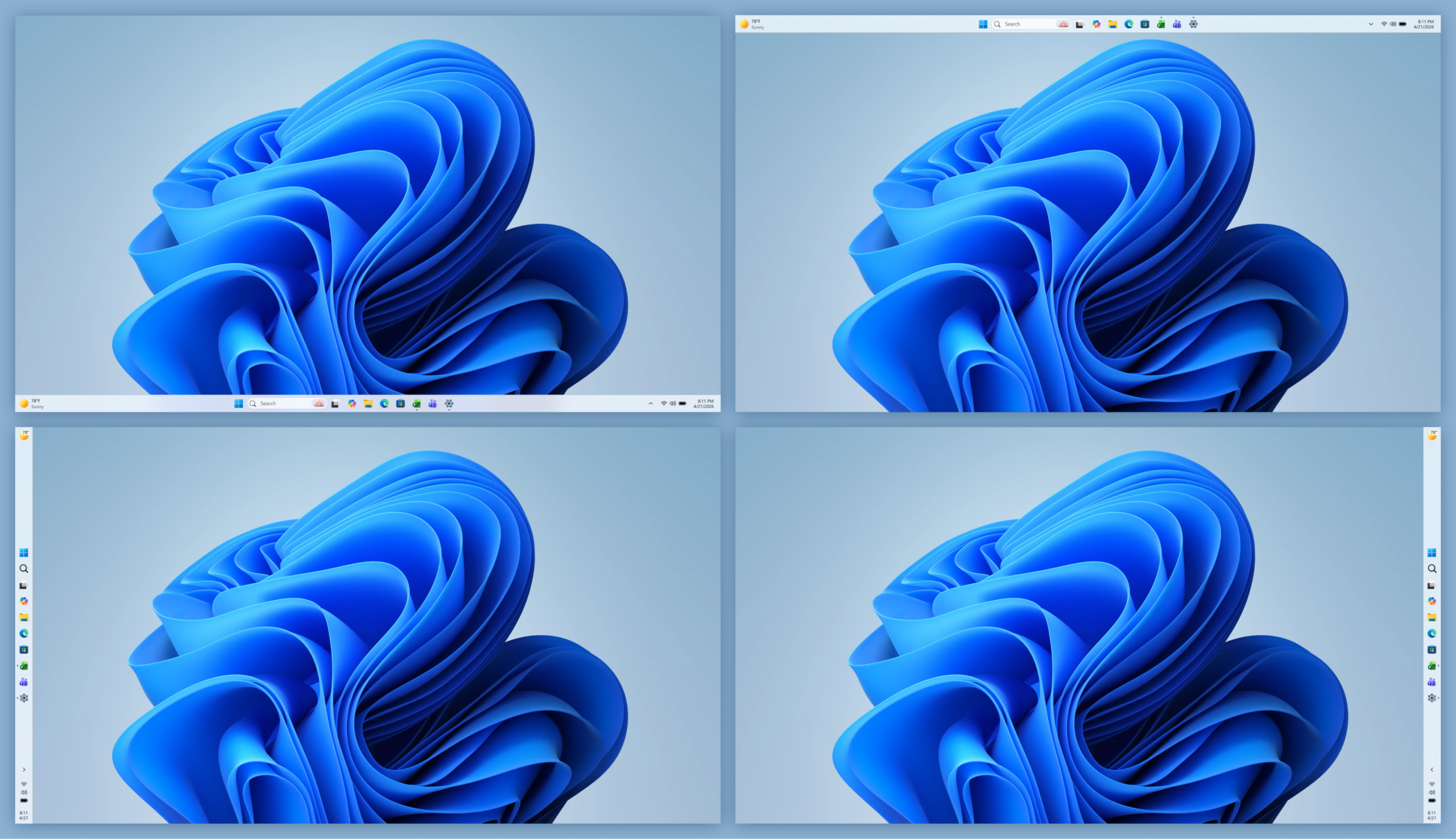
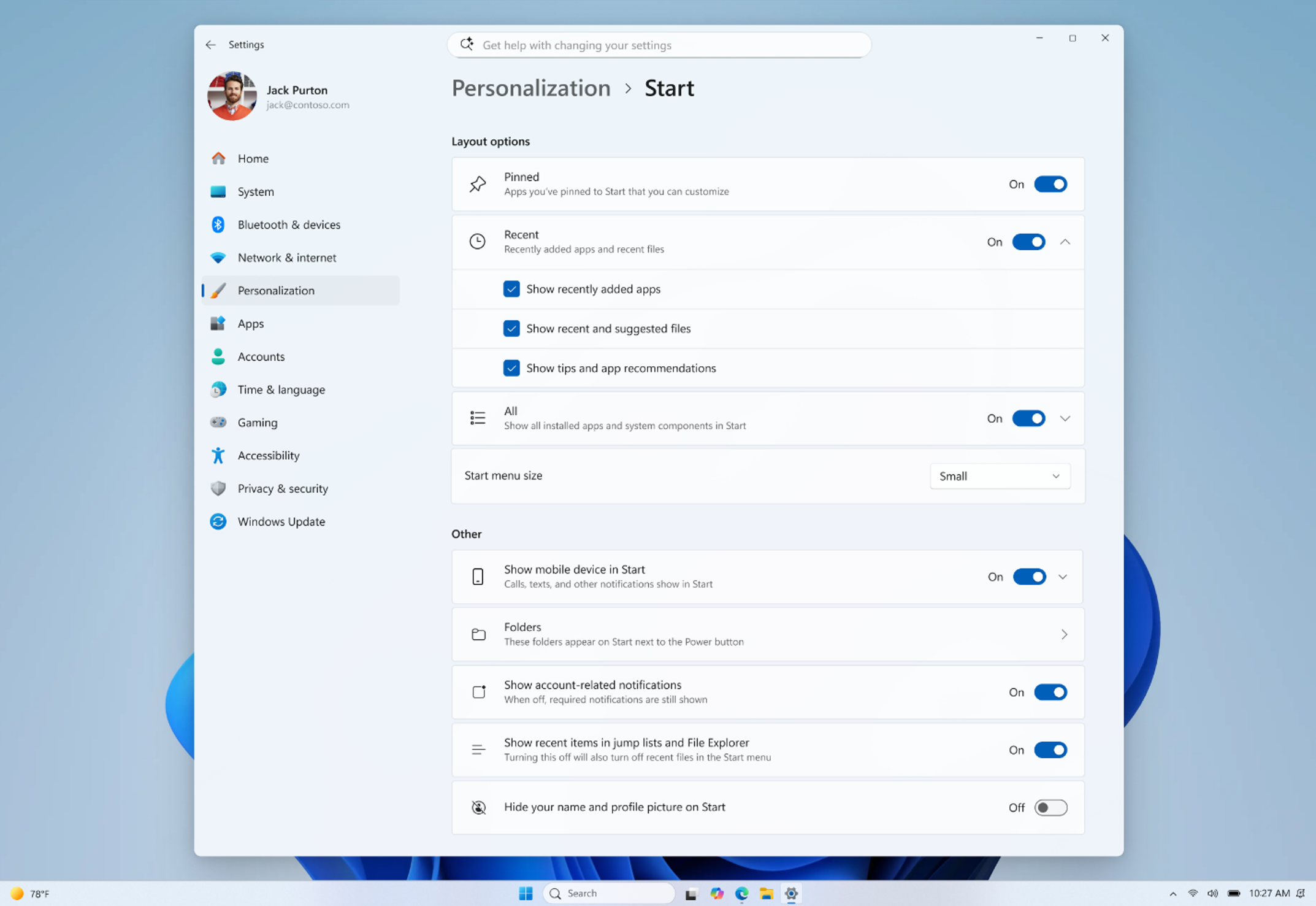
Screenshot showing alternate taskbar positions This month, we began rolling out more personalization for Taskbar and Start, two of the most used and most personal surfaces in Windows. With these updates, you can move the taskbar to any edge of the screen, choose icon alignment based on its position, and use app labels across positions to make open windows easier to tell apart. There’s also a new smaller taskbar option to help reclaim screen space. We’re also making Start easier to shape around how you work. New controls let you independently show or hide sections like Pinned, Recommended, and All apps, adjust Start menu size, and hide your name and profile picture for more privacy. The Recommended section is also being updated to Recent, with better file relevancy, so surfaced content better reflects what you’re actually working on. These updates have started to roll out in the Experimental Channel. Read more about the considerations and improvements we’re bringing to taskbar and Start in the recent blog post from Diego Baca.

Improving driver quality, reliability, and security with the Driver Quality Initiative (DQI), and Cloud Initiated Driver Recovery

In March, we committed to delivering a smoother, more dependable Windows experience with our ecosystem of partners. Drivers are a critical part of that work. Drivers sit at the heart of Windows, connecting the OS to silicon, components, and peripherals. With thousands of partners contributing to tens of thousands of active driver families, improving driver quality is essential to making Windows more reliable over time. At WinHEC 2026, we introduced the Driver Quality Initiative (DQI), a comprehensive effort designed to improve driver quality, reliability, and security across Windows. We also rolled out new changes with Cloud Initiated Driver Recovery to improve how drivers are validated, delivered, and maintained. By catching issues earlier, targeting updates more precisely, and enabling automatic recovery when needed, devices can stay reliable over time with fewer disruptions and a better path back to a known-good state. This is part of our ongoing work with partners to make Windows more dependable over time.

File Explorer improvements across reliability, readability and usability

[embed]https://youtu.be/gZUDEBbZSp4[/embed] Building on last month’s improvements, we made several updates to File Explorer across reliability, readability, and usability, including the Address Bar, file size formatting, keyboard navigation, and renaming. The Address Bar now supports paths containing double backslashes and quotation marks, such as C:\Users\user or "C:\Users\user", improving compatibility with more of the paths people paste or type into File Explorer. We also improved reliability of the Address Bar suggestion dropdown so it consistently closes after an item is selected. In Details view, file sizes now use appropriate units like KB, MB, and GB instead of KB-only, making them easier to read at a glance. We also improved keyboard navigation in File Explorer context menu flyouts. We also fixed multiple renaming issues, including one where text could be repeatedly selected while renaming items in folder views, and another where updated names with case-only changes were not immediately reflected in folder views across local and cloud storage. These are small details, but they show up in places people use all day. The goal is fewer broken paths, clearer information, and File Explorer interactions that behave more predictably. These updates also began rolling out earlier this month in the Experimental Channel.

Making Windows easier to use with voice input, touch, and more personalization

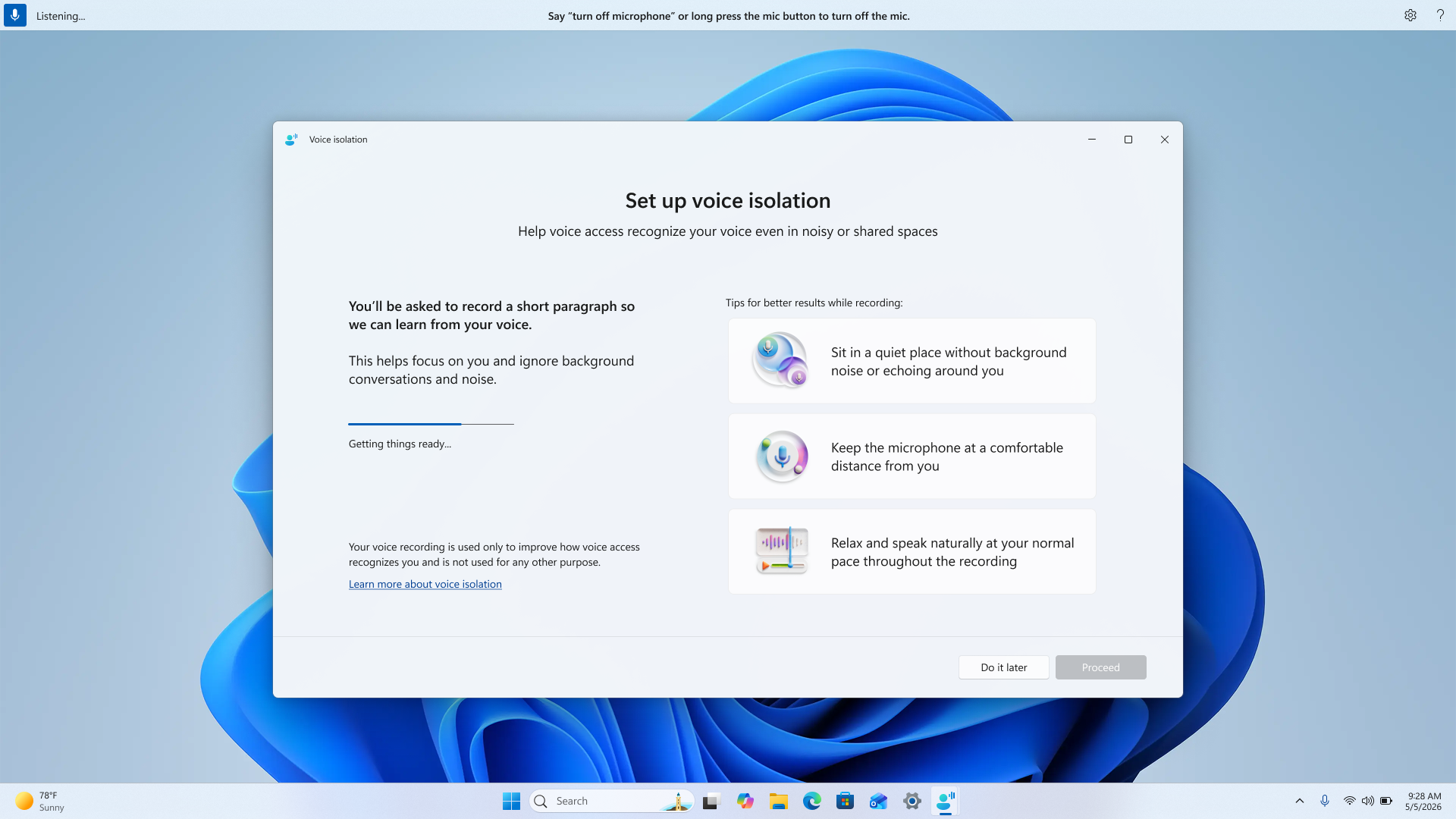
[caption id="attachment_178981" align="aligncenter" width="1024"]Screenshot showing setup of voice isolation. Screenshot showing setup of voice isolation.[/caption] Accessibility work in Windows often shows up across many different parts of the experience, because people use their PCs in different ways and in different environments. For voice, one of the most common pieces of feedback we hear is sensitivity to background noise. With Voice Isolation in Voice Access, Windows can better focus on the speaker and reduce the impact of surrounding noise, helping commands come through more consistently without needing to change where or how you’re working. We’re also adding more ways to personalize how Windows looks and feels. New options like screen tint make it easier to adjust color and opacity based on preference or lighting conditions, giving people more control during longer sessions. We’re continuing to improve Magnifier as well, making it easier to set precise zoom levels and adjust zoom directly within the experience without needing to go into Settings. Finally, we added new gesture-related controls for precision touchpads in Settings, including automatic scrolling, gesture speed controls, accelerated scrolling, and optional single-finger scrolling support. These are areas we hear about regularly in feedback. The changes are gradual, but they help reduce friction and make Windows easier to use in more moments. These updates began rolling out in the Experimental channel earlier this month.
Build next week!

Next week is Microsoft Build, where we’ll share more about what we’re doing to elevate the developer experience across the Windows platform. We’ve got a lot in store, so tune in for the keynote at 9:30am PT on Tuesday. Earlier today, we also shared the first episode of Inside Windows, a podcast where Pavan Davuluri, Executive Vice President, Windows & Devices, sits down with members of the team to share more insight into the work and people behind Windows. I was honored to be the first guest and talk through some of the work we’ve been focused on over the past several months. For those attending our meetup next week in San Francisco, I look forward to meeting you and hearing how we can keep improving the Windows Insider experience, particularly for developers. More to come next week! Marcus
  •  

Announcing new builds for 29 May 2026

29 Mei 2026 om 19:05
Hello Windows Insiders, This week we continue to expand the rollout of the new Windows Insider Program changes to devices in channels already announced. New builds this week Today we are releasing new Windows 11 Insider Preview Builds. As a reminder, all Insiders can find the release notes for your device based on the new channel system, even if you haven’t moved yet. This is to make finding build information as easy as possible during the transition. See your channel release notes here: For those on other specific build versions, here are today’s new builds and release notes:
  • Experimental (26H1): Build 28020.2207
  • Experimental (Future Platforms) – Including Canary 29500 series: Build 29599.1000
    • Please note: We have identified an issue internally causing crashes on AMD machines supporting System Guard, meaning these devices in WIP will not be offered this week's Experimental (Future Platforms) build. This should be fixed by the next flight.
As a reminder, you can always find your build number in the watermark on bottom right-hand corner of your desktop. Advanced core selection As mentioned in recent WIP blogs, we are in the process of releasing the Windows 11 version 26H1 build to those Insiders who have elected this version under Advanced options in the Windows Insider Program settings. We will begin releasing this version to those Insiders who have elected this change on June 5 2026. As outlined in our Windows IT Pro Blog, Windows 11 26H1 is a targeted release that supports some of the new device innovations coming in 2026, including devices with Qualcomm Snapdragon X2 Series processors. Devices running Windows 11, version 26H1 will not be able to update to the next annual feature update in the second half of 2026. This is because Windows 11, version 26H1 is based on a different Windows core than Windows 11, versions 24H2 and 25H2, and the upcoming feature update. These devices will have a path to update in a future Windows release. Insiders who have elected the 26H1 option in Advanced options but no longer wish to take this version, should reselect version 25H2 before version 26H1 is made available to these devices beginning June 5. Insiders who do take version 26H1 and want to move back to 25H2 will be able to do so through a complete reinstall of Windows.

Notable new features:

[Start menu]

Release channel: Experimental This update brings a number of improvements for the Start menu as first outlined in the Making Taskbar and Start more personal Insider blog. This includes:
  • Renamed "Recommended" section to "Recent" in Start and Settings page
  • Section-level toggles to independently show or hide Pinned, Recommended, and All.
  • Choose between a small and large Start menu, in addition to "Automatic (default)" setting option that's already available today
  • The option to hide your name and profile picture in Start
  • Redesigned Start menu settings page
[caption id="attachment_178960" align="aligncenter" width="1024"]Screenshot of the updated Start settings showing the new section-level toggles. Screenshot of the updated Start settings showing the new section-level toggles.[/caption]

[Windows Search]

Release channel: Experimental, Beta We're improving Windows Search results:
  • Search by Substring: Files with compound names or content (e.g., MeetingNotesApril, ProjectStatusReport) are now easily discoverable by typing “april” or “status”.
Thanks, Stephen and the Windows Insider Program team
  •  

Announcing new builds for 22 May 2026

22 Mei 2026 om 19:10
Hello Windows Insiders, Today, we continue to expand the rollout of the new Windows Insider Program changes to devices in channels already announced. As a reminder, we have not yet begun moving devices in the Canary 29500 Series Channel to the new WIP experience.

New builds this week

Today we are releasing new Windows 11 Insider Preview Builds. As a reminder, all Insiders can find the release notes for your device based on the new channel system, even if you haven’t moved yet. This is to make finding build information as easy as possible during the transition. See your channel release notes here: For those on other specific build versions, here are today’s new builds and release notes: As a reminder, you can always find your build number in the watermark on bottom right-hand corner of your desktop.

Notable new features:

[Accessibility – screen tint]

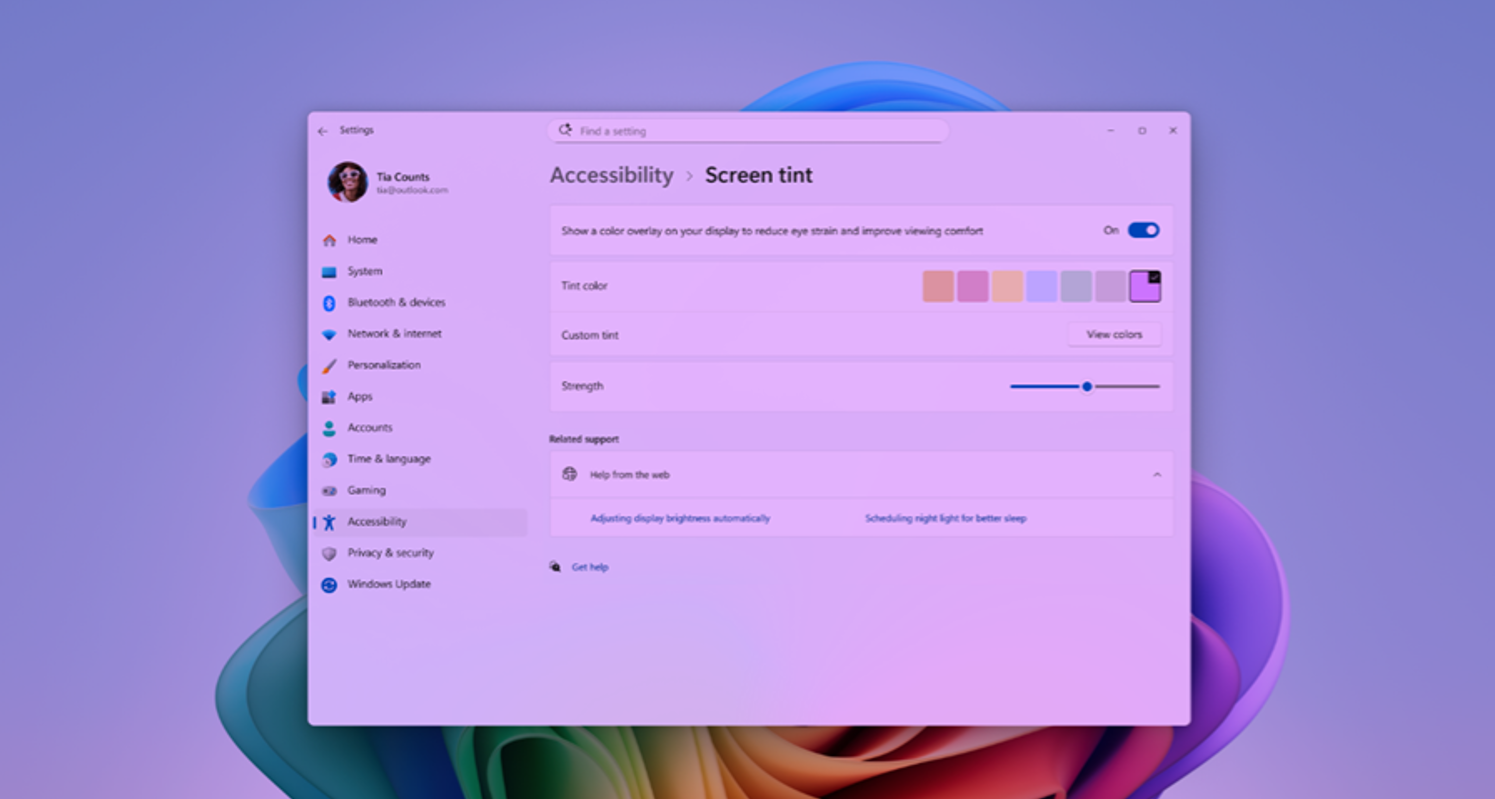
Release channel: Experimental New Accessibility setting – screen tint We're introducing screen tint, a new accessibility setting that applies a color overlay across your entire display, softening its intensity so it's easier on your eyes throughout the day. If bright, saturated screens leave you with tired or sensitive eyes by the end of a long session, screen tint can help. [caption id="attachment_178980" align="aligncenter" width="1024"]UI showing screen tint in Accessibility, with color presets and a strength slider. UI showing screen tint in Accessibility, with color presets and a strength slider.[/caption] See release notes for more details on how to get started and provide feedback

[Narrator]

Release channel: Experimental Braille displays now connect instantly with Narrator We are making refreshable braille displays easier to use in Windows. Narrator now supports displays that use the HID standard — an open industry standard for braille displays. If your display supports HID, simply connect it via USB and start reading — true plug-and-play with no additional setup required. For Bluetooth, pair your HID braille display in Settings > Bluetooth & devices just like any other accessory, and you can work wirelessly without being tethered to your PC.

[Voice Isolation in Voice Access]

Release channel: Experimental We're introducing Voice Isolation, a new option in Voice Access that helps it focus on your voice, even when others are speaking nearby. Whether you're in a shared office, an open floor plan, or at home with family around, Voice Isolation filters out other voices and background noise so Voice Access can better understand you. All processing happens privately on your device. [caption id="attachment_178981" align="aligncenter" width="1024"]Screenshot showing setup of voice isolation. Screenshot showing setup of voice isolation.[/caption] See release notes for more details on how to get started. Thanks, Stephen and the Windows Insider Program team
  •  

New in Edge for Business: AI for work, safe from day one

20 Mei 2026 om 18:00
TL;DR: Edge for Business adds agentic browsing in limited preview, a Copilot-inspired new tab page, and mobile availability for multi-tab reasoning and YouTube summarization. These experiences are built on a secure enterprise browser foundation with an IT-managed system of controls—policy-based enablement, tenant protections, and data loss prevention—so AI is safe for work from day one. AI is moving from answering questions to completing work—and the browser is where that shift becomes real. Business users want the latest AI capabilities to help with everyday work without adding another tool, and IT wants to deliver them—but the bar is higher: productivity must come with security, compliance, and IT control. Today, we're introducing agentic browsing in Edge for Business in limited preview and expanding AI experiences that help users get started faster, connect information across tabs, and make decisions more quickly—all on a secure enterprise browser foundation with IT-managed controls from day one. Here's a look at what's new:

Introducing agentic browsing with Copilot in Edge for Business

Agentic browsing lets Copilot complete multi-step tasks on approved sites, with IT controls and user oversight. Business users across your organization often spend time on repetitive, multi-step work in the browser—filling out forms, navigating sites to complete tasks, and pulling information across tabs. It's exactly the kind of work people want to shortcut. Available today in limited preview, agentic browsing with Copilot in Edge for Business brings multi-step task completion into a managed enterprise experience. Copilot can navigate pages, fill in information, and complete workflows—helping users save time without turning to unsanctioned AI. https://www.youtube.com/watch?v=mQv0EBvj2nI For IT, enabling Copilot to browse doesn't mean giving up control: you decide when to turn it on and exactly where it can run. You enable it through its own policy and is scoped to sites you designate, so you can roll it out deliberately. Purview continues to enforce data protection policies, such as copy/paste of sensitive data, while Copilot browses. For users, clear visual indicators show when Copilot is taking action, and they can pause or stop it at any time. For sensitive actions such as entering passwords or credit card numbers, Copilot pauses for user input. IT admins can request to join the limited preview. Available worldwide with a Microsoft 365 Copilot license, excluding the European Economic Area.

Quickly move from tabs to decisions

Beyond agentic browsing, we're expanding AI capabilities that help users get oriented faster, pull together information across tabs, and get to an answer—right in the flow of work.

Copilot-inspired new tab page

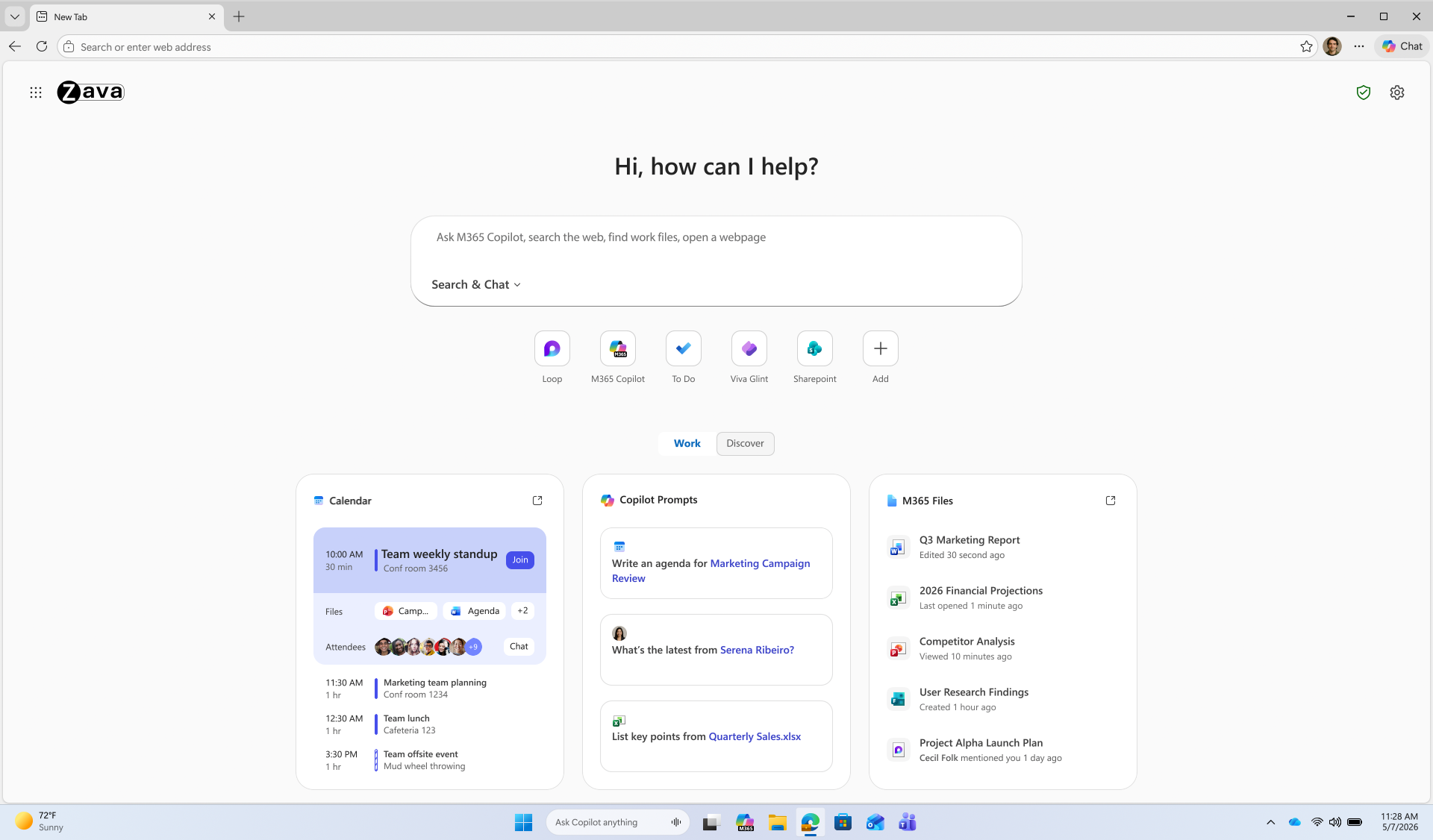
The Copilot-inspired new tab page brings calendar, files, and prompts into one work dashboard—generally available on desktop and mobile. Every day starts the same way: users open the browser, review their calendar, and track down files. A reimagined new tab page brings calendar, files, and Copilot prompts into one view, reducing the need to switch between tools. An intelligent box enables chat and search from one entry point, while work cards surface upcoming meetings, Microsoft 365 files, and suggested Copilot prompts for quick action. The experience becomes even more personalized with a Microsoft 365 Copilot license. Generally available today on desktop and mobile. Learn how to configure. Microsoft Edge new tab page.

Multi-tab reasoning and YouTube summarization

Multi-tab reasoning and YouTube summarization are now available on mobile, in addition to desktop, turning open tabs and videos into quick takeaways. Users live in tabs—jumping between docs, web pages, and videos just to piece together an answer. Multi-tab reasoning and YouTube summarization help turn that scattered information into quick answers, without adding yet another tool. Multi-tab reasoning analyzes open tabs to generate comparisons, summaries, and insights. For example, users can compare product specs across tabs, summarize vendor documentation, or pull key differences from multiple pages into one answer. And because it's Edge for Business, Purview policies exclude sensitive content from reasoning. https://www.youtube.com/watch?v=X87JA-sPz2Y When users only need a few key answers from a 15-minute video, YouTube summarization pulls out the takeaways and even answers questions—whether they're reviewing a product demo, an industry presentation, or a webinar. Learn how to configure multi-tab reasoning and YouTube summarization.

Deliver AI securely—without losing control

Edge for Business offers an IT-managed system of controls for AI—policies, tenant protections, and data protection enforcement—available from day one. AI in the browser is moving fast, and IT teams are under pressure to deliver new capabilities without becoming the team that slows everyone down. Most organizations don't want an "all or nothing" switch—they want to adopt AI in stages without changing their security posture or creating new exceptions. With Edge for Business, our mission is to offer AI experiences with enterprise-grade security and controls built-in from day one — through a system of controls that provides differentiated compliance and security for AI. That's what you should expect from an industry-leading secure enterprise browser. Edge for Business is the only major enterprise browser that protects company data in AI by enforcing data protection in the browser and keeping sensitive interactions within the tenant. Protections you rely on, such as blocking copy/paste, continue to be enforced on AI-assisted workflows. And because Microsoft 365 Copilot includes enterprise data protection, prompts, responses, and files stay within your tenant and are not used to train models. These protections apply natively when users sign into Edge for Business with an eligible Entra ID, no extensions required. A single policy enables AI features like summarization and multi-tab reasoning to help you get started quickly. For advanced AI, Copilot Mode is evolving into granular controls—so you can enable each feature individually instead of through a single toggle, making it easier to pilot and deploy advanced AI with more predictable outcomes. Existing configurations are honored for organizations that previously enabled Copilot Mode. The result: you can roll out AI on your terms—enabled by policy and fully under IT control. https://www.youtube.com/watch?v=9KFId0FzSfM

Protect against shadow AI in the browser

Purview data protections in Edge for Business can audit or block sensitive prompts and uploads on common consumer AI apps and redirect users to Copilot for protected work AI. What happens when users don't follow rules and use unsanctioned AI? Organizations need the ability to audit prompts and block sensitive uploads, especially on consumer AI tools. With Edge for Business, consumer AI doesn't have to be a gap. Shadow AI protections powered by Purview bring inline data loss prevention into the browser for the most common AI apps. Purview analyzes prompts and file uploads: when sensitive data is detected, the action is audited or blocked. Users receive a clear, policy notification and are redirected to Microsoft 365 Copilot, where enterprise data protection and DLP policies apply. These protections work on managed and unmanaged devices when users are signed into Edge for Business with their eligible Entra ID. Requires Microsoft 365 E5; pay as you go pricing applies. Learn more. https://www.youtube.com/watch?v=JIDs57MAXOo

Get started

IT admins can request to join the limited preview for agentic browsing in Edge for Business to experience how it works in a managed environment. Edge for Business plays a key role in delivering AI securely—where users already work and where controls are already in place. Request to join the limited preview for agentic browsing in Edge for Business to evaluate the experience and help shape what comes next.

Note: learn more about Microsoft 365 Copilot availability here.

  •  

Introducing new Surface devices built for business and AI acceleration

19 Mei 2026 om 15:00
Every IT leader and partner we work with is navigating the same challenges: AI is changing the demands of how teams work, security threats are growing more sophisticated and agents are changing investment decisions for the future. All under greater scrutiny than ever before. The decisions organizations make now about their PC fleet will determine whether they lead through this transformation or spend years trying to catch up. Microsoft builds Surface to meet these demands. From silicon to software, Surface hardware brings security, hybrid AI capability and intentional design into one integrated platform, so customers do not have to compromise to meet their business outcomes. For customers and partners charting a path forward, Surface is the foundation that makes the rest of the strategy possible:

"At Flagstar, we're focused on equipping our teams with technology that's secure, flexible and ready for the next wave of AI. Surface brings together the hardware, security and Microsoft ecosystem in a way that just works, giving our teams the confidence to run AI-powered workflows on device while staying protected and productive wherever they are." — Jason Pope, Chief Technology Officer, Flagstar Bank

We have always believed that the hardware people use enables businesses and teams to achieve more. Surface was created to set the standard for what a premium Windows PC can be, and that standard has never been higher. Today, we are proud to announce the next generation of the Surface for Business portfolio, the new Surface Pro for Business and Surface Laptop for Business powered by Intel Core Ultra Series 3 processors are available today in select markets, delivering world-class performance and AI on the edge to accelerate productivity. Powered by Intel's next‑generation Core Ultra Series 3 architecture, the new Surface Laptop for Business and Surface Pro for Business deliver a meaningful leap in graphics performance, delivering up to 35% more graphics performance than MacBook Air with M5[1], and more than 90% faster performance than Laptop 5[2] on select configurations with Intel Core Ultra X7. From analyzing complex information to presenting to customers or creating content on the go, the Intel Core Ultra Series 3 GPU enables work to move in real time, delivering the sustained, fluid performance leaders expect from a premium business PC, without compromising mobility, battery life or security. Whether your teams are in the boardroom, at a customer site or working from anywhere, these AI PCs are built to perform at the speed of business. Later this year, we will extend the Surface for Business portfolio with models featuring the Snapdragon X2 processors, delivering up to 80% faster local AI inferencing than before[3] and uncompromising battery life[4].

Right facing laptop computer.The new Surface Laptop for Business 13-inch is the most portable Surface Laptop, available starting today in select markets in 16GB and 24GB configurations starting at $1,499 (MSRP), with an 8GB configuration coming later this year starting at $1,299.99 (MSRP). With on-device AI processing, Wi-Fi 7[5] and a removable Gen 4 SSD designed for enterprise serviceability, it brings the full Surface experience to the entry-premium tier without asking IT or employees to trade off performance and productivity for portability.

The new Surface Laptop for Business, available in 13.8-inch and 15-inch, is designed for knowledge workers who move fast and expect their technology to keep pace, available starting today in select markets, starting at $1,949.99 (MSRP). Featuring an advanced haptic touchpad, stunning high‑resolution touchscreen display and an optional integrated privacy screen with anti‑glare on select configurations, it delivers a premium productivity experience wherever work happens. With up to 23 hours of battery life[4], Surface Laptop provides the performance and mobility professionals need to stay productive across offices, client sites and everywhere in between. Left facing view of a Surface Pro for Business 13-inch with keyboard detached. The new Surface Pro for Business 13-inch is thin, powerful and engineered to think as flexibly as your people do, available starting today in select markets, starting at $1,949.99 (MSRP). The 2-in-1 form-factor combines touch, voice, pen or keyboard input alongside on-device AI processing and laptop-level performance to meet the needs of users working on the go or at their desks with 5G options to keep them connected.[6] Our team, relentless in building Surface PCs that meet the needs of businesses today and in the future, is driven by these three product-making principles.
  • Security and trust are fundamental and should be built into every aspect of a device.
  • Innovative devices are the platform that enables organizations to move faster with hybrid AI to accelerate workflows, productivity and end-to-end management.
  • Intentional, functional and human centered design is imperative for hardware that supports how businesses work, with PCs that are built with a focus on reliability, sustainability and repairability features designed to keep employees productive and in their flow.
At Surface, security is a design principle baked in from the very first line of firmware code. Every new Surface for Business device ships as a Secured-core PC: enabling chip-to-cloud protection that is current, enforced[7] and aligned with your Microsoft security stack. Firmware updates are delivered through Windows Update without third-party complexity.

Left facing view of a laptop computer with privacy screen enabled.For the first time ever on a Surface device, we are introducing an optional integrated privacy screen with anti-glare. Built directly into select configurations of the 13.8-inch display of our Surface Laptop for Business, this software driven visual privacy filter helps protect sensitive information from unintended viewers and can be centrally managed by IT or activated instantly by employees with a single keystroke. Once activated, the privacy screen provides immediate protection from prying eyes without the need of a third-party physical screen protector. Designed from the ground up as part of our security‑by‑design approach, this innovation is made possible only by the tight integration of Surface hardware and software.

Surface is the first PC built on memory-safe firmware through our open-source Project Mu and Open Device Partnership (ODP) Unified Extensible Firmware Interface (UEFI), Rust-based drivers and secure embedded controller that is rooted in hardware-based protection, a direct response to one of the industry’s most persistent classes of vulnerabilities. When we say security is built in, we mean it at every layer of the stack. Surface for Business devices are built for the future of AI. Whether you are running models in the cloud or on device, Surface devices are built to take advantage of both. That means features like real-time meeting transcription, intelligent writing assistance, select on-device image generation and live translation that work whether your employee is in a server room, on a plane or in a hospital ward.[8] For customers putting AI to work in real-world environments, that flexibility is already proving essential:

Surface allows us to run AI where learning happens, on the device itself. The future of AI is not everything going to the cloud; it's AI at the edge." — Eric Sedore, AVP and Chief Technology Officer, Syracuse University

For organizations building and deploying enterprise AI applications, Surface is also the reference platform for Windows AI APIs and the Foundry platform. Surface is purpose-built for developers who need a trusted, consistent hardware baseline, helping to enable on-device AI processing that can help offload everyday workloads from the cloud and optimize overall AI infrastructure costs at scale. Surface for Business does not just transform the experience for employees, it transforms the experience for IT. From UEFI to browser, it can be managed through Microsoft Intune. Every device in this portfolio is built to support the end-to-end Microsoft stack: Microsoft Intune, Windows Autopilot and the Surface Management Portal give IT administrators a single, unified plane to provision devices at scale, enforce policies and manage the full device lifecycle including zero-touch deployment that gets people productive from day one.[7] When the hardware, the operating system, the management platform and the productivity suite are all built and optimized by Microsoft, the result is not just operational efficiency, it’s a level of assurance and confidence that benefits the end-customers and businesses. A person engaging the kickstand on a Surface device.Surface designs PCs for how businesses work. The materials we choose in every Surface for Business device are not for appearance alone; we build PCs with durability in mind. Each is validated through years-worth of reliability testing[9] designed to simulate the real conditions of everyday professional use: the drops, the pressure, the temperature changes, the open-and-close cycles. The result is a device that stays strong, stays functional and stays looking great. The Surface 3:2 display ratio is not an aesthetic choice, it is a productivity one. The vertical screen real estate from the display ratio means you can have two documents side by side without compromise, with multiple windows that give each app room to ensure productivity. Combined with anti-reflective display technology on select configurations. Surface displays are designed to reduce eye strain across long working days[10], because the best display is one that fades into the background, letting you focus on your work. A person's hand reaching out to a laptop keyboard.With advanced haptics, Surface Laptop for Business adds subtle, intelligent tactile feedback to the touchpad experience. From window snapping and resizing to dragging, dropping and navigating content, haptics reinforce intent across the operating system and through select third-party apps delivering a more precise, responsive and confidence inspiring experience. Surface for Business devices are built with sustainability in mind. Surface Laptop, 13.8-inch and 15-inch, and Surface Pro 13-inch are made with a durable 100% recycled aluminum enclosure, reducing reliance on virgin materials[11]. These devices are built for high performance and energy efficiency. Each device is certified by ENERGY STAR, all outperforming the efficiency baseline by at least 45%[12]. Automatic Keyboard Backlight, a new setting enabled on Surface Laptop 13-inch, 13.8 and 15-inch, and Surface Pro 13-inch Keyboards, can help reduce power usage[13]. Surface for Business PCs are also designed for repairability, meaning less glue, and more access. Nearly every major device component across the Surface for Business portfolio is replaceable, backed by a robust parts supply chain so IT teams can source what they need quickly and keep devices in service longer. Repairs are designed for simplicity, clear visual wayfinding guides technicians through each step, and the process is engineered to be completed with commonly available tools. When repair is used instead of replacement a device can stay in the field longer, which helps maximize your investment and helps reduce waste. [14] The AI PC cycle has already arrived. Organizations that move now will build the productivity advantage that compounds over time. Those that wait will find themselves closing a gap that only grows. Our team is continuing to innovate with devices designed for businesses to invest in an evolving future of computing. For a deeper dive on the newest Surface for Business PCs, read our Surface IT Pro blog. Surface for Business gives you the clarity to act: a secure, AI-ready, beautifully designed portfolio, available today in select markets with Intel Core Ultra Series 3 and expanding later this year with Snapdragon X2. It is the full Microsoft stack, realized in hardware, ready for what comes next. New Surface Pro for Business and Surface Laptop for Business are available today at Surface for Business and through Microsoft authorized commercial resellers. [1] Tested by Microsoft April 2026 using CineBench 2024 Multi-Core benchmark comparing Surface Laptop for Business, 13.8 and 15-inch with Intel Core Ultra X7 to MacBook Air, 13.5-inch, M5 Chip, 10 Core CPU. [2] Tested by Microsoft April 2026 using CineBench 2024 Multi-Core benchmark. Up to 95% faster comparing Surface Laptop, 15-inch with Intel Core Ultra X7 to Surface Laptop 5 15-inch with Intel Core i7. Up to 93% faster comparing Surface Laptop for Business 13.8-inch with Intel Core Ultra X7 processors to Surface Laptop 5 13.5-inch with Intel Core i7. [3] Tested by Microsoft April 2026 using Procyon AI benchmark comparing Surface Laptop, 13.8-inch and 15-inch (8th Edition) with Snapdragon to Surface Laptop, 13.8-inch and 15-inch (7th Edition) with Snapdragon. Performance varies by configuration. [4] Based on local video playback test. Battery life varies significantly based on usage, network and feature configuration, signal strength, settings and other factors. See aka.ms/SurfaceBatteryPerformance for details. [5] 6GHz band not available in all regions. [6] 5G not available in all areas. Compatibility and performance depend on carrier network, plan and other factors. See carrier for details and pricing. [7] Software license required for some features. Sold separately [8] Feature availability and performance may vary by device, configuration and region. Some AI experiences require internet connection, compatible hardware or Microsoft 365 subscription. [9] Reliability testing conducted under controlled laboratory conditions. Testing does not promise or guarantee future performance under the same conditions in the real world. Customer induced damage or use beyond normal use conditions is not covered under Microsoft’s Limited Hardware Warranty. [10] The Surface Laptop for Business with Intel displays has been designed to minimize unwanted reflections and has been certified by TÜV SÜD to meet the requirements of ISO 9241-307. [11] Surface Pro for Business, 13-inch enclosure includes bucket, kickstand. 86% recycled content in the enclosure, consisting of 100% recycled aluminum alloy in bucket, and 100% recycled rare earth metals in the magnets. Surface Laptop for Business, 13.8-inch and 15-inch, enclosure includes A Cover and C Bucket. 64% recycled content in the enclosure, consisting of 100% recycled aluminum alloy in A Cover and C Bucket, and 100% recycled rare earth metals in the magnets. Based on validation performed by Underwriter Laboratories, Inc. using Environmental Claim Validation Procedure (ECVP) for Recycled Content, UL ECVP 2809-2, Second Edition, dated June 2024. [12] Comparison based on product energy consumption vs. ENERGY STAR certification limits for personal computers. Actual performance varies by configuration and usage. [13] Compared to typical use without the feature enabled. Actual power savings vary based on usage, settings, ambient lighting and other factors. Not supported with wireless detach on Surface Pro 13-inch Flex Keyboard. [14] Replacement components available through Surface Commercial authorized device resellers. Components can be replaced on-site by a skilled technician following Microsoft’s Service Guide. Microsoft tools (sold separately) may also be required. Availability of replacement components and service options may vary by product, market and over time. See Surface service options - Surface | Microsoft Learn. Opening and/or repairing your device can present electric shock, fire and personal injury risks and other hazards. Use caution if undertaking do-it-yourself repairs. Unless required by law, device damage caused during repair will not be covered under Microsoft’s Hardware Warranty or protection plans.
  •  

XBOX Player Voice: A simpler way to share feedback

18 Mei 2026 om 21:20
XBOX Player Voice is a new place for the gaming community to share and track their feedback and get a clearer sense of how that input is shaping XBOX’s future. Teams will review and organize the feedback and, in some cases, ideas will move forward. While not every piece of feedback will turn into a feature or result in a change, better visibility helps close the gap between what the community tells XBOX and what will happen next on it. Get more details at XBOX Wire.
  •  

Improving Windows quality: Making Taskbar and Start more personal

15 Mei 2026 om 21:50
In our commitment to Windows quality, we outlined our plans to deliver improvements in performance, reliability, and craft. We are also committed to being transparent about the work behind those efforts, including what we are shipping, why we prioritized those features, and where we still have more work to do. Start and taskbar are some of the most visible and frequently used experiences in Windows, so we are focused on improving their quality and giving you more flexibility to personalize them to meet your needs. Let’s walk through where we're making meaningful progress against the feedback we’ve heard from you, rolling out to Windows Insiders in the Experimental channel over the coming weeks, including several rolling out today.

Bringing more personalization to the taskbar

The taskbar is where your PC experience comes to life. Just like a well-organized workspace, having it tailored to your needs helps you stay productive, so we’re introducing more ways to customize it.

Taskbar positions

Location, location, location. The ability to move the taskbar to the top or sides of the screen has been one of the most requested features, and we are bringing it to Windows 11. Starting today, Windows Insiders in the Experimental channel will be able to:
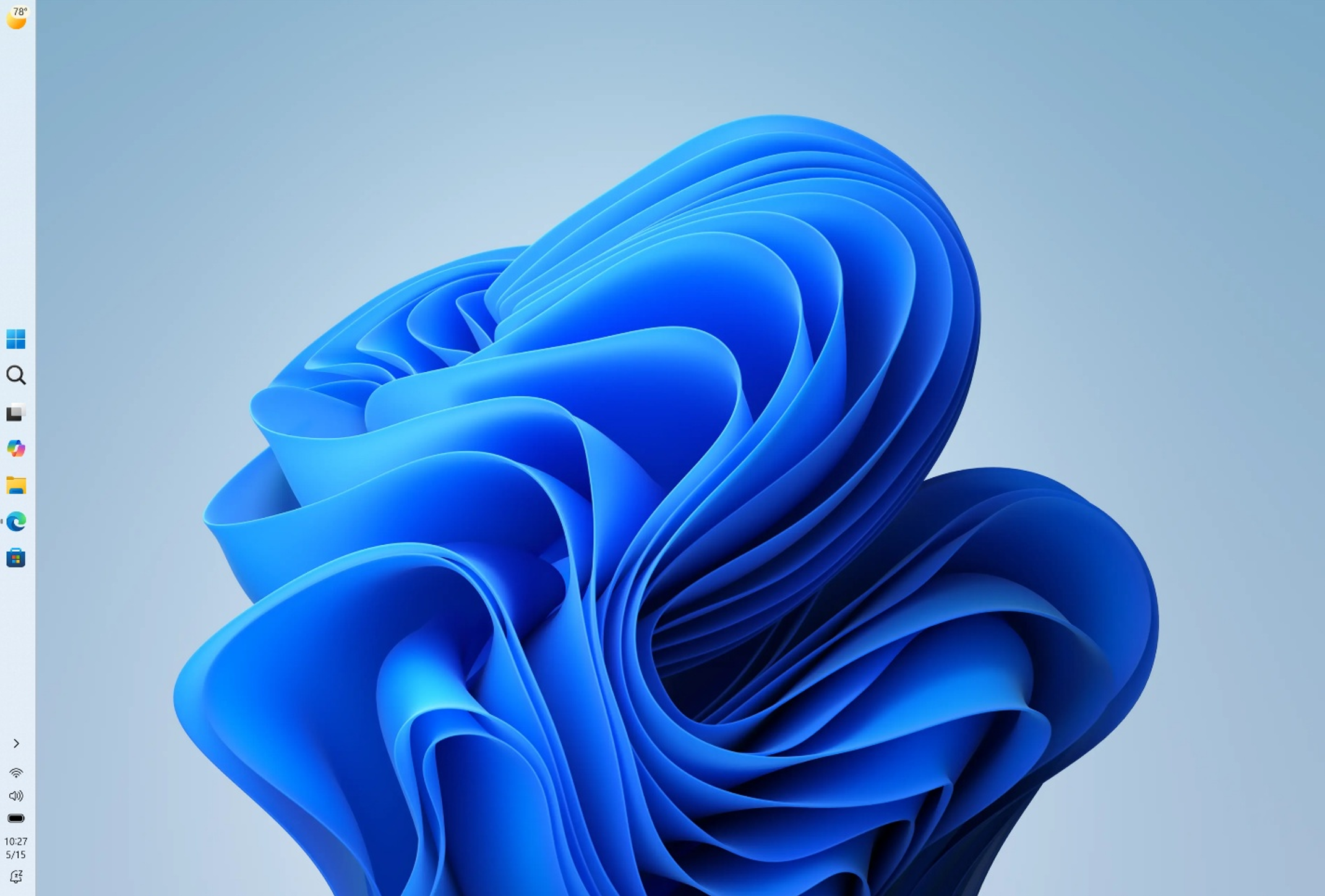
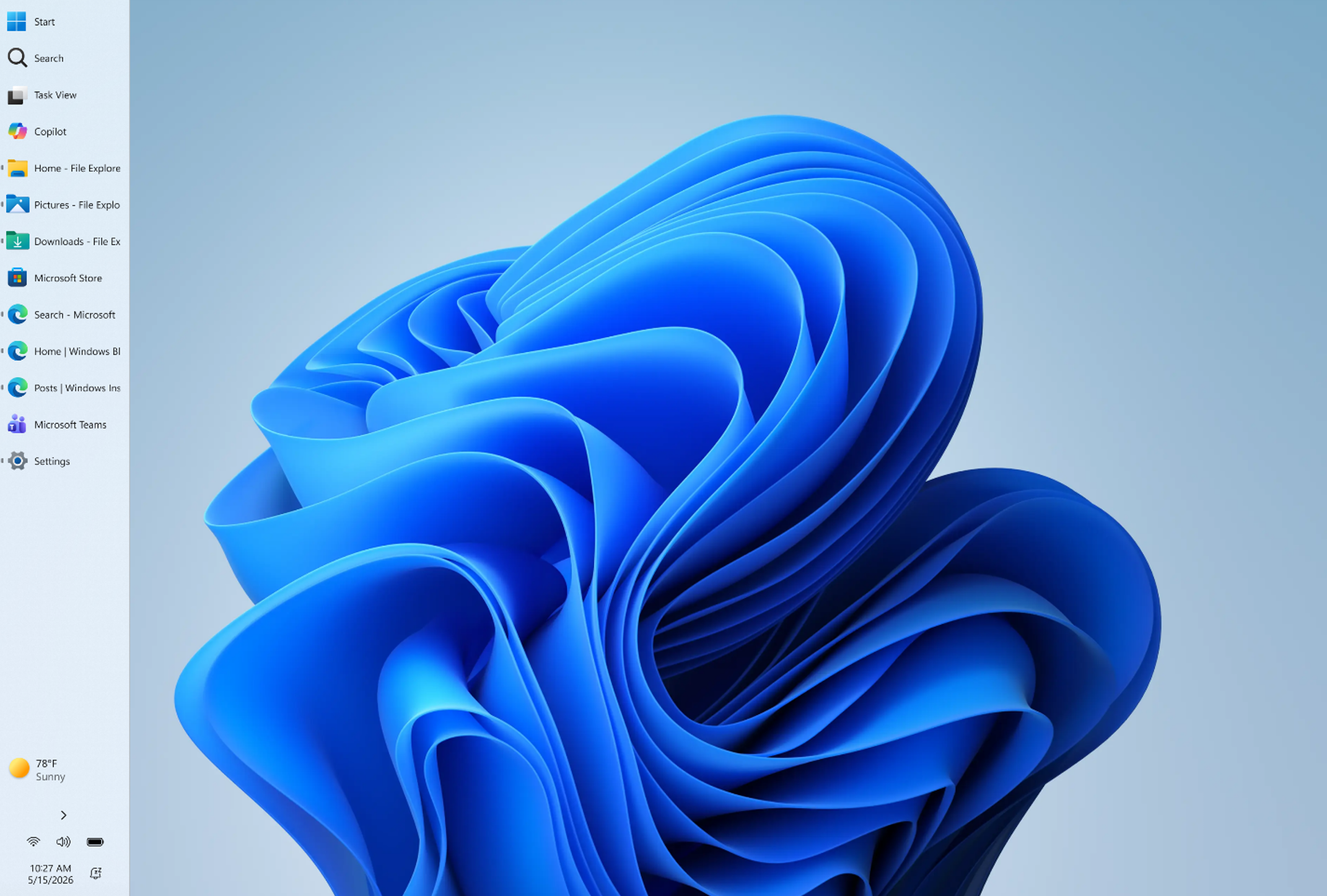
  • Position the taskbar on any edge of the screen: Top, bottom, left, or right (see figure 1).
  • Choose icon alignment for every taskbar position: Top-aligned or centered when the taskbar is on the left or right, and left-aligned or centered when the taskbar is on the top or bottom.
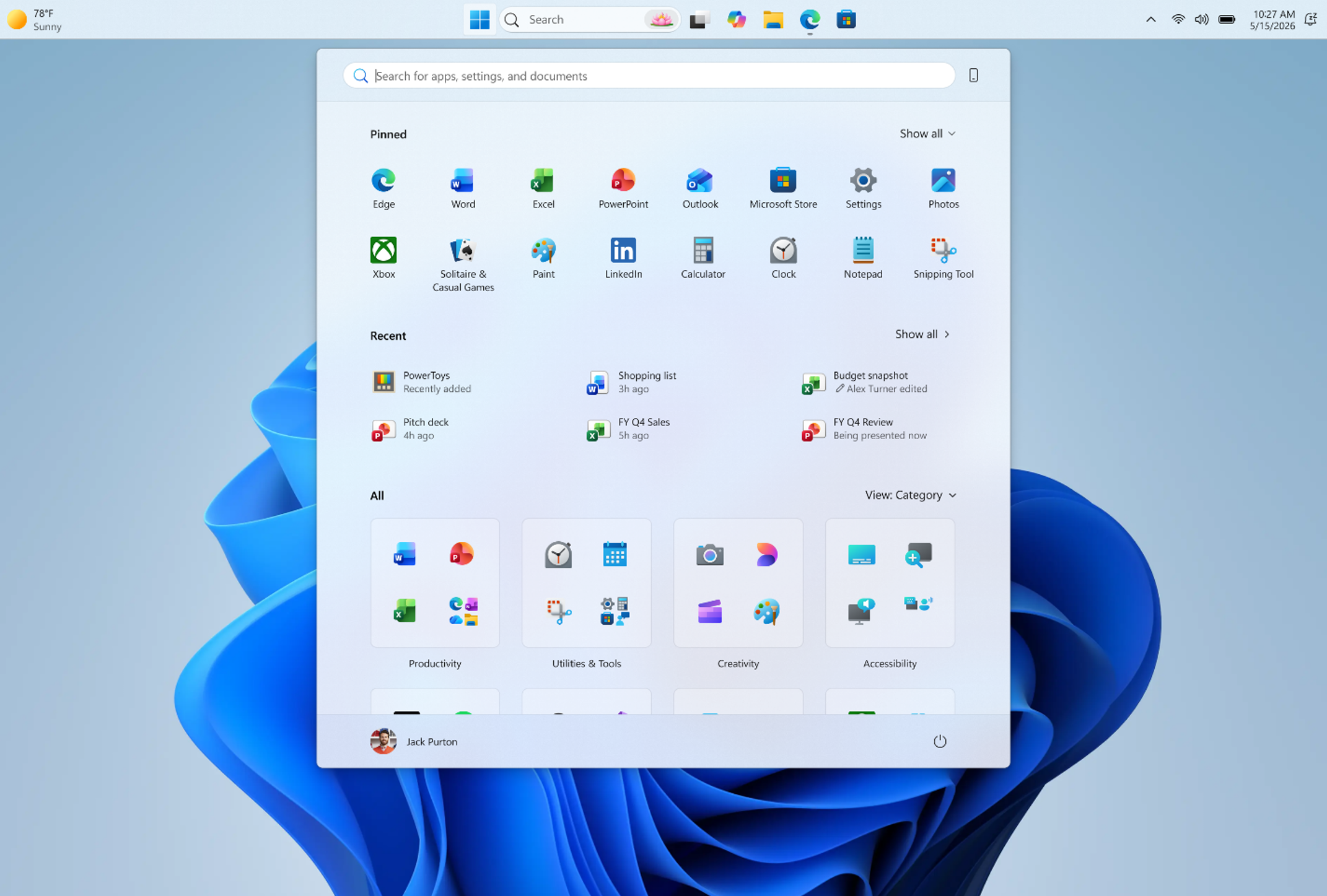
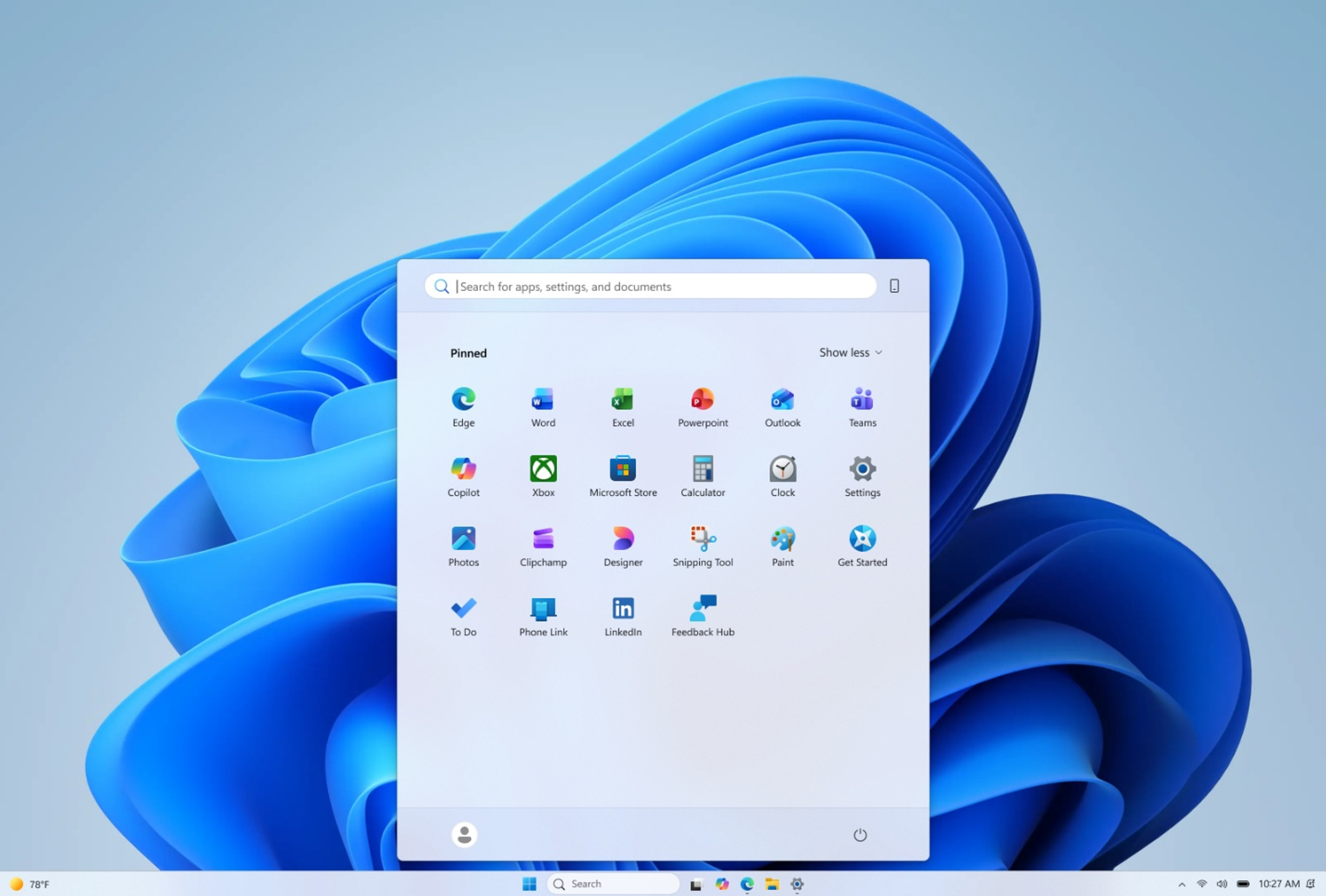
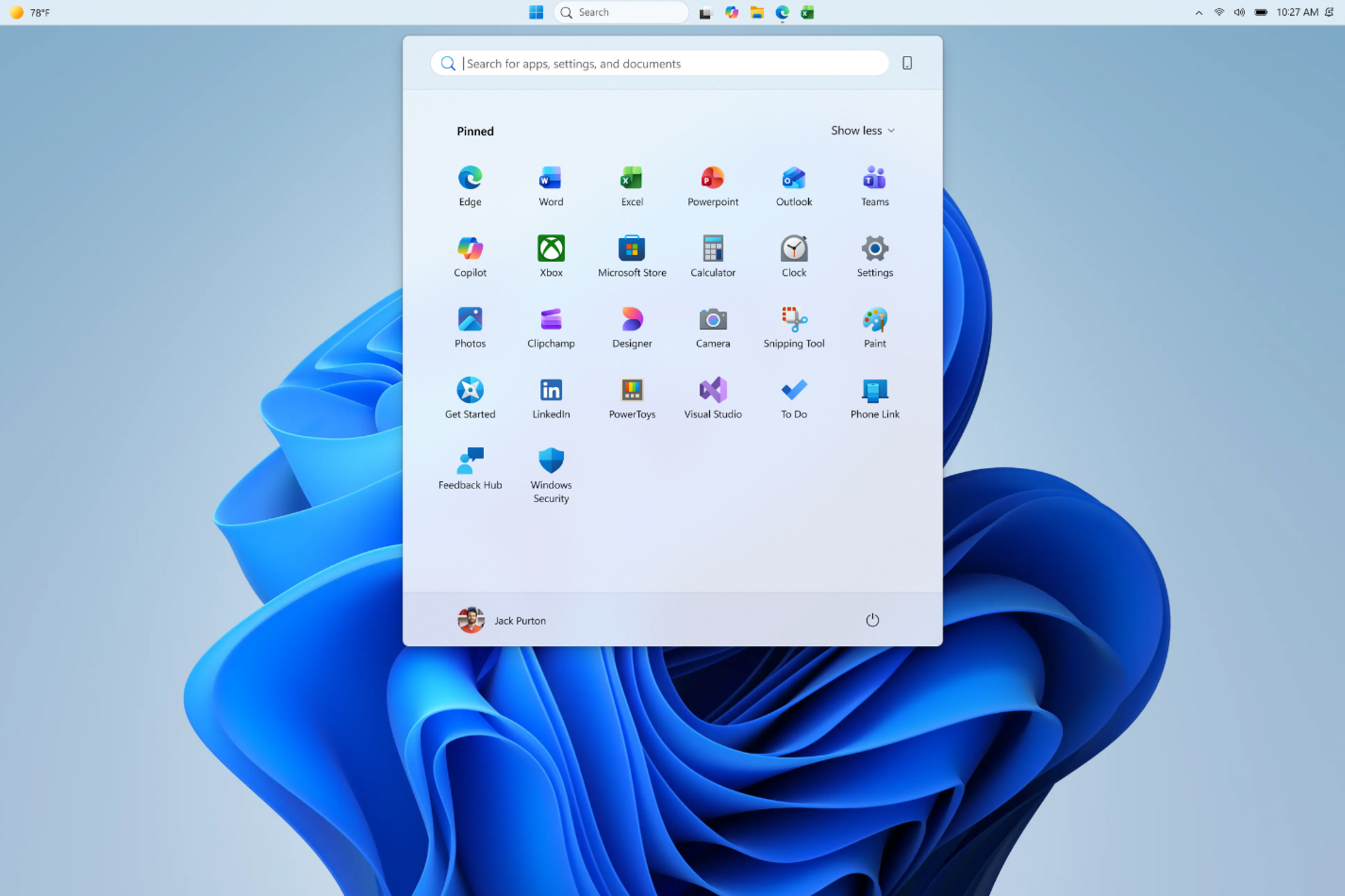
  • Use Start, Search, and other flyouts relative to the taskbar location: For example, when the taskbar is on the top, Start opens from the top (see figure 2).
  • See every window at a glance: When using a vertical taskbar with “Never combine” taskbar buttons and show labels enabled, each app window appears as a separate labeled button, making it easier to identify and switch between windows (see figure 3).
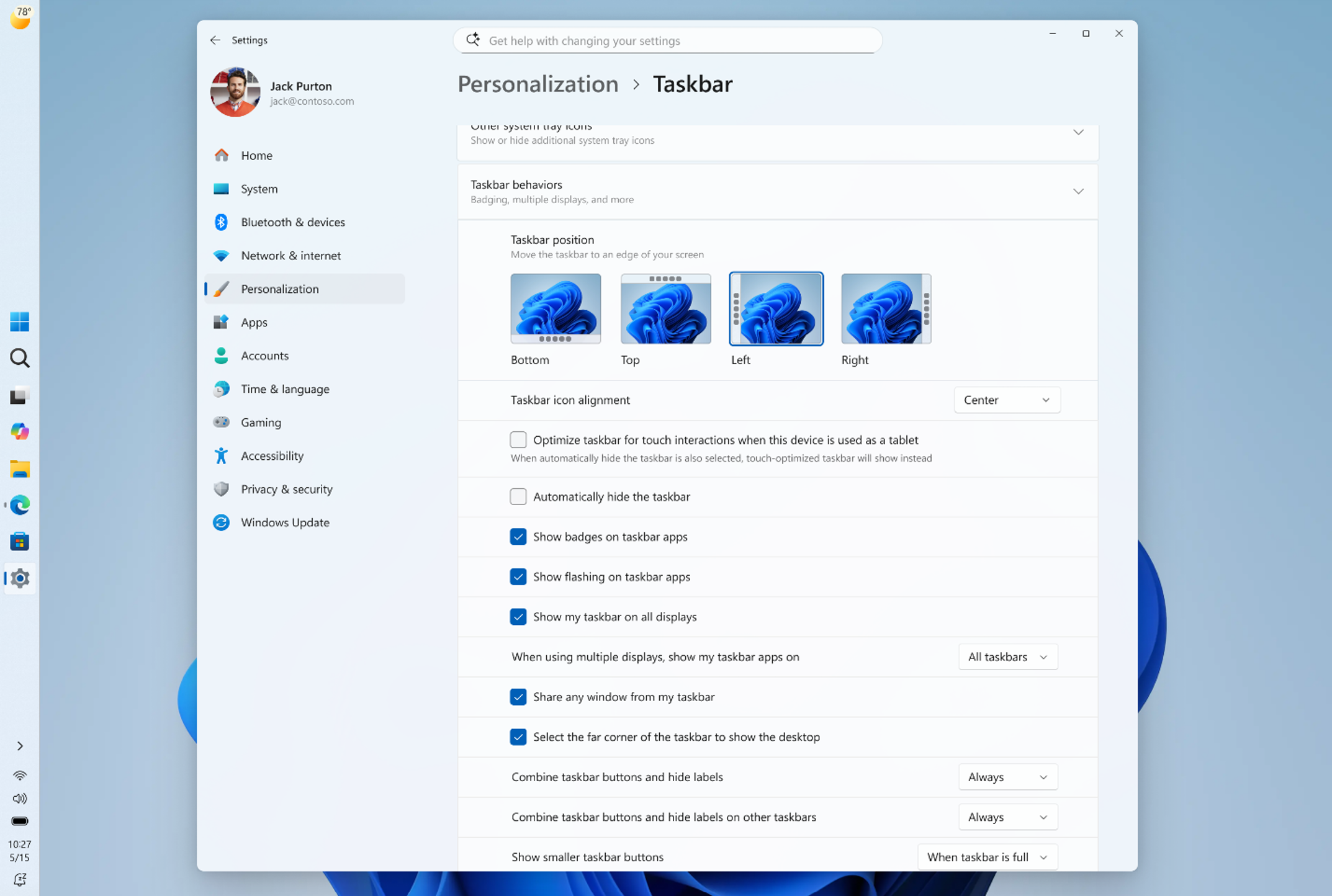
For people who value vertical screen space, like developers who want to see more of their code at once, moving the taskbar to the side can help reclaim precious room on the screen. If accessibility or ergonomics make the top of the screen easier to reach, you can place the taskbar there. If you rely on the taskbar to keep track of your work, a vertical layout with ungrouped icons can help you stay organized. The choice is yours. [caption id="attachment_178963" align="aligncenter" width="1024"]Screenshot of the taskbar in the left-aligned position. (Figure 1) Screenshot of the taskbar in the left-aligned position.[/caption] [caption id="attachment_178956" align="aligncenter" width="1024"]Screenshot of the taskbar in the top-aligned position, with Start opening from the top. (Figure 2) Screenshot of the taskbar in the top-aligned position, with Start opening from the top.[/caption] [caption id="attachment_178957" align="aligncenter" width="1024"]Screenshot of the taskbar in the left-aligned position with buttons never combined and labels shown. (Figure 3) Screenshot of the taskbar in the left-aligned position with buttons never combined and labels shown.[/caption] To change the taskbar position, go to Settings > Personalization > Taskbar > Taskbar behaviors, where you will find the new option alongside taskbar icon alignment. [caption id="attachment_178958" align="aligncenter" width="1024"]Screenshot of the new Settings > Personalization > Taskbar page showing the taskbar position options. (Figure 4) Screenshot of the new Settings > Personalization > Taskbar page showing the taskbar position options.[/caption] We’re excited to hear your feedback. We’re still working through additional visual polish, performance improvements, and a few known issues, and there are also some features that are not yet included in this release but are coming soon:
  • Auto-hide and tablet-optimized taskbar are not yet supported in alternate positions.
  • Touch gestures for alternate positions are still in progress.
  • Search boxes are not yet supported in alternate positions and will appear as a search icon for now.
We are also evaluating additional features like different taskbar positions per monitor and drag and drop. Our focus is to deliver the core functionality you need while keeping the experience simple, predictable, and free from accidental taskbar movement.

Smaller taskbar

Windows 11 introduced a roomier taskbar to support more states and features while also improving touch targets. On smaller screens, that extra height can take away from your usable workspace. We are adding the option to switch to a more compact taskbar for times when every pixel counts. With this update, when small taskbar is enabled, you get smaller icons, a shorter taskbar, and more vertical space for your apps (see video below). No restart or sign-out is required. This experience is rolling out today in the Experimental channel. To change your taskbar size, go to Settings > Personalization > Taskbar > Taskbar behaviors > Show smaller taskbar buttons. When set to Always, both the icons and the taskbar height become smaller. [embed]https://youtu.be/pvE2gyWnVHA[/embed]

Putting you in control of Start

There is a unique Start for everyone, whether you want a minimal experience with just your pinned apps, quick access to recent files, everything in one place, or something in between. We are making changes in two areas to support this. First, we are giving you easier ways to shape your Start menu. Second, we are improving the quality of what appears there by default.

More control over your layout

Today, customizing Start can require navigating multiple settings in different places. Turning off the Recommended section involves toggling several settings, and clearing pinned apps means unpinning them one by one. We are simplifying this experience. Over the coming weeks, Insiders will get:
  • Section-level toggles to independently show or hide Pinned, Recommended, and All. One toggle per section that is simple and clear.
  • A separate control for file recommendations. Today, turning off Recommended in Start also turns off jump lists and recent files in File Explorer. With this change, you can disable file recommendations in Start without affecting recent files in other places.
  • Start menu size settings that let you choose your preferred size. Today, Start adapts to your display. With this update, you can choose Small or Large so your preference stays consistent across displays whenever possible.
  • The option to hide your name and profile picture in Start for added privacy when sharing your screen, presenting, or streaming.
[caption id="attachment_178960" align="aligncenter" width="1024"]Screenshot of the updated Start settings showing the new section-level toggles. (Figure 5) Screenshot of the updated Start settings showing the new section-level toggles.[/caption] These controls are designed to work together. If you want a Start menu with just your pinned apps, you can turn off Recommended and All. If you want a full Start that shows everything, you can leave it all on. The goal is simple: it is your choice, and it should be easy to make. [caption id="attachment_178961" align="aligncenter" width="1024"]Screenshot showing Start in a minimal "pins only" configuration with hidden name and profile picture. (Figure 6) Screenshot showing Start in a minimal "pins only" configuration with hidden name and profile picture.[/caption]

Improving recommendation quality

We are also improving the content that appears in this section for people who choose to keep it on. We are renaming Recommended to Recent to better reflect what the section primarily shows, including recently installed apps and recently used files. We are keeping recently installed apps visible, as this remains one of the primary ways people discover newly installed apps alongside the Microsoft Store. Both users and developers have told us this visibility is important. In addition, we are improving file relevancy. We are refining which files appear and how they are ordered to reduce less relevant items and better reflect what you have been working on.

What’s next

Everything described will roll out to Windows Insiders in the Experimental channel over the coming weeks, including several in today's flight. We have talked about earning trust through steady and visible progress. Start and taskbar are where that trust is tested most, every time you sit down at your PC. Please share your feedback in Feedback Hub by pressing WIN + F. The Windows Insider community plays a critical role in shaping Windows, and as these features become available, we encourage you to explore them and share what is working and what is not. This work is ongoing, and our goal is to build it together with you. Thanks, Diego Twitter (X): @bacadd LinkedIn: Diego Baca | LinkedIn [caption id="attachment_178962" align="aligncenter" width="1024"]Screenshot showing top-aligned small taskbar with Start in a minimal "pins only" configuration. (Figure 7) Screenshot showing top-aligned small taskbar with Start in a minimal "pins only" configuration.[/caption]
  •  

Announcing new builds for 15 May 2026

15 Mei 2026 om 21:50
Hello Windows Insiders, Today we will be expanding the rollout of the new Windows Insider Program changes to devices in the Beta Channel, which will be moved to the new Beta experience. Please see the announce blog for more information about what this entails.

New builds this week

Today we are releasing new Windows 11 Insider Preview Builds. As a reminder, all Insiders can find the release notes for your device based on the new channel system, even if you haven’t moved yet. This is to make finding build information as easy as possible during the transition. See your channel release notes here: For those on other specific build versions, here are today’s new builds and release notes: As a reminder, you can always find your build number in the watermark on bottom right-hand corner of your desktop. Please note, existing Beta Channel Insiders on Windows 11 version 26H1 are currently getting the same build version as Experimental (26H1). In the coming weeks we will be releasing separate builds for these channels, which is when we will have a new Beta (26H1) release notes section. Additionally, Insiders who move to the new Beta experience and are on the default 25H2 core version, and who elect to move to version 26H1 under the WIP settings Advanced options, will experience a delay in their device up taking the new version during this transition.

Notable new features:

[Taskbar improvements]

Release channel: Experimental Alternate Taskbar Position You can now change the position of taskbar on your screen. In Settings > Personalization > Taskbar > Taskbar Behaviors, you can select the side of the screen you want your taskbar on: bottom, top, left, or right. In these other positions, tooltips, flyouts, and animations will still come from the taskbar, and most customization settings like small taskbar and never combine taskbar icons will work with all locations. [caption id="attachment_178963" align="aligncenter" width="1024"]Screenshot of the taskbar in the left-aligned position. Screenshot of the taskbar in the left-aligned position.[/caption] Smaller Taskbar We’re introducing a smaller taskbar for users who want to maximize screen space, especially on smaller devices. While the default taskbar remains unchanged, this setting provides a more compact experience with smaller icons and a reduced taskbar height, giving you more room for your apps. Core elements like Start, Search, and the system tray scale appropriately to stay aligned and consistent. See the in-depth blog for more information about Taskbar improvement.

[Widgets]

Release channel: Experimental As we continue to make Widgets feel less distracting, we’ve made a small but meaningful visual update to taskbar badging. For those that have taskbar badging on, the badge color will now match your Windows accent color instead of always appearing red, reducing the sense of urgency that something needs your immediate attention. We’re also testing out quieting down a user’s experience based on their level of engagement. For example, a user who highly engages with Widgets likely have their settings set to a state that works best for them, as compared to a user who barely engages with it and would benefit from having the experience quieted down with taskbar badging turned off as it is for new users who experience it as quiet by default.

[Windows Search Box]

Release channel: Experimental We've started making changes to make Windows Search Box more relevant, starting with making it easier to find your files and apps:
  • Files and apps more reliably appear ahead of web suggestions when your content is a stronger match
You can expect to see additional relevance improvements in upcoming releases. Thanks, Stephen and the Windows Insider Program team
  •  

Announcing new Release Preview builds for 14 May 2026

14 Mei 2026 om 19:05
[19 May 2026: Updated build numbers for new releases containing bug fixes - see release notes for details] Hello Windows Insiders, Today we're releasing new builds for Release Preview across our supported versions of Windows 11.  Please see the build numbers and links to the release notes below: As a reminder, Windows 11 version 26H1 is a targeted release of Windows to support specific device hardware and silicon. Read more in our IT Pro blog. Thanks, Stephen and the Windows Insider Program team
  •  

Raising the bar together. Introducing the Driver Quality Initiative at WinHEC 2026

14 Mei 2026 om 12:00
There are moments in this industry when you can feel the ecosystem lean in. This week in Taipei was one of them. For two days at WinHEC 2026 (Windows Hardware Engineering Conference) — Microsoft’s first WinHEC since 2018 — we had the privilege of spending time alongside our OEM, silicon, IHV and ODM partners, and the engineers who build Windows, to talk honestly about where we are, opportunities to be better connected as an ecosystem and where we're going together. As we shared in March, a fundamental component to raising the bar on quality across areas such as system stability, driver quality and app reliability requires coordinated execution across the entire ecosystem. At WinHEC 2026, we shared how we’re addressing this at the driver level with our partners by introducing the Driver Quality Initiative (DQI), a comprehensive, ecosystem-wide effort designed to fundamentally raise the bar on driver quality, reliability and security across Windows.

“Great platforms aren’t built in isolation. Platform quality depends on early, honest collaboration across OEMs, ODMs, silicon partners and IHVs. WinHEC brings engineers together with Microsoft to align early, solve real problems and deliver higher‑quality solutions for our shared customers” — Syam Poluri, Distinguished Engineer, Dell Technologies

Raising the bar on quality takes all of us.

Drivers sit at the heart of every Windows experience. They connect the OS to the silicon, components and peripherals that make Windows one of the most versatile platforms in the industry. Today, thousands of partners contribute to tens of thousands of active driver families across the Windows install base. When drivers are high quality, customers experience reliable, secure, performant devices. When drivers fail, customers experience it as a device problem, regardless of where the root cause sits. Chart showing four pillars of the Driver Quality Initiative.DQI builds on the learnings and infrastructure established through the Windows Resiliency Initiative (WRI) and is organized around four pillars:
  • Architecture: We are heavily investing in hardening kernel mode drivers and enabling the third-party kernel mode driver transition to either user mode driver or Microsoft authored class drivers. This is to ensure higher driver security, reliability and resiliency. User-mode driver investments include performance updates to PCIe devices with DMA support as well as Wi-fi stack (coming soon). Class driver investments include Soundwire Device Class for Audio (SDCA), introduction of the I3C class driver, NCM USB ethernet class driver as well as continuous enhancements to existing first-party class drivers on Windows 11.
  • Trust: We are raising the bar for trusted partners and trusted drivers, including stronger partner verification, expanded automated analysis and updated Windows Hardware Compatibility Program requirements.
  • Lifecycle: We are improving driver lifecycle management through better Windows Update catalog hygiene, including deprecating outdated or low-quality drivers, advancing SBOM alignment and enabling faster issue analysis through driver symbols.
  • Quality Measures: We are expanding how driver quality is measured beyond crashes to include stability, functionality, performance, and power and thermal impact, giving partners clearer signals to improve the real customer experience.
DQI is a partnership. Microsoft is building the frameworks, tools and quality signals, and we are working with partners to raise driver quality across the ecosystem so customers can rely on their Windows devices from day one through the full life of the PC.

“Delivering high-quality drivers and resilient platforms isn’t owned by any one company—it’s a shared commitment. Through our close collaboration with Microsoft, AMD is focused on building a culture of joint accountability to ensure security, stability and predictable performance for our customers at scale.” — David Harmon, Director, Software Engineering, AMD

What we did at WinHEC

Day 1 opened with a keynote presentation featuring our Windows leadership team, organized around three themes: navigating the evolving landscape, raising the bar on Windows 11 quality and the future vision for Windows. The keynote set the tone for the days ahead. We were candid about where we are, clear about where we're going and explicit about the partnership required to get there. From there, attendees broke out into workshops, with sessions spanning five tracks:
  • End-to-end driver quality — covering the full lifecycle from authoring and validation through publishing, and post-release health
  • Platform fundamentals — power, thermal and storage fundamentals that define everyday device experience
  • Exceptional device experiences — delivering best-in-class quality across media and display, camera, audio, connectivity and peripherals
  • Windows Server — platform direction, reliability and the evolving requirements for modern datacenter and edge deployments
  • Ecosystem advancement — end-to-end security, co-engineering tools, manufacturing and AI hardware innovation.
Day 2 shifted from discussion to application. Hands-on labs gave engineers the opportunity to put guidance into practice, from authoring and hardening drivers, executing hardware compatibility tests, and exploring AI-assisted crash analysis. Microsoft engineers worked side by side with partner teams, helping them move from understanding the guidance to applying it directly within their own engineering workflows. Beyond the structured sessions, attendees explored demo booths showcasing the latest tools, diagnostics and technologies coming to the Windows platform. The dedicated Microsoft Experience Room brought hardware and the operating system together to demonstrate how end-to-end experiences come to life across various Windows customers, such as students, developers, creators, information workers and gamers, making the connection between platform engineering decisions and real customer outcomes tangible. Each day concluded at the Connection Corner, an open forum where partners could engage directly with the Microsoft engineers building these tools. It was, for many attendees, the most valuable part of the event: unfiltered access to the people doing the work, with the time and space to dig into the questions that matter most.

“At Acer, we believe that continuous innovation and collaboration are the engines that drive the technology industry forward. On display at WinHEC, Windows stands out as an innovative platform that brings together partners across a broad range of expertise. The Microsoft conference is where innovation, technology and domain experts come together to unlock the true value of platform engineering.”  — Mark Yang, Associate Vice President of Compute Software Technology, Acer Inc.

"The customers ASUS serves — gamers, creators, students and professionals — each demand a different kind of Windows device. WinHEC is where ASUS and Microsoft engineers go deep on the platform fundamentals that make those very different devices share the same quality bar, generation after generation." — Justin Yo, Software Associate VP, ASUSTeK Computer Inc.

What we heard from partners

A few themes came through clearly in our conversations across the two days:
  • Quality is a shared priority. Across silicon, OEM and IHV partners, the message was consistent — driver and platform quality is central to the customer experience, and the ecosystem is ready to invest.
  • Innovation thrives on a strong foundation. When the fundamentals are solid, partners can invest more confidently in differentiated experiences, AI-powered capabilities and next-generation hardware, knowing the platform will support them. The energy around what becomes possible when quality is a given, not a variable, was one of the most exciting themes of the week.
  • There is real appetite for this kind of engagement. Partners told us repeatedly that the combination of roadmap clarity and hands-on technical depth is exactly what the ecosystem needs at this moment and going forward.
  • Transparency matters. Partners welcomed the open methodology behind driver quality metrics, the phased rollout of lifecycle states and the commitment to incentive-based distribution as the right model for moving forward together.

"The best customer experiences are built on the foundation of strong partner collaboration. WinHEC is where that work happens — engineers from HP and Microsoft aligning early, solving real problems and ensuring that what we ship together actually works for the people who depend on it every day. That kind of direct, honest partnership across the ecosystem raises the bar for everyone." — Deepak Patil, Senior Vice President, Personal Systems Engineering, HP Inc.

Looking ahead

WinHEC 2026 was an important step, but it's the start of the work, not the end. In the months ahead, we will keep investing in the fundamentals that matter most to customers: reliability, security, performance, compatibility and quality. We’ll also keep collaborating with OEMs, silicon partners, IHVs, ODMs and the broader hardware ecosystem through the Windows Resiliency Initiative, the new Driver Quality Initiative and the work we do together every day. To everyone who joined us in Taipei this week, from our CPU, GPU and silicon partners; display, camera, audio and networking teams; IBVs, ODMs and OEMs; to the peripheral and component engineers who make the breadth of Windows possible — thank you. The depth of engagement, the willingness to work together in the room, and the shared commitment to quality made this week what it was. The work we do together over the coming year will define the Windows experience for more than a billion users. We couldn't be more energized about what we're going to build. — Robin and Ian
  •  

New updates to Edge across desktop and mobile

13 Mei 2026 om 17:55
Edge just made it easier to go from first tab to final plan, wherever you go. Your favorite Copilot experiences, plus new ones, are now available directly in Edge on desktop and, for the first time, in the Edge mobile app. This includes capabilities now available to everyone on desktop and mobile like reasoning across multiple open tabs so Copilot can compare info, surface key details, and see what matters, more relevant answers from Copilot built on your browsing history and past chats, and hands-free browsing with Voice and Vision. We're also making it easier to jumpstart your day and pick up where you left off with a redesigned new tab page and Journeys, now broadly available across desktop2 and mobile3. Plus, new productivity tools on Edge desktop are designed to move you from idea to done without breaking stride. As part of today's update, we're retiring Copilot Mode1. With helpful features built directly into Edge, it's now simpler to shape how you browse and get more done. To explore what's new, visit aka.ms/CopilotinEdge or download the Edge Mobile app.

New updates to the Edge mobile app

Today, we're bringing the experiences you love on Edge desktop to the Edge mobile app so you can get more done wherever you go. Juggling tabs on your phone used to mean endless swiping and tab hopping. Not anymore. With your permission, Copilot in Edge can reason across your open tabs. Just ask a question and it pulls from your tabs to compare details, surface answers, and help you decide without the back-and-forth. https://www.youtube.com/watch?v=Q9itnNYyhGc Previously available only on desktop, Journeys is now available on the Edge mobile app3. Journeys makes it easier to pick up where you left off and resume your projects by, with your permission, organizing your browsing history into meaningful topics – with summaries and suggested next steps – so you can quickly get back to planning that dog-friendly camping adventure or that piece of clothing you can't stop thinking about. https://www.youtube.com/watch?v=it6NFi4PO30 Sometimes the fastest way to get help is to just ask. With Vision and Voice, available to everyone on desktop and now in the Edge mobile app, you can, with your permission, share your screen and talk through what you're looking at — hands-free. Ask questions, get explanations, or think through a decision out loud. It's like having a second pair of eyes wherever you are. When Copilot is active, you'll always see clear visual cues so you know when it's taking an action, helping, listening, or viewing. We are also bringing Edge desktop's redesigned new tab page to the Edge mobile app to streamline how you get your day started, making it easier to jump right into what you need to get done. Bringing together chat, searching, and browsing in one clean starting point, Edge keeps you moving forward. https://www.youtube.com/watch?v=S7CT_HiWFys

Stay in your flow

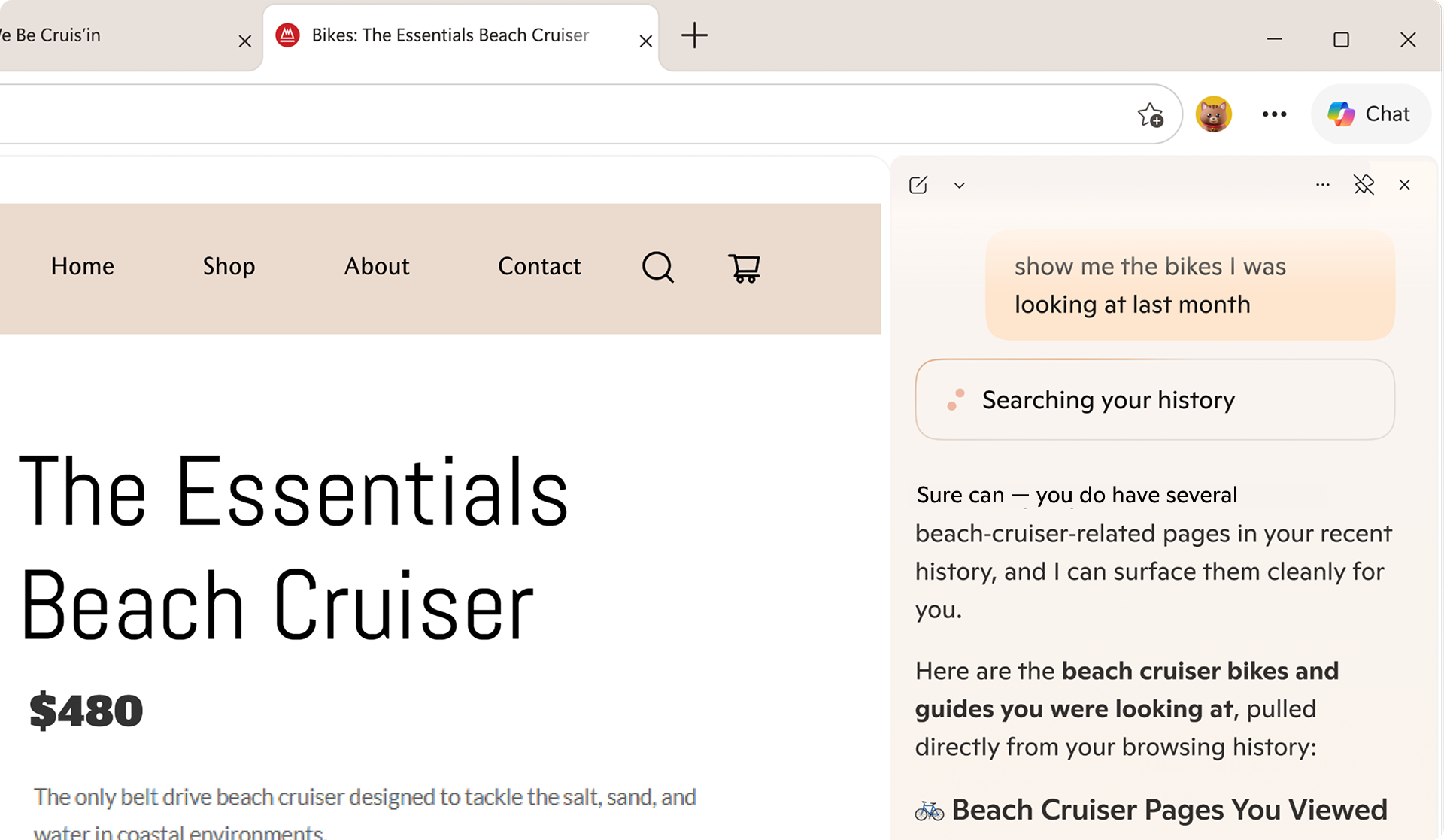
Life doesn't happen in one tab. Now available to everyone, Copilot can pull context from your open tabs to surface relevant information and help you make decisions with less effort to keep you moving forward— without having to leave the page you're on. No setup required. Just click the Copilot icon in the top right corner and ask Copilot to compare options across tabs, explain what matters, and get clear answers. Take planning your next trip to Napa — comparing wineries, restaurants, and routes across a dozen tabs is the hardest part. Copilot in Edge, with your permission, reads across every tab you have open, so you can compare options, surface what matters, and make decisions with less tab-hopping. https://www.youtube.com/watch?v=Ls6dRaxSL28 With your permission, Copilot can also use your browsing history to deliver more relevant, higher-quality answers — like finishing up your shopping, returning to a thread you were following, or picking up research you started days ago. Copilot builds on what you've already seen so you spend less time switching and more time staying in your flow. Now, with long-term memory on desktop and mobile, Copilot not only builds on what you've seen but also can reference your past chats to provide more relevant help. You're always in control of what Copilot can access. Copilot in Edge for desktop, showing a message saying 'Searching your history'.

Built to keep you moving forward

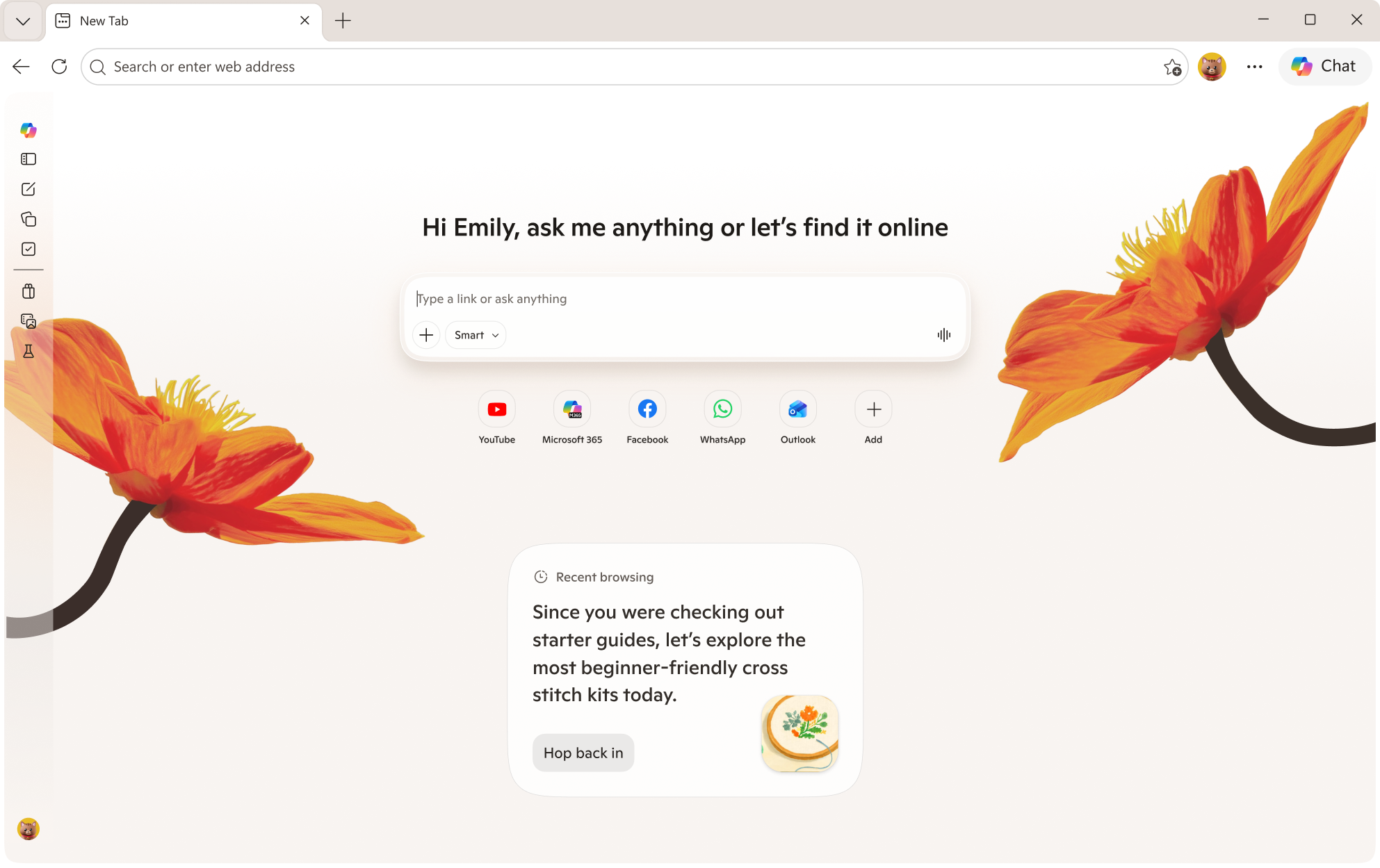
Sometimes getting started is the hardest part. The redesigned new tab page, now available for everyone to try, brings together chat, search, and web navigation in one place so you can effortlessly explore the web. It's also where all your Journeys live, so it's easy to jump back in and keep going. Edge on desktop new tab page, showing Copilot and Recent browsing. Journeys, now available for free in all English markets2, helps pick up where you left off. Ever start trying to learn something new then … life happens? Journeys brings you back to past browsing projects by grouping your browsing history into helpful topic cards on your new tab page so you can resume that cross stitching hobby – without starting from scratch. https://www.youtube.com/watch?v=5RdQ9zjMpKM

New tools to boost your productivity

Whether you're cramming for finals, writing a research paper, or understanding a complex topic, Edge has new built-in tools to help you focus, learn faster and get more done without ever leaving your browser. Study and Learn mode helps you get started breaking down topics into guided study sessions, interactive quizzes, and more to supplement your learning. To get started, simply type into Copilot in Edge "Quiz me on this topic" when you have a webpage open or locate the mode dropdown at the bottom left of the input box on the redesigned new tab page and select "Study and Learn mode." Write with confidence, right where you are. Writing assistant5 gives you extra help by generating drafts, rewriting for clarity, or adjusting tone right where you're already typing in Edge. Just look for the blue dot the next time you're writing to get help in the moment. https://www.youtube.com/watch?v=m9__zGC-miQ Turn your browsing into a study session with Copilot quizzes. Easily generate quizzes, flashcards, and guided sessions based on what you're reading so you can test yourself as you go, right in your browser. https://www.youtube.com/watch?v=4j3chZtjQvc Finally, you can now turn your tabs into a podcast6. Whether you're catching up on research or exploring something new, now you can listen, learn, and keep moving without missing a beat. Podcasts in Edge is available in English markets. Copilot chat in Edge, with the message: Create a podcast about trail running in Seattle.

You choose what you need

We're making it easier to shape your experience on the web. At any time, you can select which experiences you want or leave off the ones you don't. Just head to aka.ms/CopilotinEdge or Edge Settings to customize your experience anytime. With Copilot in Edge, your data stays yours. Microsoft only collects what's needed to improve your experience—or what you choose to provide via Personalization settings. Copilot follows Microsoft's trusted privacy standards, meaning your information is never shared without your permission. Your browser data is protected under the Microsoft Privacy Statement.

Tell us what you think

Copilot features are available in all Copilot markets4 on Edge for Windows and Mac and the Edge mobile app today. We're excited to bring you these Copilot features directly to your Edge browser7 and want to hear from you. To get started, visit aka.ms/CopilotinEdge and give us your feedback. If you're excited to share more ideas and connect with others, consider joining our Discord channel. 1 Existing Copilot Mode users will continue to receive priority access to new features through Copilot in Edge Preview. Users may change this anytime in Edge Settings. As part of retiring Copilot Mode, Copilot Actions, previously available in Limited Preview, is now available as Browse with Copilot on Edge desktop for Microsoft 365 Premium Subscribers in the U.S. only. Usage limits apply. 2 Journeys on Edge desktop is available only in all English markets (en-US, en-GB, en-CA, en-AU, en-NZ, en-IN, en-SG). 3 Journeys on Edge mobile is available in the U.S. only. 4 Vision, Voice, multi-tab context, long-term memory, Copilot quizzes, and the redesigned new tab page are available in all Copilot markets across desktop and mobile. 5 Writing assistant is available in the U.S. only. 6 Podcasts is available in all Copilot markets in English only. Must be signed in with a Microsoft Account to generate a podcast. Subscribers to Microsoft 365 Personal, Family, and Premium have access to extended usage. Learn more. 7 Usage limits apply to certain Copilot features. Availability of Copilot features subject to change.
  •  

Xbox and Discord partnership bringing more benefits to players

11 Mei 2026 om 18:37
Xbox and Discord are teaming up again to make Game Pass more flexible for players, bringing new benefits to both communities. Discord Nitro now includes a starter edition of Xbox Game Pass where available, giving eligible members a new way to discover and play games. Discord has also rolled out updates that make it even easier to discover and jump into games included with Game Pass. When you see a friend playing something you want to try, whether in their game stream or Discord game activity, look for the Play button and select Xbox Game Pass to start playing. Find out more on Xbox Wire.
  •  

Announcing new builds for 8 May 2026

8 Mei 2026 om 21:13
Hello Windows Insiders, We continue to expand the rollout of the new WIP changes to those channels already announced. We have not yet begun moving Insiders in Canary 29500 Series Channel or Beta Channel to the new WIP experience just yet, although we expect this to happen in the coming weeks. As a reminder, if you are in the Beta Channel and looking for best continuity of all existing features, we encourage you to consider moving to the Dev Channel prior to taking the new Beta experience. See the WIP changes rollout blog for more information. New builds this week Today we are releasing new Windows 11 Insider Preview Builds. As a reminder, all Insiders can find the release notes for your device based on the new channel system, even if you haven’t moved yet. This is to make finding build information as easy as possible during the transition. See your channel release notes here: For those on other specific build versions, here are today’s new builds and release notes:
  • Experimental (26H1) – Including former Canary 28000 series: Build 28020.2075
  • Experimental (Future Platforms) – Including Canary 29500 series: Build 29585.1000
As a reminder, you can always find your build number in the watermark on bottom right-hand corner of your desktop.

Notable new features:

[Touchpad]

Release channel: Experimental We’re adding new gesturing-related functionality to precision touchpads in Settings. The new features should be widely available across applications, with the exception that WinUI3-based UI requires new WinAppSDK versions for complete functionality - we're in the process of bringing the necessary changes to versions 1.8 and 2.0.
  • Scroll / zoom speed: control the baseline speed for these gestures
  • Automatic scrolling: scrolling continues indefinitely without lifting your fingers. Activate by either bringing your fingers near the edge of the touchpad while scrolling, or holding them still and pressing harder (requires hardware support).
  • Accelerated scrolling: repeatedly scrolling increases their speed, allowing quick traversal of long documents.
  • Single-finger scrolling: perform a vertical scroll with a single finger starting from the left or right side of the touchpad.
[caption id="attachment_178947" align="alignnone" width="1024"]Touchpad improvements bring new gesture capabilities including automatic scrolling, gesture speed controls, accelerated scrolling, and optional single-finger scrolling support. Touchpad improvements bring new gesture capabilities including automatic scrolling, gesture speed controls, accelerated scrolling, and optional single-finger scrolling support.[/caption]

[EDU Licensing]

Release channel: Experimental Beta Channel Free upgrade path to Windows 11 Pro Education for K-12 Windows Insiders in K–12 education environments can now experience a seamless upgrade path from Windows 11 Home to Windows 11 Pro Education edition—at no additional cost. This enables educational organizations to procure Windows 11 Home devices, upgrade them to Windows 11 Pro Education, and bring devices under school management. See release notes for more information. Thanks, Stephen and the Windows Insider Program team
  •  

An inside look at Stranger Than Heaven reveals locations and Snoop Dogg’s role

7 Mei 2026 om 18:32
“Xbox Presents: A Special Look at Stranger Than Heaven” recently wrapped. The entire show offered an inside look at the new project from RGG Studio, which arrives this winter. During the 30-minute broadcast, several minds behind the upcoming action-adventure game went through the story structure, the different locations players will explore and some of the bombastic personalities they’ll encounter. One of those characters, a “cutthroat and charismatic smuggler” – has a familiar voice: Snoop Dogg, whose son Cordell Broadus also plays a substantial role in this ambitious adventure. Head over to Xbox Wire to read the recap.
  •  

Publish to Microsoft Store as a company—now with free registration and faster onboarding

7 Mei 2026 om 18:00
We’re seeing growing demand from companies that want to reach Windows users across both consumer and enterprise devices, and we’ve heard consistent feedback that getting started should be simpler. Today, we’re addressing that with three updates: free account creation (removing the $99 fee), Microsoft Entra ID support for signing up with work accounts, and a faster onboarding experience that reduces friction and helps teams move from sign-up to submission faster. As part of our broader investment in improving developer experiences across the Microsoft Store, this new experience builds on recent improvements for individual developers that significantly increased onboarding funnel success, helping more developers complete account creation and reach submission faster. Used by over 250 million monthly active users, the Microsoft Store's open policies enable scalable distribution across both consumer and commercial devices. “At Brave, our core mission is to put users first. Distributing Brave through the Microsoft Store enables us to offer greater choice and flexibility in how people discover and install our browser on Windows. It also provides a seamless distribution channel that supports our goal of making privacyfocused web browsing more accessible to users everywhere.”  – Brave, Company developer

What’s new in company onboarding?

Free registration

The $99 onboarding fee for company developer accounts has been removed, lowering the barrier to get started on the Microsoft Store.

Sign up using your work account (Microsoft Entra ID)

Based on common feedback from developers, you can now sign up using your organization’s work account—streamlining onboarding and helping associate your developer account with your company’s organizational identity from the start.

Faster, more transparent onboarding experience

A redesigned step‑by‑step onboarding flow with clearer requirements, upfront validation and real‑time status updates to help reduce friction and common errors. Many verification checks are completed automatically, with timely feedback and email notifications to help you stay informed and take the next steps when needed. [caption id="attachment_57784" align="alignnone" width="1024"]Account type selection (Individual vs Company, both free). The redesigned account type selection step — both Individual and Company accounts are now free to register.[/caption]

How to get your organization ready to publish faster

To help you move quickly from account creation to app submission, here are a few best practices to prepare your organization before starting onboarding:

Have your D-U-N-S Number ready

Use your D-U-N-S Number to quickly retrieve your business details and expedite business verification, helping you complete onboarding faster. If your organization already has one, you can look it up here: https://www.dnb.com/duns-number/lookup.html. If not, you can request one for free here: https://www.dnb.com/duns-number/get-a-duns.html. [caption id="attachment_57785" align="alignnone" width="1024"]D-U-N-S Number entry on the Business Details step. Entering a D-U-N-S Number during the Business Details step to instantly retrieve and verify your company information.[/caption]

No D-U-N-S Number? Upload supporting documents

If your organization does not have a D-U-N-S Number, you can upload supporting documents for business verification, which may take longer due to manual review. Keep your documents ready in advance. Accepted documents include company formation documents (such as articles of incorporation), government-issued business licenses or registration certificates, official government registry records, and tax or stock exchange filings. [caption id="attachment_57786" align="alignnone" width="1024"]Document upload alternative on the Business Details step. Alternative verification via document upload — select from accepted document types if your organization does not have a D-U-N-S Number.[/caption]

Use a business domain email in contact details

Provide an email address associated with your organization’s domain (e.g., name@yourcompanydomain.com) to help verify your employment and speed up onboarding. Using a mismatched domain will require you to upload additional verification documents later for domain verification. [caption id="attachment_57787" align="alignnone" width="1024"]Contact Details step with business domain email verification. Providing contact details and a business domain email address to verify your employment and speed up account approval.[/caption]

Keep an eye on email notifications

You’ll receive email updates on your verification status. Review them and act—the faster you respond, the sooner you can complete verification and onboarding. When submitting documents, make sure to upload valid and accurate documents to avoid delays. Verification appeals are limited (up to three attempts), so submitting the right documents upfront can help you complete onboarding faster.

Why publish to the Microsoft Store?

As the Windows developer platform continues to evolve—powered by Copilot+ PCs, AI innovation, and a growing ecosystem of developers and partners—the Microsoft Store offers a trusted and flexible path to reach over 250 million monthly users. Developers can publish a wide range of app types, including Win32 (.NET WPF and WinForms), UWP, PWA, .NET MAUI and Electron, without modifying existing code. Apps are securely discoverable through Windows Search and can be distributed across enterprise environments using tools such as Microsoft Intune. Developers also benefit from flexible commerce options—including the ability for non‑game apps to use their own in‑app commerce system and retain 100% of revenue—while MSIX packaging enables Microsoft‑hosted distribution, free signing and automatic updates to reduce operational overhead.

Ready to publish?

Get started by opening your account at storedeveloper.microsoft.com.
  •  

With latest world update, Microsoft Flight Simulator shines light on aerial firefighting

6 Mei 2026 om 17:22
World Update 21: Australia of Microsoft Flight Simulator 2024 includes a collaboration with the New South Wales Rural Fire Service – widely acknowledged as the largest volunteer fire service in the world. Comprised of nearly 40,000 dedicated volunteers, the RFS is rooted in the NSW communities, studiously managing bushfires that remain a significant, reoccurring threat across Australia.  Players can experience the critical real-world operations of aerial firefighting with a new RFS-inspired mission using water bombing to put out a fire in New South Wales.  To learn more about their work in protecting the Australian wilderness, Xbox Wire talked with NSW’s director of aviation, Assistant Commissioner Jayson McKellar AFSM, about the yearly challenges the NSW Rural Fire Service faces in bushfire response, how flight simulations like Microsoft Flight Simulatorcan help educate players about aerial firefighting and what advances in technology have made the biggest difference to firefighter safety in recent years.  Read that interview on Xbox Wire.
  •  

Microsoft Flight Simulator 2024 releases largest sim update yet

1 Mei 2026 om 20:35
Sim Update 5 for Microsoft Flight Simulator 2024 is now available, with significant improvements for every aspiring pilot player. One of the biggest changes is that now all career modes are fully unlocked. Heavy aircraft and Vertical Take‑Off and Landing (VTOL) operations are also available (i.e. helicopters). The update also improves frame rates and reduces stuttering – especially in large cities and complex airports. Find out more at the MSFS 2024 site.
  •  

Windows quality update: Progress we’ve made since March

1 Mei 2026 om 19:40
Hello Windows Insiders I’ve now spent the past two months in this expanded role leading the Windows Insider Program. Two themes have stood out in my conversations with you. First, you want more transparency. You want to see what we’re doing, understand our decisions, and see progress through shipping. Second, a shared sense of pride. We want to be proud of what we build, and as Insiders, you’re proud to be the first to guide us with your feedback. When we get it right, we celebrate together. When we don’t, you push us to improve. We want Insiders to feel that same connection to what we’re building. Over the next few months, you’ll see us laser focused on the improvements we’re shipping. My ask of you: try the experiences, pressure test them, and let’s keep building a product we are proud of. Below are a few of the top improvements we’ve started rolling out to Windows Insiders over the past month, including some experiences rolling out in today’s flights.

Making the Windows Insider Program easier to navigate, with more control of the features you want

[caption id="attachment_178861" align="aligncenter" width="1024"]Newly updated Windows Insider Settings screen showing the new Experimental and Beta channels Newly updated Windows Insider Settings screen showing the new Experimental and Beta channels[/caption] Everything starts with Windows Insiders. Before a feature or improvement reaches general availability, we deliver it to you first. Last week, we began rolling changes to make the Windows Insider Program easier to navigate, simpler to understand, and with more control to try the features you want. With these changes, we're moving to two primary channels, Experimental and Beta, with clearer expectations for what each offer. In Beta, we're ending controlled feature rollouts (CFR), so when we announce a feature and you take the update, you'll have it. In Experimental, we're also adding new feature flags, so you can choose which features to try. We’re also making it easier to move between channels or leave the program without a clean install. Alongside these changes, we've continued improving Feedback Hub to reduce friction when sharing feedback, with recent updates focused on more consistent window behavior, easier navigation, and accessibility improvements. See our Windows Insider experience blog post for the full breakdown of channel changes, feature flags, and how to switch channels. For more information on the transition over the next month and how to access the new changes, read last week’s Windows Insider blog.

Less disruption from Windows Update

[caption id="attachment_178902" align="aligncenter" width="1024"]Showing ability in Windows Update to extend update pause Showing ability in Windows Update to extend update pause[/caption] The theme is simple: fewer disruptions, more clarity, more control. This update moves Windows toward a single monthly restart by consolidating OS, .NET, and driver updates, and gives you more flexibility to time updates around your schedule. We've also made changes to the Power menu so you'll always see the standard Restart and Shut down options without having to install a pending update first. You decide when updates happen, not the other way around. These improvements are available in the Experimental channel. See our Windows Update blog post for more on how unified updates, improved pause controls, and the new Power menu work together to keep you in control.

Simplifying AI experiences across inbox apps

Last month we said we would reduce where Copilot shows up across Windows, focusing on bringing AI where it’s most valuable. You’re seeing those changes roll out. In Snipping Tool and Photos, we've removed the “Ask Copilot” button entirely. And in Notepad, we've replaced the generic Copilot icon with a clearer "Writing Tools" label that better describes what it does. This is part of a broader shift to make AI in Windows more intentional and realign the experiences to those that provide the most value to users, and you’ll see us continue to be deliberate about where Copilot shows up, with fewer more curated experiences. These changes have been gradually rolling out through Microsoft Store updates over the past month.

Delivering improvements to make File Explorer faster and more dependable

File Explorer is a go-to tool for hundreds of millions of people across diverse workflows. It is an experience customers depend on to be functional, and we want to make it loved. We’re making foundational architectural improvements and rolling them out incrementally to reduce hangs, improve responsiveness, polish, and drive consistent gains in performance. In parallel, we’re addressing long-standing user feedback with targeted improvements that make day-to-day experiences more stable and reliable. This has included fixes to deliver smoother, more responsive launch and navigation, making the Home experience more stable with fewer jarring transitions and improved visual polish, including sharper thumbnails. These improvements have already begun to roll out in the Experimental channel, with several rolling out in today’s flights.

More control over widgets and feed experiences

One of the areas we’re looking at closely across the operating system is the idea of “calm”. When you’re designing an experience for over a billion users, what are the right defaults that are easy, simple, and limit distractions? One of the most significant areas we’re addressing this is in Widgets and the Discover feed to make them quieter by default. We're changing default settings for launching and badging so you have more control over when these experiences show up and when they're allowed to seek your attention. When notifications do surface, we're setting a higher bar to make sure they're meaningful. We're also continuing to separate Widgets and the Discover feed into more distinct destinations, with calmer defaults that give you more control of what you choose to see. These improvements are rolling out today in the Experimental channel. We’ll soon also be reducing the default set of Widgets on lock to just Weather, putting customers in more control of curating the Widgets they want to see on lock. [caption id="attachment_178928" align="aligncenter" width="2061"]Comparing the old widget experience (left) with the new experience (right) Comparing the in-market widget experience (left) with the new experience (right)[/caption]

Improving system performance

As part of our commitment to making Windows more responsive and consistent, we have also been making progress on system performance across several areas of the operating system. We have been actively investigating and pursuing memory savings across the system. Widgets is one of the areas we’re focused on, leveraging device characteristics and user behavior patterns to optimize memory for our users. This includes things like a smaller default memory footprint, giving back memory faster when not in use, putting the user in more control of pre-launch, and limiting pre-launch on devices with lower memory capacity. Several of these changes are beginning to roll out to Windows Insiders today and we will be sharing more of our improvements in Widgets and in other areas over the coming months. We have been improving responsiveness across key OS and app launch experiences. In mid-March, we began rolling out targeted performance/power tuning improvements for the most frequently used OS and app scenarios. While we continue to tune these policies for improvements, these optimizations accelerate app launch and core shell scenarios like the Start menu, Search, Action Center, and more. One other cool update was work the team recently did to update the Windows scheduler. By better handling processor power states (C-states), we improve user-perceived responsiveness in everyday use. This optimization is beginning to become available in retail for customers.

What’s ahead

We know there’s a lot of excitement for Taskbar customization – and that’s coming soon. We’re actively refining the experience to ensure it meets our quality bar before broader preview. I’m excited to share more on that work later this month, including how we’re improving Taskbar and Start, as well the work underway to enhance Search. Since March, we’ve also been traveling to various cities to meet with Windows Insiders, listen to feedback, and share how we’re thinking about the future of the program– first in Seattle and last week in New York. The team and I are excited to continue connecting with you at our upcoming meetups taking place in Hyderabad, Taipei, San Francisco and London in the months ahead. If you’re interested in attending, register here! The commitments we made in March reflect our focus on delivering real performance, reliability and craft improvements to Windows 11 throughout this year. With Microsoft Build next month, we’ll have more to share on how we’re making Windows even better for developers. Looking forward to seeing you there! For a complete view of what’s shipped in each build, check the latest release notes on the new Windows Insider Program Documentation Hub. Please keep the feedback coming. Marcus
  •  

Announcing new builds for 1 May 2026 and extending ISO support

1 Mei 2026 om 19:10
Hello Windows Insiders, Today we are expanding the rollout of the new Windows Insider experience improvements to Canary Channel 28000 series devices, which will begin to move to Experimental (26H1). As a reminder, this does not change your current version of Windows, just bringing you the latest improvements to the Windows Insider experience.

Extending ISO download support

One of the areas of feedback we received was that many of you like to use ISOs to install your builds. We’ve heard you, and are committing to releasing ISOs available to download alongside regularly scheduled builds across all versions of the Beta and Experimental channels. To find ISOs for Windows Insider Preview Builds, see the Windows Insider Preview Downloads page. [Update 5/6/2026: Thank you for the great feedback regarding ISO availability. For clarity, we aim to release ISOs the week following their build flighting]

New builds this week

Today we are releasing new Windows 11 Insider Preview Builds. As a reminder, all Insiders can find the release notes for your device based on the new channel system, even if you haven’t moved yet. This is to make finding build information as easy as possible during the transition. See your channel release notes here: For those on other specific build versions, here are today’s new builds and release notes: As a reminder, you can always find your build number in the watermark on bottom right-hand corner of your desktop.

Notable new features:

[Run dialog update]

Release channel: Experimental We’re rolling out a refreshed Run dialog experience designed to bring a more modern look and improved usability. This update introduces updated visuals and a cleaner interface, along with new controls that make it easier to manage the experience from within Settings. The refreshed Run dialog is currently available as an opt-in experience for Windows Insiders on the Experimental channel, where you can enable it by going to Settings > System > Advanced and turning on the new Run dialog option. See the Dev blog announcement for more information. New rundialog

New run dialog

[Feedback Hub app update]

Release channel: Experimental, Experimental (26H1), Experimental (Future Platforms) Thanks Windows Insiders that have been sharing feedback about the Feedback Hub – we’re now rolling out version 2.2604.301.0. This update contains a number of improvements based on what you’ve been telling us, including:
  • Generally improved reliability.
  • More tweaks to improve general design fit and finish, accessibility, and localization.
  • The Community feedback section for non-English now allows you to switch view to English if you’d prefer.
  • Collection titles and Official responses now will be automatically translated in top languages.
  • The file upload limit when submitting feedback is back up to 500mb.
  • Improved upvote and comment count accuracy for feedback.
Please keep the feedback coming! If you want to share any thoughts, you can file them in the Feedback Hub under Apps > Feedback Hub.

[Widgets is quiet by default]

Release channel: Experimental We’re working to make Widgets feel less distracting and overwhelming by making the experience quiet by default. To do this, we’re testing a new set of default settings designed to reduce unexpected alerts and visual interruptions. These changes include:
  • Disabling Open on hover by default
  • Turning off taskbar badging  by default
  • Opening to widgets experience on first launch
  • Limiting taskbar alerts until you choose to open and engage with the Widgets experience
If you prefer more proactive updates, you can easily turn features like taskbar badging back on through Widgets settings. Thanks, Stephen and the Windows Insider Program team
  •  

Windows 11 PC gamers: Xbox mode rolls out and ROG Xbox Ally updates include Auto SR preview

30 April 2026 om 21:09
Xbox mode will begin rolling out in select markets to Windows 11 PCs, including laptops, desktops and tablets, bringing a console-inspired Xbox experience to more players than ever. Xbox mode is designed for the moments when you want your games to take center stage on Windows 11 PCs and handhelds. Xbox mode offers a streamlined interface that puts your library and recently played titles within easy reach while minimizing background distractions. Find out more on Xbox Wire. You can also head to the site to get all the details on new ROG Xbox Ally updates, including Automatic Super Resolution (Auto SR) being available in preview for Xbox Insiders using the ROG Xbox Ally X. When docked and connected to an external display, Auto SR delivers 1440p-like detail alongside smooth framerates on larger screens. As part of this preview, Xbox Insiders can easily control when Auto SR is applied to their games through Game Bar integration. Read about this and other updates – such as docked play defaulting to TV displays – on Xbox Wire.
  •  

Your Windows update experience just got updated

24 April 2026 om 19:30
Hey Windows Insiders, Today, we’re excited to share some improvements to the Windows Update experience that are now starting to roll out. These improvements are the direct result of your feedback. We are continually reading the feedback submitted about the Windows update experience. Personally, I’ve had the opportunity to read over 7,621 direct verbatims over the last few months. Across this feedback there are two key themes that persistently pop out: disruption caused by untimely updates and not enough control over when updates happen. The changes we’re rolling out today are focused on giving Windows users more control over their PC experience, while keeping devices secure by design and by default. Let’s get into what’s new!

More control

Updates are an important part of keeping your PC secure and running smoothly. But at the wrong time, they can also critically break your flow. To make this a better experience, we are focused on giving you more control of updates in four key ways:
  1. Skip updates immediately during the out of box experience (OOBE)
  2. Extend update pauses as many times as you need
  3. Always-available options to shut down and restart without updating
  4. More insights on available updates so you can make more informed installation decisions

1. Skip updates immediately during OOBE

Earlier this year, we added the control to immediately skip updates during device setup—giving you the option of landing on the desktop faster and getting updates later or getting updates right away and landing on a PC that has all the latest features and fixes. If you choose to skip updates, the latest features and security updates won’t be available until you take the update(s). With immediate choice built into setup, you decide when updates happen. [caption id="attachment_178903" align="aligncenter" width="1024"]OOBE showing ability to update later OOBE screen showing ability to update later[/caption] *Note – this is not applicable to commercial devices where the out of box experience is being managed or in select cases where updates are required for the device to be functional.

2. New controls for pausing updates

The Pause updates experience for Windows Update now puts you more in control. First, with a new calendar experience, you can choose a specific day of the month you want to pause until, up to 35 days, enabling you to plan around expected travel, conferences, exams, or even just busy weeks. When 35 days just isn’t long enough, we are also enabling you to extend the pause end date as many times as you need.  This means you can now re-pause for up to 35 days at a time, with no limits on how many times you can reset the pause end date. [caption id="attachment_178902" align="aligncenter" width="1024"]Showing ability in Windows Update to extend update pause Showing ability in Windows Update to extend update pause[/caption]

3. Shutdown, Restart on your terms

Restarting or shutting down your PC should always be simple, predictable, and on your terms – even with updates waiting to be installed. We’re improving this experience by clearly separating power actions from update actions. With this change, the Power menu will always show the standard Restart and Shut down options, meaning you will always have a choice to just restart or shut down your device without having to install the pending update.  At the same time, update‑specific choices like Update and restart and Update and shut down will still be available when applicable. This gives you four clear options—and full control over what your device does next. [caption id="attachment_178904" align="aligncenter" width="1024"]Showing ability to restart and shut down without installing updates Showing ability to restart and shut down without installing pending updates[/caption] If you choose Restart or Shut down, Windows will perform exactly that action, without unexpectedly starting an update. If you’re ready to install updates, you can explicitly choose one of the update options. After a restart, Windows will attempt to restore previously opened applications faster, allowing users to return more easily to what they were working on. This change is about is about making the Power menu more predictable, so when you need a quick restart or want to power off before heading out, Windows does exactly what you expect.

4. More insights on available updates

One of the key pieces of feedback after moving to simplified update titles at the end of 2025 was an ask to better understand driver updates. Often, driver updates would have similar, if not identical, titles. To help provide you with more insights, we have added the device class to the driver title - ensuring pending or installed driver updates clarify whether they apply to display, audio, battery, extension, HDC, or other applicable driver update classes.

Fewer disruptions

There are few things more frustrating than sitting down to use your computer, only to find that it requires an update. Worse, is when this happens multiple times in a given month. We know this has been a major pain point for Windows users, so as of today, we’re unifying the update experience to reduce the number of reboots you see every month. We are starting by coordinating driver, .NET, and firmware updates to align with the monthly quality update, reducing update experience to a single monthly restart. Windows quality updates include monthly security updates, emergency out-of-band (OOB) updates, and optional non-security updates if initiated by the user. For Windows Insiders in Experimental and Beta you will note weekly updates, Persistent Seekers in retail will see bi-monthly updates, and retail users who have not opted to get any updates early will see monthly reboots. For users checking out the Settings > Windows Update page, you will see all of these updates collapsed into a single Available updates section. [caption id="attachment_178914" align="aligncenter" width="1024"]Showing all updates available under Available updates. Showing all updates available under Available updates.[/caption] Updates will download in the background, then will wait for a coordinated installation and restart. This installation and restart will align with the next Windows quality update or other update that you manually approve. Users can always acquire all or specific updates earlier if desired by initiating download, install, restart (if applicable) for available updates. If none of these actions are taken, updates will be downloaded in the background and applied alongside the next scheduled Windows quality update.

Keeping you secure, by default

In line with Microsoft's Secure Future Initiative, Windows is grounded in keeping devices secure by design and secure by default, getting Windows devices onto the latest security update shortly after its released. However, we know sometimes users hit issues when attempting to take these security updates due to bandwidth constraints and update failures. Over the last few months, we have made steady progress in reducing the download and overall time it takes to apply a Windows update and will continue to work toward reducing overall update time over the course of this year. These improvements are particularly impactful for devices that spend less time online or in areas with poor connectivity, leading to higher rates of update success. Further, we are ensuring devices stay secure by default through automatic recovery for update failures – taking additional steps in the background to help the update complete successfully without user intervention. This means your device will automatically attempt to recover from installation failures in real time – causing some updates to take longer to complete, but ensuring they have a higher success rate.

Stay protected, with more flexibility

Updates are a critical part of helping keep your device secure and protected, and with these changes you now have more flexibility to take these updates on your terms. As always, we recommend taking these updates shortly after they are released to keep your device and your data secure. We are excited for these changes to reduce disruption and provide you with more control to all now be available, with many beginning to roll out to devices in the Dev Channel and the new Experimental channel today, which also starts rolling out today. We will have more to share around how these features will light up for commercial customers and the controls that will be available for admins around them soon. None of this would have been possible without your feedback, so please keep it coming! Thank you! Aria Twitter (X): @AriaUpdated
  •  

We’re moving to Experimental and Beta! Announcing new builds for 24 April 2026

24 April 2026 om 19:27
Hello Windows Insiders, Today is the day we’re beginning to move to the new Experimental and Beta channels as announced earlier this month.  As a reminder, most Insiders, those who are in the Dev and Beta channels today will transition to the new channels over time as follows:

  • Beta Channel > Beta 
  • Dev Channel > Experimental
For those in the Canary Channel, you will also be transitioned to specific versions of the Experimental channel, depending on whether you are in the 28000 series Canary channel or took the optional 29500 series update. The transition takes place as follows:
  • Canary Channel 28000 series > Experimental (26H1)
  • Canary Channel 29500 series > Experimental (Future Platforms)

Transition timeline

To ensure quality and reliability of the program changes, we will be rolling out the changes in a phased approach. Starting today, we will begin moving users in the Dev Channel to Experimental. Delivering on our promise to allow Insiders in Experimental to enable new experiences before they roll out to your device, if you are in the Dev Channel and do not see the new Experimental channel UI, you can enable it yourself by going to Settings > Windows Update > Windows Insider Program > Feature flags and toggling on the new experience. We will continue this rollout over the next few weeks, expanding to Canary Channel 28000 series to Experimental (26H1), Canary Channel 29500 series to Experimental (Future Platforms) and Beta Channel to the new Beta experience. We will announce when we begin starting the rollout for these channels.

Changes to the Beta experience

Based on your feedback to have clearer definitions between channels, we have committed to updating how we use the new Beta experience to reflect what is coming to retail in the following weeks. With this, there will be a realignment of experience when Beta Channel Insiders move to the new Beta experience. While Beta Channel Insiders can generally expect a similar experience after this transition, some may notice feature changes. Although these feature differences will be minor, users who are looking for the best continuity of all existing features should consider moving from the existing Beta Channel to Dev Channel, in preparation for the move to Experimental. While users can still move from Beta to Experimental after the changes are implemented on your device, moving beforehand ensures the best continuity of experience for those features.

Updating WIP build information communications

We will also be changing how we publish the update information for each build, moving to the Windows Insider Program Documentation Hub. Moving release notes to this site provides additional benefits including:
  • Easier navigation between different channel and build release notes
  • Dark and light mode support
  • Better localization support
  • Enhanced deep linking capabilities
We will still announce when we’re releasing new builds here on the Windows Insider blog and will link to each build’s release notes in the Windows Insider Program Documentation Hub. We will also highlight some of the more notable new features coming into WIP for the first time in the blog, but Insiders should check the release notes for more detailed build information.

New builds this week

With that, today we are releasing new Windows 11 Insider Preview Builds. Starting today, all Insiders can find the release notes for your device based on the new channel system, even if you haven’t moved yet. This is to make finding build information as easy as possible during this transition. See your channel release notes here: For those on other specific build versions, here are today’s new builds and release notes: As a reminder, you can always find your build number in the watermark on bottom right-hand corner of your desktop. Thanks, Stephen and the Windows Insider Team
  •  

From clay to keyboard and controller: The making of Double Fine’s Kiln

23 April 2026 om 17:05
At Double Fine Productions, an idea that emerged almost a decade ago during an internal game jam became Kiln, a pottery party brawler. (Say that fast five times!) To better understand the craft behind the concept, members of the team got hands-on experience with in-person classes. They learned techniques and gained an appreciation for the complexity of working with clay before translating those lessons into a game infused with cathartic creation and destruction. The result blends hands‑on creativity with social play, shaped by a studio culture that encourages experimentation, kindness, collaboration and respect. It's available on Xbox Series X|S, Xbox on PC, Xbox Cloud, PlayStation 5, Steam and with Xbox Game Pass Ultimate. It will be an Xbox Play Anywhere title, and arrive Handheld Optimized. Find out more about Double Fine and Kiln on Source. Head over to Xbox Wire to get a roadmap to the game and to read their launch day tips.
  •  

Diablo IV: Now with more ways to customize builds and playstyles

22 April 2026 om 20:46
In Diablo IV, the Skill Tree system gives players the ability to pick a skill and choose an upgrade to get stronger. Now, that tree has evolved to support more player choices. These new branches don’t just make skills stronger – they make them different. “If you’re newer to Diablo IV, the system is more approachable than it looks. Click a node, try it out, and see how it grows. For the more veteran adventurers, theorycrafting just got deeper,” writes Blizzard’s Chelsea Leah. Find out more about this at Xbox Wire.
  •  

Engineering secure passkey sync in Microsoft Password Manager

22 April 2026 om 17:57
Passkeys are designed to replace passwords with strong, phishing-resistant credentials that make sign-in quick, easy, and secure. With Microsoft Password Manager, users can now save and sync passkeys across devices signed in with their Microsoft account. Syncing passkeys enables a seamless sign-in experience, allowing users to access their credentials wherever they are signed in. Instead of being tied to a single device, passkeys can be securely available across devices while continuing to leverage device-based authentication such as biometrics or PIN. However, enabling this experience requires a thoughtful approach to security. Roaming cryptographic credentials must be protected during creation, sync, and recovery without weakening their security properties. In this post, we'll walk through the architectural principles that power passkey syncing in Microsoft Password Manager.

Architecture overview

Passkey syncing in Microsoft Password Manager is built on a layered architecture that's designed to securely enable roaming credentials. The system applies multiple independent protections across the boundaries between compute (where sensitive operations are processed), key management, storage, and device authorization. At a high level, passkey syncing in Microsoft Password Manager combines:
  • Confidential computing for sensitive passkey operations.
  • Hardware-rooted key protection for service-side encryption keys.
  • Tamper-evident recovery storage for secure activation and recovery.
  • Encrypted synchronization across registered devices.
Diagram. A Client Devices box (Biometrics, PIN, and Device bound Keys) is linked to two other boxes: Edge Sync Service, and Edge Passkey Service. The Edge Passkey Service box contains Managed HSM, Confidential Ledger, and Confidential Compute. These layers work together to protect passkeys during creation, synchronization, and recovery. The passkey service backend is deployed using Confidential Containers on Azure Container Instances (ACI), which leverage Trusted Execution Environments for protected execution of sensitive workloads.

Confidential compute for passkey operations

Sensitive passkey operations, including credential creation, assertion, and recovery validation, execute inside the Azure confidential computing environments backed by hardware isolation. This ensures that:
  • Cryptographic material is processed inside protected memory.
  • The host environment cannot inspect sensitive cryptographic material (such as passkeys and encryption keys) while in use.
  • Only attested service code can access protected encryption keys.
By strictly controlling where passkey material can be decrypted and used, we ensure that sensitive cryptographic material remains protected within trusted execution boundaries, while strengthening operational integrity. Access to these operations is further gated by user verification using platform authenticators (for example, Windows Hello or device biometrics), with device-bound cryptographic keys used to authorize passkey operations.

Hardware-rooted key protection

Encryption keys that safeguard synced passkeys are protected using Azure Managed HSM. Access to these keys is restricted through attestation-based secure key release mechanisms. Before keys are released, the execution environment is verified using Microsoft Azure Attestation, ensuring that key material is only accessible within trusted confidential workloads and is not released to non-confidential environments. This provides a hardware-rooted trust anchor for service-side encryption operations. Passkeys are encrypted before synchronization and handled within authorized, hardware-isolated environments.

Secure registration and recovery

Microsoft Password Manager enables cross-device activation through a secure, auditable registration and recovery process. This process requires authentication via a user-defined knowledge factor (PIN), with all protections enforced within confidential computing boundaries. Recovery operations are validated within the confidential computing environment to ensure strong integrity guarantees. Recovery attempts are enforced using a securely maintained retry counter and associated recovery metadata, both recorded in a tamper-evident Azure Confidential Ledger. This prevents counter manipulation and rollback attempts. To protect against malicious brute-force attempts on the low-entropy PIN, the system enforces a fixed limit on consecutive incorrect attempts. Once this limit is reached, the system enters a lockout state. Recovery from lockout requires resetting the PIN through a secure flow that is initiated from a trusted device and authenticated via the user's Microsoft account. This design ensures that recovery mechanisms do not weaken the protections applied to synced passkeys.

Building for the passwordless future

Passkeys represent a major step forward in authentication. In Microsoft Password Manager, we've engineered a sync system that balances strong security protections with seamless cross-device usability. By combining confidential computing, hardware-backed key protection, and device-bound authorization, Microsoft Password Manager delivers secure passkey roaming built to withstand modern threats. These protections are designed as independent layers that collectively safeguard passkeys throughout their lifecycle. Synced passkeys are a strong step forward in our passwordless journey, bringing the simplicity and security of phishing-resistant sign-in to users. We're excited to continue this journey with new capabilities and experiences ahead.
  •  

Windows 365 Link: One year of the simple, secure, purpose-built Cloud PC device

22 April 2026 om 17:00
IT practitioners don’t hand out praise easily. So when a solution architect, a head of workplace design and a modern workplace product manager start saying the same thing about an endpoint — simpler to manage, faster to deploy, easier to secure — it's worth paying attention to. Windows 365 Link turns one year old this month. To understand why it matters, it helps to understand the service it is purpose-built for: Windows 365 is a cloud service that streams a full Windows experience — your apps, your settings, your desktop — directly from the Microsoft Cloud to any device. Your PC, essentially, lives in the cloud. Windows 365 Link was built to take that idea further, giving organizations a simple-to-manage, secure endpoint for Windows 365 with no local data, no local apps and no local admin users, so they could scale Cloud PCs simply, securely and cost-effectively. In the year since its launch, it has expanded to new regions and found a home across industries as different as manufacturing, healthcare, retail and professional services. Windows 365 Link is helping a set of organizations with genuinely different challenges — an energy company looking to eliminate the management overhead that comes with running different devices for different roles; a global packaging manufacturer trying to give hundreds of factory workers seamless access to resources as they move station to station; a New Zealand telco rebuilding its entire desktop environment after separating from its parent company; and a Japanese IT infrastructure service provider developing a robust hybrid work foundation that balances convenience with security. What they found in Windows 365 Link wasn’t just a device; it was a way to stop reconciling complexity and start running IT the way it should work. Across organizations, the feedback tells a consistent story: https://youtu.be/KRymSGLgNOg Our growing partner network helps organizations quickly procure and deploy Windows 365 Link. We’ve onboarded more than 200 resellers across 20 countries. Feedback from partners with experience deploying Windows 365 Link highlights Windows 365 Link’s ability to simplify endpoint management and deliver reliable experiences: https://youtu.be/3NUTul4a0gU Based on customer feedback, we make  regular updates to Windows 365 Link devices to further enhance user experience and streamline IT management. Key updates targeted for release this quarter include:
  • Support for pairing Bluetooth® devices during the out-of-box experience, so you can use a wireless keyboard and mouse to set up the device
  • Support for tenant branding including setting a custom wallpaper, logo and name on the sign-in screen, so you can provide a tailored experience for your users
  • Support for unique peripherals via USB redirection with no endpoint configuration required (GA) and ability to configure specific USB devices via centralized IT Admin controls (Public Preview)
  • Support for visibility into pending updates directly on the sign-in screen and ctrl+alt+del screen, so users know when updates are available
Sign-in screen on a computer monitor.Support for tenant branding on the Windows 365 Link sign-in screen As we mark this milestone, we thank our Windows 365 customers and partners for their trust and collaboration. If you’re planning a device refresh for frontline or desk-based workers, consider Windows 365 Link as a more secure, simple-to-manage and cost-effective alternative to traditional desktops. For more on the potential benefits of deploying Windows 365 Link in shared spaces, read the Forrester Consulting study New Technology: The Projected Total Economic Impact™ of Windows 365 Link, July 2025,commissioned by Microsoft. We’re committed to expanding Windows 365 Link’s availability so more organizations can benefit from the power, simplicity and security of Windows 365.
  •  

Announcing Windows 11 Insider Preview Build 28020.1863 (Canary Channel)

17 April 2026 om 19:07
Hello Windows Insiders, today we are releasing Windows 11 Insider Preview Build 28020.1863 to the Canary Channel. (KB 5083725)

What’s new in Canary Build 28020.1863

Changes and Improvements gradually being rolled out with toggle on*

  • This update includes a small set of general improvements and fixes that improve the overall experience for Insiders running this build on their PCs.

[General]

  • Fixed an issue that prevented some apps from signing in due to a false report of no internet connectivity.

Reminders for Windows Insiders in the Canary Channel

  • Many features in the Canary Channel are rolled out using Control Feature Rollout technology, starting with a subset of Insiders and ramping up over time as we monitor feedback to see how they land before pushing them out to everyone in this channel.
  • The desktop watermark shown at the lower right corner of the desktop is normal for Windows Insider pre-release builds.
  • Some features may show up in the Dev and Beta Channels first before showing up in the Canary Channel.
  • For Windows Insiders who want to be the first to get features gradually rolled out to you, you can turn ON the toggle to get the latest updates as they are available via Settings > Windows Update*. Over time, we will increase the rollouts of features to everyone with the toggle turned on. Should you keep this toggle off, new features will gradually be rolled out to your PC over time once they are ready.
  • Some features in active development we preview with Windows Insiders may not be fully localized and localization will happen over time as features are finalized. As you see issues with localization in your language, please report those issues to us via Feedback Hub.
  • To get off the Canary Channel, a clean install of Windows 11 will be required. As a reminder - Insiders can’t switch to a channel that is receiving builds with lower build numbers without doing a clean installation of Windows 11 due to technical setup requirements.
  • Check out Flight Hub for a complete look at what build is in which Insider channel.
Thanks, Windows Insider Program Team
  •  

Announcing Windows 11 Insider Preview Build for Canary Channel 29570.1000

17 April 2026 om 19:07
Hello Windows Insiders, today we’re releasing Windows Insider Preview Build 29570.1000 to the Windows 11 Insider Canary Channel on the optional 29500 build series.

What’s new in Canary Build 29570.1000

Changes and Improvements gradually being rolled out with toggle on*

  • This update includes platform changes in moving to a new active development build.

[Gaming]

  • Xbox mode is now available on Windows 11 PCs, including laptops, desktops, and tablets. Inspired by the Xbox console experience, Xbox mode offers a streamlined, full‑screen interface that puts your games front and center while minimizing background distractions. Xbox mode is designed for those moments when you want to lean back, pick up a controller, and focus on the game. Enter Xbox mode from the Xbox appGame Bar settings, or by pressing Win + F11. For more information, see Full screen experience expands to more Windows 11 PC form factors.

Feedback: Share your thoughts in Feedback Hub (WIN + F) under Gaming and Xbox > Xbox Mode.

[Policy-Based Removal of Preinstalled Microsoft Apps]

  • This update adds support for a dynamic app removal list to the “Remove Default Microsoft Store packages” policy for Windows Enterprise and Education. Administrators can remove additional MSIX/APPX-packaged apps by specifying their app package family names using Group Policy. The dynamic list is not currently available in Intune Settings Catalog. Validation must be performed using Group Policy or custom OMA-URI. For more information, see Policy-based in-box app removal.

Feedback: Share your thoughts in Feedback Hub (WIN + F) under Developer Platform > App Deployment.

[Context Menu]

  • When right clicking on a .exe, .bat, or .cmd file, the context menu’s “Open” verb will now match the icon associated with the file’s default app.
[caption id="attachment_178900" align="alignnone" width="967"]The context menu’s “Open” verb matches the icon in the default app. The context menu’s “Open” verb matches the icon in the default app.[/caption]

Feedback: Share your thoughts in Feedback Hub (WIN + F) under File Folders and Online Storage > File Explorer.

[Touchpad] 

  • We’re adding a new setting in Settings > Bluetooth & Devices > Touchpad so you can choose how large the right-click zone size is (this is the portion in the bottom-right of your touchpad where pressing a single finger will result in a right-click), between default, small, medium, and large. Note – this setting only appears for touchpads that have a pressable surface for this. Some manufacturers may provide customization for this in their own apps – if you’ve customized your setting using an app like this, a “Custom” entry will be added to the dropdown, which preserves that value.

Feedback: Share your thoughts in Feedback Hub (WIN + F)under Input and Language > Touchpad.

[Lock screen] 

  • More widget options and support for lock screen widget personalization (previously referred to as “Weather and more”) are rolling out. After initial launch with Windows Insiders in the European Economic Area (EEA), these updates are expanding to all regions. You can add, remove, and rearrange lock screen widgets such as Weather, Watchlist, Sports, Traffic, and more. Any widget that supports the small sizing option can be added. To customize your lock screen widgets, go to Settings > Personalization > Lock screen.

FEEDBACK: Please file feedback in Feedback Hub (WIN + F) under Desktop Environment > Lock screen.

[Input]

  • Pen settings: we have made refinements to the Pen settings page including small changes to the options for the pen tail button. A new option, “Same as Copilot key”, enables the pen tail button to launch the same app as the Copilot key.

Feedback: Share your thoughts in Feedback Hub (WIN + F) under Devices and Drivers > Bluetooth – Keyboards, Mice, and Pens.

Reminders for Windows Insiders in the Canary Channel

  • These builds can be unstable and may be released with limited documentation. Join Windows Insider – Get early access to Windows 11 features & updates
  • The builds we release to the Canary Channel represent the latest platform changes early in the development cycle and should not be seen as matched to any specific release of Windows. Features and experiences included in these builds may never get released as we try out different concepts and get feedback. Features may change over time, be removed, or replaced and never get released beyond Windows Insiders. Some of these features and experiences could show up in future Windows releases when they’re ready.
  • Many features in the Canary Channel are rolled out using Control Feature Rollout technology, starting with a subset of Insiders and ramping up over time as we monitor feedback to see how they land before pushing them out to everyone in this channel.
  • The desktop watermark shown at the lower right corner of the desktop is normal for Windows Insider pre-release builds.
  • Some features may show up in the Dev and Beta Channels first before showing up in the Canary
  • For Windows Insiders who want to be the first to get features gradually rolled out to you, you can turn ON the toggle to get the latest updates as they are available via Settings > Windows Update*. Over time, we will increase the rollouts of features to everyone with the toggle turned on. Should you keep this toggle off, new features will gradually be rolled out to your PC over time once they are ready.
  • Some features in active development we preview with Windows Insiders may not be fully localized and localization will happen over time as features are finalized. As you see issues with localization in your language, please report those issues to us via Feedback Hub.
  • To get off the Canary Channel, a clean install of Windows 11 will be required.
  • Check out Flight Hub for a complete look at what build is in which Insider channel.
Thanks, Windows Insider Program Team
  •  

Releasing Windows 11 Builds 26100.8313 and 26200.8313 to the Release Preview Channel

17 April 2026 om 19:06
Hello Windows Insiders, today we’re releasing Windows 11 Builds 26100.8313 and 26200.8313 (KB5083631) to Insiders in the Release Preview Channel on Windows 11, versions 24H2 (Build 26100) and 25H2 (Build 26200). This update is available through two release phases: gradual rollout and normal rollout. A gradual rollout delivers an update in phases, so features reach devices over time instead of all at once, meaning availability varies by device.​​​​​​​​​​​​​ A normal rollout is the broad release to all eligible devices at the same time, usually when it reaches general availability (GA).

Gradual rollout

Windows 11 PC experiences

This section highlights new features and enhancements for Windows 11 PCs, including AI-powered capabilities, continuous innovation, and performance improvements.
  • [Gaming] New! Xbox mode is now available on Windows 11 PCs, including laptops, desktops, and tablets. Inspired by the Xbox console experience, Xbox mode offers a streamlined, full‑screen interface that puts your games front and center while minimizing background distractions. Xbox mode is designed for those moments when you want to lean back, pick up a controller, and focus on the game. Enter Xbox mode from the Xbox app, Game Bar settings, or by pressing Win + F11. For more information, see Full screen experience expands to more Windows 11 PC form factors
  • [File Explorer]
    • Improves folder view consistency so customized settings (such as sorting files by name or adjusting icon size) now apply across all ways you open a folder. When you open the same folder from another app, such as a web browser, your preferences persist automatically. This improvement is especially helpful in the Downloads folder when Group by date is turned off.
    • Improves the speed and performance of File Explorer launch.1
    • Removes white flash when launching File Explorer in dark mode if File Explorer was set to launch to This PC or when resizing the details pane.
    • New! Adds “preview anyway” button to preview pane in File Explorer for files downloaded from the internet after viewing warning.
    • New! Expands the list of archive formats that can be used in File Explorer to include uu, cpio, xar, and NuGet Packages (nupkg).
    • Improves reliability of relevant explorer.exe processes stopping after closing File Explorer windows.
  • [Input]
    • New! You can feel haptic feedback effects on compatible input devices when performing certain actions, such as aligning objects in PowerPoint, snapping or resizing windows. These haptic signals can be turned on or off in Settings > Bluetooth & devices > Mouse, Touchpad, or Pen > Haptic signals. This experience is supported on Surface Slim Pen 2, ASUS Pen 3.0, and MSI pen 2 with haptic feedback. Support for additional compatible devices, including select mice such as Logitech MX Master 4, might become available as hardware partners release updates.
    • New! Voice typing on the touch keyboard now looks simpler and more intuitive. The updated design removes the full‑screen overlay and shows voice typing animations directly on the dictation key, helping you stay focused without extra visual distractions.
    • New! Adds a new Arabic 101 Legacy keyboard layout which can be added when selecting a keyboard for an Arabic language under Time & Language > Language & Region, for those that would prefer to use the keyboard design prior to recent changes with AltGr.
    • Improves reliability of setting custom tools under Settings > Bluetooth & Devices > Wheel.
    • Improves persistence of Fluid Dictation setting in voice typing.
    • Improves reliability of keyboard navigation for emoji panel (Windows key + Period).
    • Improves reliability of typing when using the ADLaM keyboard.
  • [Sharing] New! Drag Tray is now called Drop Tray, and its settings have moved from Nearby sharing to Settings > System > Multitasking. Drop Tray now uses a smaller peek view, which helps prevent accidental openings and makes it easier to dismiss when you work near the top of the screen.
  • [Introducing Agents on Taskbar] New! Windows is adding a new way to monitor your agents from the taskbar. This experience supports agents across first- and third-party apps, with Researcher in the Microsoft 365 Copilot app as the first adopter. When Researcher works on a report, Windows shows progress on the taskbar so you can check updates at a glance. Hover over the Microsoft 365 Copilot icon to see real-time progress. When the report is ready, Windows notifies you. Select the notification or the icon to return to the app and review and use the results.
  • [Enterprise State Roaming (ESR)] New! ESR can now be managed through Windows Backup for Organizations policies. This makes setup easier for IT administrators. To learn more, see Enterprise State Roaming
  • [Policy-Based Removal of Preinstalled Microsoft Apps] New! This update adds support for a dynamic app removal list to the “Remove Default Microsoft Store packages” policy for Windows Enterprise and Education. Administrators can remove additional MSIX/APPX-packaged apps by specifying their app package family names using Group Policy. The dynamic list is not currently available in Intune Settings Catalog. Validation must be performed using Group Policy or custom OMA-URI. For more information, see Policy-based in-box app removal.
  • [Windows Driver Policy update] New! This update improves Windows security by changing how the Windows kernel trusts third‑party drivers. Default trust for cross‑signed drivers is removed, while drivers from the Windows Hardware Compatibility Program (WHCP) and an allow list of trusted legacy drivers remain allowed. Windows audits driver compatibility for at least 100 hours and three reboots before enabling enforcement. After enforcement, a small number of cross‑signed drivers may be blocked. For more information, see the Windows driver policy documentation and the Advancing Windows driver security blog.
  • [Enhanced security and performance for batch files] New! Administrators and Application Control for Business policy authors now have additional control over how the system processes batch files and Command Prompt (CMD) scripts. Starting with this release, administrators can enable a more secure processing mode for batch files. This mode prevents batch files from changing during execution.

To enable this setting, add the following value to the registry:

Registry Key: HKEY_LOCAL_MACHINE\Software\Microsoft\Command Processor

Value name: LockBatchFilesWhenInUse

Type: DWORD

Data to be set: 0 (disabled) or 1 (enabled)

Policy authors can also enable this mode by using the LockBatchFilesWhenInUse application manifest control, as documented in the Application Control for Business manifest schema.

  • [Microsoft Store] Reduces unexpected errors when downloading and installing apps from the Store, in particular error 0x80070057, 0x80240008, and 0x80073d28.
  • [Fonts] This update includes improvements to the Leelawadee UI font family for the Thai, Lao, Khmer, and Lontara scripts to improve glyph sequencing, positioning, and rendering.
  • [Audio] Improves 3rd party driver compatibility with midisrv.exe.
  • [Taskbar] Improves reliability of loading the system tray area of the taskbar.
  • [Windows Hello]
    • Improves Windows Hello Face reliability.
    • Improves persistence of Windows Hello Fingerprint across upgrades.
  • [Storage]
    • Improves the performance when navigating to see storage on large volumes via Settings > System > Storage > Advanced Storage Settings > Disks & Volumes.
    • Increases the size limit for formatting FAT32 volumes via the command line from 32GB to 2TB.
  • [Delivery Optimization] Improves memory usage, reducing likelihood it will use an unexpectedly large amount of memory.
  • [Display and graphics] Improves persistence and availability of color profile options for supported monitors.
  • [Kiosk mode] Simplifies configuration for allowed packaged apps in kiosks when Microsoft Edge is one of the allowed apps.
  • [General Performance] Improves performance of launching startup apps after boot (apps which display under Settings > Apps > Startup).
  • [General Reliability] This update brings underlying changes to help improve explorer.exe reliability, including on login, when interacting with taskbar flyouts and task view, when unpinning items from File Explorer’s Quick Access, and more.
¹Availability may vary by device and market.

Normal rollout

This non-security update includes quality improvements. The following summary outlines key issues addressed by the KB update after you install it. Also, included are available new features. The bold text within the brackets indicates the item or area of the change.
  • [Secure Boot] With this update, Windows quality updates include additional high confidence device targeting data, increasing coverage of devices eligible to automatically receive new Secure Boot certificates. Devices receive the new certificates only after demonstrating sufficient successful update signals, maintaining a controlled and phased rollout.
  • [Windows Security] This update improves event logging related to CVE‑2024‑30098 by including the name of the affected application. This change makes it easier to identify applications that rely on smart card certificates and may need updates following recent security changes.
Thanks, Windows Insider Program Team
  •  

Announcing Windows 11 Insider Preview Build 26220.8271 (Beta Channel)

17 April 2026 om 19:05
Hello Windows Insiders, today we are releasing Windows 11 Insider Preview Build 26220.8271 (KB 5083728) to the Beta Channel. Changes in Beta Channel builds and updates are documented in two buckets: new features, and improvements (including notable fixes) that are being gradually rolled out for Insiders who have turned on the toggle to get the latest updates as they are available (via Settings > Windows Update*) and then new features, and improvements (including notable fixes) rolling out to everyone in the Beta Channel. For more information, see the Reminders section at the bottom of this blog post.

Changes and Improvements gradually being rolled out with toggle on*

[Settings]

  • Based on feedback, we’re providing clarity regarding location options in Settings > Privacy & Security > Location. When Location services is turned off, options like Default location and Allow location override are unavailable because apps and services aren’t receiving location info. To make that clearer, these options will now appear disabled (greyed out) until Location services is turned back on.
  • We have improved the reliability of navigating to Settings > Apps > Installed apps.

[File Explorer]

  • We have updated iconography placement in the File Explorer search box to be more consistent across different PCs.
[caption id="attachment_178893" align="alignnone" width="265"]Old search box. Old search box.[/caption] [caption id="attachment_178891" align="alignnone" width="224"]New search box. New search box.[/caption] [caption id="attachment_178892" align="alignnone" width="225"]Existing search box on a Copilot+ PC. Existing search box on a Copilot+ PC.[/caption]
  • Improved File Explorer reliability.
  • Improved navigation pane usage for Voice Access users.

[Windows Hello]

  • Improved reliability and performance of Windows Hello fingerprint after your PC wakes from sleep.

[Input]

  • Improved performance of opening clipboard history.

[Fonts]

  • We’ve made some font improvements, including updating the Leelawadee UI font family for the Thai, Lao, Khmer, and Lontara scripts to help improve glyph sequencing, positioning, and rendering for these scripts.

Reminders for Windows Insiders in the Beta Channel

  • Updates are based on Windows 11, version 25H2 via an enablement package (Build 26220.8271).
  • Many features are rolled out using Controlled Feature Rollout technology, starting with a subset of Insiders and ramping up over time as we monitor feedback to see how they land before pushing them out to everyone in this channel.
  • The desktop watermark shown at the lower right corner of the desktop is normal for Windows Insider pre-release builds.
  • For Windows Insiders who want to be the first to get features gradually rolled out to you, you can turn ON the toggle to get the latest updates as they are available via Settings > Windows Update*. Over time, we will increase the rollouts of features to everyone with the toggle turned on. Should you keep this toggle off, new features will gradually be rolled out to your PC over time once they are ready.
  • Features and experiences included in these builds may never get released as we try out different concepts and get feedback. Features may change over time, be removed, or replaced and never get released beyond Windows Insiders. Some of these features and experiences could show up in future Windows releases when they’re ready.
  • Some features in active development we preview with Windows Insiders may not be fully localized and localization will happen over time as features are finalized. As you see issues with localization in your language, please report those issues to us via Feedback Hub.
  • Check out Flight Hub for a complete look at what build is in which Insider channel.
Thanks, Windows Insider Program Team
  •  
❌