Normale weergave

Jonathan Dowland: Korg Minilogue XD Desktop Module

9 Juli 2026 om 21:31

I bought a new synth! Kind-of.

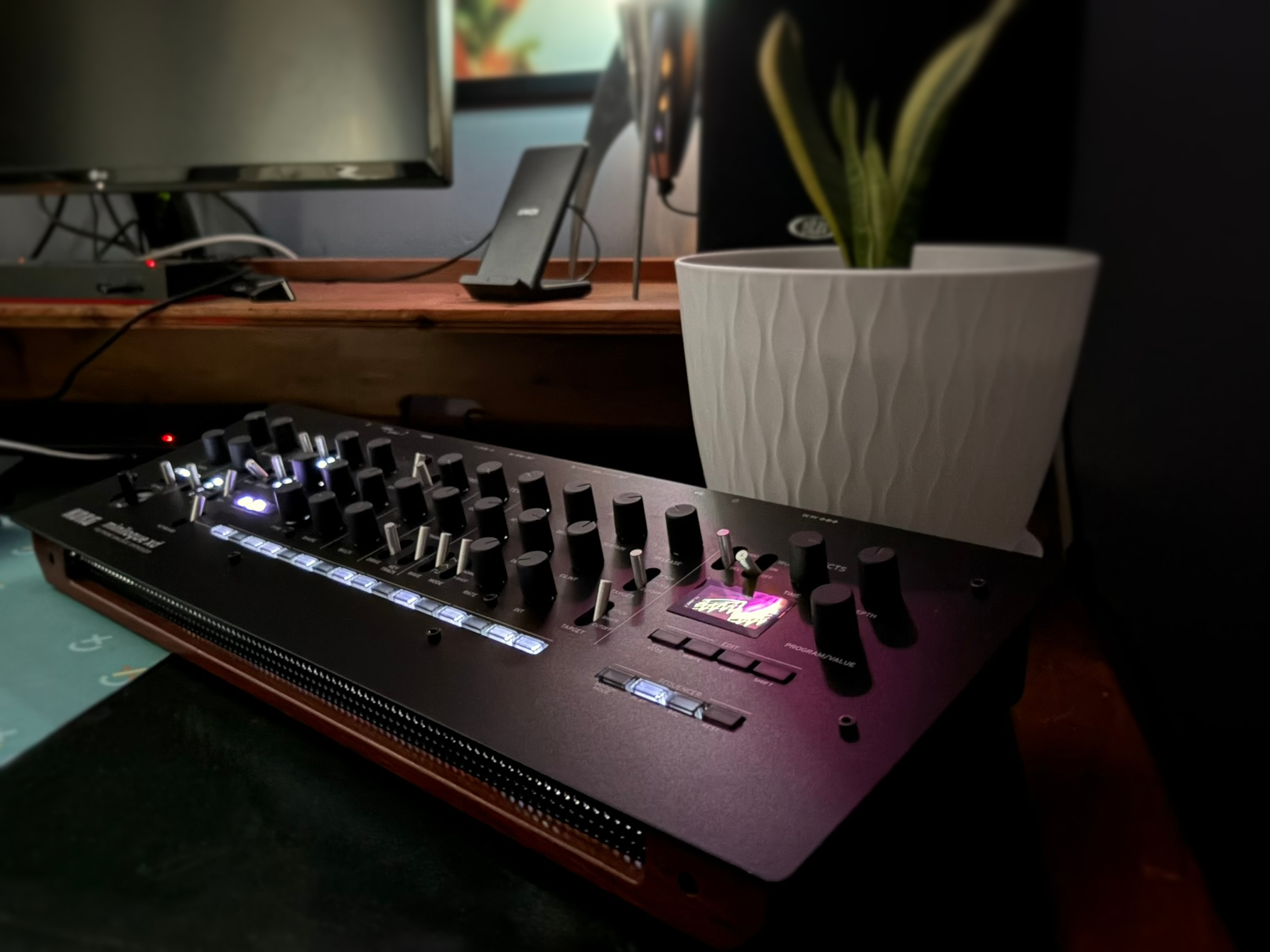
I've traded my Minilogue-XD (full-size version with integrated keyboard) for the desktop/modular alternative.

Modular Minilogue XD

Modular Minilogue XD

Why? Partly, because it fits on my desk better. Partly, because it changes the way you engage with the instrument. It makes a huge difference: the ivory keys come with so much cultural precedent. The module version of the synth gains a switch that lets you use the 16 sequencer step buttons as note inputs, so you can still play the thing solo. But the emphasis moves away from note generation and more firmly towards tone.

Both versions have a lovely stained wood back, which you never see; the modular one has a hint of that at the front as well (which you do see).

I plan to eventually buy a MIDI keyboard that could drive it, and other things: possibly an Arturia KeyStep or Minilab, but there's no rush on that.

(It's about time I recorded and shared something I produced on this)

  •  

OpenAI Debuts ChatGPT Work Agent and New GPT-5.6 Models

9 Juli 2026 om 20:01
OpenAI today announced ChatGPT Work, a ChatGPT agent with built-in Codex that can complete tasks across web, mobile, and desktop using information from your apps. ChatGPT Work can execute multi-step tasks, using scheduling to work independently. Like Claude Cowork, ChatGPT can use your computer to do tasks in the background across apps.


Tasks can be started and managed on any device, including a smartphone. On the desktop, OpenAI is merging the Codex app with the ChatGPT app. ChatGPT Work can use local files and apps to do tasks, or a new built-in browser to access websites, tools, and online files. Plugins connect apps and systems to ChatGPT Work, and a new Sites beta feature lets you create interactive sites and web apps for reports, live dashboards, and more.

ChatGPT Work is powered by OpenAI's GPT–5.6 models, which are also rolling out today after a limited preview period. Sol is OpenAI's new flagship model, while Terra is a balanced everyday work model and Luna is a cost-efficient model.

OpenAI says that GPT–5.6 Sol achieves "state-of-the-art results" in coding, knowledge work, cybersecurity, and science. It outperforms prior frontier models while using fewer tokens for a lower estimated cost.

OpenAI claims that GPT–5.6 is better at coding and has improved design judgment, able to create "tasteful, ergonomic, and functional interfaces" with just high-level direction. It can also create more accurate presentations, documents, and spreadsheets.

The model has safeguards against misuse, with layered protections that include real-time checks, monitoring, and access calibrated to risk and trust. It is OpenAI's best cybersecurity model, ideal for code review, threat modeling, and more.

GPT–5.6 is available across ChatGPT, Codex, and the OpenAI API starting today. GPT–5.6 Sol is available for Plus, Pro, Business, and Enterprise users. Free and Go users have access to GPT–5.6 Terra.

ChatGPT Work is available today for Pro, Enterprise, and Edu plans. It will expand to Plus and Business plans in the next few days.

With OpenAI merging Codex and ChatGPT, there is a new ChatGPT desktop app that's available across Mac and Windows. Users who have the Codex app installed can update it to turn it into the new ChatGPT desktop app. The existing ChatGPT desktop app is being renamed ChatGPT Classic.
This article, "OpenAI Debuts ChatGPT Work Agent and New GPT-5.6 Models" first appeared on MacRumors.com

Discuss this article in our forums

  •  

Last Call: M5 Pro MacBook Pro Remains at Pre-Hike Price But Not for Much Longer

9 Juli 2026 om 19:20
It's been a few weeks since Apple announced widespread price hikes across numerous product categories, including the 2026 MacBook Pro. These new prices are now reaching third party retailers, but there remains one exception at Best Buy, which still has one model of the 14-inch M5 Pro MacBook Pro at its pre-hike price.

Note: MacRumors is an affiliate partner with Best Buy. When you click a link and make a purchase, we may receive a small payment, which helps us keep the site running.

You can get the 24GB/2TB 14-inch M5 Pro MacBook Pro for $2,549.00, down from the new price of $2,999.00. This one is available in both Silver and Space Black, and Best Buy provides both in-store pick-up and delivery options at checkout.


Across Best Buy and Amazon, this remains one of the only products still available at pre-hike prices, with nearly every other MacBook and iPad either unavailable to purchase or only available at their newly increased prices.

If you're on the hunt for more discounts, be sure to visit our Apple Deals roundup where we recap the best Apple-related bargains of the past week.


Deals Newsletter


Interested in hearing more about the best deals you can find in 2026? Sign up for our Deals Newsletter and we'll keep you updated so you don't miss the biggest deals of the season!


Related Roundup: Apple Deals

This article, "Last Call: M5 Pro MacBook Pro Remains at Pre-Hike Price But Not for Much Longer" first appeared on MacRumors.com

Discuss this article in our forums

  •  

Evolving Windows vulnerability management to meet the speed of AI-powered discovery

Windows has adapted to emerging threats for decades, all while operating at unparalleled scale. It's our responsibility to bring clarity, transparency and sustained investment so customers understand what is happening, what Microsoft is doing and how they can reduce their exposure. The pace of vulnerability discovery is changing with advances in AI making it possible to find more issues, faster, across more code, with new mechanisms that can accelerate both discovery and analysis. The fastest way to reduce customer exposure is to find issues before attackers can use them. Windows is expanding its ability across the platform to find issues earlier, accelerate the engineering work to fix them, strengthen validation and deliver timely, high-quality updates that keep customers protected.

Finding vulnerabilities earlier and at greater scale

By applying AI across security analysis, we can identify patterns faster, prioritize risk and scale vulnerability discovery across the Windows codebase. This helps reduce the time between discovery and customer protection. It includes using Microsoft Security’s multi-model agentic scanning harness (MDASH), which utilizes multiple models including leading third-party AI vulnerability discovery models. To run MDASH at Windows scale, Windows set up dedicated cloud infrastructure for scanning and proving. A scanner pipeline scans critical binaries and validates candidates using multi-model debate across multiple model families. Confirmed candidates then flow to a separate, Windows-specific prove pipeline that helps eliminate remaining false positives, so only the highest-confidence findings reach the engineering team. This automation helps handle a larger volume of potential vulnerabilities and shortens the review window for new ones, shrinking the attack window for zero-day exploits. This effort extends beyond Windows as we work across Microsoft to drive broader adoption of these tools and practices throughout both the company and the wider ecosystem. We partner closely with AI-powered scanning teams across Microsoft’s product divisions, sharing insights, comparing best practices and aligning on key findings. In parallel, we collaborate with the Microsoft Security Response Center (MSRC) to continuously refine the end-to-end process from vulnerability discovery and issue filing to remediation and validation. We also regularly reassess our prioritization and rollout strategy based on lessons learned and feedback gathered through our Chief Information Security Officers’ (CISOs) engagements with customers. We continue to evolve our internal systems and practices so that vulnerability discovery is not treated as a separate activity, but as part of how we build, review and improve Windows before new features or updates are released. As a part of this we are updating our Secure Development Lifecycle (SDL) best practices to ensure our secure-by-design approach explicitly accounts for potential AI-enabled attack techniques and exploit paths. That means using AI to help identify potential issues earlier in the development process, while relying on human expertise to evaluate findings, make risk-based decisions and ensure fixes meet the quality bar customers expect. As AI helps defenders discover more issues, customers will see a higher volume of security updates included in each security release. This is evidence that defenders are getting better at identifying and addressing issues. Our focus is to effectively utilize these AI tools to support faster protection, stronger engineering systems and more actionable guidance for customers.

Fixing responsibly with AI and engineering discipline

Windows is evolving our engineering and validation systems to reduce the time from discovery to protection, with areas where customer risk is greatest. As we build our end-to-end system from discovery to remediation of vulnerabilities on Windows, we’re making the following investments to help ensure that we are not compromising update quality as we gain speed:
  • We are integrating AI into our process to compress the path from discovery to a validated fix, helping engineers understand failures faster, propose candidate fixes consistent with the surrounding code, surface related issues elsewhere in the codebase and select the regression tests most likely to be affected by a change.
  • Windows updates undergo validation across a range of testing environments, including the Security Update Validation Program (SUVP) and internal validation designed to help evaluate compatibility, reliability and real-world usage scenarios. This broad validation helps identify functional, application compatibility and quality issues before updates are broadly released.
  • We’re also investing in new technology, including Windows-specific tools and agentic harnesses, to enable end-to-end generation and validation of fixes using AI, keeping humans in the loop when it comes to code review.
Customers rely on Windows updates to protect their environments, and they also need confidence that updates will deploy smoothly across diverse devices, applications and configurations. That is why quality remains central to this work. As we increase the pace of vulnerability discovery and remediation, we are also committed to giving customers practical ways to test, deploy and monitor updates in their own environments. In cases where customers see signals of potential issues or regressions, they can connect with Microsoft Customer Service and Support to report the issue and/or learn if it is a known issue. In the event of an issue, we are able to employ Known Issue Rollback (KIR), a mitigation technology that allows customers to quickly revert a targeted change, fix, functionality or feature that caused the problem, to its previous behavior. This approach allows the customer’s security protections to stay in place instead of uninstalling an entire update to fix an issue.

Helping customers safely stay current

The most important guidance is to stay current and take security updates as soon as possible. Timely patching is one of the most effective ways to reduce exposure, especially as AI accelerates the speed at which vulnerabilities can be discovered and exploited. We also recognize that every customer's situation is different. Many organizations need to assess risk, validate updates, sequence deployments and prioritize critical assets. When Microsoft releases security updates, we share Common Vulnerabilities and Exposure (CVE) information and high-level guidance about the vulnerabilities addressed in the Security Update Guide, including available context on risk and mitigations where applicable. Customers should use that information to build a risk map for their own estate, prioritize protections for high-value targets and accelerate deployment where exposure is greatest. To help organizations prepare with less disruption, we also provide production-quality optional non-security preview ("D") releases ahead of the planned security update release for the following month for testing. These cumulative releases include new features and quality improvements. We target optional non-security preview releases for the fourth week of the month, two weeks before they'll see these features become part of the next monthly security update. These previews enable compatibility testing across a broad set of devices, applications and environments, helping identify issues earlier and increasing confidence in the quality and deployment readiness of the subsequent monthly security updates. Security is not just about responding faster to vulnerabilities. It is also about reducing exposure to security attacks. Windows is designed with multiple layers of protection enabled by default, strong identity protection with Windows Hello, the ability to reduce reliance on administrator privileges, trusted application experiences and hardware-rooted security. Together, these capabilities help organizations reduce exposure, strengthen resilience and provide a more secure foundation as organizations assess, test and deploy updates across their environment. To learn more about Windows security, see the Windows 11 Security Book or the Windows Server 2025 Security Book for your Server fleet. Windows also works closely with Microsoft Defender and the broader security ecosystem to help protect customers during the window between vulnerability disclosure and full deployment of security updates. Where possible, Microsoft Defender provides detections and protections that add another layer of defense. Through programs such as Microsoft Active Protections Program (MAPP), Microsoft also collaborates with security protection and antivirus partners so they can prepare protections for customers as security updates are released. We recommend that customers update their security endpoint software to the latest version and take daily signature updates for best protection. Intune helps teams identify gaps, enforce compliance and deploy fixes across endpoints, and Azure Arc makes it easy to connect Windows Servers outside Azure to Microsoft Defender for Cloud.

Tools that make patching easier

A holistic patch strategy depends on tools that help teams move across the full lifecycle: automate what can move fast, identify what still needs attention and limit exposure when devices or apps fall behind. Modern management capabilities such as Windows Autopatch with hotpatch enabled, available in Microsoft Intune, can help accelerate security updates and minimize disruptions for your Windows 11 devices. With Autopatch, customers can configure the automatic deployment of Windows security updates, driver updates and firmware updates, across rings with the option to pause based on reliability signals, so issues can be contained before they spread. Autopatch now surfaces a security-risk and compliance overview with device-level drill-down, so customers can see where their estate is exposed and how to reconfigure their policies to stay more secure. Windows Servers can be hotpatched as well through Azure Arc, enabling rebootless security updates for your critical infrastructure and VMs across the fleet, manageable at scale with Azure Update Manager. Intune Enterprise Application Management helps keep apps current. Microsoft Defender Vulnerability Management, Windows and Intune insights help teams understand remaining exposure and prioritize remediation. Compliance policies, Conditional Access and security baselines help enforce the desired state across the endpoint estate, or harden devices when updates can’t be applied right away. Together, these capabilities help customers move from a time-based patching cadence to a more continuous, risk-based approach. For practical guidance on operationalizing patching across endpoint estates, see the Microsoft Intune blog on building a patch strategy for today’s threat pace. https://www.youtube.com/watch?v=QdjSkbKXoJw

Building trust through continuous improvement

The threat environment will continue to evolve as AI advances, with researchers continuing to find new classes of issues and attackers looking for ways to move faster. Our response is to keep strengthening the systems that help us find vulnerabilities earlier, fix them responsibly and support customers through safe, timely updates. As the pace of vulnerability discovery increases, customers shouldn’t have to choose between speed and stability. Our job is to help customers stay protected while deploying updates with confidence. Windows will continue investing in the systems, engineering practices and platform protections needed to reduce exposure responsibly at global scale.

  •  

Apple Exploring Ways to Run Much Larger AI Models Directly on iPhones

9 Juli 2026 om 18:50
Apple has held meetings with PrismML about ways it could use the startup's technology to run much larger AI models directly on iPhones, according to The Information.


The report said PrismML has managed to shrink down Alibaba's open-source large language model Qwen 3.6 to run entirely on an iPhone 17 Pro. The model has 27 billion parameters, which is larger than Apple's on-device AFM 3 Core Advanced model with 20 billion parameters. Apple's model powers iOS 27 enhancements such as Siri AI's more expressive voices and improved systemwide dictation on iPhone 17 Pro and iPhone Air models.

Unlike with AFM 3 Core Advanced, all of Qwen 3.6's parameters can be active at the same time.

"One new on-device Apple model has 20 billion parameters but uses a so-called sparse architecture, in which only 1 billion to 4 billion parameters are active at a time," the report said, in reference to AFM 3 Core Advanced. "In the case of PrismML's on-device model, all 27 billion parameters are active at the same time."

Larger models running directly on iPhones would allow for more Apple Intelligence features to run on device instead of on Apple's Private Cloud Compute servers, which could reduce Apple's costs and further enhance user privacy.
This article, "Apple Exploring Ways to Run Much Larger AI Models Directly on iPhones" first appeared on MacRumors.com

Discuss this article in our forums

  •  

Apple TV and MLB Release August Schedule for 'Friday Night Baseball'

9 Juli 2026 om 18:13
Apple and MLB today released the August schedule for Apple TV's weekly Friday Night Baseball doubleheader.

Friday Night Baseball games are included with an Apple TV streaming subscription at no additional cost.
Related Roundup: Apple TV
Buyer's Guide: Apple TV (Don't Buy)

This article, "Apple TV and MLB Release August Schedule for 'Friday Night Baseball'" first appeared on MacRumors.com

Discuss this article in our forums

  •  

Apple's Manufacturing in India Gets Boost From New Tariff Exemptions

9 Juli 2026 om 18:06
Apple stands to gain from India's decision to eliminate import duties on a range of components used in smartphone manufacturing, in a move that could further lower costs for the company's rapidly growing India-based supply chain.


According to a report from Reuters, the Indian government has done away with tariffs of 7.5% and 5% that had applied to inputs for wireless charging hardware, automotive and medical device screens, and lithium-ion battery cells. The exemptions are set to remain in effect through to March 31, 2029.

The wireless charging component exemption, in particular, feeds directly into the MagSafe ecosystem used across the iPhone lineup. With import costs on that hardware now removed, Apple's India-based assembly partners have a clearer path to sourcing and building charging components domestically rather than importing them at a markup.

Apple has leaned heavily on India as it works to shift iPhone production away from China, with assembly partners now building roughly a quarter of all iPhones in the country and producing the entire iPhone 17 lineup there for the first time, including the higher-end Pro and Pro Max models. Foxconn, one of Apple's main assemblers, poured $1.5 billion into expanding its India operations earlier this year, and Tata Electronics has grown into an equally central manufacturing partner alongside it.
Tags: India, MagSafe

This article, "Apple's Manufacturing in India Gets Boost From New Tariff Exemptions" first appeared on MacRumors.com

Discuss this article in our forums

  •  

Sonos, Sony, Anker and More: The Best Amazon Accessory Deals Right Now

9 Juli 2026 om 16:15
There's a big accessory sale happening on Amazon this week, with the year's best prices on Anker chargers, Samsung monitors, Sonos audio products, and much more.

Note: MacRumors is an affiliate partner with some of these vendors. When you click a link and make a purchase, we may receive a small payment, which helps us keep the site running.

Highlights this time around include a new batch of audio devices on sale, including the Sonos Ace Headphones for $279.00, down from $399.00, and Sony's WH-1000XM5 Noise Canceling Headphones for $248.00, down from $399.00. Another notable audio discount is on the Soundcore Sleep A30 Earbuds, which are designed to be worn in bed, available for $179.99, down from $229.99.


In terms of monitor and TV deals, there are quite a few Samsung deals happening this week on Amazon. The 32-inch Smart Monitor M9 has hit its second-best price on Amazon at $1,267.20, down from $1,599.99, beating the Prime Day deal by about $30. You'll also find solid sales on The Frame TVs and Odyssey monitors right now.


We're also tracking big discounts from brands like LG, Hisense, iVANKY, Jackery, and more in the lists below. Accessories on sale include USB-C wall chargers, MagSafe-compatible wireless chargers, portable batteries, headphones, docks, and monitors.

Audio


Monitors and TVs


Docks


Wall Chargers


Wireless Chargers


Portable Chargers


If you're on the hunt for more discounts, be sure to visit our Apple Deals roundup where we recap the best Apple-related bargains of the past week.


Deals Newsletter


Interested in hearing more about the best deals you can find in 2026? Sign up for our Deals Newsletter and we'll keep you updated so you don't miss the biggest deals of the season!


Related Roundup: Apple Deals

This article, "Sonos, Sony, Anker and More: The Best Amazon Accessory Deals Right Now" first appeared on MacRumors.com

Discuss this article in our forums

  •  

'Siri AI' Lawsuit Update: Apple to Pay Owners of These iPhone Models

9 Juli 2026 om 16:08
In May, Apple agreed to pay $250 million to settle a U.S. class action lawsuit over Siri AI's delayed launch, and eligible iPhone users could receive up to a $95 payout.


This week, the California court overseeing the case held a hearing regarding preliminary approval of the settlement, but the judge has not yet issued a ruling. It will likely be at least a few more months before eligible customers can begin submitting claims, with payouts unlikely to begin until late this year or early next year if the settlement is ultimately approved. In other words, no action is required from eligible customers at this time.

Below, we have answered some key questions regarding the lawsuit.

Why Was Apple Sued?


In June 2024, Apple previewed new Siri capabilities powered by Apple Intelligence, including understanding of a user's personal context, on-screen awareness, and deeper per-app controls. For example, Apple showed an iPhone user asking Siri about their mother's flight and lunch reservation plans based on info from the Mail and Messages apps.

Apple advertised those Siri features in product presentations, on its website, in a TV commercial starring actor Bella Ramsey, and elsewhere.


In March 2025, Apple delayed the launch of the personalized version of Siri, leading to the company being hit with a class action lawsuit alleging false advertising.

In a statement, Apple touted a range of other Apple Intelligence features it had already released. Nevertheless, Apple agreed to settle the lawsuit "to stay focused" on "delivering the most innovative products and services to our users."

Apple finally announced "Siri AI" at WWDC 2026 last month, and the revamped assistant is available to test on the iOS 27 developer beta, with a public beta to follow this month. iOS 27 should be released in September, at which point "Siri AI" will finally be available to all users with an iPhone 15 Pro or newer.


Am I Eligible?


To be eligible to submit a claim, you must reside in the U.S. and have purchased any iPhone 15 Pro or iPhone 16 model between June 10, 2024 and March 29, 2025.

The full list of eligible iPhone models:

  • iPhone 15 Pro

  • iPhone 15 Pro Max

  • iPhone 16

  • iPhone 16e

  • iPhone 16 Plus

  • iPhone 16 Pro

  • iPhone 16 Pro Max

It is unlikely that individuals who submit a claim will still need to have physical possession of an eligible iPhone model. However, there is a possibility that proof of purchase or other information will be required, such as the device's serial number. Exact requirements will be outlined on the settlement website, which is still not live.

How Much Will Apple Pay Me?


According to the terms of the settlement, each person who files an eligible claim will receive a per-device payment of $25, but this amount could increase up to $95 if the total number of claims submitted is lower than anticipated.

Where and When Can I Submit a Claim?


Over the coming months, a settlement website is expected to go live with an online claims form.

Eligible class members will be notified by email within approximately 45 days after the settlement receives preliminary approval, according to the court documents. Even if you are not notified but are a U.S. resident who purchased one of the above iPhone models within the above dates, you are still eligible if you meet the criteria.
This article, "'Siri AI' Lawsuit Update: Apple to Pay Owners of These iPhone Models" first appeared on MacRumors.com

Discuss this article in our forums

  •  

Apple Pulls Ability to Restore iPhone 5c, iPad Mini, and More [Updated]

9 Juli 2026 om 14:31
Apple has stopped signing several older versions of iOS for a group of legacy iPhone and iPad models, cutting off the paths to reinstall or downgrade the affected software.


Apple will no longer validate over-the-air (OTA) or direct IPSW installs of the builds in question. Once a version is unsigned, there is no longer a way to restore or install it through Finder or iTunes.

The change is narrower than a typical signing update. Apple has not stopped signing the iOS versions themselves. Instead, it has ended signing for the baseband firmware, the low-level software that runs each device's cellular modem, tied to those releases.

The affected releases span iOS 6 through iOS 10. The full set of devices and versions that can no longer be restored is as follows:


  • iPhone 4 (CDMA): iOS 7.1.2 IPSW installs

  • iPhone 4S: iOS 6.1.3 and iOS 8.4.1 OTA installs, plus iOS 9.3.5 and iOS 9.3.6 IPSW installs

  • iPhone 5 (GSM and CDMA): iOS 8.4.1 OTA installs, plus iOS 10.3.3 and iOS 10.3.4 IPSW installs

  • iPhone 5c (GSM and CDMA): iOS 10.3.3 IPSW installs

  • iPad 2 (Wi-Fi + 3G, CDMA): iOS 6.1.3 and iOS 8.4.1 OTA installs, plus iOS 9.3.5 and iOS 9.3.6 IPSW installs

  • iPad 3rd generation (GSM and CDMA): iOS 8.4.1 OTA installs, plus iOS 9.3.5 and iOS 9.3.6 IPSW installs

  • iPad 4th generation (Wi-Fi + Cellular): iOS 8.4.1 OTA installs, plus iOS 10.3.3 and iOS 10.3.4 IPSW installs

  • iPad mini (Wi-Fi + Cellular): iOS 8.4.1 OTA installs, plus iOS 9.3.5 and iOS 9.3.6 IPSW installs


Tellingly, every model caught up in the change is a cellular variant. Wi-Fi-only iPads are untouched, since they carry no cellular modem and therefore there is no baseband to sign in the first place.

The oldest hardware on the list is the CDMA iPhone 4, which never advanced beyond iOS 7.1.2, while the newest builds affected are iOS 10.3.3 and iOS 10.3.4 on the iPhone 5 and the fourth-generation ‌iPad‌.

For context, Apple did not separate iOS and iPadOS until iPadOS 13, so these much earlier ‌iPad‌ releases were all running iOS at the time.

One of the more interesting entries is the OTA version of iOS 8.4.1, which Apple had kept signing to serve as a stepping stone. Certain devices had to pass through iOS 8.4.1 on the way to iOS 9, and the same signed build gave owners a route back if they wanted to revert. That fallback now disappears for nearly every device on the list, from the iPhone 4S up to the iPhone 5.

A device that is already up and running on its current firmware carries on as normal, but owners lose the fallback of a fresh install should that firmware ever break. It also shuts the door on restores for anyone holding onto old hardware to test apps, check compatibility, or preserve software.

Signing changes like this usually target the latest releases instead, often landing within days of a significant security patch for a current version of iOS or iPadOS. Pulling signatures for decade-old builds on aging devices is rarer, and it touches only a tiny fraction of users in 2026, since everything on the list is more than ten years old.

Update 12:00 pm: Apple has fixed the baseband signing issue for the iPhone 5c on iOS 10.3.3 and iOS 10.3.4, and presumably other devices and iOS versions will follow.

Update 12:24 pm: Baseband signing for all devices has now been restored.
Related Roundups: iPad, iPad mini
Related Forums: iOS 10, iOS 8, iOS 9, iPad, iPhone

This article, "Apple Pulls Ability to Restore iPhone 5c, iPad Mini, and More [Updated]" first appeared on MacRumors.com

Discuss this article in our forums

  •  

DuckDuckGo Browser Now Blocks YouTube Ads on iPhone and Mac

9 Juli 2026 om 14:05
DuckDuckGo's free web browser now blocks most video ads on YouTube, and the feature is on by default for iPhone and Mac users running the latest version of the app.


Announced on Wednesday, YouTube Ad Blocking stops ads that play before and during videos on YouTube's website, and DuckDuckGo says the result is the regular YouTube experience minus the interruptions, so features like viewing history and saving your spot in playlists keep working.

One thing to watch on iPhone is if you tap a YouTube link, it often opens the dedicated YouTube app if you have it installed. The blocking feature obviously won't work there, and you'll need to open the YouTube website inside the DuckDuckGo browser instead.

DuckDuckGo says it is using a community-maintained filter lists from uBlock Origin, along with its own rules to help minimize breakage. The company warns that videos may buffer a little longer than usual, but playback should run uninterrupted once a clip loads.

Note that YouTube Ad Blocking is separate from Duck Player, the browser's distraction-free video viewing mode, but the two can be enabled together.


The move follows Google's ongoing efforts to break ad blockers every which way it can, including recent changes to Chrome that targeted uBlock Origin. It's worth mentioning that DuckDuckGo isn't the first browser to block YouTube ads, with similar features already available in Brave and Opera.

DuckDuckGo's browser offers more than a dozen privacy protections, including ad tracker blocking and cookie pop-up removal. It's available for iOS devices on the App Store and for Mac on the Mac App Store and DuckDuckGo website.
This article, "DuckDuckGo Browser Now Blocks YouTube Ads on iPhone and Mac" first appeared on MacRumors.com

Discuss this article in our forums

  •  

Meta's 'Super Sensing' Prototype Glasses Quietly Record Everything

9 Juli 2026 om 13:14
Meta has prototyped "super sensing" smart glasses that use cameras and audio recordings to capture the wearer's every moment, reports the Financial Times ($).


The smart glasses continuously collect audio while taking photos every few seconds, allowing the user to leverage AI to help query what they saw or heard, or recall their day, according to the report's sources.

Meta's current AI smart glasses have an LED in the corner of the frame that lights up to signal to others when a wearer is taking photographs or filming. But Meta executives don't want to activate the LED when the super-sensing features are turned on.
In one proposed system, raw footage and audio would not be stored by Meta or made available to the user, several people said. Instead, the metadata from that audio and images would be extracted and uploaded to the server for Meta's AI to query, which proponents argue would have fewer privacy implications.

The company is also discussing whether data collected through the glasses and their features could be used to train its own AI models, as it pours billions into rivalling competition such as OpenAI, Google and Anthropic in the AI race.
The report suggests the features could be activated on Meta's existing glasses via a software update.

Meta's plan, which could still change, highlights the obvious civil liberty and privacy risks of smart glasses. Privacy experts argue that always-on devices could violate data privacy or biometric data laws. It is also unclear whether the company or the wearer would be liable for potential violations of wiretapping laws, given that several U.S. states prohibit recording third-party conversations without consent.

Meta's existing Ray-Ban smart glasses already lack a visual indicator when AI is being used to analyze the wearer's surroundings. The company says it safeguards privacy by stripping out key identifying information.

In February, it was reported that the social media giant had an inactive facial recognition feature embedded in its Ray-Ban smart glasses platform. The company later removed the system.

Apple is widely expected to release its first smart glasses in 2027, designed in-house rather than through a partner brand.

Apple's smart glasses are expected to include cameras, microphones, and AI capabilities, and will have the ability to take photos, record video, provide translations, give turn-by-turn directions, and more. However, they won't have augmented reality capabilities, and it's not clear how Apple will manage privacy concerns.
This article, "Meta's 'Super Sensing' Prototype Glasses Quietly Record Everything" first appeared on MacRumors.com

Discuss this article in our forums

  •  

iPhone 18 Pro Max Said to Be Thicker and Heavier Than Predecessor

9 Juli 2026 om 10:57
Apple's upcoming iPhone 18 Pro Max could be noticeably thicker and heavier than its predecessor, suggesting a trade-off behind the device's rumored larger battery.


Chinese leaker Ice Universe today claimed the iPhone 18 Pro Max will measure around 9mm thick and weigh approximately 240 grams. That would make the device around 0.25mm thicker and roughly 7 grams heavier than the current iPhone 17 Pro Max.

The latest claim comes off the back of recent regulatory filings indicating the iPhone 18 Pro Max will feature a 5,391mAh battery in China and a 5,567mAh battery in the U.S. – an increase of nearly 500mAh over the iPhone 17 Pro Max.

Ice Universe suggested the added thickness and weight are a direct result of the larger battery, but Apple is also said to be adopting a new type of vapor chamber that uses stainless steel, which could also be a contributing factor.

The rumor builds on an earlier claim that Apple's next flagship could become the heaviest iPhone ever. If so, it would have to be heavier than the iPhone 14 Pro Max, which also weighed 240 grams, so it may turn out that there are only milligram-level differences between the two.

Apple's use of titanium instead of stainless steel made the iPhone 15 Pro and iPhone 16 Pro models lighter than the iPhone 14 Pro models. Apple then switched away from titanium to less-dense aluminum for the iPhone 17 Pro models, but internal changes and slightly thicker designs bumped up their weight again.

The ‌iPhone 18 Pro‌ and ‌iPhone 18 Pro‌ Max are expected to launch alongside Apple's first foldable iPhone this September.
Related Roundup: iPhone 18 Pro

This article, "iPhone 18 Pro Max Said to Be Thicker and Heavier Than Predecessor" first appeared on MacRumors.com

Discuss this article in our forums

  •  

Everything Coming in the 2026 Apple TV 4K

9 Juli 2026 om 01:51
The Apple TV 4K hasn't been updated since 2022, and it's due for a refresh. An update is planned for 2026, but Apple is likely going to wait to launch it after Siri AI launches in iOS 27.


Design


‌Apple TV‌ design updates don't happen often, and that's not changing. The next ‌Apple TV‌ is going to have the same squircle shape as the current model, and it'll continue to be made from a black plastic material.

We're expecting the 2026 ‌Apple TV‌ to be indistinguishable from the existing ‌Apple TV‌ on the exterior, with no changes to size or design.

New Chip


The ‌Apple TV‌ 4K is going to get a new A-series chip, and that'll be the biggest upgrade. Rumors suggest Apple is planning to use the A17 Pro that was first introduced in the iPhone 15 Pro models.

Compared to the A15 Bionic in the current ‌Apple TV‌, the A17 Pro is a solid update, and it's a good reason to hold off on buying the current model. The A17 Pro is built on a 3-nanometer process for faster speeds and better efficiency. It has hardware-accelerated ray tracing for higher-quality graphics in games and it supports hardware-accelerated AV1 decoding, which is useful for streaming content.

The A17 Pro is the oldest chip Apple makes that supports Apple Intelligence, and it's also used in the iPad mini 7.

Since Apple has held the ‌Apple TV‌ update for so long, it's possible it'll get an even newer chip like the A18 or A19. A RAM update is possible too, especially if the ‌Apple TV‌ has any kind of ‌Apple Intelligence‌ support.

Apple Intelligence and Siri


The next ‌Apple TV‌ is ready to launch, but new ‌Siri‌ features are the holdup. Apple wants to release the ‌Apple TV‌ with the smarter version of ‌Siri‌ that Apple is testing in ‌iOS 27‌, iPadOS 27, and macOS 27.

Bloomberg's Mark Gurman says the Apple TV is linked to "new artificial intelligence features" that Apple has postponed until iOS 27, which is launching in September 2026. Apple intended to debut the ‌Apple Intelligence‌ ‌Siri‌ features in spring 2026, but the company was still experiencing issues with ‌Siri‌. At this point, we're not going to see new ‌Siri‌ capabilities until ‌iOS 27‌, which also means a delay for all the devices that Apple is holding.

Along with the ‌Apple TV‌, the rumored home hub and a new version of the HomePod are waiting on ‌Siri‌ AI's launch.

Updated ‌Siri‌ features may require more RAM and a faster chip, so if you want the smarter ‌Siri‌ on the ‌Apple TV‌, that's another reason to wait before making a purchase.

Wi-Fi


The ‌Apple TV‌ could get Apple's N1 networking chip with Wi-Fi 7 support. Wi-Fi 7 works with the 6GHz band offered by newer routers.

6GHz connectivity is faster and less congested, which you want for a streaming device.

Bluetooth and Thread


The ‌Apple TV‌ 4K could get Bluetooth 6 for connecting devices like controllers and earbuds.

Apple's N1 chip also supports Thread, so the ‌Apple TV‌ will be able to continue to serve as a Thread border router and a Matter hub for smart home devices.

Siri Remote


It's possible Apple will introduce a new Siri Remote alongside the ‌Apple TV‌, though it's unclear what Apple might change.

Pricing


There were rumors of a price drop, but with the June 2026 price increase for the 2022 ‌Apple TV‌ and all Macs and iPads, a lower price is unlikely.

Launch Date


With ‌Siri‌ AI set to launch in September in ‌iOS 27‌, we could see the ‌Apple TV‌ refreshed right around when new iPhone models come out.
Related Roundup: Apple TV
Buyer's Guide: Apple TV (Don't Buy)

This article, "Everything Coming in the 2026 Apple TV 4K" first appeared on MacRumors.com

Discuss this article in our forums

  •  
❌