
❌

Normale weergave

Tim Retout: seL4 repo relationships

21 Juni 2026 om 17:36

The seL4 organisation on GitHub uses git-repo to manage multiple source repositories, and so there are a large number of projects to get your head around when figuring out the ecosystem.

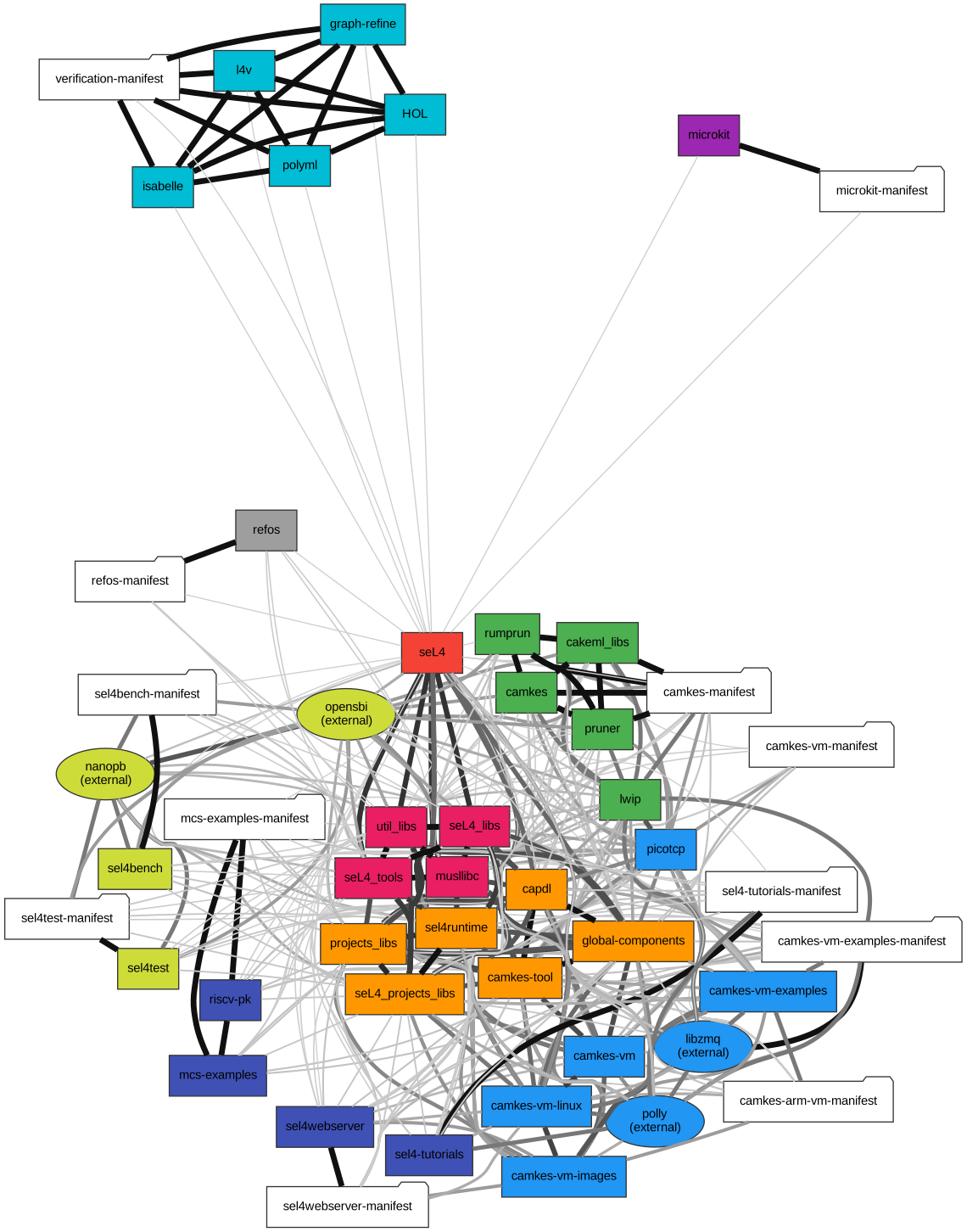
As an experiment, I have taken the various manifest files across the org, and constructed a graph based on how frequently each pair of repositories is mentioned in a manifest together. See below:

Graphviz Diagram

[This may render badly when syndicated outside of my blog; and also on small screens. And probably large screens. I’ve attempted to make sure there’s a non-JS fallback – on my site with JS enabled, if you hover over a node, it should highlight connected nodes.]

The colouring of the nodes is mostly manual; I experimented with graph clustering algorithms but have not found a satisfactory result so far. Still, some clusters are obvious:

  • Kernel – the seL4 microkernel proper. This often but not always co-exists with the main cluster of core libraries, but it is pulled away slightly by the verification and microkit manifests.

  • Verification – the verification repositories (l4v, HOL, graph-refine, polyml, isabelle) form a very distinct group. These are connected only to the seL4 microkernel itself, which is the only component formally verified.

  • Microkit – microkit is a newer operating system framework that does not use CAmkES, so stands apart from the rest of the pack. I chose to scope this work to the seL4 org, so the LionsOS ecosystem and sDDF which are maintained by Trustworthy Systems are not shown. Also not linked is rust-sel4, because this modern world isn’t using git-repo in the main to manage its repositories.

  • RefOS – I’d not come across refos before, but it appears to be an example OS from 2021 built on the seL4 kernel.

It’s quite hard to pull apart the CAmkES framework and the core libraries; there are definitely some which are more associated with VM management, but the overall shape of this co-occurence data is a messy ball in the middle with some outliers in orbit. One observation is that camkes is correctly identified as more peripheral than camkes-tool, which contains the actual core CAmkES code.

Reflecting on this approach, in hindsight I’m surprised that using co-occurences worked as well as it did – there was no attempt to actually inspect the code and find direct mentions of other code e.g. library header dependencies. As the newer microkit effort largely eschews git-repo, better results might be found by actually taking that more detailed approach, so that graph edges could represent real dependencies between two packages. Additionally, this could allow diving into the various libraries held in the different ’libs’ repos, to get a more granular graph of relationships between them.

However, I think I spent more time on making it possible to render graphviz graphs easily on my blog than actually gaining any insight into the codebase!

  •  

AirPods Pro 3 Return to Record Low $169 Price Ahead of Prime Day

21 Juni 2026 om 17:32
Amazon today has the AirPods Pro 3 available for $169.00 in an early Prime Day sale, down from $249.00. This is an all-time low price on the AirPods Pro 3, beating the previous low by $10.

Note: MacRumors is an affiliate partner with some of these vendors. When you click a link and make a purchase, we may receive a small payment, which helps us keep the site running.

This model of the AirPods Pro launched in September 2025 and has 2x better Active Noise Cancellation than the previous generation, better audio quality, a revised fit that's meant to improve comfort and stability, Live Translation for in-person conversations, and heart rate sensing for workouts.


Shoppers should note that this price has been heavily fluctuating on Amazon today, so if you don't see it when you click, there is a chance that it will return soon.

Head to our full Deals Roundup to get caught up with all of the latest deals and discounts that we've been tracking over the past week.


Deals Newsletter


Interested in hearing more about the best deals you can find in 2026? Sign up for our Deals Newsletter and we'll keep you updated so you don't miss the biggest deals of the season!


Related Roundup: Apple Deals

This article, "AirPods Pro 3 Return to Record Low $169 Price Ahead of Prime Day" first appeared on MacRumors.com

Discuss this article in our forums

  •  

Apple to Release These 20 New Products Across Rest of 2026 and 2027

21 Juni 2026 om 16:42
Apple's annual WWDC developers conference is in the rearview mirror, but there is still a lot to look forward to over the next year and beyond.


In his Power On newsletter today, Bloomberg's Mark Gurman listed around 20 products that he expects Apple to release across the remainder of 2026 and 2027.

Now that the more intelligent and personal version of Siri has finally arrived in beta, a full two years after Apple first previewed it at WWDC 2024, we should begin to see some new devices that were reportedly postponed until the new Siri was ready.

Beyond the usual annual updates to iPhones and Apple Watches in September, Gurman said Apple's all-new smart home hub could still arrive this year. He is also expecting a foldable iPhone Ultra and long-awaited updates to the Apple TV and HomePod mini. And a redesigned MacBook Ultra with an OLED display is expected by early next year.

Here is what to expect from Apple by the end of 2027, according to Gurman and other sources.

iPhones


Apple Watches

iPads

Macs


Home, AirPods, Smart Glasses


This article, "Apple to Release These 20 New Products Across Rest of 2026 and 2027" first appeared on MacRumors.com

Discuss this article in our forums

  •  

Dirk Eddelbuettel: RcppArmadillo 15.4.0-1 on CRAN: New Upstream Minor

21 Juni 2026 om 16:18

armadillo image

Armadillo is a powerful and expressive C++ template library for linear algebra and scientific computing. It aims towards a good balance between speed and ease of use, has a syntax deliberately close to Matlab, and is useful for algorithm development directly in C++, or quick conversion of research code into production environments. RcppArmadillo integrates this library with the R environment and language–and is widely used by (currently) 1282 other packages on CRAN, downloaded 47.1 million times (per the partial logs from the cloud mirrors of CRAN), and the CSDA paper (preprint / vignette) by Conrad and myself has been cited 697 times according to Google Scholar.

This versions updates to the 15.4.0 upstream Armadillo release made on Thursday. We had run a complete reverse-dependency check leading up to it, asserting there were no issues with packages dependent on it. As it sometimes goes with that many packages involved, one CRAN package reported one test failure. And it turned out to be both unrelated and pre-existing. But sorting this out over one round of email delayed things by a day. And then I went cycling for a good cause so this announcement post comes a little later than usual. The package has also been updated for Debian, built for r2u, and by now also at CRAN for the different binary releases.

All changes since the last CRAN release follow.

Changes in RcppArmadillo version 15.4.0-1 (2026-06-17)

  • Upgraded to Armadillo release 15.4.0 (Medium Roast Agave)

    • Added fill::nan, fill::pos_inf, fill::neg_inf as optional fill forms for the Mat class

    • Added .push_back() for appending elements to vectors

    • Faster handling of find() within .elem()

    • Faster element-wise min() and max()

    • Faster conv_to when element types of input and output objects are the same

Courtesy of my CRANberries, there is a diffstat report relative to previous release. More detailed information is on the RcppArmadillo page. Questions, comments etc should go to the rcpp-devel mailing list off the Rcpp R-Forge page.

This post by Dirk Eddelbuettel originated on his Thinking inside the box blog. If you like this or other open-source work I do, you can sponsor me at GitHub. You can also sponsor my Tour de Shore 2026 ride in support of the Maywood Fine Arts Center.

  •  

Vasudev Kamath: Releasing debvulns: CLI for listing Debian vulnerabilities

21 Juni 2026 om 14:06

Following up on my previous post, I have released the debvulns CLI. This utility uses the same parsing logic as the debsecan-mcp server but exposes the functionality directly via the command line.

Why a new CLI?

While Debian's native debsecan utility exists, it lacks modern output formats like JSON and CSV, and fails to expose a significant amount of metadata available in the Debian Security Team's daily snapshot.

Additionally, running a persistent Model Context Protocol (MCP) server introduces context window overhead. The manifests and tool descriptions required by the protocol consume tokens even when idle. For debsecan-mcp, the MCP Inspector utility shows an overhead of roughly 150 tokens.

By contrast, an LLM can parse a standard CLI help menu on-demand without permanently draining the context window. Integrating the CLI into a persistent agent workflow can be achieved via a skill file, allowing the LLM to leverage the tool without repeated discovery overhead.

What else is NEW?

During testing, I observed discrepancies between the output of debsecan-mcp/debvulns and native debsecan. Debugging with an LLM revealed a bug in the version comparison logic that caused debvulns to underreport vulnerabilities. This has been resolved.

The current interface supports structured formatting and customizable data backends:

usage: debvulns [-h] [-s {critical,high,medium,low,negligible}] [-f {json,csv}] [--sort-by {package,cve}] [--vuln-url VULN_URL] [--epss-url EPSS_URL] [--suite SUITE]
                [--cache-dir CACHE_DIR] [--no-cache] [-v]

debvulns - CLI Debian Vulnerabilities Tracker

options:
    -h, --help            show this help message and exit
    -s, --severity {critical,high,medium,low,negligible}
                          Filter vulnerabilities by severity
    -f, --format {json,csv}
                          Output format (default: json)
    -sort-by {package,cve}
                          Sort vulnerabilities by 'package' or 'cve'
    --vuln-url VULN_URL   Custom URL or local path for Debian Security Tracker data
    --epss-url EPSS_URL   Custom URL or local path for EPSS scores data
    --suite SUITE         Debian suite name (e.g. bookworm, sid). Auto-detected by default.
    --cache-dir CACHE_DIR
                          Directory to cache fetched and parsed data (default: /var/cache/debvulns)
    --no-cache            Do not use cached data, force downloading and parsing
    -v, --verbose         Enable verbose debug logging (sent to stderr)

By allowing users to override data sources with local snapshots of the Debian Security Tracker and EPSS feeds, debvulns can run natively in airgapped environments.

What Next?

The next step is building a Prometheus exporter for this vulnerability data to streamline scanning and monitoring across data center infrastructure. Stay tuned.

  •  
❌